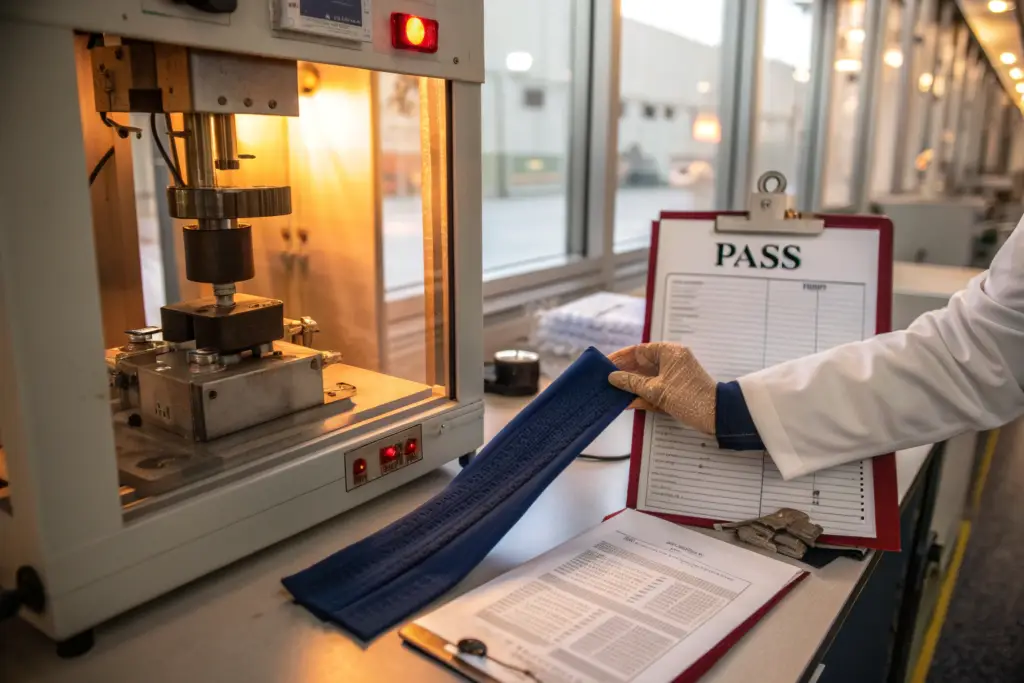
A brand owner from Copenhagen called me in a state of quiet panic last March. His spring collection of 1,500 men's linen shirts had just landed in Rotterdam. His customers were opening their packages and discovering that the shirts shrank two full sizes after the first wash. The fabric care label said "Machine Wash Cold." The fabric itself did not agree with the label. The returns poured in. His customer service team was overwhelmed. His social media pages filled with angry comments. The entire collection was a write-off. When I asked him what pre-production fabric tests he had requested, he was silent for a moment. Then he said, "The supplier sent me a lab report. It looked official. I thought that was enough." It was not. The report was a template, copied and pasted from a different fabric, a different batch, a different year. He had trusted a piece of paper instead of requiring verified, batch-specific testing before the cutting started.
Pre-production fabric testing is non-negotiable for European brand owners because the EU market enforces some of the strictest consumer protection and textile labeling laws in the world. A brand that sells a garment with inaccurate fiber composition, illegal chemical residues, or performance characteristics that do not match the care label faces forced product recalls, fines from national authorities, and permanent reputational damage. Verified, independent fabric testing conducted before bulk cutting is the only reliable defense against these regulatory and commercial risks.
The European consumer is protected by a robust legal framework that does not exist in many other markets. The EU Textile Labeling Regulation demands precise fiber composition disclosure. REACH restricts over 200 substances of very high concern. National market surveillance authorities actively pull products from shelves and test them. If your product fails, your brand name appears on a public alert system. The damage is instantaneous and permanent. In this environment, fabric testing is not a quality add-on. It is a legal requirement disguised as a quality process. At Shanghai Fumao, we have structured our entire pre-production workflow around European testing standards. We do not cut a single meter of fabric destined for the EU until the lab results are in and approved.
Which Specific EU Regulations Make Fabric Testing Legally Mandatory?
Many brand owners outside Europe, and even some within it, treat fabric testing as a recommendation. It is not. It is a direct consequence of binding legislation. The European Union has constructed a regulatory architecture that makes the brand owner, the importer of record, legally responsible for the safety and accuracy of the products they place on the market. You cannot outsource this responsibility to your factory. If a test is faked or omitted, it is your brand that faces the legal consequences, not the factory in a different jurisdiction.
The specific EU regulations making fabric testing legally mandatory are the EU Textile Labeling Regulation (1007/2011) for fiber composition accuracy, the REACH Regulation (1907/2006) for chemical substance restrictions, and the General Product Safety Directive (2001/95/EC) for overall consumer safety. These laws require the brand owner to ensure their products are safe and accurately labeled. The only way to demonstrate this due diligence in a legally defensible way is through documented, independent pre-production testing.
These regulations are not static. They are updated regularly. New substances are added to the REACH restricted list. New testing standards are published by the European Committee for Standardization. A test that was sufficient two years ago may be insufficient today. The brand owner must stay current, or partner with a factory that proactively tracks these regulatory changes. The consequence of ignorance is not sympathy from the authorities. It is a fine.

How Does the EU Textile Labeling Regulation Require Fiber Composition Verification?
The EU Textile Labeling Regulation (No 1007/2011) is deceptively simple. It requires that textile products sold in the EU carry a label clearly stating the fiber composition, by percentage, in descending order. A label that says "100% Cotton" must be 100% cotton, with a tolerance of only 3% for extraneous fibers that are technically unavoidable in good manufacturing practice. A label that says "50% Wool, 50% Acrylic" must be exactly that, with a tolerance of 3% for each fiber.
The regulation does not explicitly say "you must test your fabric." But the legal obligation to be accurate makes testing the only practical way to comply. You cannot rely on the mill's verbal assurance or a visual inspection. A fabric that looks and feels like cotton can contain significant amounts of viscose or polyester. The only way to know is a quantitative fiber analysis performed by a laboratory using the methods specified in the EU harmonized standards.
We had a case where a mill supplied us with a fabric they invoiced as "100% organic cotton." Our pre-production test revealed a 4% polyester contamination. The mill had run the fabric on a machine previously used for a polyester blend and had not cleaned it thoroughly. The contamination was unintentional, but it made the fabric non-compliant with the "100% cotton" claim. If we had shipped that garment to our European client, the product could have been pulled from shelves by market surveillance. Our test caught the issue. We rejected the fabric batch before cutting. The mill re-ran the order on a properly cleaned machine. The delay was one week. The alternative was a public recall that would have devastated the brand. Information on the specific labeling requirements and harmonized testing standards can be found through the official channels of the European Commission.
What Are the Most Common REACH Restricted Substances Found in Apparel?
REACH, which stands for Registration, Evaluation, Authorisation and Restriction of Chemicals, is the EU's chemical safety regulation. It is one of the most comprehensive chemical laws in the world. For apparel, the most relevant section is Annex XVII, which lists the substances that are restricted or banned in consumer products. These substances can be present in dyes, finishing agents, waterproof coatings, and even in the raw fiber itself if agricultural chemicals were used.
The most common REACH restricted substances found in apparel are azo dyes that release carcinogenic aromatic amines, certain phthalates used in plastisol prints and synthetic leather, formaldehyde used in anti-wrinkle finishing, and heavy metals like lead and cadmium used in zippers, buttons, and pigment dyes. These are not theoretical risks. We find them regularly in our incoming fabric inspection. A brightly colored polyester print from an uncertified mill has a high probability of containing restricted azo dyes. A cheap synthetic leather patch on a pair of jeans is a common source of phthalates.
A European brand owner I work with had a shipment of printed t-shirts detained by Belgian customs because the black print contained a restricted azo dye above the legal limit of 30 parts per million. The entire shipment of 2,000 units was seized and destroyed at his expense. The print was a tiny logo on the chest, no larger than a business card. The fabric was fine. But that small print made the entire garment illegal. His factory had used a cheaper ink to save a fraction of a euro per unit. The destruction cost him the full value of the shipment plus disposal fees. Pre-production testing of the print paste would have cost about €200 and caught the issue. The economic equation is brutal. A €200 test versus a €30,000 loss. The European Chemicals Agency (ECHA) maintains a public database of substances restricted under REACH, which is an essential reference for any brand owner.
How Does Batch-Specific Testing Differ from Generic Mill Certificates?
A mill certificate is a document the fabric mill issues. It states that the fabric meets certain specifications. It is a promise from the seller to the buyer. It has its place in the supply chain, but it is not an independent verification. A mill certificate tells you what the mill wants you to believe about their product. A batch-specific test from an independent laboratory tells you what is actually true about the specific rolls of fabric sitting in your factory right now. The difference between these two documents is the entire argument for pre-production testing.
Batch-specific testing differs from a generic mill certificate in three critical ways: it tests the exact fabric lot that will be used for your production, it is conducted by an independent ISO 17025 accredited laboratory with no financial interest in the fabric sale, and it provides legally defensible data that can be used to demonstrate due diligence to European authorities. A mill certificate is a commercial document. A batch-specific lab report is a legal and quality assurance document.
Fabric production is not perfectly uniform. A mill can produce a beautiful sample batch for certification and then ship a slightly different bulk batch to the factory. The dye lot can shift. The finishing chemistry can be adjusted. The yarn source can change. A mill certificate from a test conducted six months ago on a different production run tells you nothing about the fabric that just arrived. Only testing the actual bulk fabric, after it has been delivered to the cutting factory, provides reliable verification.
Why Can't You Trust a Mill's Own Internal Quality Report?
A mill's internal quality report is produced by the mill's own laboratory, using the mill's own equipment, operated by the mill's own employees. The mill has a direct financial interest in the outcome of that test. If the fabric fails the test, the mill loses money. It must either rework the fabric, sell it at a discount, or discard it. This financial pressure creates an inherent conflict of interest. The mill is being asked to grade its own homework.
I am not saying that all mills falsify their internal reports. Many reputable mills maintain excellent internal labs and report honestly. But the risk of intentional or unintentional bias is simply too high for a brand owner to accept without independent verification. An internal lab might calibrate its equipment less frequently. It might take samples from the best part of the roll, not a random section. It might apply a slightly generous interpretation of the pass/fail criteria. These small biases compound across a large order.
We source fabric from several high-quality mills, and we have long-standing relationships with them. We still test every batch independently. We have found discrepancies between the mill's internal report and our independent lab results on multiple occasions. Most of the time, the discrepancy is minor and unintentional. But occasionally, it is significant. A mill once reported a shrinkage rate of 2% on a cotton poplin. Our independent test, conducted on a random sample from the bulk delivery, showed a shrinkage rate of 5%. The mill had tested the fabric after a calming process that was not applied to the bulk. Our test reflected the fabric as it would actually behave when the consumer washed it. The mill had to take back the fabric and apply the correct finishing. The conflict was resolved professionally because we had independent data. Without that data, it would have been our word against theirs, and the defective fabric would likely have been cut and sewn.
How Do You Ensure the Test Sample Matches the Bulk Fabric You Received?
This is the most practical and most overlooked aspect of pre-production testing. An accurate test result on the wrong sample is worse than no test at all, because it gives you false confidence. If the factory sends a carefully selected "golden sample" to the lab instead of a random sample from the bulk delivery, the test report is worthless. You will have a beautiful certificate that applies to a fabric that does not exist in your inventory.
The protocol to ensure sample integrity is straightforward but requires discipline. When the bulk fabric arrives, a designated quality control staff member, not the sales team, cuts samples from randomly selected rolls. The samples are labeled with the batch number, the date, and the style code. They are sealed in a tamper-evident bag. The bag is sent directly to the independent laboratory by the factory's own courier account, so there is no opportunity for the mill to intercept and swap the sample. The lab receives a sealed package from an unknown factory address. They open it, test the contents, and issue a report linked to the sample's batch number.
We photograph this entire process. The cutting of the sample, the labeling, the sealing of the bag, the courier receipt. These photos are stored with the test report. For a European client, this photographic chain of custody is invaluable evidence of due diligence. It transforms a test report from an abstract document into a provable physical process. If a market surveillance authority ever questions the accuracy of a label, the brand can produce the test report and the chain of custody photos. The case is closed before it opens. This level of rigor is what separates professional European-focused supply chains from the rest of the market.
What Standardized Tests Are Most Critical for Wool, Cotton, and Synthetic Blends?
Not all fabrics are tested the same way. A test that is critical for a wool suiting fabric, like pilling resistance, may be less relevant for a cotton poplin shirt. A test that is essential for a synthetic performance blend, like colorfastness to perspiration, may be irrelevant for a dry-clean-only wool coat. The testing protocol must be tailored to the fiber composition and the intended end-use of the garment. A generic "fabric test" that covers everything is expensive and inefficient. A targeted test plan, focused on the specific risks of each fiber type, is both more economical and more protective.
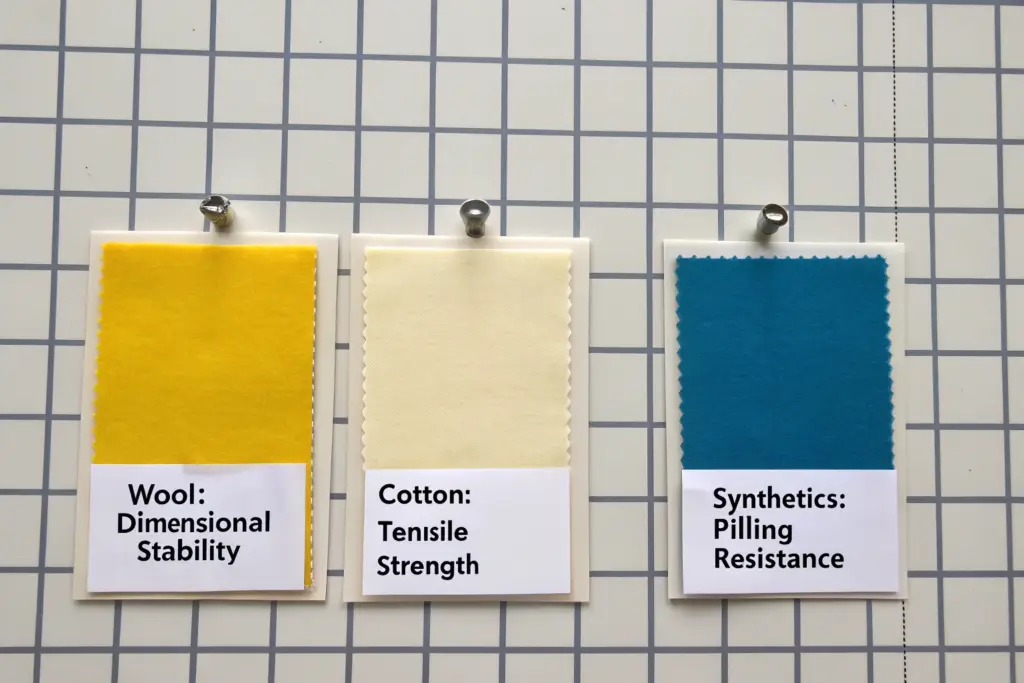
The most critical standardized tests for wool are pilling resistance (ISO 12945-2) and dimensional stability to dry cleaning (ISO 3175). For cotton, the critical tests are tensile strength (ISO 13934-1) and dimensional stability to washing and drying (ISO 5077). For synthetic blends, the priorities are colorfastness to light (ISO 105-B02), perspiration (ISO 105-E04), and seam slippage (ISO 13936-2). Each test addresses the most common failure modes for that specific fiber category.
This targeted approach comes from years of observing which garments fail in the hands of European consumers. A wool sweater that pills into a fuzzy mess after three wears. A cotton shirt that tears at the elbow because the fabric was too weak. A synthetic dress that fades dramatically under a shop window's lights. Each failure mode is preventable with the correct test.
What Is the "Martindale Test" and Why Is It Essential for Wool Blazers?
The Martindale test, formally known as ISO 12945-2, is the standard method for determining the pilling and fuzzing resistance of fabrics. It simulates the abrasion a garment experiences during normal wear. Small fabric samples are mounted on a machine that rubs them against each other in a circular motion, under controlled pressure, for a specified number of cycles. After the test, the samples are compared against a standard set of photographs that show different levels of pilling, from Grade 5 (no pilling) to Grade 1 (severe pilling).
For a wool blazer, this test is essential. A blazer is worn in high-friction areas: the elbows, the cuffs, the areas where a shoulder bag strap rubs against the body. The customer expects a wool blazer to look pristine after months of wear, not just days. The Martindale test provides a quantifiable prediction of how the fabric will perform. A result of Grade 4 or above is generally considered acceptable for quality suiting. A result of Grade 3 is borderline. A result of Grade 2 or below means the blazer will pill badly in normal use and should not be cut.
We once received a beautiful wool-linen blend from a new mill. The hand feel was luxurious. The drape was perfect. The price was competitive. We were excited to offer it to our clients. Our routine Martindale test returned a pilling grade of 2. The fabric was a disaster waiting to happen. We showed the test results to the mill. They acknowledged that the yarn twist was too loose and reformulated the blend. The next batch scored a Grade 4. Without that test, we would have produced blazers that would have been returned en masse by furious customers. The test cost a few hundred dollars. It saved a brand reputation and tens of thousands in potential returns.
How Do You Test for Colorfastness to Light, Perspiration, and Sea Water for Resort Wear?
Resort wear is subjected to an extreme combination of environmental stresses. Intense sunlight, salt water, chlorinated pool water, and perspiration. A vibrant turquoise kaftan that fades to a pale, patchy blue after one holiday is a customer complaint guaranteed. European tourists expect their holiday purchases to survive the holiday itself. Testing for colorfastness to these specific agents is a non-negotiable step for any garment marketed as resort wear.
Colorfastness to light is tested according to ISO 105-B02. The fabric is exposed to a high-intensity xenon arc lamp that simulates sunlight. It is exposed alongside a set of blue wool reference standards that fade at known rates. The fabric's fading is compared to the standards and given a grade from 1 (very poor) to 8 (excellent). For resort wear, we require a minimum grade of 5 for outer fabrics.
Colorfastness to perspiration is tested according to ISO 105-E04. The fabric is soaked in a simulated alkaline or acid perspiration solution, placed under pressure between plates, and heated. The change in color of the fabric and the staining of an adjacent white fabric are assessed. This test is critical for garments worn against the skin in hot, humid conditions.
Colorfastness to sea water is tested according to ISO 105-E02. The fabric is soaked in a sodium chloride solution and tested similarly to perspiration. This test is specific to swimwear and beach cover-ups.
A client who runs a luxury resort boutique in Mykonos had a problem with a previous supplier. The vibrant hand-painted prints on her kaftans were bleeding onto customers' swimsuits after contact with salt water and sunscreen. She faced dozens of complaints and had to refund a significant portion of her summer collection. She came to us specifically asking for proof of colorfastness testing. We provided the full test reports for light, perspiration, sea water, and chlorinated water for her new order. She used those reports in her marketing, telling her customers, "Our colors are scientifically proven to stay vibrant through sun, sea, and sweat." Her return rate on the new collection was under 2%. The test reports became a sales tool. This is the strategic value of testing that goes beyond mere compliance.
How Can Pre-Production Testing Reduce Long-Term Brand Liability and Returns?
Returns are a silent killer of brand profitability. A garment that is returned costs the brand not just the lost revenue, but the outbound shipping, the return shipping, the inspection and restocking labor, and often, the final liquidation of the item at a steep discount. The total cost of a return can easily exceed 30% of the product's retail value. For a brand with a 20% return rate, that is a 6% top-line revenue leakage that goes directly to the bottom line as a loss. Reducing returns is not just a customer service goal. It is a financial survival strategy.
Pre-production fabric testing reduces long-term brand liability and returns by eliminating the root causes of the most common customer complaints: shrinkage, color fading, pilling, and seam failure. A garment that fits correctly after ten washes, retains its color, and does not pill is a garment that is not returned. The investment in testing generates a return on investment through lower return rates, higher customer lifetime value, and reduced legal exposure to consumer protection claims.
The European consumer is particularly protected by a strong right of return. Distance selling regulations give the consumer the right to return any product purchased online within 14 days, for any reason. But the more damaging returns are those caused by product defects or mislabeling. These are the returns that trigger negative reviews, social media complaints, and, in the worst case, investigations by national consumer protection agencies.
What Is the True Cost of a Garment Return for a European Online Brand?
Let me share the real economics, based on what my European brand clients tell me. A typical online sale of a €120 dress has a gross margin of perhaps 65%, or €78. The cost of outbound shipping and packaging is €8. When the dress is returned for a quality reason, like shrinkage or color fading, the brand pays for the return shipping, which is another €7. The dress is inspected, found to be defective, and cannot be resold as new. It is liquidated through a secondary channel for €30. The total cost to the brand is €8 outbound, €7 return, plus the lost margin of €78, minus the €30 recovery, for a net loss of approximately €63. The brand loses more than the profit it would have made if the sale had stuck.
Now multiply that by a few hundred returns across a collection. A brand selling 5,000 units of a garment that has a quality-induced return rate of just 5% above the normal fit-related return rate will lose tens of thousands of euros in profit. The €500 fabric test that could have prevented the quality issue is not an expense. It is a profit protection measure with an astronomical return on investment.
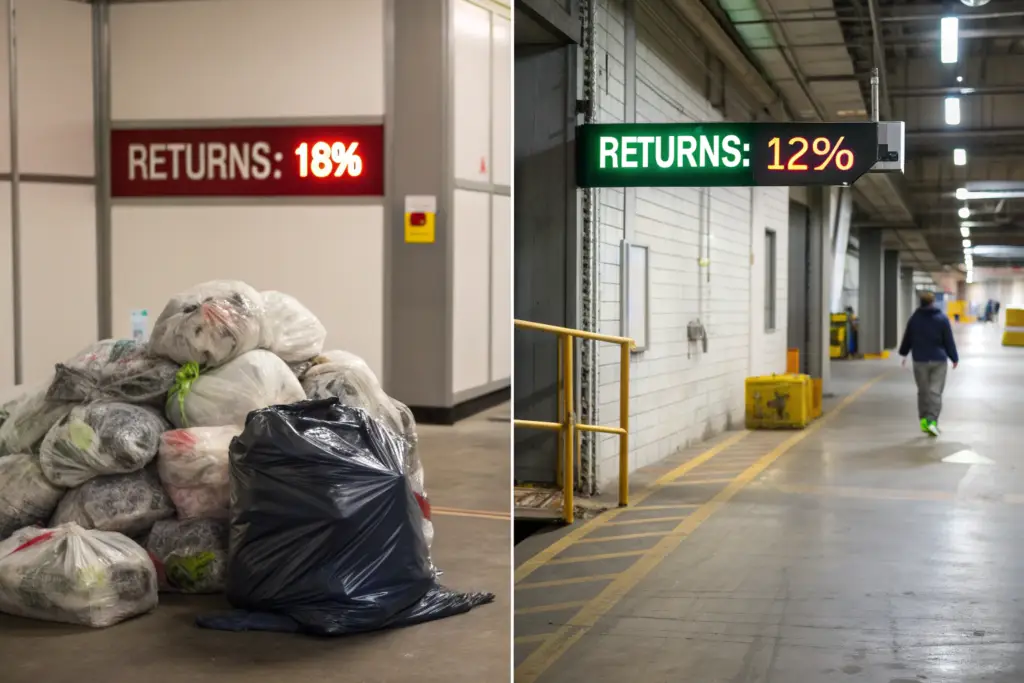
A client in Berlin sells mid-priced women's dresses online. She invested in comprehensive pre-production testing after a season where she experienced a 12% quality-related return rate on her linen collection, primarily due to shrinkage. She spent about €2,000 on batch-specific testing for her next collection. Her quality-related return rate dropped to 1.8%. On a collection revenue of €200,000, the reduction in returns saved her roughly €20,000 in direct costs and preserved an estimated €50,000 in customer lifetime value from customers who did not have a negative experience and churn. The testing paid for itself many times over in a single season.
How Do You Build a "Testing Passport" That Travels with Each Garment Batch?
A Testing Passport is a concept we developed at Shanghai Fumao for our European clients. It is a single digital document that accompanies each production batch and contains all the relevant test reports, chain of custody photos, and compliance declarations. It is designed to be the single source of truth that the brand can use internally for quality assurance and externally for regulatory defense.
The passport includes the independent lab test reports for fiber composition, REACH restricted substances, colorfastness, dimensional stability, and any other tests specified for that fabric type. It includes the chain of custody photos showing the sampling process. It includes the mill's transaction certificates for any organic or recycled content claims. It includes the OEKO-TEX or other chemical safety certifications. All of these documents are compiled into a single PDF file, bookmarked and indexed by test type, and stored on a shared drive accessible to the brand and, if necessary, their legal counsel.
When a batch ships, the Testing Passport ships with it, digitally. If a customs authority questions the fiber composition, the brand has the lab report ready. If a consumer protection agency investigates a customer complaint, the brand has the full compliance documentation ready. The passport turns a potential legal crisis into a simple document retrieval exercise. This level of organization is still rare in our industry. Most brands scramble to find test reports when a problem arises, wasting time and credibility. The Testing Passport is a competitive advantage because it allows the brand to respond to any challenge instantly, with evidence. It signals to regulators and consumers alike that this brand is serious, organized, and transparent. That signal is worth a great deal in the European market.
Conclusion
Pre-production fabric testing is the line that separates professional European fashion brands from the amateur operators who will not survive the next regulatory crackdown. It is the process that transforms a supplier's promise into a verifiable fact. We have seen how specific EU regulations, the Textile Labeling Regulation, REACH, the General Product Safety Directive, create a legal framework that makes the brand owner ultimately responsible for the product they sell. Ignorance of a fabric's chemical content or fiber composition is not a defense. It is an admission of negligence.
We have examined the practical difference between a generic mill certificate and a batch-specific independent lab report. The former is a commercial courtesy. The latter is a legal shield. We have identified the specific tests, the Martindale for wool pilling, the tensile strength for cotton, the colorfastness for resort wear, that address the most common failure modes for each fiber type. And we have calculated the true cost of skipping these tests, a cost measured not in testing fees, but in returns, refunds, lost customers, and destroyed brand equity.
The European apparel market is the most demanding and the most rewarding in the world. It rewards quality, transparency, and compliance with consumer loyalty and premium pricing. It punishes shortcuts with fines, recalls, and public reputational damage. The choice for a brand owner is clear. Build a testing protocol into the pre-production process, or accept the risk of being the next brand exposed for selling a defective or mislabeled product.
At Shanghai Fumao, we have internalized European regulatory standards into our daily operations. Our pre-production testing protocol is mandatory for every EU-bound order. Our Testing Passport system provides our brand partners with the documentation they need to sell with confidence in Paris, Berlin, Copenhagen, and beyond. We do not ask our clients to trust our fabric. We ask them to review our lab reports.
If you are a European brand owner, or a brand selling into the European market, and you want to build your next collection on a foundation of verified quality and regulatory compliance, I invite you to contact our Business Director, Elaine. She can provide you with a sample Testing Passport, a schedule of our standard testing protocols by fiber type, and a quotation for your specific product needs. Reach Elaine at elaine@fumaoclothing.com. Let's ensure your fabric is not just beautiful to look at, but proven to perform, proven to be safe, and proven to be exactly what your label says it is.