A brand owner from Manchester once told me that his previous supplier relationship had given him a new form of anxiety he called "inbox dread." Every morning, he would open his email with a knot in his stomach. Would there be a reply to the three questions he sent four days ago? Would the reply actually answer the questions, or would it be another vague "Dear, we are checking"? Would there be a sudden, unexplained delay notification, or just more silence? He told me, "The not-knowing was worse than bad news. Bad news I can plan around. Silence is just a void that fills with worst-case scenarios. I realized I was spending more emotional energy managing my factory communication than I was spending on my own business."
Shanghai Fumao has no communication pain points because we have systematically dismantled the four structural dysfunctions that cause communication breakdowns in traditional factory relationships. We replaced the non-technical, low-authority sales rep with a senior, technically fluent Business Director who can answer your questions directly. We replaced reactive silence with mandatory, scheduled weekly updates that include real photos and proactive traffic-light alerts. We replaced vague, delayed replies with a guaranteed one-business-day response standard for all inquiries. And we replaced the information-filtering buffer layer with direct, peer-to-peer technical dialogue supported by live video and shared digital tools.
Communication pain in apparel sourcing is not a personality clash. It is a structural failure. The traditional factory communication model is built around a sales rep who is linguistically, technically, and organizationally separated from the production reality. This structure guarantees delayed, filtered, and vague communication, regardless of how well-intentioned the individual rep may be. We have restructured the communication interface entirely. I want to walk you through the four specific dysfunctions we have eliminated, and the four structural replacements that produce a fundamentally different experience.
Why Does the Traditional Sales Rep Model Create So Much Pain?
A quality manager from a US outdoor brand once described the traditional sales rep as a "human firewall." He said, "Their job is not to help me get information. Their job is to stop me from bothering the production team. They absorb my questions, they give me soothing, non-technical answers, and they hope I will just go away and wait for the shipment. The problem is, I need answers to run my quality assurance process. The firewall burns my time and increases my risk."
The traditional sales rep is structurally positioned to be a communication bottleneck, not a communication facilitator. Understanding this structural failure is the first step to understanding why our model is different.
How Does Our Business Director Model Eliminate the 'Buffer Layer'?
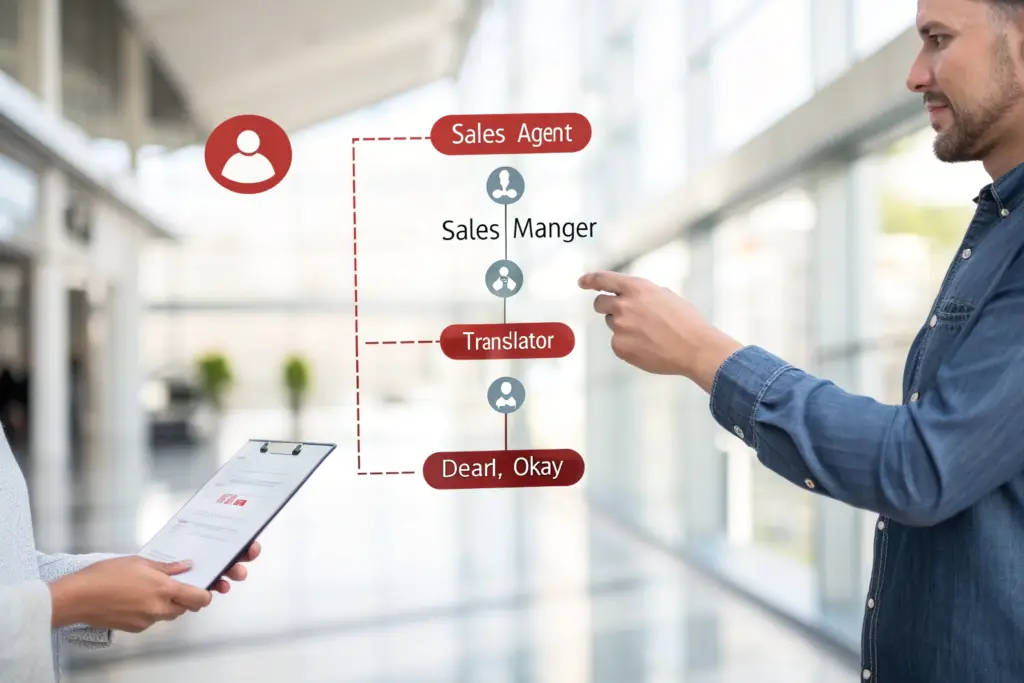
We have eliminated the sales rep role entirely. Your contact at Shanghai Fumao is a Business Director, a senior professional with a minimum of ten years of garment manufacturing and export experience.
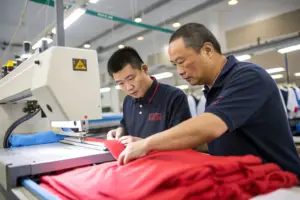
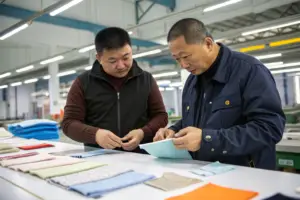
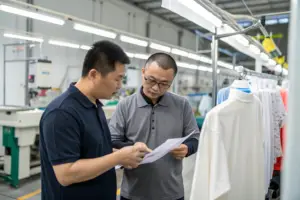
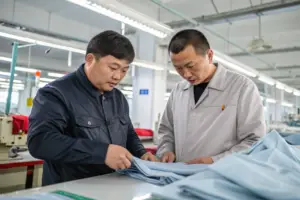
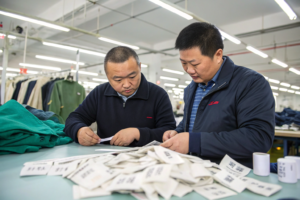
This person is not a messenger. They are the person who manages your order. They understand garment construction, fabric properties, quality standards, and logistics. When you ask a technical question, they understand the question. They do not need to translate it for an internal contact. They can walk onto the production floor, inspect the specific garment or process, and answer you directly. They have the authority to make decisions. They can stop a line, approve a fabric substitution, or authorize a logistics change without escalating to a manager. There is no buffer layer between you and the production reality. There is no internal relay race. Your question goes to the person who can answer it, and the answer comes back from the person who verified it. This direct technical communication model in manufacturing eliminates the root cause of the communication bottleneck.
Why Does Our Commitment to Specific, Technical Replies Remove Ambiguity?
The traditional sales rep answers in vague generalities because they lack the technical knowledge to answer specifically. "Quality is good," "Delivery on time," "No worry." These phrases are meaningless because they are not falsifiable. You cannot hold someone accountable to "no worry."
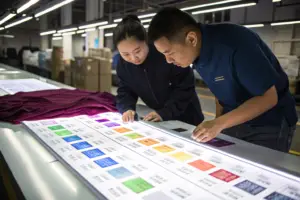
Our Business Director answers with specific, verifiable data. Instead of "quality is good," you receive "The AQL 2.5 inspection on the first 500 units found zero critical defects and three minor defects, all related to loose thread ends, which have been corrected. The inspection report is attached." Instead of "delivery on time," you receive "Your goods are on vessel EVER FORTUNE, voyage 045E, currently at these coordinates, ETA Long Beach March 28. The customs entry will be pre-filed on March 26." This specific, data-rich communication removes the ambiguity that causes anxiety. You know exactly what is happening. You can verify the information independently. You can make decisions based on facts, not on interpreted vague assurances. The specific data-driven client communication is a deliberate, disciplined practice.
How Does Proactive Transparency Replace Anxious Silence?
The Manchester brand owner's "inbox dread" was the direct result of reactive, silence-based communication. He only heard from his factory when there was a problem, or when he chased them. The silence between those moments was filled with his own anxiety. He was not managing a supply chain. He was managing his own fear.
Proactive communication breaks this cycle. It replaces unpredictable, anxiety-driven requests for information with a predictable, scheduled flow of transparent updates. You do not need to ask, because you already know. You do not dread opening your inbox, because you know what will be there, and when it will arrive.

What Is the Weekly Visual Update and How Does It Build Trust?
Every client with an active production order receives a weekly update email every Friday, Shanghai time. This is not an optional service. It is a standard operating procedure.
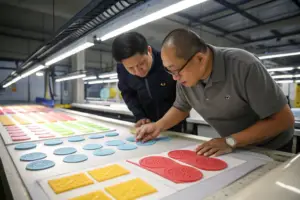
The update contains three mandatory components. A visual progress bar showing the completion percentage of each major phase. A real-time photograph of your specific goods at their current production stage, showing your fabric, your garments, your labels. And a traffic-light status alert: green for on track, yellow for a minor issue with a corrective plan already in place, red for a delay with specific reasons and a costed menu of recovery options. This weekly rhythm replaces the chaotic, anxiety-driven communication pattern. You know that every Friday, you will receive a complete, visual, and honest status report. You can plan your week, your inventory, your marketing, and your customer communication around this reliable information flow. The trust is built not by grand promises, but by the accumulated evidence of 20, 30, 50 weekly updates that consistently provide accurate, transparent information. The weekly visual production update protocol is the backbone of our proactive communication model.
How Do We Surface Problems Early, with Solutions, Not Just Excuses?
In a traditional factory relationship, problems are hidden until they can no longer be concealed. The delay is announced as a fait accompli, with no options and an implicit demand for the client to simply accept the damage.
Our traffic-light system is designed to surface problems at the yellow stage, not the red stage. A yellow alert means a minor deviation has been detected, a zipper delivery delayed by two days, a dye lot requiring a re-dye, a machine requiring unexpected maintenance. The yellow alert is communicated in the Friday update, or immediately if it is significant. It includes the specific issue, the impact on the timeline, and the corrective action already initiated or the options for the client to choose from. The problem is presented alongside the solution. This transforms a potential trust-destroying crisis into a trust-building demonstration of competence. The client sees that the problem was caught early, that it is being managed professionally, and that they are being treated as a partner whose business interests are being protected. The proactive problem and solution communication is the highest expression of a trusted partnership.
How Do We Use Technology to Make Distance and Time Zones Irrelevant?
A designer from Stockholm once told me she had developed "Skype PTSD" from her previous factory relationships. She said, "The call would connect after twenty minutes of technical difficulties. The video was grainy. The audio was delayed. The sample they were showing me was a blurry shape. I could not see the stitch detail. I could not see the fabric texture. The entire exercise was a frustrating waste of time that left me more uncertain than before the call."
Technology is not a magic solution. Bad technology, or good technology used badly, amplifies communication pain. We have invested in both the right tools and the right protocols to make technology a bridge, not a barrier.
How Do We Use Video to Make You Feel Like You Are on the Factory Floor?
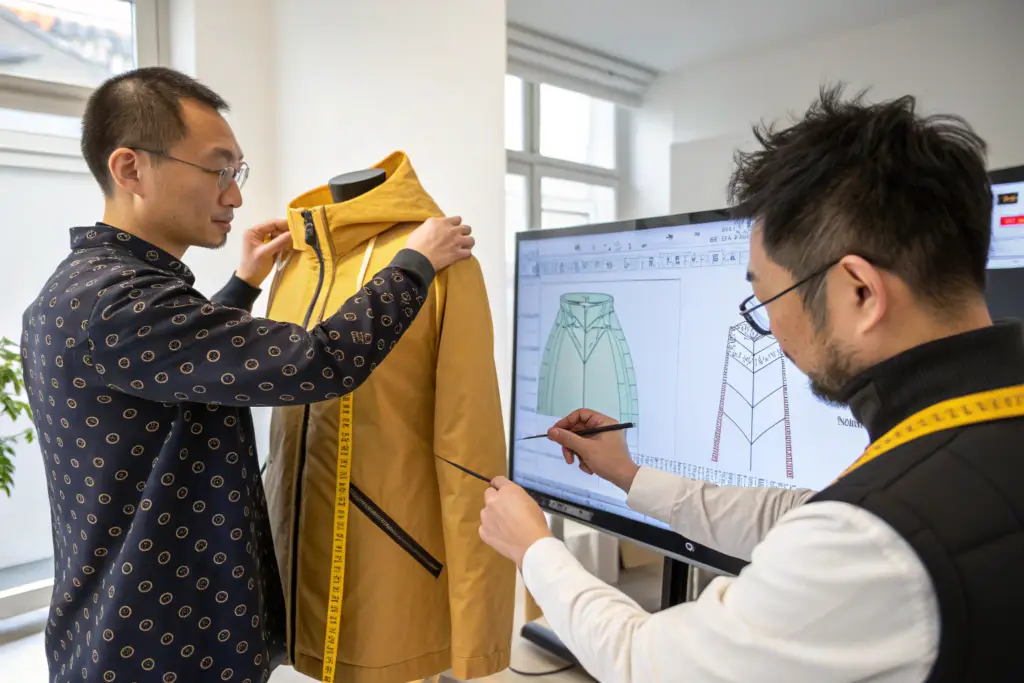
We use high-definition video calls as a standard collaborative tool, not an emergency measure. When a fit sample needs to be reviewed, we do not just send photos and wait for written feedback.
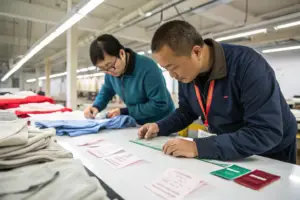
We schedule a technical video call. Our pattern maker or Business Director is on the call, in the factory, with the physical sample. The sample is placed on a mannequin or a fit model. You direct the camera. "Zoom in on the collar. Show me the back armhole when she raises her arm. Show me the hem from the side. Now show me the inside seam finish." You see the garment in high definition, in real-time. You discuss the adjustments directly with the person who will execute them. The pattern maker takes notes, asks clarifying questions, and often proposes solutions on the spot. This live, visual, collaborative session replaces weeks of back-and-forth shipping of physical samples and ambiguous written comments. It makes you feel present on the factory floor, looking at the garment together with the technical team. The HD video collaboration for garment development collapses the distance between the design studio and the production floor.
What Asynchronous Tools Do We Use to Respect Your Time Zone?
The time zone difference between Shanghai and Western markets is a fact. We do not expect you to take calls at inconvenient hours. We use asynchronous communication tools to ensure you begin your working day with a complete, clear update.
The weekly update email, with its photos and traffic-light status, is the primary asynchronous tool. It arrives overnight, US or European time, and is waiting in your inbox in the morning. For more detailed updates, we use pre-recorded short video messages. Elaine might record a 90-second video walking you through a specific quality checkpoint, showing the garments, the inspection process, and the results. You watch this video at your convenience. You reply with questions or approval by email. The communication loop is complete without both parties needing to be online simultaneously. This asynchronous communication for global manufacturing partnerships is a deliberate strategy to respect your time and reduce the real-time meeting burden.
Conclusion
The absence of communication pain points with Shanghai Fumao is not an accident of having "nice people" or "good English." It is the predictable output of a deliberately designed communication system that has dismantled the four structural dysfunctions of the traditional factory relationship. The non-technical, low-authority sales rep has been replaced by a senior, technically fluent, decision-empowered Business Director. Reactive silence has been replaced by proactive, scheduled weekly visual updates with traffic-light problem surfacing. Vague, delayed replies have been replaced by specific, data-rich answers delivered within one business day. And the distant, disconnected feeling of outsourcing has been replaced by high-definition video collaboration and thoughtful asynchronous tools that make you feel like an extension of our team, not a remote customer.
If communication pain has been a recurring theme in your sourcing experience, and you are looking for a manufacturing partner who treats communication as a core operational discipline, not an afterthought, I invite you to test our system with a single email. Contact our Business Director, Elaine, at elaine@fumaoclothing.com. Send her a technical question about a product you are considering. Ask her about her experience, her role, and how she manages client communication. Evaluate the speed, the specificity, and the substance of her reply. Let that first interaction be the evidence that a manufacturing relationship without communication pain is not a fantasy. It is a system, and we have built it.