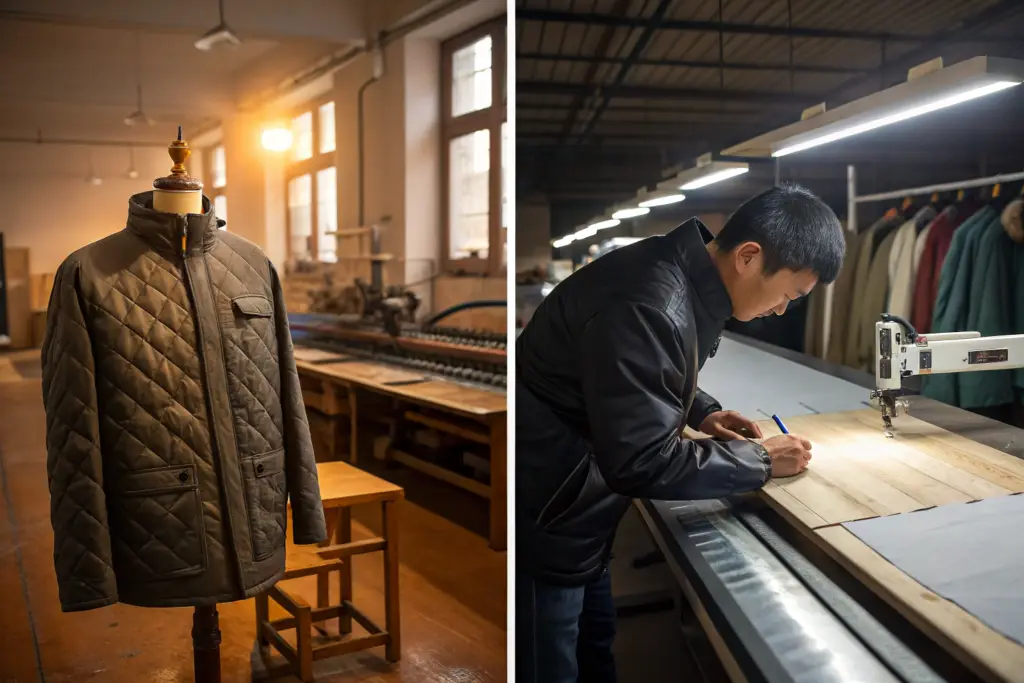
In the autumn of 2024, I hosted a brand director from a respected mid-size outerwear label based in Milan. He had spent twenty years producing his collections within a 200-kilometer radius of his office, between Como for fabrics and Veneto for production. He sat in our Shanghai Fumao showroom and placed three jackets on the table. One was a traditional wool car coat, perfectly executed but commercially unremarkable. The second was a bonded softshell trench with laser-cut ventilation and ultrasonically welded seams. The third was a reversible down parka with a reflective foil print, a detachable backpack harness system, and a recycled polyester shell with a PFAS-free DWR finish. He pointed to the second and third jackets and said, "I cannot make these in Italy. The machinery is not there. The technical skills for bonded construction are not there. The supply chain for these specific performance trims does not exist within my local network. I have to come to China, not because it is cheaper, but because it is capable."
European brands are shifting rare-style and technical outerwear production to China because China has invested heavily in the specialized machinery, material science expertise, and integrated supply chains required for complex, non-traditional jacket construction. Italy remains the global leader in classic tailored outerwear, wool coats, structured blazers, where the value lies in hand-finishing and artisanal cutting. But for bonded seams, ultrasonic welding, complex multi-layer lamination, integrated technical hardware, and rapid prototyping of unconventional silhouettes, China's manufacturing ecosystem has become the most advanced in the world. The brands are following the capability, not the cost.
This shift is not a loss for Italy. It is a recalibration of global manufacturing roles. Italy focuses on heritage craftsmanship. China focuses on technical innovation. The brand owner who understands this distinction sources each product from the country that is structurally optimized to make it. Rare-style outerwear, experimental silhouettes, performance hybrids, and hardware-intensive designs, has migrated toward the manufacturing ecosystem that can execute them. Let me explain the specific capabilities that are driving this migration.
What Technical Capabilities Does China Offer for Complex Outerwear Construction?
The outerwear industry has bifurcated. On one side is classical tailoring, where the value is in the hand of the tailor, the quality of the canvas, and the precision of the pattern matching. This remains firmly in Italy, England, and a few specialized houses in Japan. On the other side is technical outerwear, where the value is in the performance of the fabric bond, the waterproof rating of the seam seal, and the precision of the laser-cut ventilation pattern. This is the domain where China has built a decisive lead.
China's technical advantage in complex outerwear rests on three pillars: the density of specialized machinery such as ultrasonic welders, hot-air seam sealing machines, and high-frequency welding presses that are concentrated in Chinese manufacturing hubs, the depth of material science expertise in bonding, lamination, and performance coating applications, and the integrated supply chain that allows a factory to source a waterproof zipper, a laser-cut reflective appliqué, and a thermally bonded insulation layer within a single industrial district. No other country combines these three pillars at a commercial scale.
The Italian outerwear supply chain is optimized for woven wool, cashmere, and cotton gabardine. The machinery is optimized for pressing, shaping, and tailoring these materials. When a brand asks an Italian factory to construct a jacket from a non-woven membrane bonded to a stretch knit backer, with ultrasonically welded pocket entries and taped internal seams, the factory does not have the machines. They would need to invest in new equipment, train operators on new processes, and develop new supplier relationships for technical components. The Chinese factory already has the machines, the trained operators, and the supplier relationships in place. Here is how two specific technical processes demonstrate the gap.
How Do Bonded Seams and Ultrasonic Welding Replace Traditional Stitching?
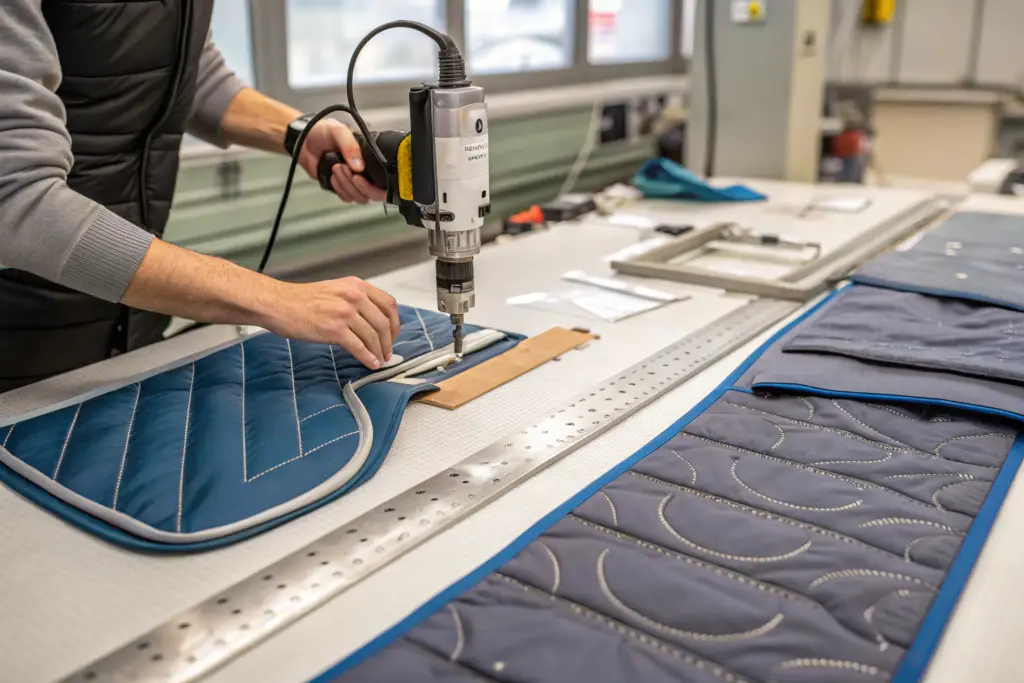
Traditional stitching creates holes in fabric. Every needle penetration is a potential leak point in a waterproof garment. For a classic wool coat, this does not matter. For a performance rain jacket rated to a 20,000mm water column, needle holes defeat the purpose. The solution is bonded seams and ultrasonic welding, which join fabric panels without thread, using heat, pressure, or high-frequency vibration to fuse the materials together at a molecular level.
The machinery required for these processes is expensive and specialized. A hot-air seam sealing machine costs tens of thousands of dollars and requires a controlled production environment with consistent temperature and humidity. Ultrasonic welding machines require precise calibration for each fabric combination. The operators require training that is different from traditional sewing. A sewing operator learns to control thread tension and stitch length. A bonding operator learns to control temperature, pressure, dwell time, and cooling rate. The skills are not transferable between the two processes. China built a workforce skilled in these techniques because it invested in the technical outerwear sector over the past fifteen years, driven initially by international performance brands establishing production bases in the country. That workforce is now available to European fashion brands entering the technical outerwear space.
Why Is Multi-Layer Lamination Expertise Concentrated in China?
A rare-style outerwear piece often involves bonding multiple functional layers into a single fabric system. An outer shell fabric, a waterproof-breathable membrane, and an inner backer fabric are laminated together under heat and pressure. Each layer has different thermal properties, different stretch characteristics, and different chemical compositions. The lamination process must bond them permanently without delamination after washing, without compromising the membrane's porosity, and without creating a stiff, boardy hand feel.
This is material science, not sewing. It requires an understanding of polymer chemistry, adhesive rheology, and thermal dynamics. The lamination expertise in China developed because the country became the world's largest producer of performance textiles. The factories that laminate fabrics for outdoor brands accumulated decades of process knowledge. They know exactly the temperature curve required to bond a polyester tricot backer to a TPU membrane without pinholing. They know which adhesive chemistry works for a recycled polyester face fabric without delamination after 50 wash cycles. This knowledge is tacit, built through millions of yards of production, and it is not easily replicated by a factory that is just entering the category.
How Does Prototyping Speed Differ Between Chinese and Italian Facilities?
Speed is a design value. A brand that is creating rare-style outerwear is experimenting with silhouettes that have no established pattern block. The first sample rarely works. It requires iteration, adjustment, a second sample, a third. The speed at which a factory can turn around a prototype iteration determines how many iterations the brand can afford within the development calendar. The more iterations, the more resolved the final design.
Chinese prototyping for outerwear is significantly faster than Italian prototyping, particularly for technical styles, because Chinese factories typically operate integrated sample rooms with in-house digital pattern-making, 3D virtual sampling, and dedicated sample sewing lines that run on short-cycle schedules. An Italian prototyping process for a complex jacket might take three to four weeks per iteration, constrained by the availability of specialized artisans and the sequential nature of hand-based development. A Chinese factory with an integrated sample room and digital tools can deliver a revised prototype in seven to ten days, enabling four iterations in the time it takes to produce one in a traditional setting.
This speed difference is not a reflection of work ethic. It is a reflection of process design. The Italian system is optimized for precision and craft, each iteration is a careful, manual process. The Chinese technical outerwear system is optimized for iteration velocity, with digital tools compressing the time between design revision and physical sample. For a brand developing a rare, experimental silhouette where the first sample is likely to require significant pattern adjustment, the faster iteration cycle is a structural advantage.
How Do Digital Pattern-Making Tools Accelerate the Development Cycle?
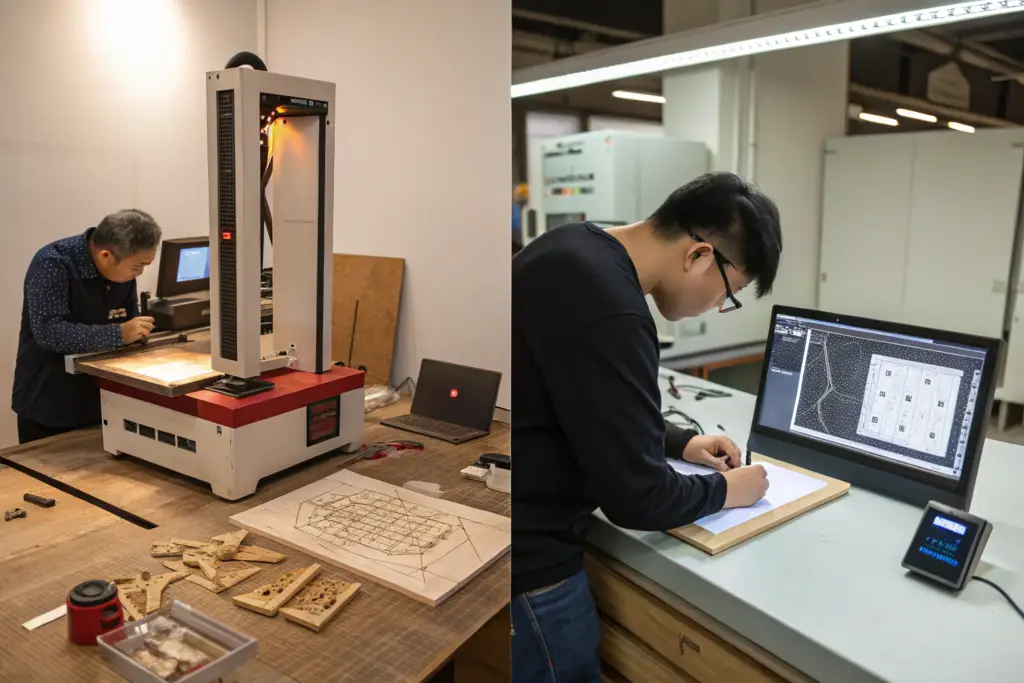
Digital pattern-making uses CAD software to draft, grade, and modify patterns on a screen rather than on paper. When a brand sends a fit comment, "the sleeve cap needs 1.5 centimeters more ease and the pitch needs a 3-degree rotation," a digital pattern maker modifies the file in minutes and sends it to an automatic cutting machine that cuts the new pattern pieces from sample fabric within the hour. The sample sewer begins constructing the revised sample the same day.
In a traditional paper-based system, the pattern maker must physically draft the new pattern piece on pattern paper, cut it out, and manually transfer the markings. This process takes hours for each pattern piece. For a complex jacket with twenty pattern pieces, the drafting alone can consume two days. The digital process reduces this to an afternoon. The time saved is reinvested in additional iterations, which improves the final design quality. At Shanghai Fumao, our sample room operates on a 48-hour sample turn for simple revisions and a 7-day turn for complete new styles. This speed is enabled by digital pattern-making integrated with an in-house cutting table and a dedicated sample sewing team. The Gerber Technology and similar CAD platforms are standard in advanced Chinese outerwear factories.
Why Does an Integrated Sample Room Reduce Time-to-Market?
An integrated sample room has all the necessary functions under one roof: pattern-making, fabric sourcing, cutting, sewing, finishing, and quality inspection. When a revised sample is required, the pattern maker walks to the cutting table. The cutter cuts the new pieces. The pieces walk to the sample sewer. There is no courier between a pattern studio in one location and a sample sewer in another. There is no waiting for a specialized artisan who is booked on another brand's project.
In the traditional Italian system, particularly for high-end outerwear, the pattern maker, the cutter, and the tailor may work in different small workshops. The coordination is managed through relationships and appointments. The system produces exquisite results, but it is not optimized for speed. A brand developing a rare, unorthodox outerwear silhouette needs speed. The integrated sample room delivers speed. The brand that can iterate four times before the season's design freeze date will launch a more resolved product than the brand that can iterate twice. The time-to-market compression is a competitive advantage that European brands are recognizing and acting upon.
What Supply Chain Advantages Make China the Hub for Rare Outerwear Trims?
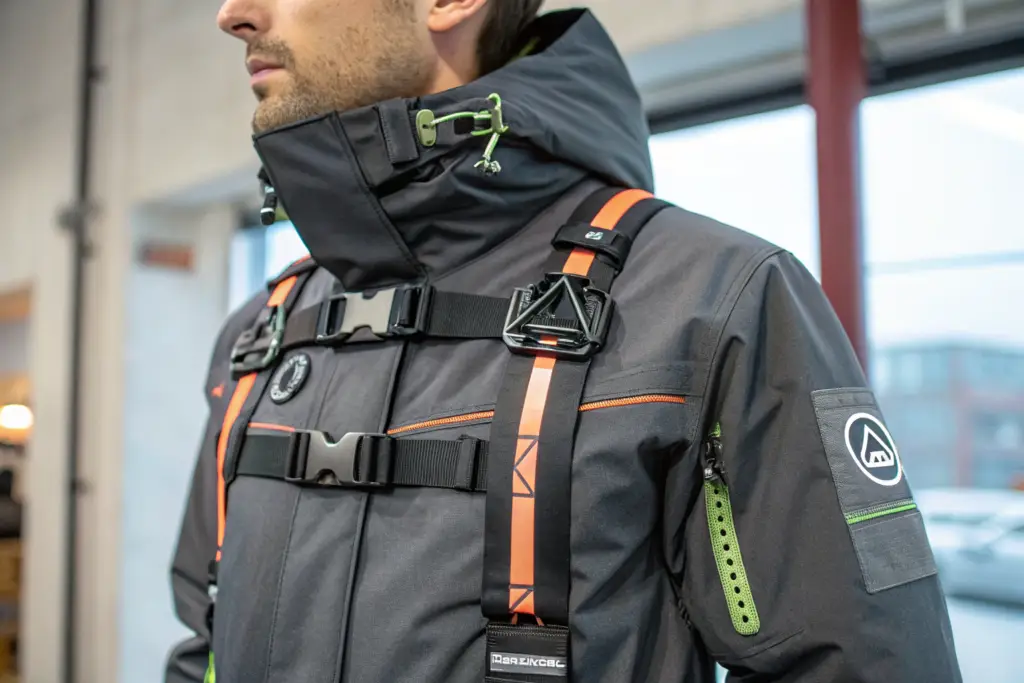
Rare-style outerwear relies on rare trims. A jacket with a detachable harness system needs specific injection-molded buckles that can be sourced quickly and at manageable minimum order quantities. A parka with integrated LED safety lighting needs a flexible circuit supplier who can embed electronics into a washable garment. A shell with a magnetic storm flap closure needs magnets sealed in waterproof capsules that will not corrode after fifty wash cycles. These trims are not generic. They are engineered components, and their availability determines whether a rare design can be produced at all.
China has become the global hub for specialized outerwear trims because the entire supply chain for garment hardware, injection-molded components, technical fasteners, and performance coatings is concentrated within the country's industrial clusters. A factory developing a complex jacket can source a custom waterproof zipper from a supplier 50 kilometers away, a laser-cut reflective patch from a supplier in the same province, and a thermally bonded insulation panel from a supplier in the next industrial park. This geographic density of specialized suppliers does not exist anywhere else in the world at comparable scale.
The trim advantage is not just about availability. It is about minimum order quantities and iteration speed. An Italian factory developing a rare-style jacket needs a custom buckle. The Italian trim supplier may require a minimum order of 5,000 pieces and a four-week lead time for the mold. A Chinese factory can walk the design to a supplier in the same industrial district, discuss the specification in person, and receive a sample mold within a week. The MOQ may be 500 pieces. This makes rare, small-batch outerwear economically viable. The brand does not need to commit to 5,000 buckles for a 500-unit jacket run. Here is how this advantage plays out in practice.
How Do Minimum Order Quantities for Custom Hardware Differ?
Custom hardware MOQs in European trim markets are high because the trim suppliers serve a market that prioritizes volume and consistency. A European zipper supplier, producing for luxury houses and large apparel groups, is set up for long production runs. The setup cost for a custom zipper pull mold is amortized over thousands of units. A small, rare-style brand ordering 300 jackets cannot meet the MOQ.
In China, the trim supply base is more fragmented and more flexible. Smaller, specialized trim manufacturers compete on responsiveness and low minimums. A factory in the Guangdong or Zhejiang hardware clusters will produce a custom zipper pull mold for a relatively low setup fee and deliver the finished pull at an MOQ of a few hundred pieces. This flexibility is not because Chinese trim suppliers are inherently different. It is because the density of competition in the Chinese trim market has created a segment of suppliers who specialize in small-batch, high-complexity orders. The rare-style outerwear brand benefits from this market structure. The YKK global network sets the quality standard, but the specialized local suppliers provide the flexibility that experimental outerwear design requires.
What Role Does the Electronics Integration Supply Chain Play?
The most avant-garde outerwear now incorporates electronic elements. Heated jacket liners with rechargeable battery packs. LED safety lighting strips integrated into commuter jackets. Fiber optic threads woven into the fabric for decorative illumination. These are not garments with a battery sewn into a pocket. They are engineered products that require collaboration between garment manufacturers, flexible circuit suppliers, and battery pack manufacturers who understand washability and durability requirements.
The electronics supply chain for wearable technology is concentrated in China because China is where consumer electronics, flexible circuits, and lithium-ion batteries are manufactured. A garment factory in China can partner with a flexible circuit supplier to develop a washable heating element that is bonded into the jacket liner. The factory and the circuit supplier speak the same language, work in the same time zone, and can iterate on the integration design together. An Italian factory would need to import the heating element from Asia, manage the customs clearance, and integrate a component it did not co-develop. The result is a longer lead time, a higher cost, and a less optimized integration. For outerwear that incorporates electronic features, the Chinese supply chain advantage is structural and difficult to overcome.
How Does China's Experience with Global Performance Brands Benefit Fashion Labels?
For the past two decades, the world's leading performance outerwear brands have manufactured their most technically advanced products in China. These brands imposed rigorous standards on their manufacturing partners. The factories had to learn how to achieve a waterproof rating of 20,000mm. They had to learn how to apply seam tape that would survive 50 industrial wash cycles without peeling. They had to learn how to test for breathability using a sweating guarded hotplate apparatus. This knowledge was transferred from the global brands to the Chinese factory floor, where it accumulated over millions of units of production.
The knowledge accumulated by Chinese factories through decades of manufacturing for global performance brands is now available to fashion labels entering the technical outerwear category. A European fashion brand that wants to produce a bonded softshell trench coat with a 10,000mm waterproof rating does not need to teach the factory how to seal a seam or apply a DWR finish. The factory already knows, because it has been doing these processes for Arc'teryx, The North Face, or Patagonia for ten years. The fashion brand benefits from a manufacturing knowledge base that was built and paid for by the performance sector.
This knowledge transfer is not direct, specific brand manufacturing agreements are confidential. But the process knowledge, the operator skills, the quality control protocols, and the testing infrastructure are embedded in the factory's workforce and systems. A fashion brand can access this capability without having to develop it from scratch. The factory's quality manager knows what a failed seam tape looks like because they have seen millions of taped seams pass through their inspection station. The pattern maker knows how to engineer a sleeve that allows a full range of overhead motion because they have cut thousands of performance jacket sleeves. The knowledge is in the building.
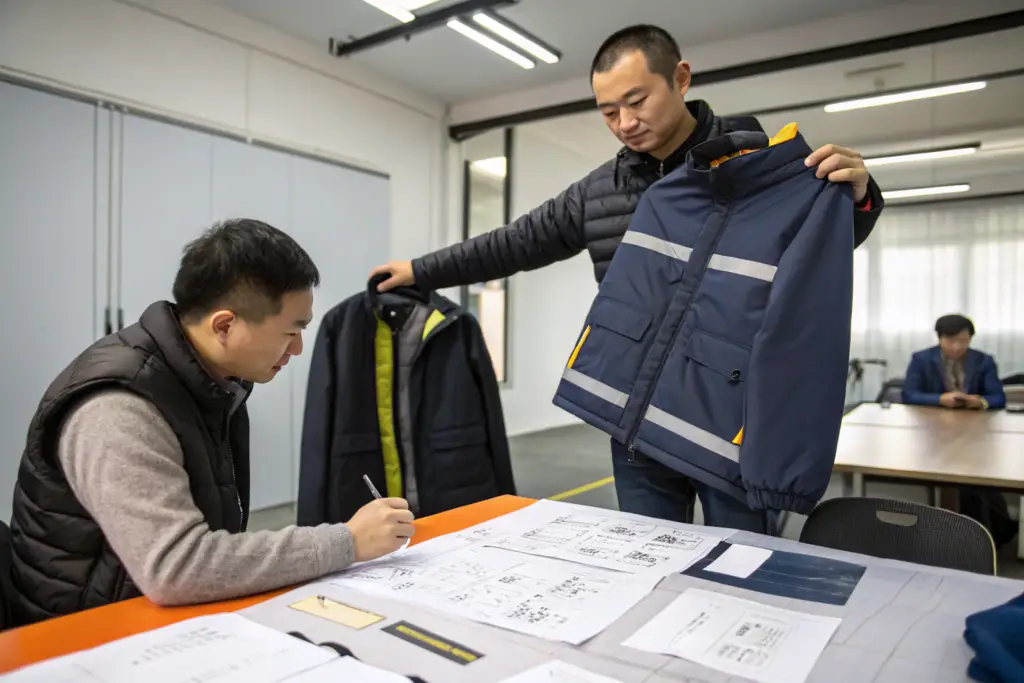
How Do Performance Construction Techniques Translate to Fashion Silhouettes?
A bonded seam is a bonded seam, whether it appears on a mountaineering shell or a fashion trench coat. The process parameters are the same: the temperature of the hot-air nozzle, the speed of the tape feed, the pressure of the roller. A factory that has bonded millions of seams on performance shells can bond seams on a fashion jacket with the same reliability. The difference is in the design intent, not the construction technique.
This translation of techniques from performance to fashion is enabling a new hybrid category of outerwear. A trench coat with the seam-sealed waterproof construction of a rain shell. A down parka with the bonded baffle construction of a sleeping bag. A blazer with the breathable membrane and taped seams of a hiking jacket, but cut in a tailored silhouette. These hybrid garments are technically demanding to produce. They require the construction knowledge of the performance world applied to the fit and aesthetic standards of the fashion world. Chinese factories that serve both sectors are uniquely positioned to bridge this gap.
What Testing Infrastructure Supports Technical Outerwear Production?
A fashion brand producing a standard wool coat needs a few basic tests: fiber content, colorfastness, perhaps seam strength. A fashion brand producing a waterproof bonded jacket needs a completely different testing infrastructure. Hydrostatic head testing for waterproof rating. Breathability testing using the inverted cup method. Seam tape adhesion testing after multiple wash cycles. Cold-crack testing to ensure the membrane does not stiffen and crack at sub-zero temperatures.
Chinese factories that serve the performance outerwear market have this testing equipment in-house or have immediate access to accredited labs that do. They can test a prototype's waterproof rating during the development phase and provide the brand with data, not just a sample. The brand knows the jacket is rated to 15,000mm before it goes into production. This testing infrastructure is a fixed cost that a factory must amortize over its production volume. The high volume of performance outerwear produced in China justifies the investment. The testing infrastructure exists, and the fashion brand benefits from it without having to pay for it directly. The ASTM D751 and related testing standards for coated fabrics are the protocols that govern this testing.
Conclusion
The migration of rare-style outerwear from Italy to China is not a story of Italian decline. It is a story of category specialization. Italy remains the world leader in tailored outerwear, where the value is in the wool fiber, the hand-sewn canvas, and the artisan's eye. China has become the world leader in technical and hybrid outerwear, where the value is in the bond strength, the waterproof rating, and the integration of specialized hardware. The European brands that are moving production are not abandoning quality. They are following capability.
At Shanghai Fumao, I have invested in the machinery, the workforce training, and the supplier relationships to serve this growing category of technical and rare-style outerwear. We operate ultrasonic welders and hot-air seam sealers alongside traditional sewing lines. We source waterproof zippers and reflective appliqués from suppliers within our industrial district. We test our prototypes in-house for waterproof rating and seam adhesion. We do this because we see where the market is going. The future of outerwear is not purely traditional or purely technical. It is the integration of both.
If you are a European brand developing a rare-style outerwear collection that requires technical construction, specialized trims, or rapid prototyping, and you are finding that your local supply chain cannot support the complexity, let us discuss your design. We can show you how our technical capabilities translate to your aesthetic vision. Reach out to our Business Director, Elaine, at elaine@fumaoclothing.com. The capability you need exists. It is just located in Shanghai.