You have a sketchbook full of designs that your target audience would love. You have a brand name, a logo, and a Shopify store waiting for inventory. Then you email a factory and receive the reply: "MOQ 500 units per style per color." Your heart sinks. You need three sizes and four colors. That is 6,000 units before you have sold a single piece. The math does not work for a startup. You either abandon the design, gamble on inventory that could bankrupt you, or settle for blank wholesale T-shirts that dilute your brand vision. This is the crushing moment that kills more promising apparel startups than any other single factor.
A top clothing manufacture's wholesale MOQ for USA brand startups should not be a rigid, one-size-fits-all number. It should be a flexible framework that offers a graduated path from small test runs to scaled production, with transparency about where costs increase and why. The ideal startup-friendly MOQ structure starts as low as 50-100 units per style for initial market testing, with clear per-unit pricing tiers that decrease as volume increases to 300, 500, and 1,000+ units.
At Shanghai Fumao, we have restructured our minimum order approach specifically because we saw talented brand founders abandoning their visions or settling for commoditized blanks. We believe a factory's role is to help a brand grow, not to gatekeep production behind impossible volume requirements. Let me explain what a fair MOQ structure looks like, why low MOQs cost more per unit and why that is acceptable, and how a startup can navigate the MOQ conversation without compromising on customization.
Why Do Most Factories Set High MOQs That Exclude Startups?
Most factories are not cruel. They are optimized for efficiency. Their entire cost structure, production line configuration, and profit model depend on long, uninterrupted runs of identical garments. A 100-unit order disrupts this efficiency in the same way that asking a long-haul truck driver to make fifty local deliveries would disrupt their route. The factory's refusal is not personal. It is structural. Understanding this structure helps a startup negotiate more effectively and identify factories that have chosen to build a different operational model.
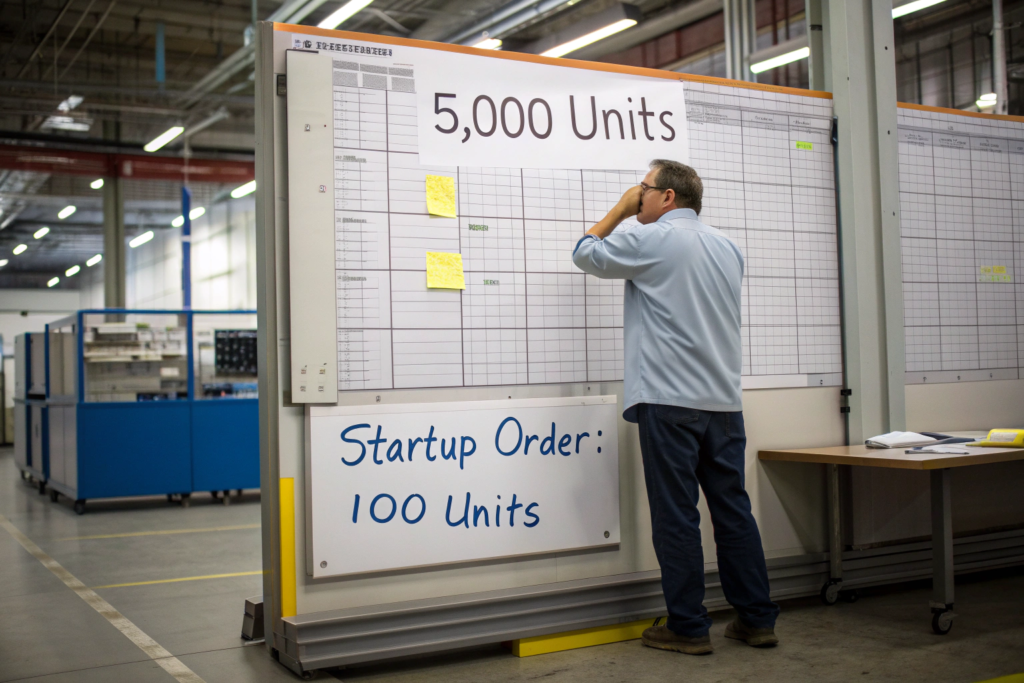
Factories set high MOQs because their cost structure is built around fixed setup costs that must be amortized across the production run. Cutting table setup, screen printing screen creation, embroidery digitization, and production line changeover each incur a fixed time and labor cost. If these costs are $500 and the factory needs $1 profit per unit, a 50-unit order would require a $11 per-unit surcharge just to break even. Rather than quote that high price, most factories simply decline the order.
What Fixed Costs Make Small Orders Unprofitable for Traditional Factories?
The cutting room illustrates the problem perfectly. To cut fabric for your 50 hoodies, a worker must spread the fabric roll across a 20-meter cutting table. The spreading takes 30 minutes. The marker (pattern layout) takes 15 minutes to position. The cutting takes 20 minutes. The labor cost is roughly $40. After cutting, the table must be cleared and reset for the next order, another 15 minutes. The total cutting room labor for your 50 hoodies is about $55. For a 5,000-unit order, the spreading, marker, and cutting might take four hours total, costing $160 in labor. The per-unit cutting labor is $1.10 for your small order and $0.03 for the large order. The difference is a factor of 37.
The same math applies to screen printing screen creation, embroidery file digitization, sewing line setup, and quality control documentation setup. These fixed costs are the reason high MOQs exist. A factory that accepts a 50-unit order at standard per-unit pricing loses money. A factory that quotes the true cost—which might be $18 per unit for a T-shirt—fears scaring away the customer. Many choose the simpler path of setting a high MOQ and focusing on large accounts. Understanding these garment production fixed costs empowers startups to have realistic conversations about pricing rather than feeling rejected by the MOQ barrier. A transparent factory will show you the cost breakdown and collaborate on ways to reduce the fixed cost impact.
How Do Material Supplier Minimums Constrain the Factory's Flexibility?
Even if the factory wants to accept a 50-unit order, the fabric mill might not cooperate. Mills set their own minimum order quantities for custom-dyed fabric. A specific shade of sage green for your startup hoodie might require a minimum dye lot of 200 kilograms. If each hoodie consumes 0.5 kilograms of fabric, that 200-kilogram minimum represents 400 hoodies' worth of fabric. The mill will not run the dye machine for less. The factory has a choice: buy the full 200 kilograms and hope you order more, or decline the order.
This material minimum constraint is particularly challenging for startups that want custom colors. The workaround is using stock fabrics—greige goods that the factory already holds in inventory—or pooling fabric across multiple small orders. We maintain an inventory of popular base fabrics in neutral colors that can accept piece-dyeing for smaller lots. For a startup that wanted 100 units of a specific coral color, we took our stock organic cotton jersey and piece-dyed it to their Pantone specification. The per-yard cost was higher than a bulk dye lot, but the brand avoided buying 400 units' worth of fabric. This flexibility requires a factory that has invested in fabric inventory management and has relationships with mills willing to accommodate smaller dye runs. Not every factory makes these investments. Those that do can offer lower MOQs without asking the startup to absorb the full minimum dye lot cost.
What Does a Fair Startup MOQ Structure Look Like in Practice?
A fair MOQ structure is not just a lower number. It is a transparent pricing framework that shows the startup exactly how costs decrease as volume increases. This transparency turns the MOQ conversation from a rejection into a growth plan. The startup sees that the 100-unit test run costs $18 per hoodie, the 300-unit reorder costs $14, and the 1,000-unit bulk order costs $10. They can build their retail pricing and fundraising pitch around this cost curve. They know exactly what margin awaits them at each scale milestone.
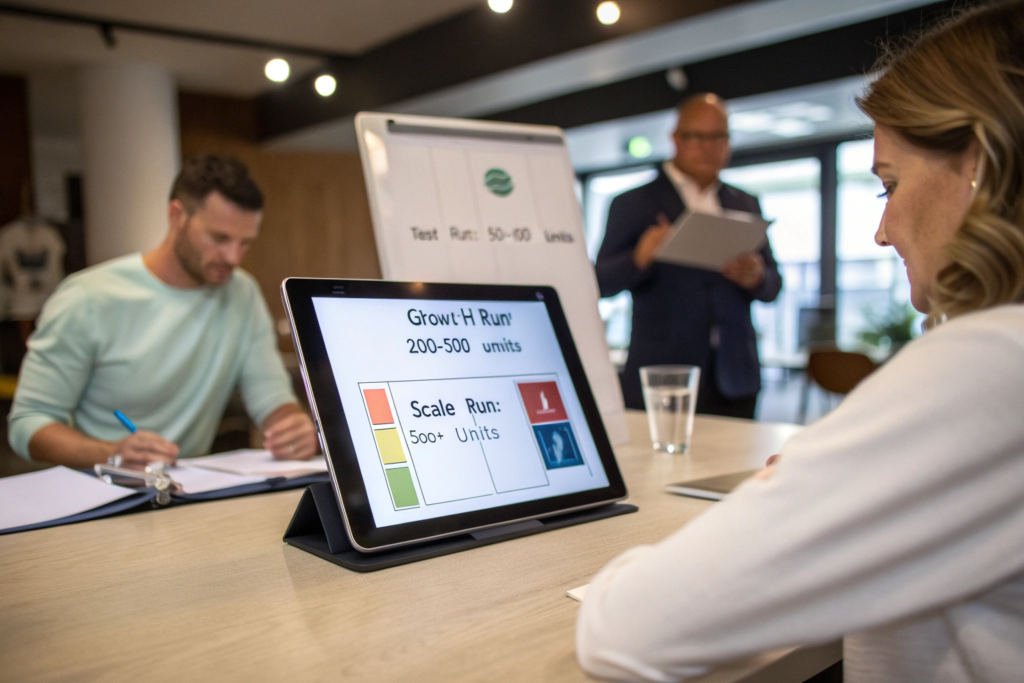
A startup-friendly MOQ structure offers three tiers: a Test Run tier of 50-100 units at a higher per-unit cost that covers fixed setup expenses and allows market validation, a Growth tier of 200-500 units at a mid-range per-unit cost reflecting partial amortization of fixed costs and improved material pricing, and a Scale tier of 500+ units at the factory's standard competitive wholesale pricing. Each tier should be presented transparently as a stepping stone, not a penalty.
What Should the Test Run Tier Cost, and Why Is It Worth the Premium?
The Test Run tier is the startup's most critical purchase. These 50-100 units are not just inventory; they are market research tools. They will generate the product photography, the influencer seeding samples, the first customer reviews, and the sell-through data that informs the next order. A startup that spends $1,800 on 100 units at $18 each, sells through at a $45 retail price, and generates $4,500 in revenue has not only made a profit but has also de-risked a larger inventory commitment.
The premium per-unit cost at this tier is the price of market intelligence. We are transparent about the cost breakdown at this level. For a recent startup hoodie order of 75 units, the cutting and setup labor was $5.20 per unit. The fabric cost was $6.80 per unit due to a small dye lot surcharge. The sewing labor was $4.00 per unit. The total production cost was $16 per unit, and we quoted $18 to cover our margin. The same hoodie at 1,000 units costs $10.20 to produce and would be quoted at $12. The brand founder understood the math and was willing to pay the premium because the test run generated the sales data she needed to confidently order 500 units for her second run. This startup production pricing transparency builds trust. A factory that simply quotes $18 without explaining the cost structure creates suspicion. A factory that shows the cost waterfall creates a partner.
How Can a Startup Negotiate Style and Color Flexibility Within Low MOQs?
The highest MOQ constraint often comes from color variations. A factory might agree to 50 units per style but require all 50 units in one color. For a startup, offering only one color on a new design limits market testing. The workaround is to negotiate total unit commitment across colors rather than per-color minimums.
We structure flexible startup packages where the total order quantity meets our minimum, but the allocation across colors and sizes is flexible. A startup ordering 100 hoodies can split them across three colors and four sizes, with a minimum of 12 units per size-color combination to justify the cutting setup. This flexibility is enabled by our modular production lines that handle mixed-color cutting and our inventory of stock fabrics that allow quick dye-lot changes. Another negotiation lever is style consolidation. If a startup designs three hoodie styles that share the same base fabric, thread color, and label type, we can pool the fabric order across all three styles, meeting the mill's minimum with a single fabric purchase. The startup gets three distinct designs for market testing at a lower per-unit fabric cost than if each style used a different material. These small-batch production strategies require a factory that is willing to think creatively about its own constraints and present options rather than just stating limitations.
How Does Low MOQ Production Work Without Sacrificing Custom Branding?
The greatest fear of a startup founder considering a factory with low MOQs is that "low minimum" means "no customization." They imagine receiving blank garments with no label, no hang tag, and no logo—just a generic product in a polybag. This fear is rooted in real experience with print-on-demand services and blank wholesalers. A true manufacturing partner treats branding as integral to the product, regardless of order size.
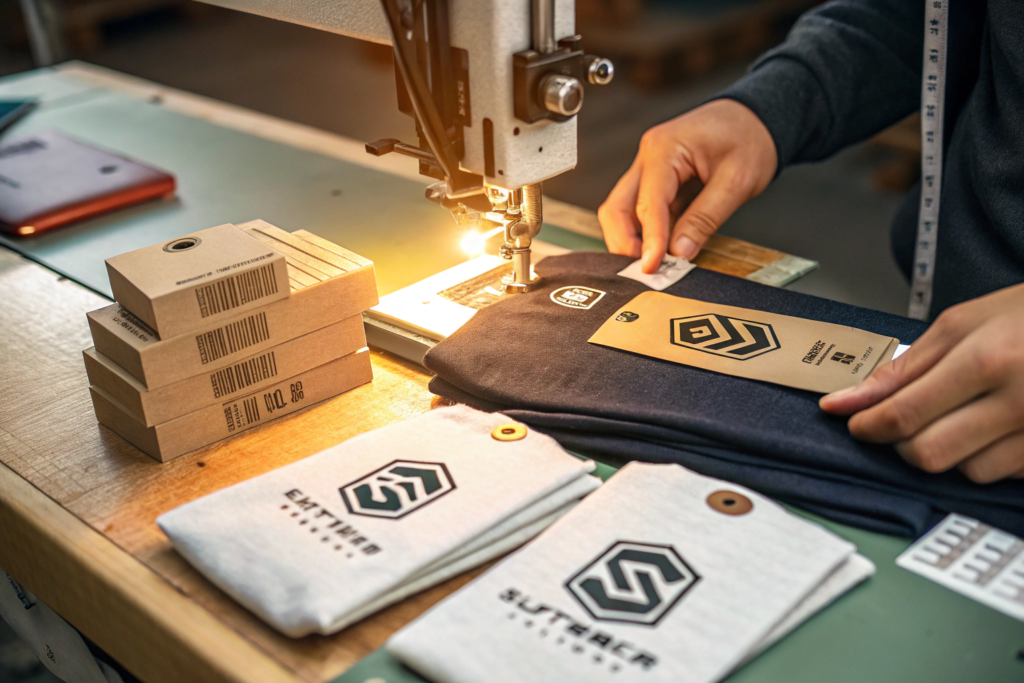
Custom branding is achievable at low MOQs when the factory offers in-house label printing, digital heat transfer, and small-batch embroidery services that do not require the expensive screen setups of traditional branding methods. The per-unit branding cost is higher at low volumes, but the absolute investment is manageable for a startup that understands branding is not an optional add-on but the core of their product identity.
What Branding Methods Are Cost-Effective at 50-Unit Quantities?
Screen printing, the traditional method for T-shirt logos, requires screen creation for each color in the design. A four-color chest print might require four screens at $50 each, plus setup labor. The $200+ screen setup cost amortized across 50 units adds $4 per unit. This is prohibitive. Digital heat transfer requires no screens. The logo is printed onto a transfer film using a digital printer, then heat-pressed onto the garment. The per-unit cost is higher than screen printing at scale—perhaps $0.80 versus $0.30—but there is zero setup cost. For 50 units, digital transfer is dramatically cheaper overall.
We offer digital heat transfer, direct-to-garment printing, and small-batch embroidery for startup orders. For embroidery, we have a minimum digitization fee of $30 for the logo file conversion, but no minimum stitch count run. A startup can order 50 embroidered chest logos. The per-unit embroidery cost is $1.20 compared to $0.60 at 500 units, but the total branding investment is $90 rather than $330. Woven labels follow the same logic. A custom woven label requires a loom setup, which typically mandates a 1,000-label minimum from the supplier. We solved this by investing in an in-house digital label printer that produces high-quality printed fabric labels with no setup cost. A startup can order 50 custom labels at a per-label cost of $0.40. The same label at 1,000 units from an external supplier costs $0.08. The startup pays a premium for the flexibility but avoids ordering 950 labels they do not need. These low-MOQ branding solutions make custom identity accessible without waste.
How Does Branding Quality Hold Up at Small Scale?
A legitimate concern is that low-volume branding methods produce an inferior result. A screen print is durable for 50+ washes; a digital transfer might crack after 20 washes if not properly cured. A woven label has a premium texture; a printed label can feel like a cheap tag. These quality differences matter. A startup's first customers are its most important; their impression of quality determines whether they return and whether they recommend the brand.
We address this by being transparent about the performance characteristics of each branding method. We do not sell digital transfers as equivalent to screen prints. We explain that the transfer will maintain its appearance for approximately 25 washes under normal care, and we recommend it for market-testing runs where long-term durability is less critical than speed to market. For brands that prioritize durability even at low volumes, we offer embroidery and woven labels with their higher setup costs but superior longevity. A custom garment branding consultation is part of our onboarding process for startup partners. We do not simply ask "what logo do you want?" We ask about the brand's positioning, the target customer's quality expectations, and the intended retail price point. These answers guide the branding method recommendation. A luxury startup charging $120 per dress should not use a digital transfer. A streetwear startup testing a new graphic design should not pay for screen setup. The right method matches the brand's market position and stage.
What Questions Should Startups Ask to Find a Genuinely Flexible Factory?
The difference between a factory that genuinely supports startups and one that merely tolerates small orders is visible in how they answer specific questions. A genuinely flexible factory provides transparent, data-backed answers. A reluctant factory provides vague reassurances or makes promises that dissolve when the purchase order arrives. Asking the right questions before committing to a production partner protects the startup from discovering MOQ inflexibility after the deposit is paid.
Startups should ask factories five specific questions to test flexibility: What is the exact per-unit cost at 50, 200, and 500 units, and can you provide a cost breakdown showing where the savings come from? Can you pool fabric and trim orders across multiple styles to meet supplier minimums? Do you offer in-house digital branding solutions for low-volume orders? What is your sample timeline for a new design? And will you reserve future production capacity based on a sell-through projection rather than a firm purchase order? A factory that answers all five with specific, favorable terms is genuinely startup-friendly.

How Can a Startup Test a Factory's Transparency Before Signing a Contract?
Request the cost breakdown for a hypothetical 100-unit order of a simple garment, such as a T-shirt with a chest print and a custom neck label. A transparent factory responds with a line-item breakdown: fabric cost per yard, fabric consumption per unit, cutting labor per unit, sewing labor per unit, print cost per unit, label cost per unit, packing cost per unit, and factory margin. A non-transparent factory responds with a single number and vague language about "quality materials" and "skilled labor" justifying the price.
We provide this breakdown as a standard part of our quoting process. A startup founder recently told me that three other factories she contacted refused to provide cost breakdowns. Two of them quoted a lower all-in price than ours. She chose us because the transparency gave her confidence that our numbers were real and that the other quotes might contain hidden charges or substitution of lower-quality materials. This garment cost transparency is a competitive advantage for factories that operate honestly. A startup should treat an unwillingness to provide cost breakdowns as a significant red flag, regardless of how attractive the headline price appears.
What Post-Pilot Commitment Should a Startup Expect from a Factory?
A startup invests heavily in developing a product with a factory. They spend weeks on sampling, branding, and fit approvals. If the product sells well, the startup needs to reorder quickly. But if the factory treats every order as a one-off transaction, the startup may face a different price, a different timeline, or even a refusal to reorder at the same MOQ because the factory took on larger clients in the interim.
A genuinely startup-friendly factory offers a post-pilot commitment. After the initial test run, the factory agrees to hold the pattern file, the branding setup, and the material specifications for a defined period, typically six to twelve months. The factory provides a reorder price schedule that is locked for that period. The factory commits to a reorder production timeline that is faster than the initial order because the sampling and setup are already amortized. We formalize this commitment in a production partnership agreement for our startup partners. The agreement is not a binding purchase commitment from the startup's side—we understand that sell-through is uncertain—but it is a binding service commitment from our side. The startup knows that if their product sells, we will produce the reorder at the agreed price and timeline. This reduces the risk that a successful test run becomes a sourcing dead end.
Conclusion
A top clothing manufacture's wholesale MOQ for USA brand startups should function as a growth ladder, not a brick wall. The 50-unit test run should be accessible at a transparent premium that reflects the real fixed costs of small-batch production. The 200-unit reorder should show measurable savings from improved material pricing and setup amortization. The 1,000-unit scale order should arrive at the factory's best competitive pricing. At every step, the brand's custom identity should be preserved through flexible, in-house branding solutions that do not demand 1,000-label minimums.
At Shanghai Fumao, we designed our startup program because we remember what it was like to build something from nothing. We know that today's 75-unit test order from a founder with a Shopify store and an Instagram following is tomorrow's 5,000-unit reorder from a brand with wholesale accounts and retail distribution. The brands that survive and scale are the ones that find manufacturing partners who view low MOQs as an investment in a long-term relationship, not a nuisance to be tolerated.
If you are a USA brand startup sitting on designs you believe in but stalling at the MOQ barrier, send us your concept. We will return a transparent cost breakdown for a 50-unit test run, a 200-unit growth run, and a 500-unit scale run. We will show you exactly where your money goes and exactly what margins await you as you grow. Contact our Business Director, Elaine, at elaine@fumaoclothing.com. Let us turn your sketchbook into sellable inventory without asking you to bet your entire savings on 6,000 units of hope.