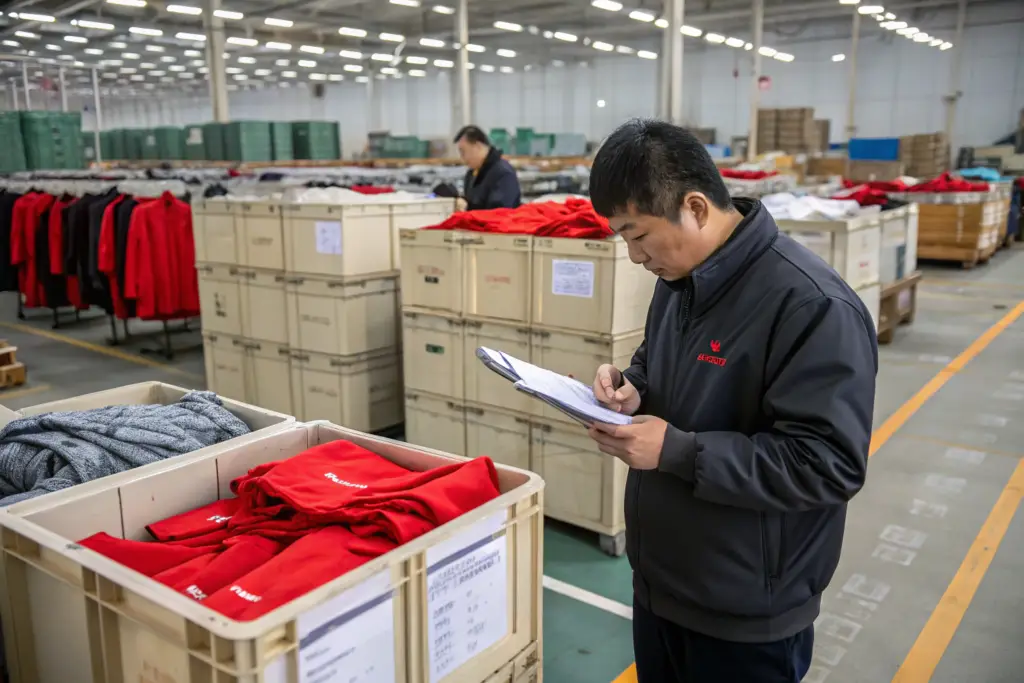
Your container of winter coats is scheduled to arrive at Hamburg Port on October 15th. Your retail launch is November 1st. On October 10th, you receive an email: the vessel has been diverted to Rotterdam due to Hamburg congestion, and your container will need to be trucked across Germany at an additional cost of €1,200. The delivery will be five days late. Your launch window is compromised. Your factory partner saw the Hamburg congestion developing three weeks ago but said nothing, hoping the situation would resolve. It did not.
A top clothing manufacture never ignores logistics red flags that threaten delivery timelines, cost predictability, or customs compliance for European clients. These red flags include port congestion signals in major European hubs, incomplete or inconsistent customs documentation that risks border delays, failure to account for the new EU carbon border regulations and product compliance requirements, and lack of visibility into the final mile delivery network within the destination country. Ignoring these flags means shipping on hope. Addressing them means shipping with certainty.
European logistics present unique challenges that differ from the U.S. market. Multiple countries, each with distinct customs procedures. A complex web of environmental regulations that are tightening rapidly. Port infrastructure that varies dramatically in efficiency. At Shanghai Fumao, we have developed specific logistics protocols for our European brand and distributor clients. These protocols are designed to detect and address red flags before they become delivery failures. Let me walk you through the specific warning signs we monitor and how we respond to them.
Why Is European Port Congestion a Critical Red Flag for Garment Shipments?
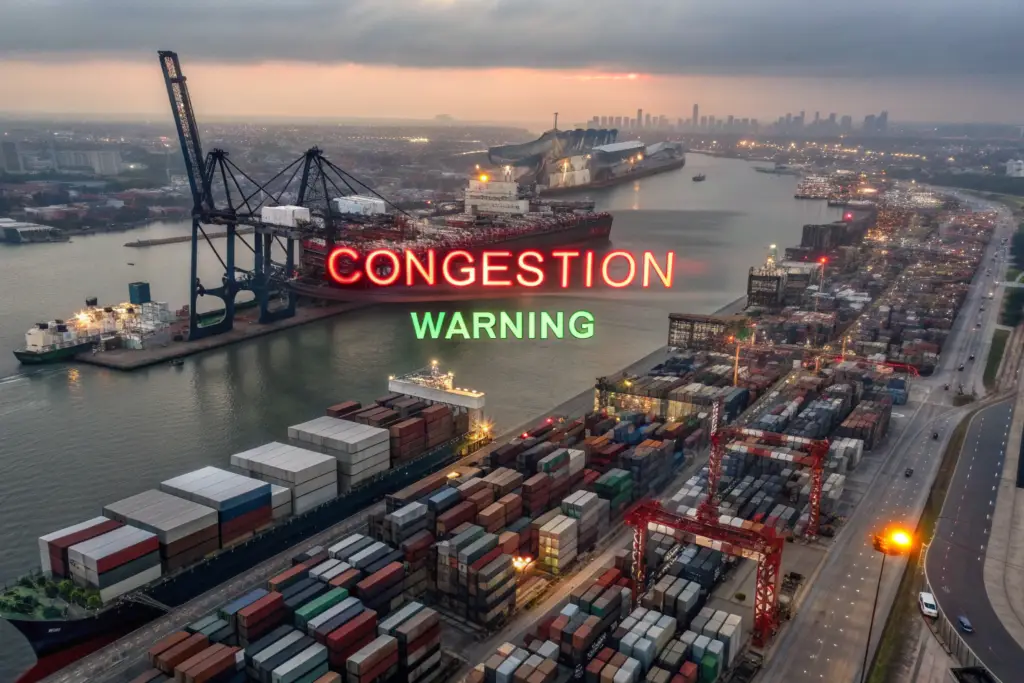
The three largest European container ports—Rotterdam, Antwerp, and Hamburg—handle the majority of apparel imports from Asia. When one of these ports experiences congestion, the ripple effects impact delivery schedules across the continent. A container that sits at anchorage for five days waiting for a berth is a container that misses its trucking appointment, its warehouse receiving window, and ultimately, the retail launch date. The factory that treats port selection as a static routing decision—"we always ship to Hamburg"—is failing to manage a dynamic risk.
Port congestion red flags include vessel waiting times exceeding 24 hours at the destination port, labor actions or strikes announced at major European terminals, seasonal peak volume periods such as the weeks before Christmas and the summer holiday season, and infrastructure disruptions like lock closures on inland waterways that serve as primary freight corridors. A top manufacturer monitors these indicators in real time and proactively adjusts routing to protect delivery dates.
How Does Real-Time Congestion Data Change Routing Decisions?
A factory that books a shipment based on the cheapest available rate without considering port conditions is optimizing for cost at the expense of reliability. A factory that monitors real-time port congestion data can balance cost, speed, and reliability based on the specific delivery requirements of each order.
We use live port congestion data from maritime analytics platforms to track vessel waiting times, berth availability, and terminal productivity at all major European ports. When a shipment is ready to book, our logistics team checks the current congestion status at the primary destination port and evaluates alternatives. If Rotterdam is showing a 48-hour vessel waiting time and Antwerp is showing a 12-hour waiting time, we evaluate whether routing to Antwerp with trucking to the final destination in the Netherlands would be faster and more reliable than waiting at Rotterdam. The decision is made collaboratively with the client. We present the options, the cost implications, and our recommendation. A recent shipment of women’s knitwear for a European distributor was originally routed to Hamburg. Two weeks before vessel departure, our congestion monitoring showed Hamburg waiting times increasing due to a labor slowdown. We rerouted to Bremerhaven, a smaller port 60 kilometers away with available capacity. The container arrived three days earlier than the original Hamburg routing would have achieved, even accounting for the additional trucking distance. The distributor’s launch proceeded on schedule. This port congestion management capability is not a luxury. It is the difference between a factory that ships boxes and a factory that protects delivery commitments.
What Alternative European Entry Points Does a Top Manufacturer Consider?
The major ports are not the only options. A logistics strategy that relies exclusively on Rotterdam, Antwerp, and Hamburg is fragile. Alternative ports like Zeebrugge in Belgium, Gdansk in Poland, Koper in Slovenia, and Piraeus in Greece can serve as effective entry points for specific destinations. The key is matching the entry point to the final delivery location rather than defaulting to the closest major port.
A shipment destined for southern Germany or Austria might clear customs faster through Koper than through Hamburg, even though the ocean transit to Koper is slightly longer. The total door-to-door time can be shorter because the port is less congested and the inland trucking route is more direct. A shipment destined for Eastern Europe might enter through Gdansk and avoid the congested Western European corridor entirely. We evaluate the complete door-to-door timeline for each shipment, considering ocean transit, port dwell time, customs clearance efficiency, and inland transportation. The cheapest port-to-port rate rarely produces the best door-to-door outcome. This European logistics routing strategy is standard practice at a top manufacturing partner and an indicator of logistics sophistication that distributors should demand.
What Customs Documentation Gaps Create Border Delay Risks?
European customs authorities are increasingly rigorous. A missing or incorrect document that might have passed through five years ago now triggers a full inspection, storage fees, and days of delay. For apparel shipments, the documentation requirements are extensive: commercial invoice, packing list, certificate of origin, fabric composition test reports, product safety certificates, and increasingly, sustainability and carbon footprint documentation. A factory that treats customs documentation as an administrative afterthought is creating a risk that compounds at every European border crossing.
Customs documentation red flags for European shipments include HS code classification inconsistencies between the commercial invoice and the packing list, incomplete or missing fabric composition percentages on the commercial invoice, absence of the Economic Operator Registration and Identification (EORI) number for the importer of record, missing REACH compliance documentation for chemical substances in the garments, and incorrect declared value that triggers customs audits. A top manufacturer reviews documentation for completeness and consistency before the container leaves the factory, not after it arrives at the border.

How Does HS Code Accuracy Impact European Customs Clearance?
The Harmonized System code classifies the product for customs purposes. It determines the duty rate, the applicable trade agreements, and the regulatory requirements. An incorrect HS code on a European shipment is not a minor clerical error. It is a misdeclaration that can result in customs detention, penalty fees, and a compliance record that subjects future shipments to increased scrutiny.
Apparel HS codes are particularly complex. The code depends on fiber composition, garment type, gender, and construction method. A women’s knitted wool sweater has a different code than a women’s woven cotton blouse. If the commercial invoice lists the wrong code, or if the code does not match the fabric composition stated on the invoice, customs will flag the shipment for inspection. We cross-reference every HS code on European shipments against the EU TARIC database before documents are finalized. We verify that the code matches the garment specifications and that the duty rate is correctly calculated. For a recent shipment of hybrid jackets containing both wool and synthetic fibers, our compliance team identified that the correct classification required a breakdown of the fiber percentage by weight and surface area, with the predominant fiber determining the classification. We provided the detailed breakdown on the commercial invoice. The shipment cleared customs without query. A factory that simply uses a generic "jacket" code risks a customs hold that delays the entire order and generates unplanned charges from the inspecting authority. This EU customs classification precision is a baseline requirement for European logistics competence.
Why Is the EORI Number a Non-Negotiable Documentation Element?
The Economic Operator Registration and Identification number is the unique identifier for any business importing goods into the European Union. Without a valid EORI number on the customs declaration, the shipment cannot clear customs. It sits in a bonded warehouse accruing storage fees while the importer scrambles to resolve the issue.
This sounds obvious, yet EORI-related delays are surprisingly common. A distributor may have recently changed their legal entity structure and not updated their EORI. A brand may be importing into the EU for the first time and not yet have an EORI. A factory that ships without confirming the EORI validity is setting the shipment up for a customs standstill. We require EORI confirmation from every European client before the first shipment is dispatched. We verify the number format against the EU EORI validation system. We include the EORI prominently on all customs documentation. For a new brand partner shipping to France for the first time, we flagged during our pre-shipment documentation review that their EORI number was registered to a previous company address. They updated it before the shipment departed, avoiding a customs delay at Le Havre. This EORI number requirements check is a small administrative step with outsized consequences if missed. A top manufacturer makes it a mandatory checkpoint.
How Do EU Environmental Regulations Create New Logistics Compliance Risks?
The European Union is implementing the most ambitious environmental regulatory framework for imported goods in the world. The Carbon Border Adjustment Mechanism, the EU Strategy for Sustainable and Circular Textiles, the Digital Product Passport requirements, and extended producer responsibility schemes for textiles are not future proposals. They are current or imminent regulations that directly affect apparel imports. A factory that is unaware of these requirements, or that treats them as the buyer’s problem to solve independently, is exposing its European clients to compliance risk.
EU environmental regulation red flags include the absence of carbon footprint data for the production of the garments, lack of material traceability documentation required for upcoming Digital Product Passport mandates, non-compliance with REACH restricted substances regulations for chemicals used in dyeing and finishing, and failure to provide the documentation required under extended producer responsibility schemes that are being implemented in multiple EU member states. A top manufacturer proactively builds compliance documentation into the production and shipping process.

What Is the Digital Product Passport and Why Must Factories Prepare Now?
The EU Digital Product Passport is a forthcoming requirement that will mandate a digital record accompanying every textile product sold in the EU. The passport will include information on material composition, country of origin, manufacturing processes, chemical substances used, recycled content, and recyclability. The regulation is being phased in, with full implementation expected by 2030, but early adopter brands and retailers are already demanding passport-ready data from their suppliers.
A factory that cannot provide the granular data required for a Digital Product Passport will be disqualified from European supply chains. We have begun building the data infrastructure to support passport requirements now. For every garment we produce for European clients, we are documenting the supply chain at a level of detail that exceeds current requirements but positions our partners for future compliance. We track the mill source and certification for each fabric lot, the chemical formulations used in dyeing and finishing with their ZDHC conformance status, the recycled content percentage with GRS certification where applicable, and the production facility details including audit status. This data is stored digitally and can be exported into the Digital Product Passport format as the regulatory requirements crystallize. A Digital Product Passport textile readiness strategy is not optional for factories serving European clients. It is a competitive requirement that separates future-proofed manufacturers from those who will be forced out of the market by regulatory change.
How Does REACH Compliance Affect Fabric and Trim Sourcing?
REACH is the EU regulation concerning the Registration, Evaluation, Authorisation, and Restriction of Chemicals. It restricts the use of specific hazardous substances in products sold in the EU. For apparel, this affects dyes, finishing chemicals, printing inks, and trim components like buttons and zippers that may contain restricted substances. A garment that contains a REACH-restricted substance above the permitted limit cannot legally be sold in the EU.
A factory that sources the cheapest available fabric and trims without verifying REACH compliance is creating a legal liability for its European client. The brand or distributor is the entity legally responsible for the product on the EU market, and they face fines, product recalls, and reputational damage for REACH violations. We require REACH compliance documentation from every material supplier. Our fabric mills provide test reports demonstrating that restricted substances are below the regulatory thresholds. Our trim suppliers provide REACH declarations for buttons, zippers, snaps, and labels. We conduct periodic third-party testing on finished garments to verify the supply chain documentation. For a European children’s wear brand we serve, we specifically test for phthalates and heavy metals in prints and trims because children’s products face even stricter REACH limits. This REACH compliance textiles rigor is not a value-added service. It is the minimum standard for legally shipping apparel to the European market.
What Final Mile Delivery Failures Does a Top Manufacturer Prevent?
The container arrived at the European port on time. Customs clearance was completed without delay. The shipment was deconsolidated and loaded onto a truck. Then, the truck arrives at the distributor’s warehouse or the brand’s retail store at the wrong time, with the wrong documentation, or with carton labeling that does not match the receiving system. The final mile failure undermines the entire logistics chain. For European clients, the final mile is complicated by diverse receiving environments, language differences, and varying local delivery practices.
Final mile red flags for European shipments include lack of pre-delivery appointment scheduling with the receiving facility, carton labeling that does not match the client’s warehouse management system, absence of local-language delivery documentation where required, and failure to account for access restrictions in historic European city centers where many boutiques and concept stores are located. A top manufacturer manages the final mile with the same rigor applied to ocean freight and customs.

How Does Delivery Appointment Scheduling Prevent Receiving Rejections?
A European distribution center or retail store operates on a receiving schedule. Deliveries that arrive without an appointment, or outside the scheduled window, may be refused. The truck is turned away. The goods sit in the carrier’s yard, accruing storage fees, while a new appointment is scheduled. The delay can add days to the delivery timeline and generate costs that erode margins.
We coordinate delivery appointments directly with the receiving facility before the truck departs. Our European logistics partner contacts the warehouse manager or store receiving team, confirms the delivery window, and schedules the appointment. The appointment confirmation is shared with the client. If the receiving facility has specific requirements—a particular dock door, a pallet jack type, a preferred carrier—we communicate those requirements to the trucking company. For a boutique chain we serve in Paris, we schedule deliveries during their designated receiving hours of 8 AM to 10 AM on Tuesdays and Thursdays. The driver arrives within the window with the correct documentation. The delivery is accepted on the first attempt. This retail delivery appointment scheduling discipline prevents the costly, frustrating cycle of refused deliveries and rescheduled appointments that plague poorly managed supply chains.
How Does Carton Labeling Integration Support European Warehouse Systems?
European warehouses use automated scanning systems to receive inventory. A carton that arrives with a barcode that does not match the Advance Shipping Notice in the warehouse management system cannot be processed. The carton is quarantined. Manual intervention is required to identify the contents and update the system. This slows down receiving, delays inventory availability, and incurs handling fees.
We generate carton labels according to the specifications provided by the client’s warehouse management system. Whether the client uses SAP, Oracle, or a specialized retail WMS, we configure our label generation to produce barcodes in the correct symbology with the correct data structure. Before shipment, we send the ASN file to the client so their system is expecting the incoming cartons. When the cartons are scanned at the receiving dock, the scan matches the ASN. The inventory is received in minutes, not days. For a European distributor using SAP, we integrated our label output with their system’s barcode requirements. Their receiving team reported zero quarantine events on the first shipment. The warehouse manager called it the smoothest supplier onboarding they had experienced. This warehouse labeling integration is a technical detail that has an outsized impact on operational efficiency and client satisfaction.
Conclusion
European logistics is not simply a longer version of U.S. logistics. It is a distinct operating environment with its own congestion patterns, customs requirements, environmental regulations, and final mile complexities. A top clothing manufacture serving European clients treats these differences not as obstacles to be navigated reactively but as requirements to be mastered proactively.
At Shanghai Fumao, our European logistics protocols are built on real-time port congestion monitoring, meticulous customs documentation review, proactive environmental compliance data collection, and disciplined final mile coordination. We do not wait for red flags to become delivery failures. We identify them early, communicate them transparently, and resolve them collaboratively with our clients. The result is a European supply chain that delivers on time, at the agreed cost, with full regulatory compliance.
If you are a European brand or distributor seeking a manufacturing partner that treats your logistics requirements with the sophistication they demand, let us provide a detailed logistics proposal for your upcoming production. We will include port routing options with current congestion data, a documentation checklist specific to your destination country, and a final mile delivery plan. Contact our Business Director, Elaine, at elaine@fumaoclothing.com. Ship with certainty, not with hope.