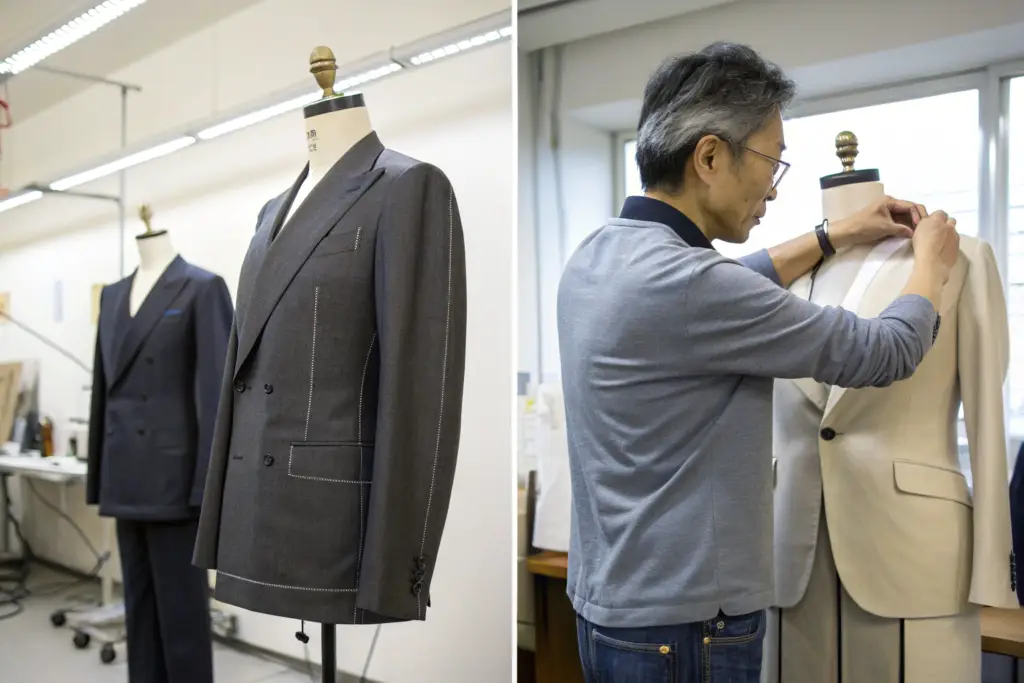
In the spring of 2022, I sat in our Shanghai Fumao showroom with a menswear brand founder from San Francisco. He had brought two blazers with him. One was a sample from a previous factory in Vietnam. The other was his own design, a soft-shouldered, lightly canvassed jacket he had been selling successfully in California for years. He placed them side by side on the cutting table and asked me a question I have never forgotten: "Why does the Asian-made jacket look sharp and modern, but feel stiff and restrictive, while the Western jacket feels comfortable but sometimes looks sloppy?" He had put his finger on the central aesthetic tension in global menswear tailoring. The two jackets were the same size, the same fabric weight, and roughly the same price point. But they were not the same garment. The difference was not in the stitching quality. It was in the philosophy of the male silhouette embedded in the pattern.
The key aesthetic differences between Asian and Western men's suit tailoring stem from fundamentally different ideals of the male form. Asian tailoring prioritizes a clean, elongated, and slim silhouette with structured shoulders, narrow sleeves, and a suppressed waist that creates a V-shaped taper. Western tailoring, particularly in the Italian and American traditions, prioritizes comfort, natural movement, and a softer expression of the chest and shoulder, often with more drape, a lower armhole, and a gentler waist suppression. Neither approach is superior. They serve different body types, different cultural preferences, and different retail markets.
Understanding these differences is essential for a brand that sources suits from Asia but sells to a Western customer. The factory's default pattern may not match your customer's expectations. If you do not specify the aesthetic, the factory will default to its house style, and you will receive a product that feels foreign to your end consumer. Let me break down the specific construction and pattern differences that create these two distinct looks, so you can communicate exactly what you want to your manufacturing partner.
How Do Shoulder Construction and Sleeve Setting Define the Jacket Silhouette?
The shoulder is the soul of a suit jacket. It sets the entire silhouette from the top down. When I walked the floors of menswear factories in Shanghai and compared them with tailoring houses I visited in Italy, the first thing I noticed was the shoulder pad. In a typical Asian factory, the default shoulder pad for a business suit is thick and structured. It lifts the shoulder point, squares it off, and creates a sharp, architectural line from the neck to the sleeve head. In a typical Italian or soft American construction, the shoulder pad is thin or even absent, allowing the natural slope of the wearer's shoulder to define the line. The Asian shoulder says "I am in control." The Western shoulder says "I am at ease."
Asian suit tailoring generally uses a thicker, more structured shoulder pad combined with a narrower shoulder width, creating an upright, broad-shouldered effect even on a slender frame. Western tailoring uses a softer, thinner pad or a completely unpadded spalla camicia construction that allows the sleeve head to follow the natural contour of the shoulder. The armhole in Asian tailoring is typically cut higher and tighter for a clean range of motion, while Western tailoring may use a slightly lower armhole for comfort, though high-end Western makers also cut high armholes.
The shoulder pad is only part of the story. The sleeve attachment method and the armhole shape create the functional difference between a jacket that moves with the body and a jacket that resists it.
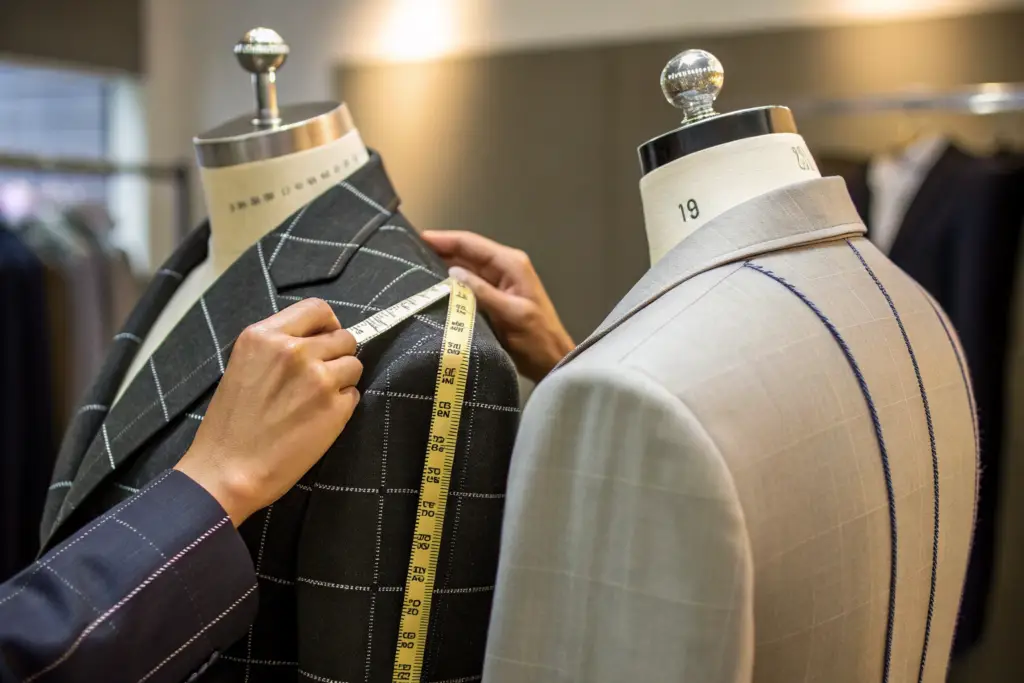
Why Does the Asian Suit Jacket Have a More Pronounced Squared Shoulder?
The squared shoulder in Asian tailoring comes from a combination of a denser shoulder pad and a specific cutting technique. The pad is often made of multiple layers of needle-punched felt or foam, building up from the shoulder point and tapering toward the neck. This pad tilts the shoulder line slightly upward and outward. The pattern itself is cut with a straighter shoulder seam angle, which reinforces the squared-off look.
This aesthetic originated in the post-war period when Asian tailoring houses adopted a structured, military-influenced look that conveyed formality and status. It has persisted because it photographs well and creates a consistent, uniform silhouette across different body types. The trade-off is comfort. A heavily padded shoulder restricts the arm's upward movement. If a wearer raises his arm to hail a taxi, the entire jacket shoulder lifts with it. This is a complaint I hear from Western customers who buy Asian-made suits without specifying a softer shoulder construction. They feel like the jacket is wearing them, not the other way around.
How Does the Italian Spalla Camicia Differ from a Machine-Set Sleeve?
The spalla camicia, literally "shirt shoulder," is the signature of Neapolitan tailoring. The sleeve head is set into the armhole by hand, with the excess fabric gathered and pleated rather than eased in smoothly by machine. The result is a soft, slightly ruffled texture at the sleeve cap that gives the shoulder a natural, lived-in look. The sleeve hangs with a gentle drape rather than standing up rigidly.
This construction is fundamentally different from the standard machine-set sleeve used in most Asian mass-production tailoring. A machine-set sleeve uses a uniform ease distribution around the sleeve cap, creating a smooth, clean join between sleeve and body. It is faster to produce, more consistent at scale, and creates a polished look. But it does not have the organic softness of a spalla camicia. At Shanghai Fumao, we can execute both constructions, but the cost and time differ significantly. A hand-finished spalla camicia requires a skilled tailor who has trained specifically in that technique, and it adds approximately 45 minutes to the making time of a jacket. I recommend brands understand their customer's preference before choosing. A tech-bro in San Francisco may prefer the soft Italian shoulder. A banker in Singapore may prefer the structured Asian silhouette.
What Role Does Waist Suppression Play in the Two Tailoring Traditions?
The waist of a suit jacket is where the tailor makes a decision about the male body. Asian tailoring tends to suppress the waist aggressively, pulling the jacket in tightly at the midsection to create a dramatic V-shape from the shoulders to the hips. The silhouette is athletic, youthful, and sharp. Western tailoring, depending on the tradition, suppresses the waist more gently or not at all. The English sack suit has minimal waist shaping. The Italian jacket has a soft, curved waist that follows the body without constricting it. The difference is not just a matter of inches on a tape measure. It is a difference in how the jacket allows the wearer to sit, breathe, and move through a day.
Asian tailoring suppresses the waist more aggressively, often by 4 to 6 inches from the chest measurement, creating a fashion-forward, slim-fit silhouette that appeals to younger consumers. Western tailoring suppresses the waist by 2 to 4 inches, allowing more room for movement and a more forgiving fit across a wider range of body types. The Asian approach prioritizes visual impact. The Western approach prioritizes all-day comfort.
This difference creates a practical issue when sourcing suits for Western markets. A pattern graded for the Asian market will produce a jacket that is too tight in the waist for the average American or European customer. Here is how the two traditions handle the waist curve and the button stance.
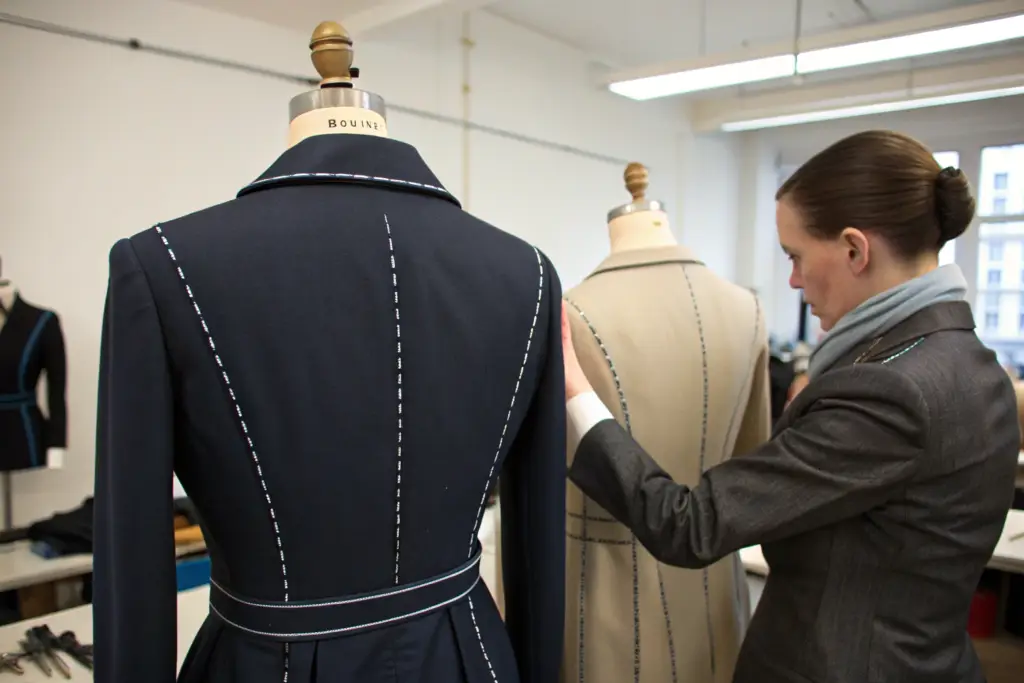
Why Is the Asian Silhouette Noticeably Slimmer Through the Torso?
The slim torso is achieved through a combination of pattern cutting and construction choices. The side seams are cut with a more dramatic inward curve. The front darts are extended deeper into the jacket body. The canvas interlining is often fused rather than floating, which creates a flatter, more rigid front panel that holds its shape tightly against the body.
This silhouette dominates the Asian menswear market because it aligns with a cultural preference for a neat, controlled appearance. It also photographs extremely well for e-commerce and social media, which has driven its popularity among direct-to-consumer brands globally. But the fit is unforgiving. A man who carries any weight around his midsection will find the jacket pulls at the button and gapes at the back vent. The jacket is designed for a specific body type: slim, straight up and down. When Western brands source this silhouette without adjustments, their return rates spike. I have seen return rates of 25% or higher on slim-fit suits sold to American customers over 35. The jacket fits the model on the website beautifully, but it does not fit the customer at home.
How Does Button Stance Affect the Perception of Proportions?
Button stance is the height at which the top button of a two-button jacket or the middle button of a three-button jacket is placed. Asian tailoring tends to position the button stance higher, often 1 to 2 inches above the natural waist. This high button stance elongates the leg line visually, making the wearer appear taller and leaner. It is a flattering trick for the average Asian male body type, which tends toward a longer torso and shorter legs relative to Western proportions.
Western tailoring places the button stance lower, closer to the natural waist or slightly below it. This lower stance opens up the chest, creates a longer lapel line, and gives a more relaxed, masculine proportion. When a Western customer tries on a jacket with a high Asian button stance, the jacket feels like it is pulling upward. The chest looks compressed. The lapels look short. The overall effect is uncomfortable and visually off, even if the customer cannot articulate why. At Shanghai Fumao, I always ask new brand partners to specify their button stance preference in the tech pack. If they do not specify, we default to the Western standard, because that is where most of our export volume goes. But the default must be a conscious choice, not an assumption.
How Do Lapel Widths and Gorge Lines Reflect Regional Style Preferences?
The lapel is the face of the jacket. Its width, shape, and the height of the gorge, the point where the lapel meets the collar, tell you instantly what market the jacket was designed for. A wide lapel with a low gorge reads as classic, powerful, and European. A narrow lapel with a high gorge reads as modern, sleek, and Asian. These are generalizations, of course, but they hold true across the vast majority of production tailoring that I see in our factory and in our competitors' showrooms. The lapel is also one of the easiest details to adjust when you are specifying a suit for a particular market, because it does not require changing the entire pattern. It requires changing the facing pattern piece and retraining the presser on the new gorge fold.
Asian suit tailoring favors a narrower lapel, typically 2.25 to 2.75 inches at the widest point, with a higher gorge line that sits above the clavicle, creating a sharp, vertical emphasis. Western tailoring, especially the Italian and English traditions, favors a wider lapel of 3 to 3.75 inches with a lower gorge that broadens the chest visually. The notch shape in Western tailoring is often a subtle fishmouth or a straight cut, while Asian notches tend to be more angular and sharply defined.
Lapel width is cyclical, influenced by fashion trends that move back and forth between slim and wide. But the gorge height is a more stable regional marker. Here is how the two traditions differ on lapel detailing.
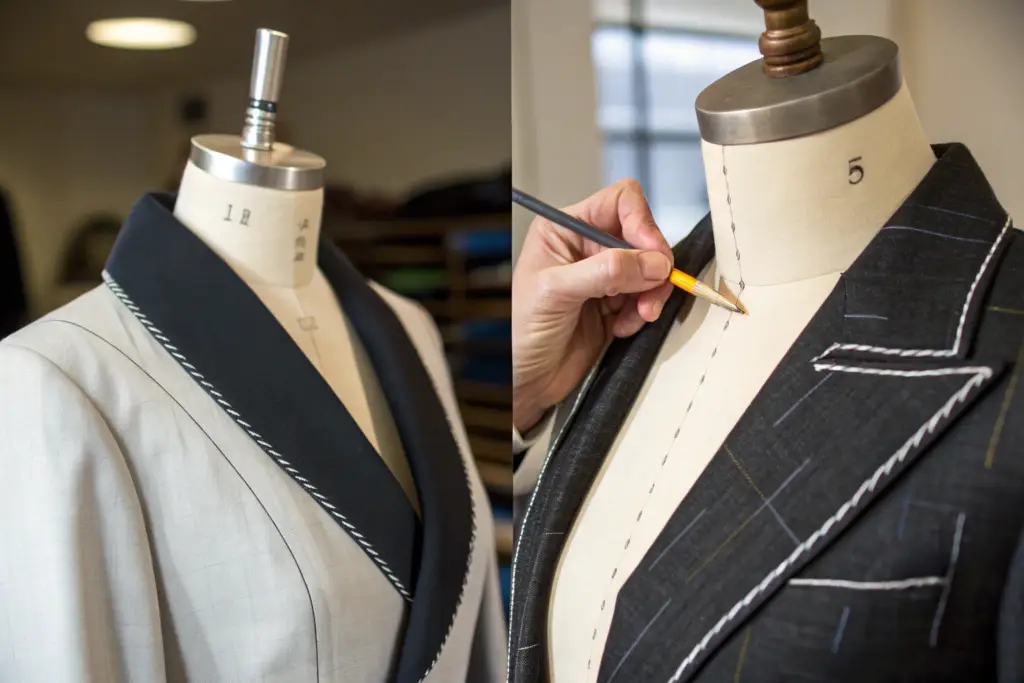
Why Do Asian Suits Prefer a Higher Gorge Line?
A high gorge line lifts the visual center of gravity of the jacket. It draws the eye upward toward the face, which complements the Asian silhouette's emphasis on vertical elongation. It also pairs well with the narrow lapel and the high button stance to create a unified look where all the horizontal lines are elevated.
The technical challenge of a high gorge is that it reduces the collar's contact surface with the shirt collar. If the gorge is too high, the jacket collar can gap away from the neck. This is a common fit issue in poorly made high-gorge jackets. The collar band must be precisely cut and attached to follow the neck curve without pulling away. This requires skilled pressing and careful undercollar felting. A well-executed high gorge is a mark of quality. A poorly executed high gorge is a constant annoyance to the wearer.
How Has the Wide Lapel Come Back in Western Menswear?
The wide lapel was pronounced dead in the skinny-suit era of the 2010s. It is now firmly back in Western tailoring, driven by the resurgence of classic menswear, the influence of Italian tailoring houses on Instagram, and a general shift away from the razor-thin silhouettes of the previous decade. A 3.5-inch lapel on a double-breasted jacket is now a statement of confidence and sartorial knowledge.
For a brand sourcing from an Asian factory, this trend requires explicit specification. The factory's default lapel width may still be set to the 2.5-inch standard that was dominant five years ago. If you do not update the spec sheet, you will receive narrow-lapel jackets for a market that has moved on. I keep a lapel width swatch card in our showroom that shows the evolution from 2.25 inches to 4 inches, and I ask brand partners to physically point to the width they want. This removes ambiguity. A measurement on a spec sheet is abstract. A physical sample is not.
How Do Fabric Choices and Interfacing Methods Influence the Final Aesthetic?
The external silhouette of a suit is determined by the pattern. The internal character of a suit is determined by the materials hidden between the outer fabric and the lining. The interfacing, the canvas, the shoulder pad, the lining. These internal components are invisible to the consumer, but they are felt every time the jacket is worn. A fused jacket feels different from a canvassed jacket. A polyester lining breathes differently from a cupro lining. The fabric itself, the weight, the weave, the fiber blend, all contribute to how the suit drapes, holds its shape, and ages over time.
Asian tailoring at the mass-market level often relies on fusible interfacing, which bonds a synthetic resin to the back of the outer fabric to provide stiffness and shape, combined with higher-shine, lower-cost polyester linings. Western tailoring, particularly at the mid-to-high end, favors a floating canvas construction using horsehair and wool, which shapes the jacket naturally to the wearer's body over time, paired with breathable viscose or cupro linings. The fused jacket is consistent and affordable. The canvassed jacket is dynamic and durable.
The choice between fused and canvassed is not just a quality decision. It is an aesthetic decision. It affects how the jacket looks on day one and how it looks on day 100. Here is how these internal choices play out.
What Is the Difference Between Fused and Canvassed Construction in Appearance?
A fused jacket has a smooth, flat, uniform appearance. The front panel lies like a board. The lapel has no roll. The buttonhole is often machine-made and lies flat. This look is clean, modern, and consistent. It is the standard for entry-level and mid-tier suits globally.
A canvassed jacket has a three-dimensional quality. The lapel has a gentle roll, a soft curve where it folds back from the button. The chest has a subtle fullness, created by the horsehair canvas that is hand-padded and shaped. When the jacket is worn, the canvas molds to the wearer's chest over time, creating a personalized fit. This dynamic quality is what menswear enthusiasts mean when they talk about a jacket "breaking in." A fused jacket does not break in. It stays the same shape forever, which is either a feature or a flaw depending on your perspective. At Shanghai Fumao, we offer both half-canvassed and full-canvassed options. The cost difference is meaningful, a full-canvassed jacket is about 30% more in labor than a fused jacket, but the aesthetic difference is visible to an educated consumer.
Why Do Asian Factories Often Default to Higher-Shine Fabrics and Linings?
The default fabric and lining choices in many Asian factories are driven by cost, availability, and local market preference. A polyester lining with a slight sheen is inexpensive, widely stocked, and perceived as "silky" and luxurious by a segment of the Asian mass market. A matte cupro lining is more expensive, more delicate to sew, and requires a different supply chain.
The same logic applies to the outer fabric. A super 120s worsted wool with a smooth, almost slick finish is the default "good suit" fabric in many Asian markets. It looks new. It catches the light. In the Western market, particularly in the Italian tailoring tradition, a fabric with more texture—a hopsack, a flannel, a subtle slub—is often preferred because it reads as "rich" and "artisanal" rather than "shiny" and "mass-produced." The difference is not in the quality of the fiber. It is in the finishing of the fabric. I work with our fabric suppliers to offer matte-finish, textured fabrics to our Western brand partners. The supply chain can deliver both aesthetics. The brand just needs to ask for the right one.
Conclusion
The difference between an Asian-tailored suit and a Western-tailored suit is not a difference in quality. It is a difference in cultural aesthetic, body type assumption, and market expectation. The Asian silhouette is sharp, structured, and slim. The Western silhouette is softer, more draped, and more forgiving. A brand that understands these differences can design a suit that deliberately blends the two traditions, taking the clean finish of Asian production and applying it to a Western-friendly pattern with a softer shoulder, a lower button stance, and a wider lapel.
At Shanghai Fumao, I have built a tailoring program that is aesthetic-agnostic. We do not impose a house style. We ask the brand what their customer expects, and we execute that specification. We can cut a sharp, high-gorge, slim-fit jacket for a Singapore retailer and a soft, natural-shoulder, full-canvas jacket for a New York menswear brand on the same production floor. The difference is in the pattern, not the factory.
If you are developing a menswear collection and you are unsure whether your factory's default aesthetic matches your market, send us your reference samples. We will reverse-engineer the shoulder construction, the waist suppression, and the lapel proportions, and we will show you exactly how we would adapt our production to meet your customer's expectations. Reach out to our Business Director, Elaine, at elaine@fumaoclothing.com. A suit that fits your customer's body is a technical achievement. A suit that fits your customer's identity is a business advantage.