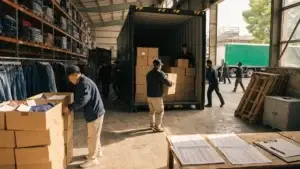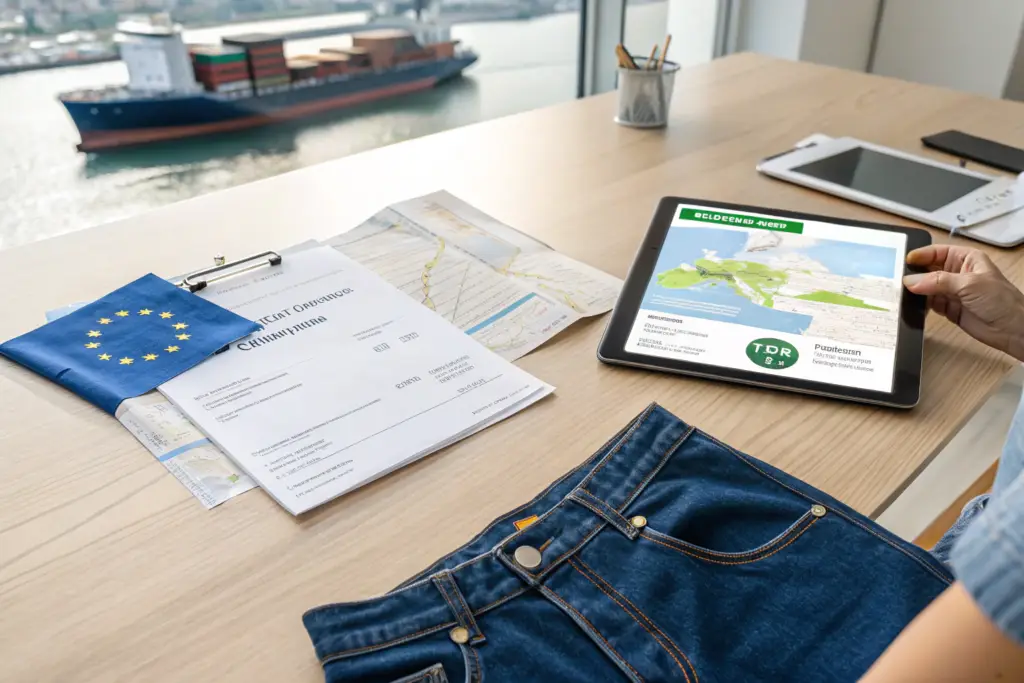
Shipping to Europe used to be simple for a Chinese factory. You put the goods on a boat. You sent the bill of lading to the buyer. Your job was done. The buyer handled everything else. Those days are gone. The European Union has built a wall of regulations. REACH. The Digital Product Passport. The Corporate Sustainability Due Diligence Directive. The EU Deforestation Regulation. Customs authorities are enforcing compliance more aggressively than ever before. A container of denim shorts can be stopped at Rotterdam not because the shorts are defective, but because the factory cannot prove where the cotton came from. A shipment can be seized because the nickel content in the buttons exceeds the REACH limit by 0.5 parts per million. DDP shipping to Europe is no longer just a logistics service. It is a regulatory compliance guarantee. The factory that offers DDP to Europe is telling the buyer "we will handle not just the freight, but the legal responsibility for getting this product past EU customs and onto your warehouse floor."
Shanghai Fumao is one of a limited number of Chinese clothing manufacturers offering a fully realized DDP shipping service to the European Union. We are a top choice in this category because our DDP service is built on a foundation of documented EU regulatory compliance. We act as the Importer of Record into the EU. We clear customs under our own EORI number. We provide the REACH test reports, OEKO-TEX certificates, GOTS transaction certificates, and supply chain traceability documentation that EU customs authorities are increasingly demanding. We assume the legal and financial risk of customs rejection. And we deliver to your warehouse in any EU member state with a single, predictable landed cost per unit.
I run Shanghai Fumao. I decided three years ago to build a DDP-to-Europe capability because I saw where the market was going. European brands wanted the simplicity of DDP, but most Chinese factories could not offer it because they could not provide the compliance documentation. I invested in the testing, the certifications, the traceability systems, and the customs broker relationships. This article explains what we built, why it matters, and how it compares to the alternatives.
What Makes DDP Shipping to Europe Different from DDP to the USA?
DDP to the United States is a well-established service. Many Chinese factories offer it. The U.S. customs framework is relatively straightforward. One country. One set of customs regulations. One duty rate for denim shorts, 16.6% on the FOB value. One federal agency, CBP, enforcing the rules. The compliance requirements, CPSIA for children's products, flammability standards, are well-understood and stable.
DDP to the European Union is an entirely different proposition. The EU is not a single country. It is 27 member states with a common customs union but different VAT rates, different languages, and different national customs authorities interpreting the common rules. The EU's regulatory framework is more complex and more aggressively enforced than the U.S. framework. REACH restricts hundreds of chemicals. The Textile Labeling Regulation requires fiber content disclosure in a specific format in the official language of the member state. The Digital Product Passport is coming. The Forced Labor Regulation is coming. For a factory to offer DDP to the EU, they must not only manage the logistics complexity. They must manage the regulatory complexity. They must be able to provide the documentation that proves compliance. And they must be willing to accept the legal and financial risk if something goes wrong.
Let me explain the specific logistical and regulatory hurdles that make DDP to Europe a challenging service to offer.
What Are the Logistical Complexities of DDP Across 27 EU Member States?
When we ship DDP to the United States, we clear customs at the port of entry, Los Angeles, Long Beach, New York. From there, the goods are in free circulation in the U.S. We truck them to the buyer's warehouse. One customs clearance. One duty payment. One trucking leg.
When we ship DDP to the European Union, the complexity multiplies. We can clear customs at the port of entry, Rotterdam, Hamburg, Antwerp, and release the goods into free circulation in the Netherlands, Germany, or Belgium. That is one customs clearance. But if the final destination is France, Italy, Spain, or Poland, the goods must be transported from the entry port to the destination country. This transport is an intra-EU movement. VAT must be accounted for in the destination country. The buyer may have specific VAT reporting requirements. If we clear customs at the entry port and the buyer is in a different member state, we need a customs broker who can handle the fiscal representation for VAT in the destination country, or the buyer must handle the VAT themselves under the reverse charge mechanism.
This complexity is manageable. We manage it through our customs broker partners in the Netherlands and Germany. They handle the customs clearance at the port of entry and the fiscal representation for VAT in the destination member state. But it is an additional layer of coordination that does not exist in U.S. DDP. The EU customs and VAT for importers guide explains the intricacies. A factory offering DDP to the EU must have robust customs brokerage relationships and a working knowledge of EU VAT rules.
Why Does EU Regulatory Compliance Make DDP a Risk Most Factories Avoid?
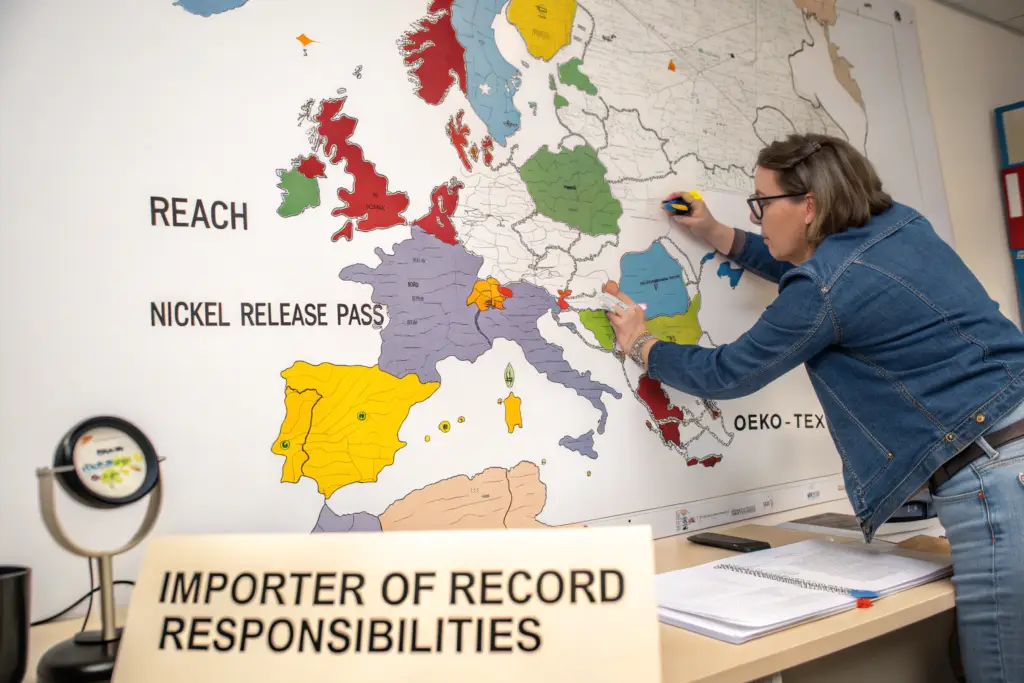
Under DDP, the factory is the Importer of Record. The Importer of Record is legally responsible for the compliance of the imported goods. If the goods are found to be non-compliant, the Importer of Record is liable. Fines. Seizure. Destruction of the goods. Legal action.
Most Chinese factories are not willing to accept this risk for the EU market. The EU's regulations are complex, unfamiliar, and strictly enforced. A factory that has never tested its buttons for nickel release under REACH is taking a huge gamble by acting as the Importer of Record into the EU. If the shipment is tested at the border and fails, the factory bears the loss. Most factories avoid this risk entirely. They sell FOB. The risk is the buyer's problem.
We accept the risk because we have built the systems to manage it. We test our materials for REACH compliance before production. We maintain our OEKO-TEX certification. We document our cotton supply chain. We know our products are compliant because we have the test reports to prove it. The DDP risk is a calculated risk, backed by evidence. A factory that cannot produce a REACH test report is gambling. We are not gambling. We are insuring a known outcome with documented proof. The EU importer of record responsibilities are serious legal obligations. We take them seriously.
How Does Our DDP Service Handle EU Customs, Duties, and VAT?
Our DDP service to the European Union covers the entire import process. Ocean freight from Shanghai to the European port of entry. Marine cargo insurance. EU customs clearance under our EORI number. Payment of EU import duties. Handling of VAT obligations. Inland transportation to the buyer's warehouse in any EU member state. The buyer receives one invoice with one price per unit, delivered.
The customs clearance process begins before the vessel arrives. Our customs broker files the import declaration electronically while the ship is in transit. The declaration includes the commercial invoice, the packing list, the bill of lading, the certificate of origin, and the compliance documentation. REACH test reports, OEKO-TEX certificate, fiber composition report. By the time the vessel docks, customs has reviewed the declaration. If the documentation is in order, the goods are released. If customs selects the shipment for a physical inspection, our broker manages the inspection process. If the goods are found to be non-compliant, we bear the consequences. This is the risk we assume as the Importer of Record.
Let me explain the specific steps of the customs clearance process and how VAT is handled.
What Are the Steps in Our EU Customs Clearance Process?
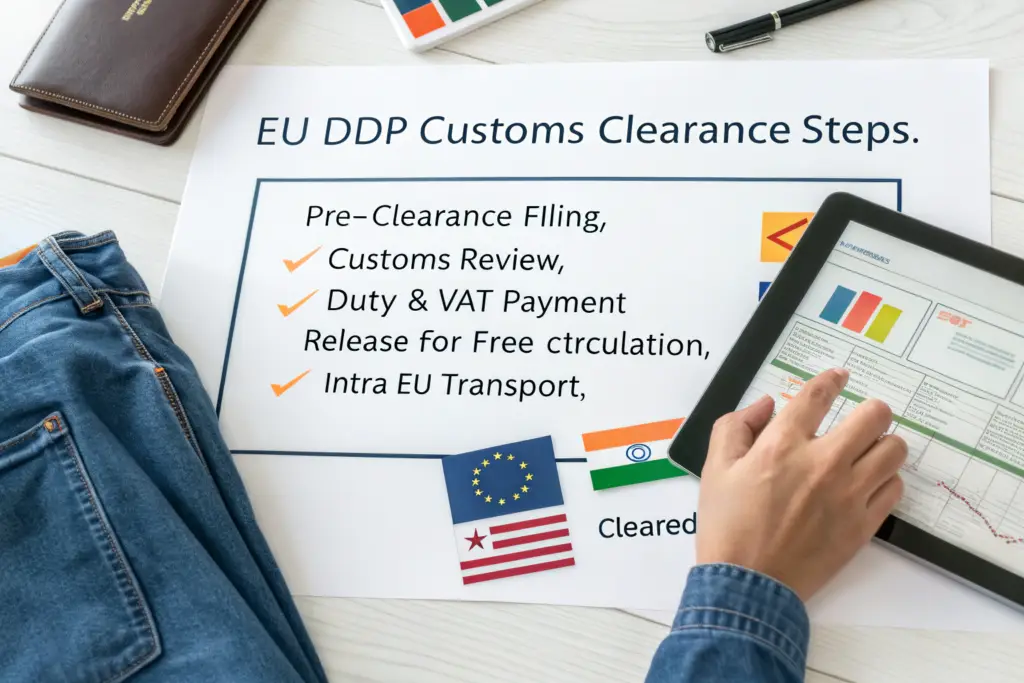
The customs clearance process follows a defined sequence. Step one, pre-clearance filing. Three to five days before the vessel arrives at the EU port, our broker files the Entry Summary Declaration and the import declaration with the customs authority of the entry member state, usually the Netherlands or Germany. The declaration includes the commodity code for denim shorts, the customs value, the origin, and all required supporting documents. Step two, customs review. The customs authority reviews the declaration. They may accept it as filed. They may request additional documentation. They may select the shipment for a documentary check, a scan, or a physical inspection. Our broker responds to any requests. Step three, duty and VAT payment. Once the declaration is accepted, the duties and VAT are calculated. We pay them from our deferment account or through our broker's payment facility. Step four, release for free circulation. Once duties and VAT are paid and any inspections are cleared, the goods are released into free circulation in the EU. They are no longer in customs bond. They are domestic EU goods. Step five, intra-EU transport. The goods are trucked from the port of entry to the buyer's warehouse in the destination member state. The transport is an intra-EU movement. No further customs formalities are required. The EU import customs clearance procedure is standardized across the union. The specific implementation varies by member state. Our brokers navigate these variations.
How Do We Handle VAT on DDP Shipments to Different EU Countries?
VAT is the most complex part of DDP to the EU. When goods are imported into the EU, import VAT is due at the rate applicable in the member state of import. The rate varies. 21% in the Netherlands. 19% in Germany. 20% in France. 22% in Italy. Under DDP, we are responsible for paying this import VAT.
However, there are mechanisms to avoid a VAT cost burden. Under the EU's Import One-Stop Shop scheme, we can declare and pay the import VAT through a simplified return, rather than registering for VAT in each member state. This is the method we use for B2C shipments. For B2B shipments to a VAT-registered buyer, the buyer can account for the VAT under the reverse charge mechanism. We do not charge the buyer the VAT. The buyer declares it on their own VAT return and reclaims it simultaneously, resulting in a zero net cash flow impact. This is the standard treatment for B2B imports.
The key is to get the VAT treatment right at the point of import. If we pay import VAT that the buyer could have reverse-charged, the buyer has to reclaim it from the foreign tax authority, which is slow and administratively burdensome. Our brokers confirm the buyer's VAT status before filing the import declaration and apply the correct VAT treatment. The EU import VAT rules are complex. A competent customs broker is essential. Our brokers are competent. We have vetted them through successful shipments.
What EU Compliance Documentation Does Our DDP Service Include?
The DDP service is not just about logistics. It is about the documentation that gets the goods through customs. Without the right documentation, the shipment is delayed or rejected. With the right documentation, it clears smoothly. Our DDP service includes a comprehensive documentation package that we compile and submit as part of the customs declaration.
The documentation package is based on our understanding of what EU customs authorities are currently requesting for textile imports. This understanding is updated regularly based on feedback from our customs brokers and from our brand clients who have their own compliance teams monitoring regulatory developments. We do not guess at what is required. We provide what is required, documented with test reports and certificates from accredited bodies.
Let me detail the specific documents included in our standard EU DDP compliance package.
What Documentation Package Do We Provide for EU Customs Clearance?
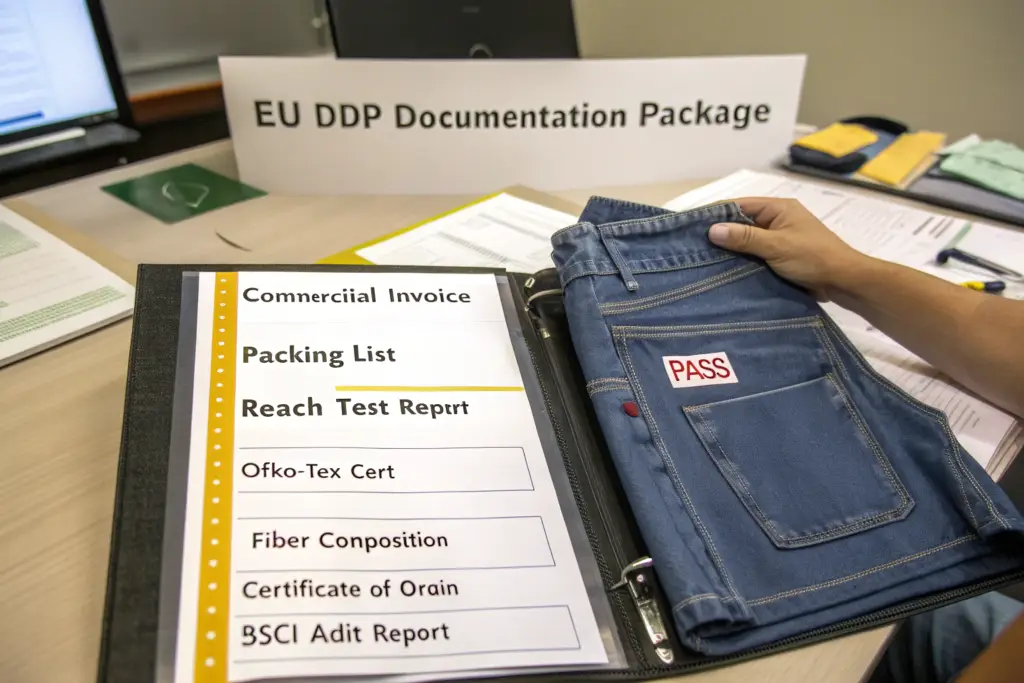
Our standard EU DDP documentation package includes the following. The commercial invoice, which states the description of goods, the HS code, the quantity, the unit price, the total value, the Incoterm DDP, and the country of origin. The packing list, which details the carton numbers, dimensions, weights, and contents. The bill of lading, the transport document issued by the shipping line. The REACH compliance test report, from an ISO 17025 accredited laboratory, testing for the restricted substances applicable to the garment's materials, azo dyes, nickel release, phthalates, formaldehyde, organotins. The OEKO-TEX Standard 100 certificate, which is a product safety certification that aligns with REACH requirements in many categories. The certificate number is included and can be verified online. The fiber composition test report, which verifies the fabric content as stated on the care label and as required by the EU Textile Labeling Regulation. The care label itself, attached to the garment, showing the fiber composition in the official language of the destination member state if required, and the care symbols in accordance with ISO 3758. The Certificate of Origin, issued by the China Council for the Promotion of International Trade, certifying that the goods are manufactured in China. For GOTS organic orders, the GOTS transaction certificate, which provides chain of custody documentation for the organic cotton. For BCI cotton orders, the BCI transaction certificate. The EU textile import documentation requirements are published by the European Commission. Our package meets or exceeds the standard requirements.
How Do We Prove Compliance with the EU's Forced Labor and Sustainability Regulations?
The EU's Forced Labor Regulation, once finalized, will prohibit products made with forced labor from the EU market. The EU's Corporate Sustainability Due Diligence Directive requires large companies to conduct due diligence on human rights and environmental risks in their supply chains. Brands will need documentation from their suppliers to meet these obligations.
We provide two levels of documentation for forced labor and sustainability due diligence. For social compliance, we provide our BSCI and SMETA audit reports. These reports are conducted by independent auditors and verify that our factory meets standards for freely chosen employment, no child labor, fair wages, safe working conditions, and reasonable working hours. The audit reports include worker interviews and document reviews. They are not self-declarations. For cotton traceability, we provide the GOTS or BCI transaction certificates that document the origin of the cotton fiber. The certificates trace the cotton from the gin to the spinner to the weaver to our factory. They provide documented evidence that the cotton was grown in accordance with standards that prohibit forced labor.
We also maintain a digital record of our supply chain that can be made available for brand audits. This includes the names and addresses of our fabric mills, trim suppliers, and wash chemical suppliers. The EU forced labor and supply chain due diligence requirements are evolving. We are monitoring the final legislation and updating our documentation practices accordingly.
How Do Our EU DDP Costs Compare to FOB and Other Shipping Options?
The DDP price is higher than the FOB price. That is obvious. The DDP price includes the freight, the insurance, the customs clearance, the duty, the VAT handling, and the trucking. The FOB price includes none of these. The real question is whether the DDP price is lower than the total cost the buyer would pay if they managed the logistics themselves under FOB terms. The answer, in most cases for small to medium brands, is yes. Our DDP price is competitive with the buyer's total landed cost under FOB, and it provides additional value in the form of reduced administrative burden and transferred risk.
We achieve competitive DDP rates because we consolidate shipments and negotiate volume rates with carriers and brokers. A brand importing two containers a year is a small customer to a freight forwarder. We are a large customer. Our rates are better. Our customs broker relationships are deeper. Our ability to resolve port issues is stronger. The savings from this volume advantage are passed on to the DDP price.
Let me provide a specific cost comparison and explain how we manage freight rate fluctuations.
What Is the Landed Cost Comparison Between Our DDP and an FOB Quote?
Let me use a real example. A brand in Amsterdam orders 2,000 denim shorts. Our FOB Shanghai price is €5.50 per unit. Our DDP Amsterdam price is €8.20 per unit.
If the brand chooses FOB, they must arrange and pay for the following. Ocean freight from Shanghai to Rotterdam, allocated per unit: €0.45. Marine insurance: €0.05. EU customs clearance and brokerage: €0.30. EU import duty at 12% on the FOB value: €0.66. Port handling at Rotterdam: €0.12. Inland trucking from Rotterdam to Amsterdam: €0.18. Total additional costs: €1.76. Total landed cost under FOB: €5.50 + €1.76 = €7.26.
The DDP price of €8.20 is €0.94 higher than the FOB landed cost. For that €0.94, the brand receives several valuable benefits. They do not coordinate four different logistics vendors. They do not set up an EU EORI number or a customs bond. They do not pay a surprise demurrage bill if the container is delayed at Rotterdam. They do not bear the risk of a customs rejection for non-compliance. They do not manage the VAT accounting. The brand receives a single invoice. A single delivery. A single point of accountability. And the compliance guarantee that the documentation is in order and the goods will clear customs.
For most small to medium brands, the additional €0.94 per unit, or €1,880 on a 2,000-unit order, is well worth the administrative savings, the risk transfer, and the peace of mind. The DDP vs FOB landed cost for European imports analysis consistently shows that DDP is a superior value proposition for brands that value their time and want predictable costs.
How Do We Manage Freight Rate Fluctuations Within a DDP Quotation?
Freight rates from China to Europe fluctuate. They are affected by fuel prices, vessel capacity, seasonal demand, and geopolitical events. When we quote a DDP price, we lock in that price for the order. If freight rates increase between the quotation and the shipment date, we absorb the increase. If freight rates decrease, we capture the saving.
We manage this risk by booking freight in advance where possible, by negotiating fixed-rate contracts with carriers for our regular shipping lanes, and by building a small freight contingency into our DDP pricing model. The contingency is not a hidden markup. It is a risk buffer that protects both us and the client from price volatility. If the buffer is not fully consumed by the actual freight cost, the surplus contributes to our margin. If the buffer is exceeded by an unexpected freight spike, we absorb the loss. Over time, the buffer and the actual costs average out.
This is the same risk management model used by freight forwarders and logistics companies. We have simply integrated it into our DDP pricing. The client sees one price. That price does not change. The ocean freight rate management challenge is one of the reasons many factories avoid DDP. We have the volume and the experience to manage it effectively.
Conclusion
Shanghai Fumao is a top clothing manufacturer for DDP shipping to Europe right now because we have built the infrastructure that DDP to Europe requires. The compliance testing infrastructure, our REACH test reports, our OEKO-TEX certification, our GOTS and BCI traceability documentation. The customs brokerage partnerships in the Netherlands and Germany that handle clearance, duty, and VAT across all 27 EU member states. The logistics volume that allows us to negotiate competitive freight rates and manage rate fluctuations. And the willingness to act as the Importer of Record and accept the legal and financial risk of EU customs compliance, a risk we manage through rigorous pre-production testing and documentation.
Most Chinese factories cannot offer a true DDP service to Europe because they lack one or more of these elements. They may be able to arrange the freight, but they cannot provide the REACH test reports. They may have the test reports, but they are not willing to accept the Importer of Record liability. They may be willing to accept the liability, but they cannot manage the VAT complexity across 27 member states. The full package is rare. We have assembled it.
If you are a European brand, or a non-European brand selling into the EU, and you want the simplicity of a single landed cost with the compliance guarantee that your goods will clear customs, I invite you to test our DDP service. Contact our Business Director, Elaine. She can provide a DDP quotation to your specific EU delivery address, a sample of our EU compliance documentation package, and a timeline showing the clearance and delivery milestones. Her email is elaine@fumaoclothing.com. At Shanghai Fumao, we do not just ship to Europe. We deliver to your door, with the paperwork to prove it is legal. That is the DDP difference.