You've found a factory with a beautiful floral dress catalog, and their prices are compelling. They're responsive on WhatsApp, and the sample photos look great. You're ready to send a deposit. Then, a nagging question hits you: are they legally allowed to export this shipment? The fear of sending tens of thousands of dollars to a company that can't legally clear customs is real and paralyzing. I've heard too many stories from U.S. brand owners who had containers seized at a Chinese port because a factory's export credentials were expired, fake, or simply didn't cover the garment category they were shipping. That shipment, and the entire season's revenue, vanished into a customs legal nightmare.
Verifying a Chinese factory's export license easily requires a two-step digital audit: first, a free, real-time check of the company's business registration on the National Enterprise Credit Information Publicity System to confirm its legal existence and operational status, and second, a direct request for their Customs Registration Certificate and a specific export record under their own name to prove they hold active import/export rights.
This process is not about mistrust; it's about professional due diligence. In my years operating Shanghai Fumao, I've learned that a legitimate factory is proud of its compliance and can produce these documents in minutes. A factory that stumbles, offers excuses, or claims they "only use a friend's license" is a massive red flag. The export license is the bedrock of your shipment's legal journey. Without a valid one held by the factory you are paying, you are not the exporter of record. You are at the mercy of a third-party trading company you've never met, who will be the declared shipper on the Bill of Lading. This creates a direct risk to your cargo title and your brand's supply chain integrity. The check I'm about to walk you through is simple, free, and will separate a genuine manufacturing partner from a domestic-only workshop or a middleman in disguise.
Understanding the Core Document: Business License vs. Export Rights
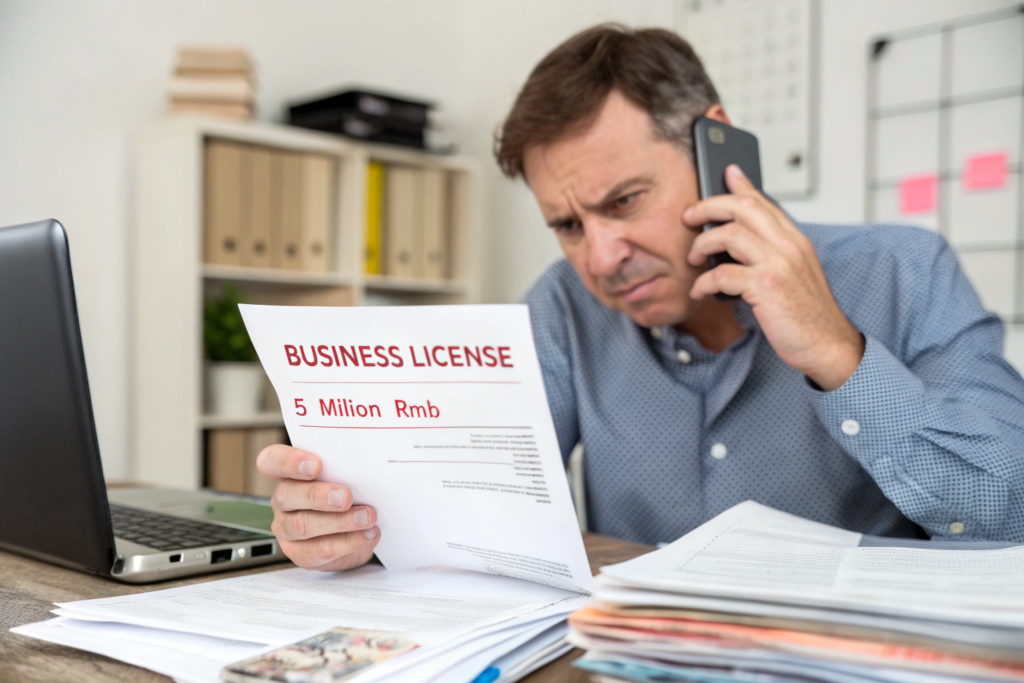
I received a frantic call last year from a startup brand owner in Austin who had paid a 30% deposit for 1,000 floral midi dresses. The factory had sent him a Business License showing a registered capital of 5 million RMB. He assumed this meant they were a major exporter. Three weeks before the ship date, the factory told him there would be a "small delay" because they needed to "borrow an export quota" from another company. He had confused a generic Business License with an actual Import/Export Customs Registration. The Business License, which every legally registered Chinese entity has, simply gives a company the right to exist and operate domestically. It does not, under any circumstances, grant the right to ship goods across a border. This confusion is the most common and costly paperwork error I see from new sourcing professionals.
The core difference is that a Chinese Business License is a domestic operating permit issued by the local Administration for Market Regulation, while an Export License (formally the Customs Registration Certificate) is a federal-level authorization issued by China Customs under the General Administration of Customs, granting the entity the legal right to act as a consignor or consignee in international trade.
Understanding this distinction is your first shield against fraud. A factory might have a beautifully framed Business License in their lobby and a huge registered capital figure on paper. Registered capital in China is a subscribed amount, not a paid-up cash reserve, and can be highly misleading. It tells you nothing about their export capability. I always advise my clients to think of it like a U.S. driver's license versus a passport. A driver's license proves identity but won't get you into another country. A factory's Business License proves it's a real company but won't get your container through customs. Only the Customs Registration Certificate, often accompanied by a unique 10-digit Customs Code, functions as the passport. This code is the critical piece of data. It's the key you'll need to log into the official verification portals yourself, and a legitimate, active exporter like Shanghai Fumao will provide it to you without hesitation, often including a screenshot of our current status on the China Customs portal as part of our standard New Partner Introduction Package.
What Is the Exact Legal Name of the Export License Document?
The terminology in this space is messy, and factories often throw around English translations that confuse rather than clarify. You might hear "export license," "import-export authority," or "foreign trade rights." These are all informal terms for a very specific set of official Chinese documents. The formal, legally binding record is a dual-component proof: The first component is the physical or electronic "Customs Registration Certificate for Foreign Trade Operators". Before 2021, this was a paper certificate. Now, it's often a digital record with a QR code that can be scanned for real-time verification. The second, and more practically important component for your due diligence, is the 10-digit Customs Registration Code. This code, historically known as the "Import-Export Code," is the company's unique digital identifier in the China Customs system. The specific document to ask for is a recent screenshot of their profile page from the "China International Trade Single Window" portal, showing their company name, the 10-digit code, and a green "active" or "registered" status field. If they show you a paper certificate without a verifiable customs code, or if the code is only 9 digits, you are looking at an old, possibly expired document. The code is everything. It’s the fingerprint you will use to trace their actual export history.
Can a Factory Legally Use a Trading Company's Export License?
Technically, yes, this happens constantly, but it comes with a severe commercial risk that most buyers don't fully price in until it's too late. A domestic factory without its own export rights can pay a small fee to an authorized foreign trade agent to handle the customs declaration and shipping logistics. The problem is the Bill of Lading. In this triangular transaction, the exporter of record—the legal shipper whose name appears on the House Bill of Lading and the customs export declaration form—is the trading company, not the factory where your garments were sewn. This creates a dangerous legal separation. You have a purchase contract with Factory A, but your freight is legally shipped by Trading Company B. If a quality dispute arises, your legal claim is against Factory A, but your proof of export and cargo title is tied to Trading Company B. Factory A can, and often does, disclaim responsibility for shipping problems, and Trading Company B has no contractual obligation to you regarding the product's stitching quality or fabric content. Worse, the trading company becomes a choke point. If Factory A has a payment dispute with their agent Trading Company B, your finished goods sitting in a warehouse can be held hostage, and neither party feels fully responsible for your shipment. I've been called in to mediate this exact deadlock. My advice to any serious brand owner is to demand that the manufacturing entity holds its own direct export license. At Shanghai Fumao, our factory name, the name on your purchase contract, and the exporter of record on the customs declaration are one and the same legal person. This direct line eliminates the legal gray zones and gives you complete cargo title transparency from the moment the container seals close.
The Free, Government-Backed Digital Audit for a Chinese Factory
Before you ever ask a factory for a private document, there is a completely free, official government portal where you can do your own silent background check. I consider this the "public record check" phase of due diligence, and it takes less than five minutes. The website is the National Enterprise Credit Information Publicity System. This is a public-facing database managed by the State Administration for Market Regulation, and it's the source of truth for any legally registered Chinese company's basic health. At Shanghai Fumao, I encourage every prospective client to run this check on us before we even negotiate terms, because a transparent relationship starts with open data.
The free, government-backed digital audit for a Chinese factory involves conducting a search on the official National Enterprise Credit Information Publicity System using the factory's exact legal Chinese name or its 18-digit Unified Social Credit Code to instantly verify its registered business scope, operational status, and any administrative penalties or import/export filing records.
This portal is your weapon against ghost factories and paper companies. A factory might have a glossy Alibaba page and a professional LinkedIn presence, but if its Unified Social Credit Code pulls up a "revoked" or "abnormal operation" status on this government site, you should immediately stop all communication. The data points this portal reveals are invaluable. First, the "Business Scope" section will list specific activities. You are looking for explicit wording that includes the manufacture of garments, clothing, or textiles. If the business scope only lists "domestic trade" or "consulting services," you are dealing with a trading company, not a factory, regardless of what they tell you. Second, the "Business Status" field must read "In Business" (存续). Any other status—like "Revoked" or "Cancelled"—means the legal entity is dead. Third, the "Administrative Penalty" section will list any fines from Chinese customs, tax, or labor authorities. A pattern of customs fines for false declarations is an instant dealbreaker. The site is in Chinese, but your browser's translate function works perfectly. Type in the company's exact legal Chinese name, solve a simple captcha, and you have a direct line of sight into their legal soul.
How Do I Use the National Enterprise Credit Information Publicity System?
Navigating a foreign government website can feel intimidating, but the process is logically straightforward. The site exists specifically for this transparency purpose. You don't need a login, and you don't need to pay anyone for a "special report" that just repackages this free data. Here is the step-by-step method I walk my non-Chinese speaking clients through.
First, you must obtain the factory's full, exact legal name in Chinese characters. The English name, like "Shanghai Fumao Garment Co.," is a translation and will not return results. Ask them directly: "Please send me your exact company name in Chinese characters for a standard government database verification." Any hesitation is a red flag. The Chinese name is a string of characters, like 上海某服装有限公司. Second, open the official website of the National Enterprise Credit Information Publicity System. The URL is http://www.gsxt.gov.cn. Third, locate the search bar in the center top of the page. Paste the Chinese company name. Fourth, a captcha will appear. It's a simple slide puzzle or a short sequence of Chinese characters to type. This is the only slightly technical hurdle. If you can't solve the Chinese character captcha, use the Google Lens app on your phone to translate it in real-time. Fifth, after passing the captcha, a single result or a short list will appear. Click the correct company name. You are now looking at their official "Enterprise Credit Information Report." Sixth, and most critically, look for a small tab or link that says "Customs Filing Information" or "Import and Export Filing" on the left navigation bar. If the factory has legal export rights, this section will have a green light and a filed record number. If this section is empty or missing, the company has not filed with customs as an independent exporter. This single missing piece of data, which you obtained for free in a few clicks, can save you from a disastrous triangular trade entrapment.
Why Is the Unified Social Credit Code a Non-Negotiable Piece of Data?
The 18-digit Unified Social Credit Code is the single most important piece of alphanumeric data you can ask for in your first conversation with a factory. Think of it as a social security number for a Chinese company. It uniquely and permanently identifies one, and only one, legal entity. If I give you Shanghai Fumao's code, it will only ever resolve to our company, with our registered address and our legal representative. An English company name can be translated in a dozen different ways, and multiple shell companies can have deceptively similar names. The code cannot be fudged or duplicated.
This code is the master key that unlocks all official government databases. It's printed on the Business License and is far more important than the "registered capital" number that factories love to brag about. Here is why I tell clients to make this data point a mandatory, first-email request:
- Unambiguous Identity: A factory in Shenzhen and a factory in Guangzhou might both call themselves "Global Textile Co." in English. The 18-digit code eliminates the identity confusion instantly.
- Cross-Database Verification: You can use this single code to query not just the business registry but also China Customs, court judgment databases, and even export tax rebate eligibility records through third-party corporate data aggregators.
- Tax Compliance Proof: The code is the company's taxpayer ID. A valid, active code means the company is in good standing with the tax bureau and can issue a legitimate VAT invoice for export tax rebate processing, which is essential for certain DDP trade terms.
- Legal Traceability: If the worst happens and you need to pursue international arbitration, this code is the legal handle your Chinese lawyer needs to file a case against the correct corporate body. Without it, you are legally swinging at ghosts.
Ask for a clear photo of their Business License, not a promotional flyer. The 18-digit code is right there on the top. Write it down. Test it on gsxt.gov.cn. This one-minute check is the most efficient, high-impact piece of due diligence you can do.
Decoding the Anatomy of a Genuine Chinese Export License
A factory that proudly sends you a file named "Export License.pdf" might be sending you a real document, a perfectly photoshopped fake, or most commonly, a real but completely irrelevant certificate. I once had a client from Portland who was sent a beautifully stamped "ISO 9001 Quality Certificate" by a factory when they asked for export proof. The document was real, but it certified a quality management process, not a legal right to ship goods across a border. The factory was hoping the client wouldn't know the difference. You need to know what a genuine export authorization looks like, both in its paper vestige and, more importantly, on a live Chinese government screen. The gold standard is no longer a paper PDF; it's a real-time, verifiable digital record. My clients are most confident when we send them a live screen-share walkthrough of our active status on the China International Trade Single Window portal, not a static picture.
The anatomy of a genuine Chinese export license is defined by a visible 10-digit Customs Registration Code, a matching company name and Unified Social Credit Code, and a verifiable "Active" status displayed on the official China International Trade Single Window portal, a digital credential that completely supersedes old paper certificates.
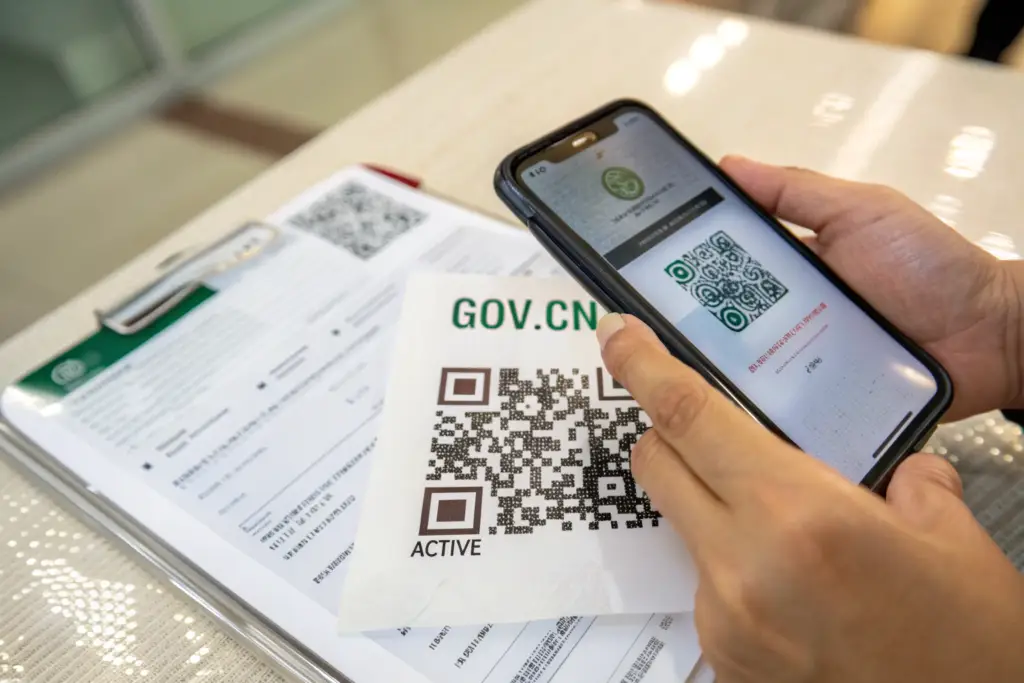
The paper certificate, historically a maroon-colored booklet, is almost obsolete. In 2021, China Customs moved to a paperless "filing receipt" system. So, if a factory shows you a crisp, perfect-condition "original" paper booklet dated 2023 or later, it's a scanned copy of an old, superseded format. This doesn't automatically mean fraud, but it signals that their compliance department isn't current. What matters now is the digital filing receipt, which is a standard A4 PDF generated by the customs system itself. This document will feature a large, scannable QR code in the corner. Scanning this QR code with WeChat or Alipay instantly redirects you to an official customs.gov.cn page showing the company's active status. This is the unspoofable check. Also, scrutinize the "Business Type" or filing type on the document. It should read "Consignor and Consignee of Import and Export Goods" . This is the specific legal category that permits a company to export goods it has manufactured. An agent or logistics company's filing will say "Customs Broker," which does not confer the right to export self-manufactured goods. This distinction is critical and is often deliberately glossed over by middlemen posing as manufacturers.
What Does the 10-Digit Customs Registration Code Really Tell You?
That 10-digit string of numbers is not just a random ID; it's a structured code with embedded logic that you can use to do a preliminary sniff test. The first five digits are a location code that corresponds to the city and district where the company is registered for customs purposes. You can find lookup tables online for "Chinese customs port codes." For example, a code starting with 3122 would historically relate to a specific district in Shanghai. If a factory tells you their workshop is in Hangzhou but their customs code resolves to an inland city in a completely different province, they are likely filing through an agent in a low-cost inland zone, which is fine, or they are using a shell company's code, which is not. This discrepancy is a conversation starter. Ask directly: "Your factory is in X City, but your customs code shows Y. Can you explain the filing structure?"
Furthermore, the code's online status carries a binary meaning. When entered into the "Credibility Query" section of the China Customs online portal, it returns a real-time registration validity status. A green, active status means the company is in good standing and its credit rating with customs is normal. A yellow or "abnormal" status indicates issues like late tax payments or inconsistent cargo declarations. A red status is an export death sentence; the company is blacklisted and cannot clear any goods. This real-time credit rating is China Customs' AEO (Authorized Economic Operator) system in action. A factory with a high-level AEO certification is a low-risk operator in the eyes of customs, meaning your containers are subject to fewer random inspections, which directly translates to faster, more reliable shipping times for your brand. This is a direct commercial benefit of choosing a factory with a healthy, transparent customs profile.
How to Spot a Spliced or Forged Electronic Document?
Document fraud in the sourcing industry is real, but most forgeries are surprisingly unsophisticated and can be spotted with a keen eye for metadata and layout consistency. A fraudster will often take a real license from Company A and use basic image editing software to paste Company B's name and logo over it. The first check is a visual one. Zoom in to 400% on the company name field. Look for a slight blurring, a mismatch in font aliasing (the smoothness of the edge of the letters), or a block of color behind the text that doesn't perfectly match the rest of the document's background. This "digital ghost box" is a tell-tale sign of a clumsy text replacement. The second, more advanced check is to inspect the PDF metadata, which you can do in Adobe Acrobat under "Document Properties." If the file claims to be a scan generated by a scanner today, but the author metadata field shows a completely different company name, you've caught them.
But the most foolproof defense is to reject a static image entirely. The QR code on a legitimate digital filing receipt from 2022 onwards is your silver bullet. Don't just look at it; scan it with a QR reader app on your phone. A genuine QR code will resolve to a secure *.customs.gov.cn URL that dynamically pulls the company's live registration status. A forged document might have a QR code that resolves to a fake lookalike website (watch the URL carefully) or is simply a dead, decorative image that doesn't scan. I tell my clients to be politely paranoid. Tell the factory: "Please hold the physical document up and rotate it slowly in a video call under a light, so I can see the holographic security foil catch the light." Most legitimate certificates, even paperless ones when printed on official security paper, have embedded security features. A fraudster will make excuses. A real partner at Shanghai Fumao will show you the security elements with pride, because our compliance is a competitive advantage, not a secret.
A Direct, Conclusive Verification Protocol for Your Deposit Safety
Verifying a document is just the price of entry. The real test of an export license is the factory's ability to use it under commercial pressure. Before you send a cent of your deposit, you must confirm that the license is not just a piece of paper but is operational and actively clearing containers of your product category. I had a tense situation with a new client a few seasons ago. A factory in another province had passed all the document checks, and the license looked perfect. But one day before the payment deadline, I advised our client to perform one final, live test. They asked the factory for the customs declaration form and Bill of Lading from their last shipment of a similar category—women's woven dresses—to a U.S. client. The factory went silent for 48 hours and then admitted they had never actually shipped garments under their own license. Their license was real but dormant; they'd always piggybacked on a relative's trading company. The deal was saved by that one final, blunt question.
A direct, conclusive verification protocol involves a three-part deposit-safety gate: a live video walkthrough of the customs portal, a request for a redacted historical customs declaration form for a similar product category, and a confirmation of your own shipment's rights through a pre-shipment preview of the Bill of Lading instructions, all completed before funds are transferred.
This final-stage protocol is about closing the gap between a legally valid license and an operationally proven one. A license is a driver's license; the historical customs declaration is a clean driving record. You need both. The factory that can provide a declassified export declaration form (Form 0201, a single-page document with the Chinese customs stamp) for a recent shipment of apparel is demonstrating an unbroken, real-world compliance chain. The document will contain sensitive commercial information like the buyer and the unit price, which they can and should redact with a black marker before showing it to you on a video call. What you are looking for is unredacted: the shipper's name, the customs code, the port of export, and most importantly, the Harmonized System (HS) code for the product. That HS code must match the category of goods you are ordering—for example, HS 6204 for women's woven suits and dresses. A factory that has successfully navigated a real customs clearance for your product category under its own name is a factory that can do it again for you.
Why Should You Demand a Live Video Walkthrough of Their Customs Portal?
A screenshot is a frozen moment in time that can be 12 months old. A PDF is a file that can be perfectly fabricated on a graphic designer's laptop. A live video call where you direct the action is the only way to close the time-based forgery window completely. This is a non-negotiable step in my recommended protocol. The psychology is simple: a scammer can spend days crafting a perfect fake document, but they cannot improvise a fake government portal login in real-time on a screen share.
The protocol is straightforward and puts you in complete control of the verification. You initiate a Zoom or Teams call with screen share enabled. You ask the factory representative to open a fresh, incognito browser window. This prevents any cached pages or pre-saved login states from being used. You then watch them type the official URL for the China International Trade Single Window portal directly into the address bar. You observe them enter their login credentials, which should be a complex, enterprise-level USB Key digital certificate or an authenticated password, not a simple auto-fill. Once logged in, you direct them to navigate to their company profile or enterprise credit section. You ask them to slowly scroll through the page, showing the company name, the 10-digit customs code, and the status indicator in real-time. The key is to ask them to hover the mouse over the status indicator, which often triggers a small pop-up date stamp showing the "Last Updated" record. This date should be today's date or a very recent system refresh. This live, directed tour of a secure government portal, with you calling the shots, is the closest you can get to walking into their office and looking at their wall certificate in person. A compliant factory will be happy to give this tour, and it should take no more than 4 minutes.
Should You Ask for a Historical Customs Declaration Form Before Paying?
Absolutely. This is the proof of life. A license proves the right to export. A historical customs declaration form proves the practical execution of that right. The specific document to request is a "Customs Export Declaration Form" from a shipment within the last 12 months. In Chinese, it's called a 报关单. The factory will be reluctant to share this because it contains confidential pricing and buyer information. That's fine. Tell them you specifically want them to redact, with thick black marker lines, the buyer's name, the unit prices, and the total FOB value. What must remain visible is the Exporter of Record name and address, their 10-digit Customs Code, the Chinese Port of Export, and the 8 or 10-digit HS Code of the exported goods.
The HS Code is your verification target. For a floral dress, the code will fall under Chapter 62 for non-knitted apparel. A code like 6204.42 is for cotton dresses. Seeing this HS code on a past declaration confirms the factory has a documented compliance history with this exact product type's export controls, quota checks, and labeling requirements. This is also the moment to check for consistency between the license and the operational documents. The 10-digit code and company name on the declaration form must be an exact string match for the license you verified. Any difference, even a single digit, indicates a different legal entity or an unauthorized sub-filing. I always offer a redacted declaration form from a previous client's shipment to our new partners at the exact point in the negotiation when trust needs to move from theoretical to transactional. It's the physical evidence that our license isn't just a filing, but a regularly exercised capability.
Conclusion
Verifying a Chinese factory's export license is not a bureaucratic hurdle; it is the single most direct test of a supplier's legal integrity and operational capability. The process we've mapped out moves from a simple, free public database check to a sophisticated, live-screen proof of operational history. We've seen that a Business License is not an Export License, and that a trading company's borrowed code puts your cargo title at legal risk. We've dissected the anatomy of a genuine digital filing, showing you exactly how to use the 18-digit Unified Social Credit Code and the 10-digit Customs Code as your forensic tools. And we've built a direct, pre-deposit protocol that uses a live video call and a redacted historical declaration form to turn a theoretical license into a commercially proven truth.
The real cost of skipping these checks is not just the lost deposit. It's the missed selling season, the empty racks, and the shattered customer trust when your "Made in China" shipment never clears U.S. customs because the exporter was a shell with no rights. This risk is entirely avoidable. The tools—the government portals, the QR codes, the video call protocols—are free and accessible to any brand owner willing to spend 15 minutes protecting a $20,000 investment. A factory that is a genuine, professional manufacturer with its own export rights will pass these checks with ease and speed. At Shanghai Fumao, we view these verification requests not as an insult, but as a sign of a serious, professional buyer who knows how to manage a supply chain. We walk our partners through every step of this protocol proactively, because our transparent compliance is the strongest asset we can offer.
If you are on the verge of committing to a new garment manufacturer and need a partner whose legal export credentials are as solid as their stitching quality, we should talk. Let me walk you through our live customs portal on a video call and share our operational history so you can send your deposit with complete peace of mind. For a direct, transparent, and fully compliant manufacturing partnership, please contact our Business Director, Elaine. She will personally coordinate the technical verification walkthrough with our logistics and compliance team. Reach her at elaine@fumaoclothing.com. Let's build a supply chain that starts on a foundation of verified legal truth.