I walked into a brand partner’s off-site storage unit in Miami three summers ago and felt my heart sink. The air was thick with humidity. The temperature must have been above 35 degrees Celsius. Cartons of beautiful silk dresses, worth $40,000 wholesale, were stacked directly on a concrete floor. The bottom cartons had wicked moisture from the concrete. The fabric inside was stained with mildew. The entire bottom layer of inventory was destroyed. The brand owner had stored her inventory exactly as she had stored her old college textbooks. She had not realized that textiles are organic materials that rot, fade, and degrade when stored incorrectly. The $800 she saved on a climate-controlled facility cost her $12,000 in destroyed inventory.
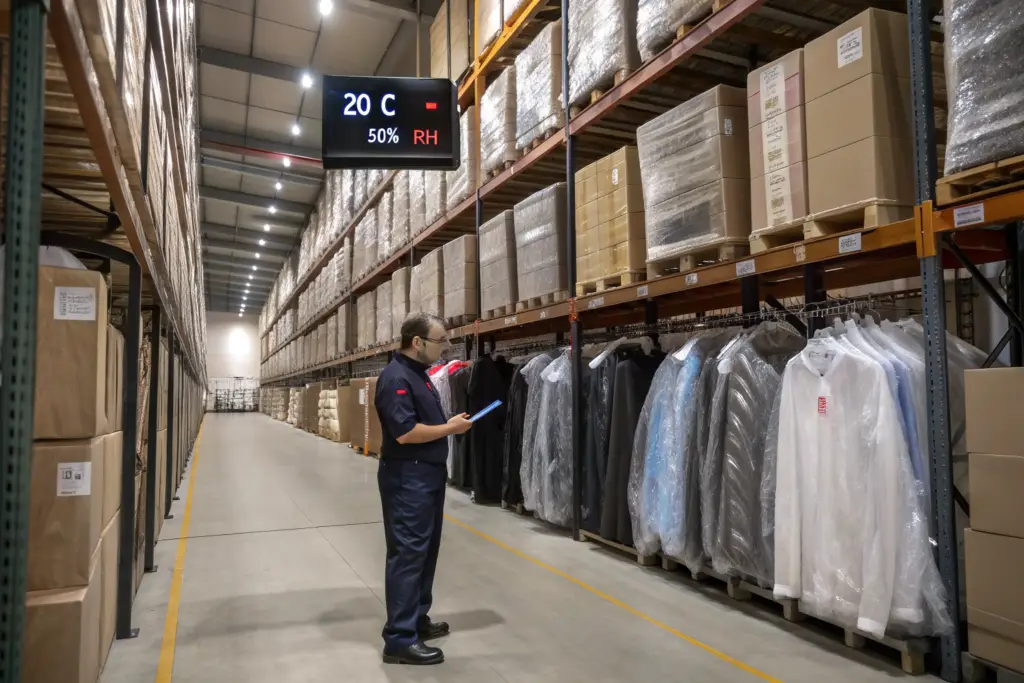
You safely and securely store massive bulk apparel inventory by controlling five environmental enemies: humidity, temperature, light, pests, and pressure. The storage environment must maintain a stable relative humidity between 45% and 55% and a temperature between 18°C and 22°C. Fabric is hygroscopic. It absorbs moisture from the air. High humidity causes mold, mildew, and fiber weakening. Low humidity causes brittleness and static buildup. All garments must be stored in breathable, opaque covers to block UV light, which fades dyes and degrades fibers. Cartons must be elevated on pallets, never placed directly on concrete, and stacked with weight distribution in mind to prevent permanent creasing. A systematic First-In-First-Out rotation and a quarterly "fabric health audit" must be enforced. Storing inventory is not warehousing. It is preservation.
Most brand owners treat inventory storage as a logistics afterthought. They find the cheapest available square footage, stack the cartons, and forget about them until it is time to ship. That approach works for canned goods. It destroys apparel. The investment you made in design, fabric sourcing, and manufacturing can be wiped out in six months by a humid summer and a concrete floor. I want to share exactly how we store finished goods at Shanghai Fumao, and how you can demand and implement the same standards in your own warehouse or with your third-party logistics partner.
What Are the Exact Environmental Thresholds That Prevent Mold, Mildew, and Fiber Degradation?
A brand owner I work with once asked me why her cotton t-shirts felt "crispy" and had developed a yellow tinge after six months in storage. She had stored them in a standard, non-climate-controlled warehouse in Georgia. The summer humidity had regularly exceeded 75%. The cotton fibers, being hygroscopic, had absorbed moisture from the air. That moisture provided a breeding ground for micro-organisms. The "crispy" feel was fiber degradation. The yellow tinge was the beginning of mildew staining. The t-shirts were unsellable. The problem was invisible until the cartons were opened. By then, $7,000 worth of inventory was scrap.
The exact environmental thresholds for safe apparel storage are a stable temperature between 18°C and 22°C and a relative humidity between 45% and 55%. These thresholds are not arbitrary. They are based on the physical properties of textile fibers. Below 45% RH, natural fibers like cotton and linen become brittle. They lose moisture to the air, and the fibers contract and weaken. Above 55% RH, mold spores, which are always present in the air, begin to germinate. They feed on the organic material of the fiber and any residual sizing or starch from the manufacturing process. Temperatures above 25°C accelerate chemical reactions, including dye fading and fiber oxidation. Temperature fluctuations are particularly dangerous because they cause condensation. A carton that cools down overnight releases moisture that condenses on the fabric surface. The solution is a climate-controlled environment with continuous monitoring and automated alerts. A warehouse without humidity and temperature control is a ticking clock on your inventory’s lifespan.
The investment in climate control is not an overhead cost. It is an insurance policy against inventory loss. The cost of a climate-controlled storage unit is typically 20% to 30% higher than a standard unit. The cost of losing a container of inventory to mildew is 100% of the inventory value. The math is straightforward.
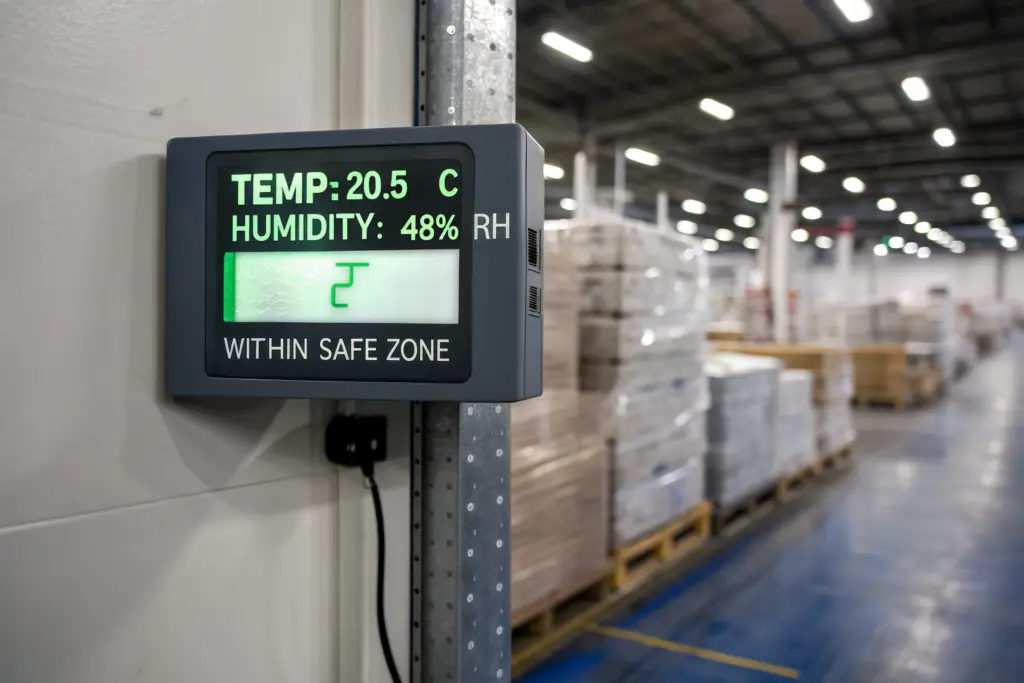
How Does Fluctuating Humidity Above 60% RH Activate Mold Spores Embedded in Cotton Fibers?
Cotton is a cellulose fiber. Mold and mildew are fungi that digest cellulose. Mold spores are always present in the environment, including on the surface of cotton garments. These spores remain dormant as long as the moisture level is low. When the relative humidity rises above 60%, the cotton fibers absorb enough moisture to raise their internal moisture content above the threshold where mold spores activate. The spores germinate, send out hyphae that penetrate the fiber, and begin digesting the cellulose. The visible result is black, green, or yellow staining. The structural result is weakened, brittle fibers that tear easily. The damage is irreversible. The textile conservation environmental standards define 55% RH as the absolute maximum safe threshold.
Why Must Garments Be Stored in Complete Darkness to Prevent Photochemical Degradation of Dyes?
Light, particularly ultraviolet light, is a catalyst for photochemical reactions that break down dye molecules. This is why a garment displayed in a sunny store window fades within weeks. Even indirect, ambient light causes cumulative fading over months. A garment stored in a clear poly bag on an open shelf is slowly fading every day. The solution is complete darkness or opaque covers. Cartons must be sealed. Garment bags must be opaque. Storage areas must have no direct sunlight and minimal ambient light when not accessed. The effect of light exposure on textile dye fading is well documented. The blue wool scale is the standard measure.
What Physical Storage Techniques Prevent Permanent Creasing and Distortion in Bulk Garments?
A brand owner opened a carton of wool coats that had been stored for the summer season. The coats had been folded tightly and stacked ten cartons high. The pressure had created permanent creases along the fold lines. The wool fibers had been compressed so long that they had "set" in the folded position. The coats required professional steaming and pressing to recover, costing $4.50 per unit. The $900 in reconditioning costs could have been prevented by simply hanging the coats on proper hangers.
The physical storage technique must match the fabric weight, structure, and fiber memory. Heavy woven garments like denim, wool coats, and structured jackets must be stored flat or hung on wide, padded hangers to preserve their shape. Folding them creates creases that set permanently under pressure. Lightweight knits like t-shirts and jerseys can be folded, but they must be stacked with a maximum of three to four cartons high to prevent bottom-layer compression. Folded garments should have acid-free tissue paper inserted at the fold points to prevent hard creases. All garments should be stored away from direct contact with metal shelving, which can cause rust stains or snagging. Cartons must be of uniform size and stacked on pallets to distribute weight evenly. The physical storage plan is a function of the garment type, the storage duration, and the available space.
Gravity and pressure are constantly working on your inventory. A folded wool coat left under 50 kilograms of pressure for six months will develop a crease that no amount of steaming can fully remove. The storage method must respect the physical properties of the fiber.
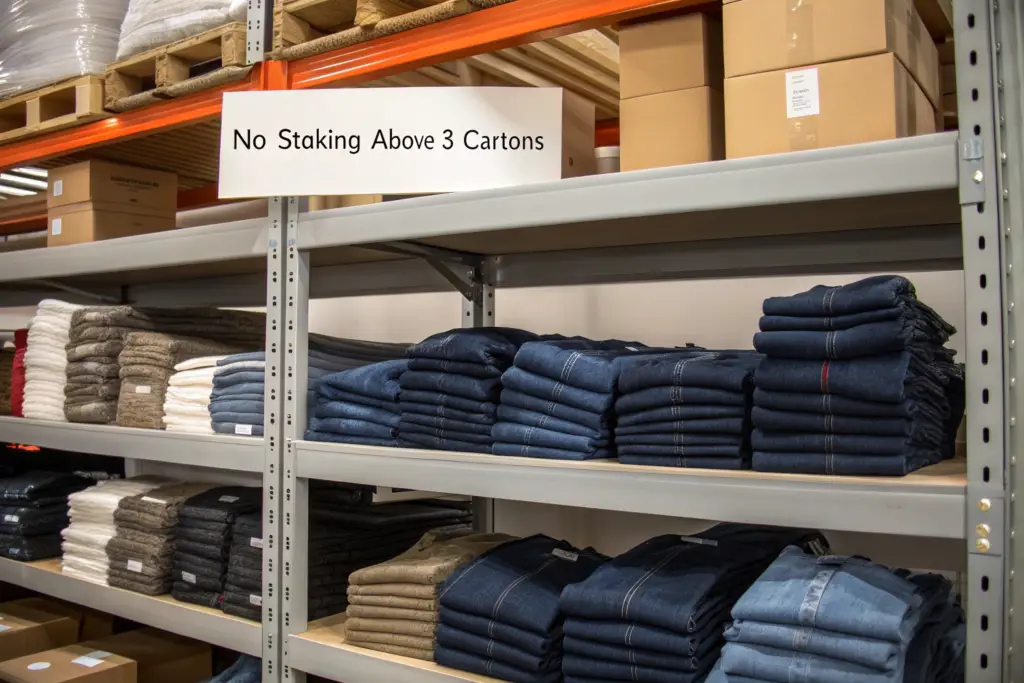
Why Must Heavy Woven Tailoring Be Stored Flat or Hung Rather Than Folded?
Woven wool, linen, and structured cotton garments have fiber memory. When folded, the fibers along the crease line are stretched on the outside of the fold and compressed on the inside. Under pressure and over time, the fibers lose their elasticity and permanently set in the folded position. This is called "crease memory." A hung garment distributes weight along the shoulder seam and the grain line, the natural load-bearing structure of the garment. A wide, padded hanger supports the shoulder without creating a point load that would stretch the fabric. Heavy tailored jackets must be hung in breathable garment bags. Folding is a last resort for very short-term storage. The garment storage methods by fabric type are standard practice in museum textile conservation.
How Does Acid-Free Tissue Paper Prevent the “Crispy Fold” Effect on Delicate Natural Fibers?
Acid-free tissue paper acts as a buffer between layers of fabric. It absorbs the micro-abrasion that occurs when fabric layers rub against each other during handling and movement. It also diffuses the pressure at the fold point, preventing the sharp, permanent crease that forms when fabric is folded hard against itself. Standard tissue paper contains lignin and acids that yellow over time and transfer to the fabric. Acid-free, archival-quality tissue is chemically inert and will not stain or degrade the fabric even during years of storage.
What Warehouse Management Protocols Guarantee First-In-First-Out Rotation and Zero Forgotten Inventory?
A brand owner called me in a panic. She had discovered 200 units of a discontinued jacket style sitting in the back corner of her warehouse. They had been there for 18 months. They were covered in dust, the colors had faded on the exposed shoulders, and the style was now two seasons out of date. They were worthless. She had paid $4,800 to manufacture inventory that she forgot she owned. The jackets had not been entered into her inventory management system. They were placed in the corner during a busy season and never touched again.
You prevent forgotten inventory and fabric aging by enforcing a digital Warehouse Management System with FIFO logic and physical bay labeling. Every carton that enters the warehouse receives a unique barcode containing the SKU, the production date, and the storage location. The WMS enforces a First-In-First-Out picking logic: the oldest inventory is picked first. This prevents new inventory from being shipped while old inventory ages in the back. The WMS also generates a "Days in Storage" report that flags any item that has not moved in 90 days. This forces a quarterly review of slow-moving stock. The brand owner must decide: liquidate, donate, or promote. The decision is forced by the system, not forgotten. Physical labels on every bay must be large, clear, and updated weekly. A warehouse without a WMS and FIFO discipline is a museum of lost inventory.
Inventory that sits is inventory that dies. Fabric ages, styles change, and the value of a stored garment declines with every passing week. The WMS is the immune system that prevents the slow accumulation of dead stock.

How Does a Barcode-Based “In-Date” System Prevent a 2-Year-Old Batch from Accidentally Shipping to a Key Retailer?
When a carton is produced, it receives a barcode label. The barcode is scanned into the WMS and linked to the production date. When a picker receives an order, the WMS directs them to the oldest barcode of that SKU. The picker scans the barcode to confirm the pick. If the picker accidentally scans a newer carton, the system rejects the scan and redirects them to the correct, older carton. This barcode-based FIFO enforcement is automated. It cannot be overridden by a rushed picker. The warehouse barcode and FIFO management systems eliminate the human error that causes old inventory to ship while new inventory sits.
What Is a “Quarterly Fabric Health Audit” and How Does It Catch Slow-Blooming Disasters Like Carpet Beetles?
A quarterly fabric health audit is a physical inspection of a random sample of stored cartons. The inspector opens the carton, removes a garment, and examines it under bright light for signs of mold, insect damage, fading, or creasing. They check the seals on the garment bags. They check the humidity indicator cards inside the cartons. They document the findings with photographs and notes. The audit catches slow-blooming problems that an electronic sensor cannot detect: carpet beetle larvae feeding on a wool coat, silverfish nesting in a carton seam, a slow leak in the roof dripping onto a pallet. The textile pest management and storage auditing is practiced by museums. It should be practiced by any brand storing inventory worth more than $10,000.
What Pest and Contamination Control Measures Are Non-Negotiable for Long-Term Apparel Storage?
A brand owner opened a carton of cashmere sweaters in October to fulfill a large wholesale order. The sweaters were riddled with small holes. Clothes moth larvae had infested the carton. The moths had entered through a tiny gap where the carton tape had dried out and peeled back. They had been feeding on the cashmere for months. The entire carton, 50 sweaters at $45 wholesale each, was a total loss. The $2,250 loss was caused by a $0.02 piece of tape.
Non-negotiable pest control for long-term apparel storage includes three physical barriers and one monitoring system. First, every carton must be sealed with high-quality, wide packing tape that will not dry out and peel back over time. No gaps, no loose flaps. Second, the warehouse perimeter must be sealed against rodents and insects, with door sweeps, sealed window frames, and no standing water. Third, natural fiber garments, especially wool, cashmere, and silk, should be stored with natural pest deterrents like cedar blocks or lavender sachets, or in sealed garment bags. The monitoring system consists of strategically placed pheromone traps for clothes moths and carpet beetles. These traps are checked monthly. If a trap captures insects, the source is immediately investigated. A single moth found in a trap is an early warning. A carton full of larvae is a disaster. The early warning system catches the problem before it spreads.
Pests are the silent destroyers of stored apparel. They work in the dark, inside cartons, for months. By the time you see the damage, the inventory is destroyed. The defense is physical exclusion and early detection.
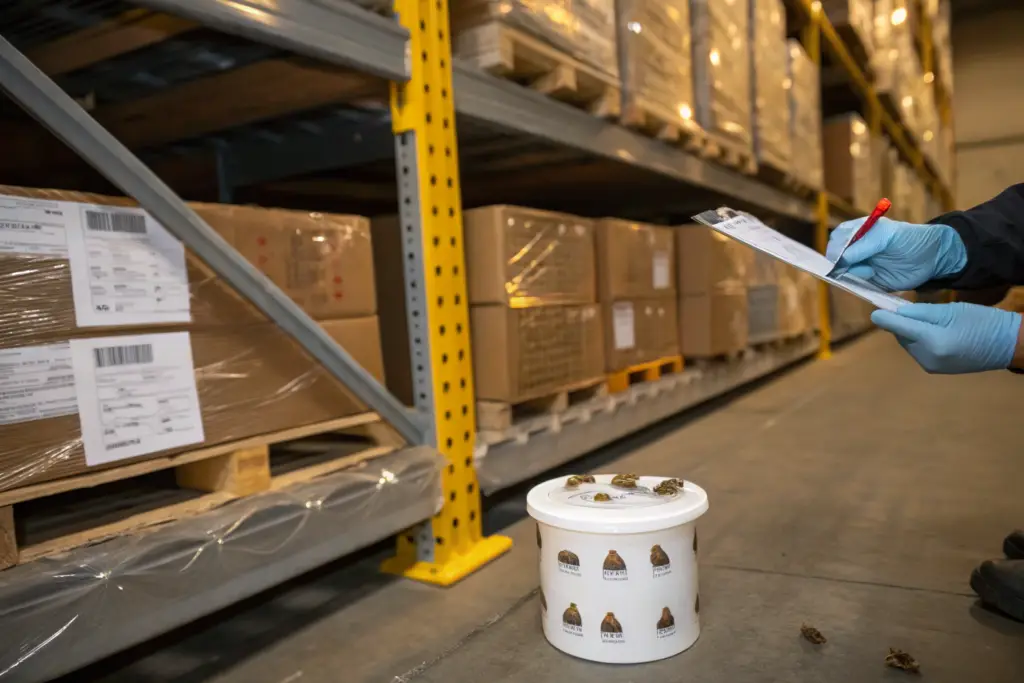
Why Are Clothes Moth and Carpet Beetle Larvae Specifically Attracted to Unwashed, Stored Wool and Silk?
Clothes moth and carpet beetle larvae are keratin feeders. They digest the protein keratin found in animal fibers: wool, cashmere, silk, alpaca, and fur. Unwashed garments are particularly attractive because they contain residual human sweat, skin cells, and food particles that provide additional nutrients for the larvae. A wool coat that was tried on once and then stored without dry cleaning is a feast for moth larvae. The solution is to ensure all garments are clean before long-term storage. Even "clean" new garments may contain sizing or starch that attracts pests. The keratin-feeding pest biology explains why these insects target specific fibers.
How Do Pheromone Traps and Routine Seam Inspections Act as an Early Warning System?
Pheromone traps attract male moths using a synthetic version of the female moth’s mating pheromone. The male moths enter the trap and are caught. A trap that captures moths signals the presence of a breeding population. The warehouse manager immediately inspects nearby cartons, focusing on seams and folds where larvae hide. A seam inspection involves carefully opening the folded edge of a garment and looking for tiny, rice-like larvae or silken webbing. If larvae are found, the affected carton is isolated, and the garments are either frozen at -20°C for 72 hours or heat-treated to kill the larvae and eggs. The pheromone trap monitoring for textile pests is an established museum conservation technique.
Conclusion
Safely storing massive bulk apparel inventory is a practice of environmental control, physical protection, systematic rotation, and pest defense. The five enemies of stored fabric are humidity, temperature, light, pressure, and pests. Each enemy is manageable with the right infrastructure and discipline. Climate control maintains the stable, cool, dry environment that prevents mold and fiber degradation. Proper hanging, folding, and stacking prevent permanent creasing and distortion. A digital WMS with FIFO logic prevents forgotten inventory from aging into worthlessness. Sealed cartons, pheromone traps, and quarterly audits prevent pest infestations from destroying valuable natural fiber garments.
The $12,000 Miami storage disaster was preventable. The $4,800 in forgotten jackets was preventable. The $2,250 in moth-eaten cashmere was preventable. Every inventory storage disaster I have seen in 15 years of manufacturing was the result of treating storage as a passive activity rather than an active preservation process.
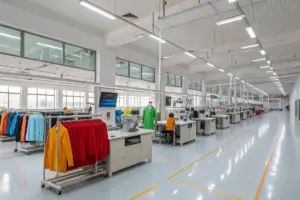
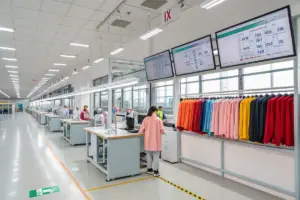
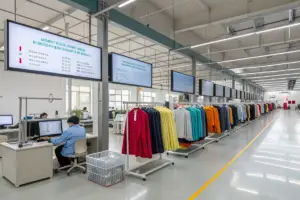
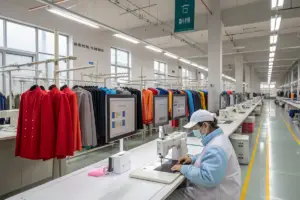
At Shanghai Fumao, we apply these preservation standards to the finished goods we store for our brand partners. Our warehouse is climate-controlled. Our garments are stored in breathable, opaque covers. Our inventory is managed by a barcode WMS with FIFO enforcement. We conduct quarterly fabric health audits. We maintain a pest-free environment with routine monitoring. We do this because we know that the garment’s journey does not end when it leaves the sewing line. It ends when the customer takes it home. Every day in between, the garment must be protected.
If you are storing inventory in your own warehouse or with a third-party logistics provider, or if you want to store finished goods with us, we can help you evaluate your storage practices. At Shanghai Fumao, we will share our storage standards checklist, our environmental monitoring log template, and our pest prevention protocol. Contact our Business Director, Elaine, at elaine@fumaoclothing.com. She can provide a sample inventory health audit report and discuss our finished goods storage program. Your inventory is the physical embodiment of your brand’s capital. Store it with the care it deserves.