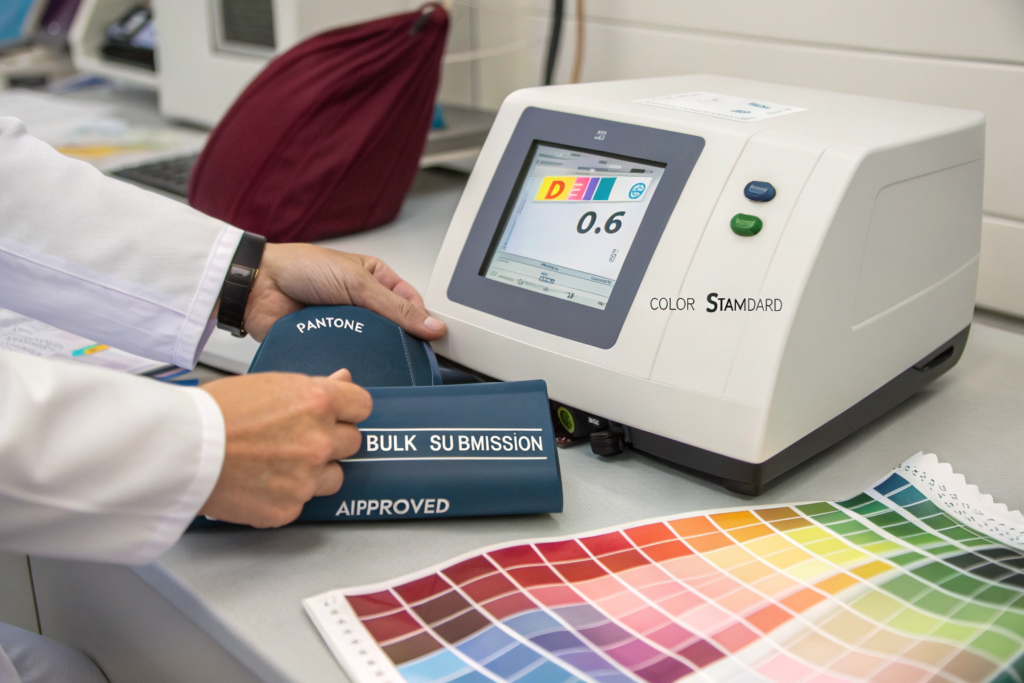
You have chosen the perfect Pantone color for your new collection. You can already picture the rich, vibrant garments in your marketing campaign. You send the Pantone code to the factory and wait. The sample arrives. Your heart sinks. The color is… off. It is a shade too yellow, a bit too dull, or just not quite right. A frustrated designer once told me, "I used to think giving a Pantone code was the end of the color conversation. Now I know it's just the beginning. Color is a science, and you have to manage it like one, or your beautiful palette will be a muddy mess."
Ensuring your apparel colors match the required Pantone codes exactly requires a rigorous, three-stage scientific and visual process. It cannot be left to chance. The essential steps are: 1) The Digital Standard (using a spectrophotometer to create an objective, measurable target and setting a clear Delta E (ΔE) tolerance of less than 1.0), 2) The Physical & Visual Standard (meticulously approving the "Lab Dip" under a standardized D65 lightbox, as this becomes the binding physical reference), and 3) The Bulk Continuity Check (verifying the final production fabric against the approved Lab Dip, not just the original Pantone chip, to account for the textile's unique surface and texture).
At Shanghai Fumao, we treat color as a critical, non-negotiable science. Our in-house color lab is equipped to manage this process with precision, ensuring the color you design is the color your customer receives. Let me explain the exact protocol we use to achieve a flawless, repeatable color match for our B2B partners.
Why Is a Spectrophotometer the First Line of Defense, Not the Pantone Book?
The Pantone book is a beloved and essential starting point, but it is a flawed physical object. The chips fade over time, they get dirty, and the way they look depends entirely on the light source under which they are viewed. Two people looking at the same chip in different rooms can see two different colors. The first step to a perfect match is to move from a subjective visual reference to an objective, digital standard. This is the role of the spectrophotometer.
The spectrophotometer is the essential first line of defense because it translates a subjective color into an objective, digital fingerprint. It measures the exact light reflected by your Pantone chip and generates precise color coordinates (CIE Lab* values). This digital standard is then used to communicate an unambiguous target to the dye house. It also allows you to set a clear, measurable tolerance for the match using a Delta E (ΔE) value. A ΔE of less than 1.0 is an imperceptible difference to the human eye and should be your gold standard for a perfect match.
A brand we work with was having a recurring, frustrating problem where their "Navy" looked slightly purple against their specific wool coating. We helped them solve it by first digitizing their Pantone standard. We measured the chip with our spectrophotometer and then measured the failing fabric. The data showed the fabric had a spectral spike in the red part of the spectrum, causing the purple cast. We sent the mill the exact Lab* coordinates of the target, not just the Pantone code, and demanded a ΔE < 1.0. The next submission was a flawless match. The problem was solved with physics, not opinions. This is the power of objective color measurement .
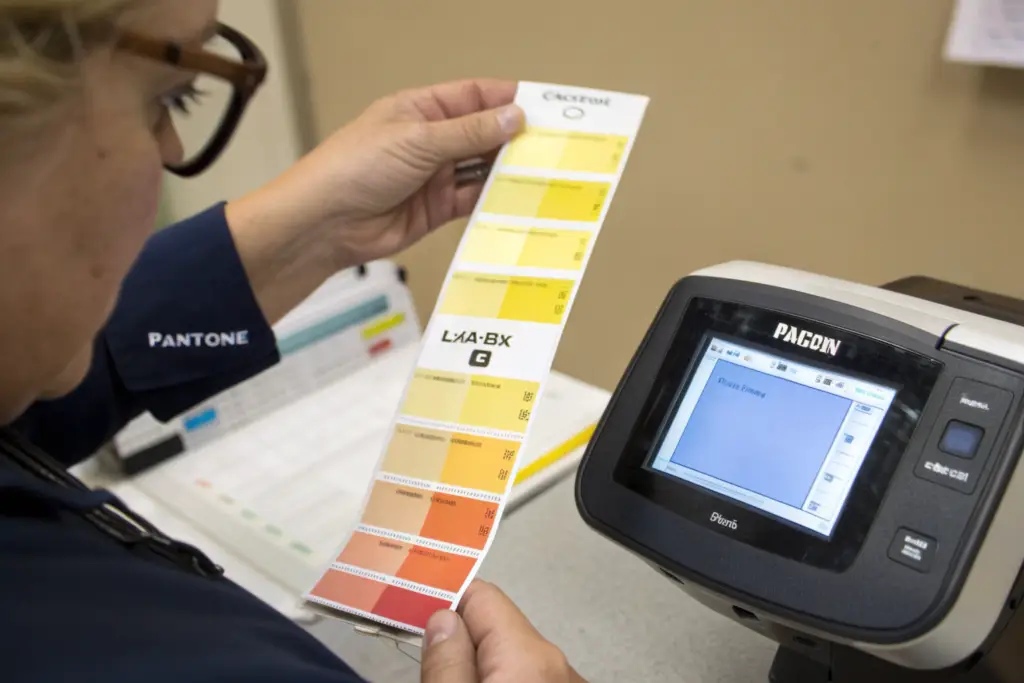
What Is Delta E (ΔE) and Why Is a Value Under 1.0 the Gold Standard?
Delta E (ΔE) is a single number that represents the mathematical distance between two colors. A ΔE of 1.0 is a just-noticeable difference to a trained eye under perfect lighting. For a perfect, commercially acceptable match, you should demand a ΔE of less than 1.0 from your dye house. This is the objective, non-negotiable standard we use in our color quality control .
How Do You Communicate a Spectrophotometer Reading to a Dye House?
You provide them with the digital color "fingerprint." A professional report will include the *CIE Lab values and the spectral reflectance curve. This data tells the lab exactly where your color sits in a standardized 3D color space. You combine this digital data with a physical swatch of your target for a complete, unambiguous instruction. This is the standard of our color communication protocol** .
How to Approve a Lab Dip with Scientific Rigor, Not Hope?
The lab dip—a small swatch of your specific fabric dyed to your target color—is the most critical approval you will make in the production process. This single, physical swatch becomes the binding master standard for the entire bulk dye lot. A rushed or casual approval is a direct path to a catastrophic color mismatch. This step must be performed with ritualistic precision.
Approving a lab dip requires a controlled, two-step evaluation under a standardized D65 lightbox. First, you must visually assess the match under calibrated artificial daylight, looking for any difference in hue, saturation, or lightness. A D65 light source is non-negotiable, as it eliminates the variability of ambient light and provides a universal, objective reference. Second, you must document the approval. Your signed approval form, with the approved lab dip swatch attached, becomes the legally binding "Color Standard" that governs the entire bulk production.
A brand owner I mentor once approved a lab dip for a "Dusty Rose" linen dress by glancing at it under her warm office desk lamp. It looked beautiful. The bulk production arrived, and under the cool daylight of the retail floor, the dresses looked like a murky beige. The warm light had masked the blue undertone. She learned a $15,000 lesson. She now uses a D65 lightbox we recommended for all color approvals. This is the discipline of professional color management .
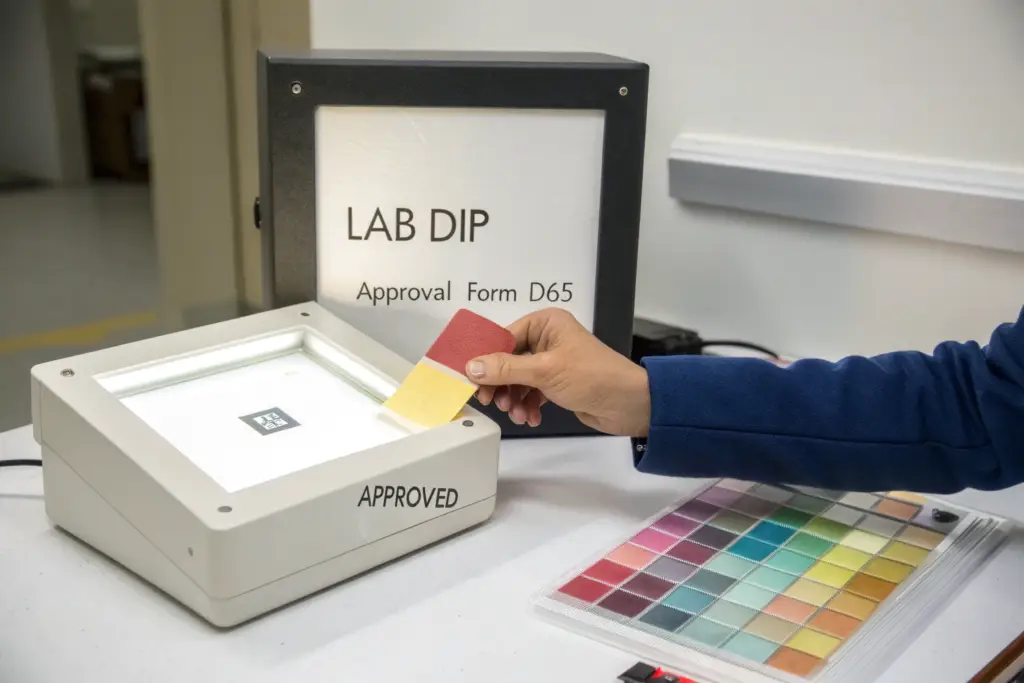
Why Is a D65 Lightbox the Only Acceptable Light Source for Color Approval?
Different light sources have different spectral power distributions. A color that matches perfectly under the yellow glow of an incandescent bulb can look completely different under the blue-white of a store's fluorescent light. The D65 lightbox provides a calibrated simulation of noon daylight, the international standard for color evaluation in the textile industry. It is the only light source that provides a universal, objective reference. This is a non-negotiable tool for any serious brand.
What Happens to the Approved Lab Dip? It Becomes the "Master Standard."
This small piece of fabric is now the most important color reference for your entire production run. It supersedes the original Pantone chip, because it demonstrates how the target color is achieved on your specific textile. The mill will use this master standard to formulate the bulk dye. Our incoming QC team will check the bulk fabric against this approved lab dip, not the Pantone book. This is the critical link in the chain.
How to Verify Bulk Fabric Against the Standard, Not Just the Pantone Chip?
The final, and perhaps most common, point of failure is the handoff from the lab to the bulk dye house. The lab dip was perfect, but the bulk fabric that arrives from a massive industrial dye machine looks slightly different. This is why the final verification must be a direct comparison between the approved lab dip standard and a swatch cut from the actual bulk roll, under a controlled D65 light source. This is the moment of truth.
The final verification is a direct, physical comparison between the approved Lab Dip "Master Standard" and a swatch from the bulk fabric roll, conducted by our QC team under a D65 lightbox. This process accounts for the subtle shifts in color that can occur when scaling up from a small dye beaker to a massive bulk dye machine. We perform this check on every single roll, using a technique called "shade banding" to group rolls with micro-variations, ensuring perfect color continuity within each garment and across the entire production run.
At Fumao, this is a non-negotiable part of our Incoming Inspection process. When the bulk fabric arrives from the mill, we do not assume it matches the standard. Our QC team unrolls a section from each roll and physically compares it against the approved lab dip in a D65 lightbox. If a roll is off-shade, it is immediately quarantined and reported to the client. This rigorous check is the final safety net that catches a potential color disaster. This is the standard of our bulk fabric quality control .
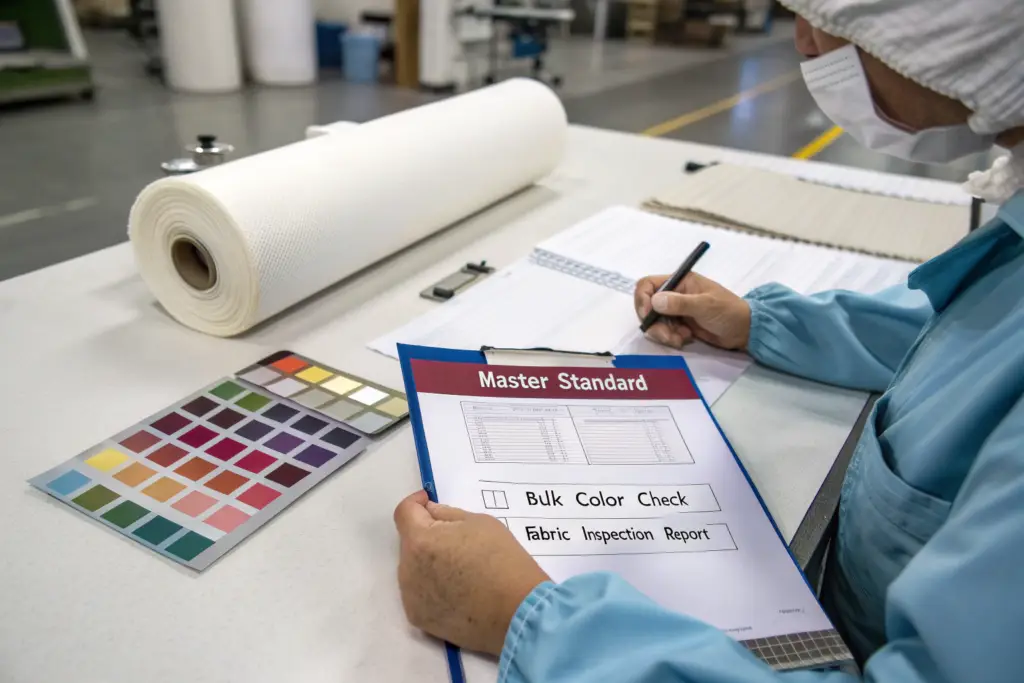
What Is "Shade Banding" and How Does It Ensure Perfect Color Continuity?
Even within a single, "passed" dye lot, there can be micro-variations in shade from one roll to the next. Our QC team groups the rolls into "light," "medium," and "dark" bands. The cutting plan then ensures that all panels for a single garment are cut from rolls within the same band. This prevents the disaster of a jacket with a slightly lighter sleeve than the body. This is the meticulous detail of premium manufacturing .
How Do We Handle a Roll That Fails the Bulk Color Check?
We immediately quarantine the roll and provide you with a detailed report, including spectrophotometer data and photos showing the deviation against the standard. You can then use this documentation to file a claim with the fabric supplier. We never cut into off-color fabric, protecting your production's integrity. This is our commitment to brand protection .
How Does Fumao's In-House Color Lab Make Perfect Matching a Seamless Process?
We do not see color management as a one-time task; it is an integrated, systematic discipline that runs through our entire pre-production and production process. Our in-house capabilities and rigorous protocols are designed to provide our B2B partners with complete confidence that the color they specify is the color they will receive, consistently, order after order.
Fumao's in-house color lab and rigorous protocols make perfect color matching a seamless part of our partnership. We manage the process from start to finish: digitizing your color standard, managing the lab dip process with our dye houses, performing a rigorous incoming color audit on all bulk fabric, and providing transparent data and reporting at every stage. We ensure your color story is told with scientific precision.
A new brand partner, who had been burned by poor color management in the past, was amazed by our process. "You didn't just ask for a Pantone code and hope for the best," she said. "You gave me data, you showed me the lab dip under your D65 lightbox on a video call, and you sent me the spectrophotometer report from the bulk fabric. I've never felt so confident in a color match." That is our goal. To provide a scientific, transparent, and stress-free color experience. This is the value of a detail-obsessed manufacturing partner .
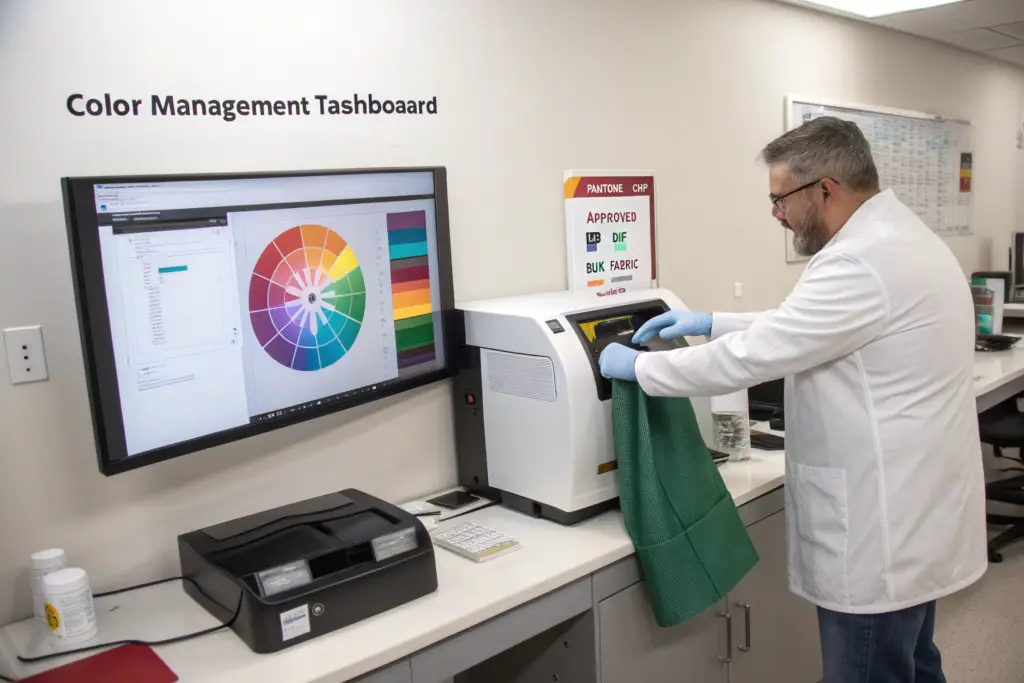
What Happens During a Collaborative Color Review on a Video Call?
If you have a concern about a lab dip, you do not need to travel. We can schedule a live video call from our color lab. You watch as our QC technician places the lab dip and the target standard into our D65 lightbox, and we discuss the match in real-time. This collaborative, transparent process ensures we are both looking at the exact same thing under the correct light.
How Can We Help You Digitize Your Entire Color Palette?
For established brands, we can take your entire physical color library and create a digital database of spectrophotometer readings. This creates a permanent, un-degradable record of your signature colors, ensuring perfect consistency for reorders years into the future. This is the ultimate level of strategic color management .
Conclusion
Ensuring your apparel colors match the required Pantone codes exactly is a journey from a subjective, analog reference to an objective, digital, and rigorously verified process. It requires a scientific approach, using spectrophotometers and D65 lightboxes to eliminate guesswork, and a disciplined series of approvals, from the lab dip to the final bulk fabric.
At Shanghai Fumao, our in-house color laboratory and our systematic protocols provide this scientific precision as a core part of our B2B service. We transform color from a source of anxiety into a predictable, managed, and beautifully executed reality. We protect the integrity of your design, right down to the wavelength of light.
If you are ready to partner with a manufacturer who treats color matching as a science, let's talk. Our Business Director, Elaine, can walk you through our color management process. Please email Elaine at: elaine@fumaoclothing.com.