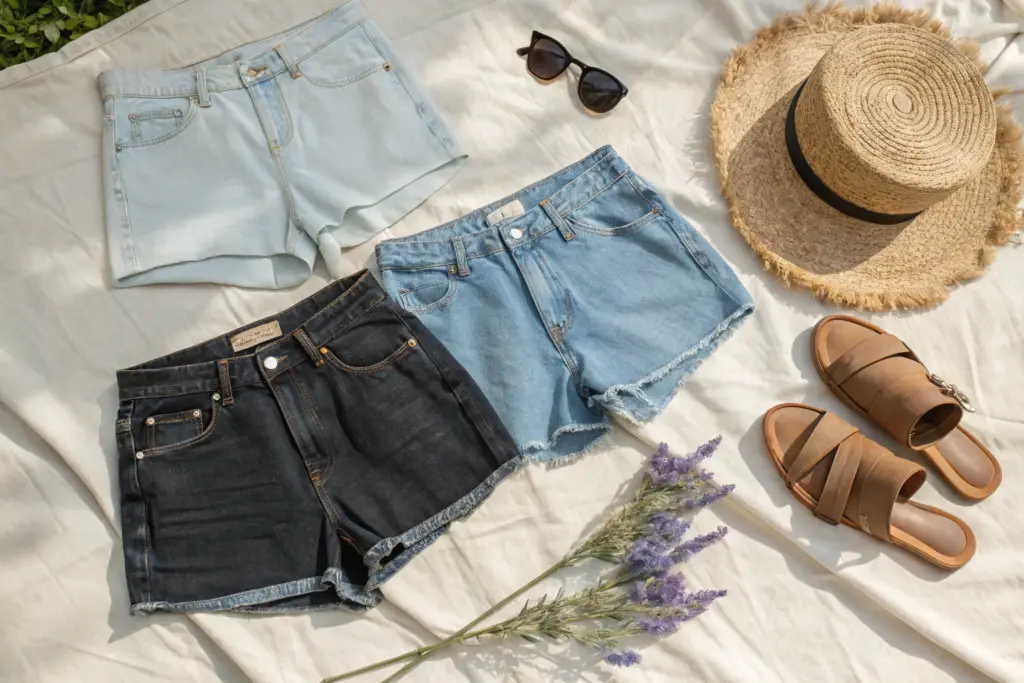
I want you to imagine something. It's a sweltering Saturday in July, and a customer walks into your retail partner's store—or lands on your website. They're looking for a pair of denim shorts that doesn't feel like a compromise. Not the fast-fashion pair that will sag at the knees by August. Not the overpriced designer pair that costs more than their monthly grocery bill. Something in the middle. Something with texture, with a wash that looks like it has a story, with a fit that makes them feel like the garment was designed specifically for them. That customer is holding your brand in their hands, and the decision they make in the next sixty seconds determines whether you earn a loyal repeat buyer or a one-time transaction. Building a summer denim shorts collection that wins that sixty-second decision is what I want to help you do. I'm Richard, and I run Shanghai Fumao. I've spent years helping North American brands construct warm-weather lines that sell through, not just sell in.
A summer collection is not a random assortment of blue shorts. It's a curated story told through fabric weights, wash tones, and silhouette choices that respond to how people actually live during the hottest months of the year. The guy wearing shorts to a backyard barbecue wants something different from the guy wearing them to a beachside bar, and both want something different from the guy wearing them to a casual Friday office. If your collection doesn't address these distinct use cases, you're leaving revenue on the table. The brands that win summer are the ones that build intentional range plans, not just product lists. At Shanghai Fumao, we approach collection building as a collaborative design process, and in this article I'm going to walk you through exactly how we do it.
What Styles of Denim Shorts Should Anchor a Summer Line?
Every collection needs anchors. These are the styles that do the heavy lifting—the volume drivers that your retail buyers order deep and your customers buy on repeat. In a summer denim shorts collection, I recommend three anchors: a clean, mid-length classic; a fashion-forward baggy or oversized fit; and a premium rigid or raw-hem option that speaks to the quality-obsessed customer. If you cover these three bases, you've addressed roughly 80% of the summer denim shorts market.
The classic anchor is your volume play. Think a 9-inch inseam, mid-rise, straight or slightly tapered leg, in a medium stone wash that goes with everything. This is the short that the 35-year-old guy buys two pairs of because he knows they fit and he doesn't want to think about it. The fit must be forgiving without being sloppy. The wash must be consistent batch to batch because this customer reorders the same style every year and will notice if the shade shifts. The margin on this piece will be thinner because it competes directly with mass-market options, so you need to make it up on volume and operational efficiency.
The fashion anchor is your trend play. In 2026, this is the baggy, wide-leg silhouette I discussed at length in a previous article. The inseam ranges from 7 to 11 inches depending on the sub-trend, and the fit is intentionally oversized. This short attracts the younger, fashion-conscious customer who wants to look like they stepped off a streetwear blog. The wash should be distinctive—a vintage tint, a micro-acid haze, something that signals "I know what's cool" without screaming. This style commands a higher retail price because the customer perceives it as a design piece, not a basic. The margin is healthier.
The premium anchor is your brand statement. This is the rigid, unwashed or lightly rinsed short, often with a raw, frayed hem. The fabric weight is heavier—13 to 15 ounces—and the construction details are prominent: a selvedge edge peeking out from the outseam when you cuff the leg, hidden rivets on the back pockets, a leather brand patch that ages with the garment. This short sells at the highest price point in your collection, usually above $80 retail. The customer who buys it is buying into a philosophy of quality and longevity. They will become your most vocal brand advocates.
These three anchors don't exist in isolation. They should share a common design DNA—a consistent approach to pocket shape, hardware finish, and brand labeling—so that the collection feels coherent even as the silhouettes vary widely. A customer who discovers your brand through the fashion baggy fit should recognize your hand when they see the classic fit on a friend.
Beyond the three anchors, I recommend one or two experimental styles per season. These are your creative bets—a knee-length jort, a carpenter short with a hammer loop, a short in an unexpected color like dusty rose or faded olive. These styles won't drive your volume, but they generate the buzz and the press coverage that brings new customers into the brand. They also give your retail buyers something to talk about. A buyer who sees a unique piece in your line is more likely to remember the entire collection.
How Do You Design a Cohesive Denim Short Range for Different Demographics?
A cohesive range is not a range where every short looks the same. It's a range where every short feels like it belongs to the same family. The customer who buys your classic fit and the customer who buys your baggy fit may be different people, but they should both feel that they're wearing a "your brand" product. Achieving this coherence requires a deliberate set of unifying design elements that run across the collection.
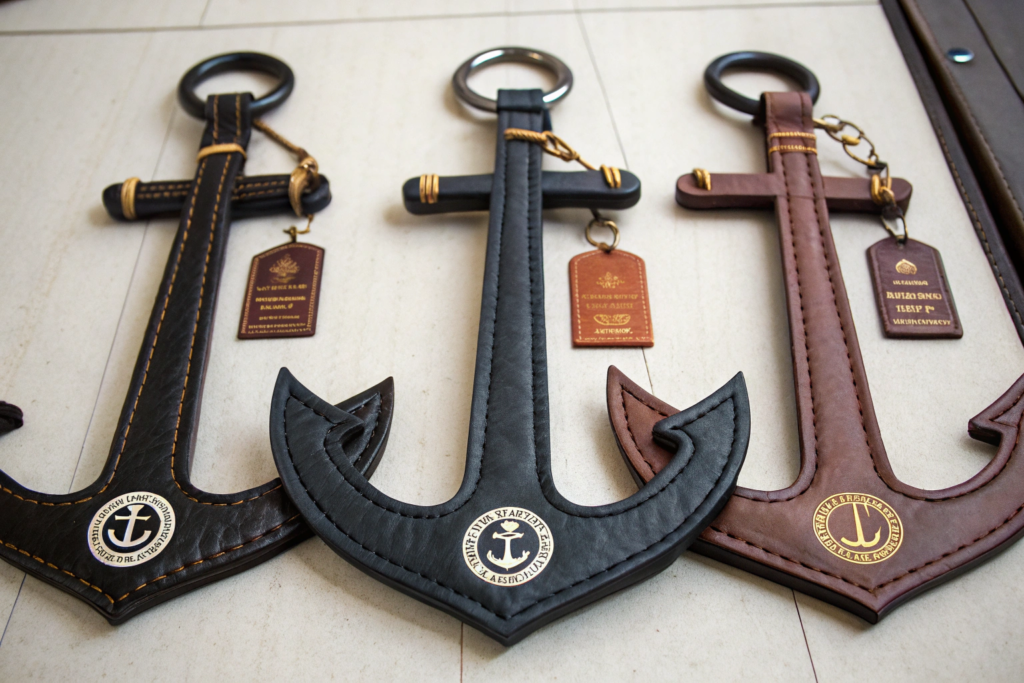
The first unifying element is the hardware story. Choose a button and rivet finish that becomes a brand signature. Antique brass, matte black, brushed nickel—pick one and use it across every style in the collection. When a customer sees that distinctive rivet on a baggy short, they'll recognize it from the classic short they saw online. This visual consistency builds brand recognition faster than any logo.
The second unifying element is the pocket design. The front pocket shape, the coin pocket curve, the back pocket size and placement—these should be consistent across the collection. You can vary the pocket treatment (a plain back pocket on the classic, a branded tab on the premium, a utility pocket addition on the fashion fit), but the underlying architecture should be the same. A customer who tries on the classic fit and likes how the front pockets sit will have the same positive experience with the baggy fit.
The third unifying element is the waistband construction. The waistband feel is one of the most tactile and memorable parts of wearing denim shorts. If your classic fit has a soft, curved waistband with a clean interior finish, your baggy fit should have the same treatment. The customer might not consciously notice the waistband, but they'll notice if it feels different between styles.
The differentiation between demographics comes through the fit, the wash, and the styling. The classic fit, aimed at an older or more conservative customer, gets cleaner washes and more subtle branding. The baggy fit, aimed at a younger customer, gets bolder washes and more visible design details. The premium fit, aimed at a discerning customer, gets the most tactile fabric and the most considered construction. The range works because the unifying elements create a brand identity, while the differentiated elements address specific customer needs.
Why Is Fabric Weight Selection Critical for Summer Sell-Through?
Fabric weight is the invisible factor that makes or breaks a summer denim short. A short that's too heavy feels oppressive in 90-degree heat. A short that's too light loses the structure and durability that denim customers expect. The sweet spot for summer is 8 to 12 ounces, with different weights serving different purposes within the collection.
The lightweight zone, 8 to 10 ounces, is for the shorts that will be worn on the hottest days. These fabrics have an open weave that breathes well and a soft drape that moves with the body. They're ideal for the classic anchor style, which will be worn for hours at a stretch in direct sunlight. The trade-off is that lightweight denim shows wear faster and doesn't hold a crease as crisply. The customer who buys this short values comfort over structure.
The midweight zone, 10 to 12 ounces, is the workhorse of the summer collection. This weight provides enough substance to hold the silhouette of a fashion-forward baggy fit, yet it's light enough to wear comfortably through a summer afternoon. Most of the volume in a summer denim collection lives in this weight zone. The fabric has enough body to carry a complex wash—the stone texture, the whisker fades, the tint variations—and enough durability to survive a season of regular wear.
The heavyweight zone, 13 ounces and above, is for the premium rigid anchor. This short is not designed for comfort on a 100-degree day. It's designed for the customer who wants the authentic denim experience—the stiffness, the break-in period, the personalized fades that develop over time. This customer will wear the shorts on cooler summer evenings, at bonfires, on late-afternoon hikes. They accept the weight as part of the value proposition. The heavyweight short also has the longest retail life; it can transition into early fall as a layering piece with a hoodie.
I advise my brand clients to map their fabric weights to their retail price points and their customer use cases. The lightweight classic short sits at the entry price point, for the customer who wants easy summer dressing. The midweight fashion short sits at the middle price point, for the customer who wants style and substance. The heavyweight premium short sits at the top price point, for the customer who wants an investment piece. This weight-to-price mapping creates a logical upgrade path within the collection.
How Can You Use Wash Variations to Create Collection Depth?
Wash is the emotional core of a denim short. Two shorts with identical construction and identical fabric can feel completely different based on the wash alone. A light stone wash says "easy summer weekend." A dark indigo rinse says "dressed-up casual." A dirty tint says "urban edge." The wash is what the customer sees first in a thumbnail image, and it's what they touch when they pick up the short in a store. Your collection's wash story is as important as its fit story.
I think about wash in terms of a spectrum, from light to dark, with texture and tint as the variables that create interest along the spectrum. A well-constructed summer collection offers three to five distinct wash options that cover the spectrum without redundancy. You don't need two light stone washes that are five percent different from each other. You need a light wash, a medium wash, a dark wash, and one or two specialty washes that provide a point of difference.
The light wash is your summer workhorse. It's airy, it's bright, it reflects heat, and it pairs easily with white tees and linen shirts. This is the wash for your classic anchor style. The medium wash is your versatile middle ground—worn enough to look relaxed, dark enough to look intentional. This wash works across multiple fits and appeals to the broadest customer base. The dark wash is your "elevated" option, the short a customer wears to a summer dinner with a tucked-in short-sleeve button-up. It photographs well and looks more expensive than it is.
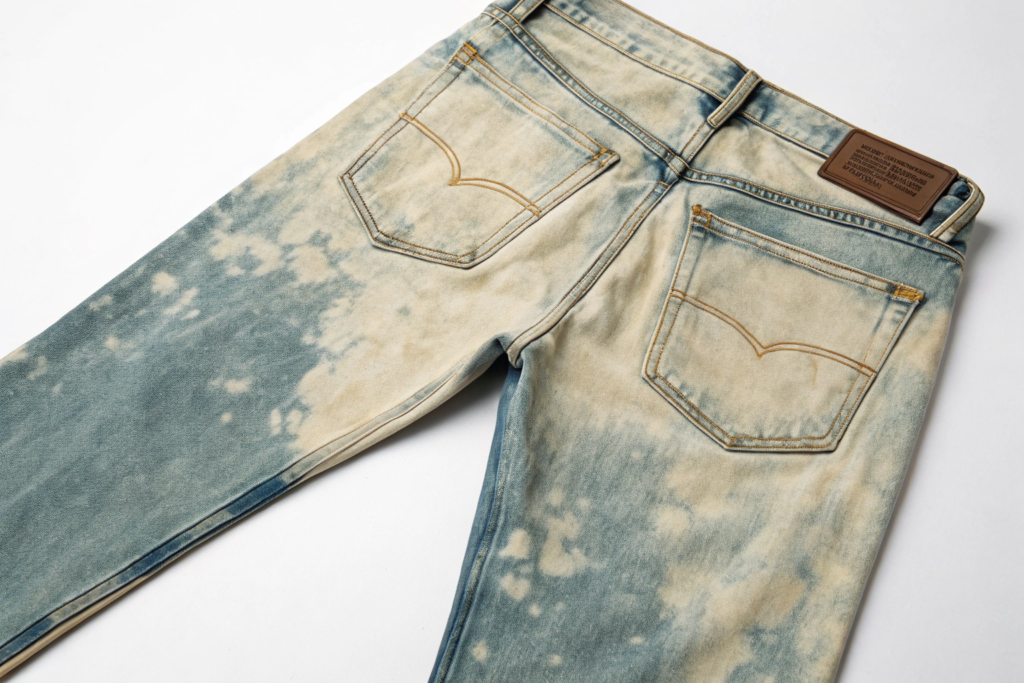
The specialty wash is where you differentiate your brand from the competition. This could be a vintage ecru tint that gives the denim a sun-faded, archival look. It could be a micro-acid haze that creates a cloudy, marbled surface. It could be a dirty cast with subtle ochre undertones. The specialty wash doesn't need to be your volume seller; it needs to be the wash that makes a buyer stop scrolling and click into your product page. It's the wash that gets featured in editorial roundups and Instagram carousel posts.
When I work with a brand on their summer wash development, I always ask them to bring three to five reference images. Not just denim shorts—any visual reference that captures the mood they want their collection to convey. A weathered plaster wall in Santorini. A faded 1970s photograph. A rusted metal sign on a coastal boardwalk. These references give my wash team an emotional target, not just a technical one. We translate the mood into a chemical recipe. The result is a wash that feels cohesive across the collection because it was developed from a unified visual direction, not assembled from a catalog of disconnected options.
What Are the Must-Have Washes for a Summer 2027 Collection?
I'm writing this in mid-2026, and my wash development team is already running trials for Summer 2027. Based on what we're seeing from early adopter brands, trend forecasts, and our own material experimentation, I can identify four wash directions that I believe will define the Summer 2027 denim shorts market.
The first is the "Sun-Bleached Pale" wash. This is an evolution of the light stone wash, pushed further toward an almost white, sun-bleached appearance. The technique involves a heavy enzyme wash to lift the indigo, followed by a very mild peroxide brightening that removes the yellow cast that often remains in heavily washed denim. The result is a clean, bright, optimistic pale blue that photographs beautifully against summer skin tones. This wash will anchor the classic fits in many collections.
The second is the "Mineral Cast" wash, which I previewed in a previous article on rare wash development. This is a multi-layer tint process that gives the denim a subtle, earthy undertone—think sandstone, dried clay, or pale moss. The wash starts with a medium stone base, followed by a pigment tint in an earth tone, then a light enzyme wash that pulls the tint back from the high points, leaving it concentrated in the creases and seams. The effect is organic and grounded, appealing to the customer who is tired of synthetic-looking denim finishes.
The third is the "Cloud Burst" wash, an evolution of the acid wash that's softer and more organic. Instead of the harsh, high-contrast snow pattern of 1980s acid wash, the Cloud Burst uses a low-pressure gas bleaching technique to create a diffuse, cloudy pattern with soft edges. The effect looks like sunlight filtering through moving clouds onto a well-worn pair of shorts. It's a specialty wash that will differentiate fashion-forward styles.
The fourth is the "Dark Rinse Heritage" wash. This is a response to the market fatigue with overly distressed denim. The wash is a simple dark indigo rinse, with no artificial fading, no whiskers, no distressing. The shorts are raw-looking but have been rinsed enough to remove shrinkage and soften the hand feel slightly. The appeal is the clean, dark, minimalist aesthetic that works for elevated casual dressing. This wash works brilliantly on the premium anchor style.
These four washes—Sun-Bleached Pale, Mineral Cast, Cloud Burst, and Dark Rinse Heritage—span the spectrum from light to dark, from classic to experimental. A brand that adopts three of these four washes for Summer 2027 will have a visually rich, trend-aligned collection with clear differentiation between styles.
How Do You Balance Trend-Driven and Core Wash Offerings?
The balance between trend and core is where many brands stumble. Lean too heavily into trends, and you risk a collection that looks dated by August and leaves you with markdown inventory. Lean too heavily into core, and you risk a collection that looks safe and boring, failing to attract new customers.
My recommendation is a 60/40 split, weighted toward core. Sixty percent of your production volume should be in core washes that sell consistently year after year: a medium stone, a light stone, a dark rinse. These are the washes that your wholesale accounts reorder without hesitation and your repeat customers search for by name. The margin on these washes may be thinner because they face more price competition, but the volume and the predictability make them the financial foundation of the collection.
The remaining forty percent is for trend-driven washes. These are the styles that generate excitement, attract press attention, and bring new customers into the brand. The risk is that a trend wash might not sell through at full price. The mitigation is to order these washes in smaller initial quantities, with the ability to reorder quickly if the style takes off. This is where a factory with a responsive supply chain and low minimum order quantities becomes essential. If your trend wash sells out in three weeks, you need to be able to restock before the summer selling window closes.
I saw a brand execute this brilliantly last summer. They launched a collection anchored by three core washes that represented 65% of their buy. They also launched two trend washes—a bold acid treatment and a colored tint—in small quantities. The acid treatment sold out in ten days. Because we had the greige fabric in stock and the wash recipe already dialed in, we turned a reorder of 800 units in 25 days. The brand captured the trend upside without the inventory risk. The core washes provided the steady revenue; the trend washes provided the growth spike. That's the 60/40 model working as intended.
The key operational requirement is fabric flexibility. If your core washes and your trend washes use the same base denim fabric, you can shift production between them quickly in response to sell-through data. If every wash uses a different fabric, you're locked into your initial allocation and can't respond to market signals. I always advise brands to develop their wash range on a shared base fabric whenever possible.
What Trend-Driven Details Elevate a Basic Denim Short?
The difference between a $29.99 denim short and a $68 denim short is not always the fabric. It's the details. The small, considered design choices that signal to the customer that someone thought carefully about this garment. In a crowded summer market, these details are what justify a premium price point and build a brand identity that transcends any single season's trends.
The raw, frayed hem is the most impactful detail in the current market, and I believe it has staying power beyond a single trend cycle. A raw hem eliminates the traditional folded-and-stitched hem, leaving the cut edge of the denim exposed to fray slightly over time. The effect is casual, effortless, and slightly rebellious. From a production standpoint, a raw hem is actually less labor-intensive than a traditional hem, which I discussed in an earlier article on pricing negotiation. The savings can be redirected into a heavier, more premium fabric, creating a short that feels more expensive than its price point.
The utility pocket is another detail that's performing well across men's and women's categories. A slim, zippered side pocket on the thigh, a hammer loop detail on the side seam, a reinforced coin pocket with a visible bartack—these functional touches tap into the workwear heritage trend that has dominated menswear for several seasons and shows no sign of fading. The key is to integrate utility elements thoughtfully, not just slap them on. A side pocket that disrupts the clean line of the leg does more harm than good. A side pocket that sits flush and adds a subtle design accent elevates the short.
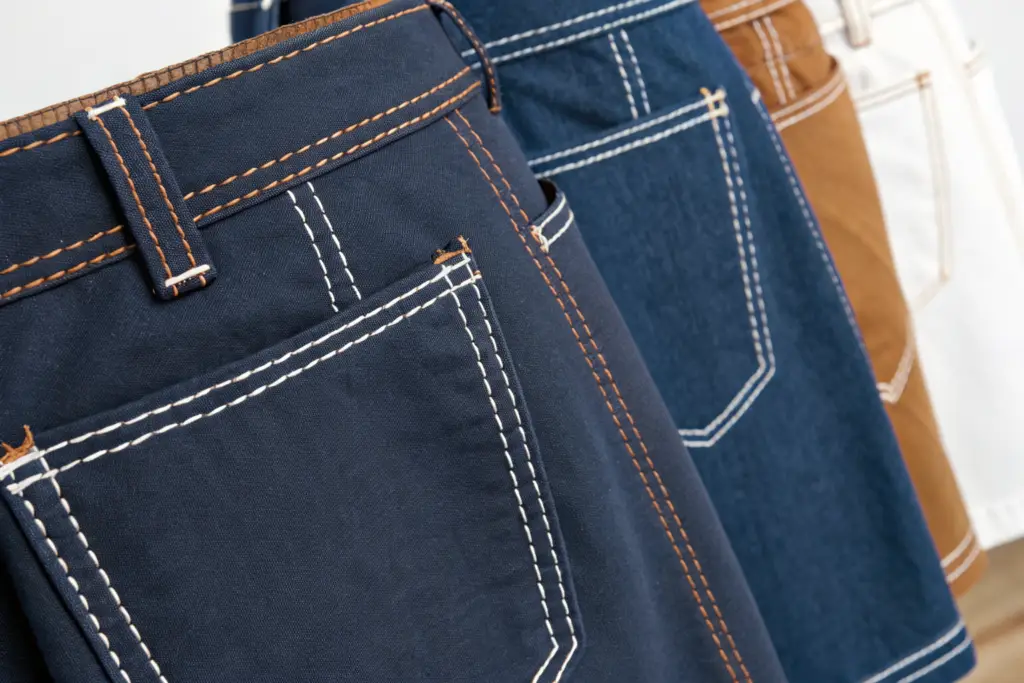
The contrast stitch is a quieter detail that signals quality to the attentive customer. A tonal stitch blends in and does its job invisibly. A contrast stitch—a warm tobacco thread on a dark indigo short, or a crisp white thread on a light wash—draws attention to the construction lines. It says, "Look at the quality of this seam." Contrast stitching requires higher precision in the sewing because any wobble is immediately visible. It's a detail that separates factories that care from factories that cut corners.
The selvedge outseam is a detail that speaks directly to the denim enthusiast. When the outseam is finished with the selvedge edge of the denim—the self-finished edge from the loom, often with a colored stripe woven into it—it signals authenticity and craftsmanship. The selvedge is visible when the short is cuffed, creating a distinctive flash of color and texture. This detail adds cost because selvedge denim is more expensive and the cutting process must preserve the selvedge edge along the outseam, reducing fabric utilization. But for the premium anchor style, it's a detail that the target customer actively seeks out and is willing to pay for.
How Do You Incorporate Utility and Streetwear Elements Tastefully?
The line between "inspired by utility" and "costume" is thin. Cross it, and your short looks like a prop from a movie about construction workers. Stay on the right side of it, and your short looks like a thoughtful design object.
The principle I share with my brand clients is this: utility elements should add function or the illusion of function, not just visual noise. A carpenter loop that's too small to hold an actual hammer is a fake detail, and customers sense the inauthenticity. A carpenter loop that's proportioned correctly, placed where it doesn't interfere with the hand pocket, and constructed from the same denim as the short body, feels like a genuine design choice.
Streetwear elements—bold branding, asymmetrical pocket layouts, exaggerated proportions—require a different kind of tastefulness. The streetwear customer wants the brand's presence to be visible. They want the short to be recognizable from across the street. But there's a difference between a confident brand statement and a desperate one. A single, well-placed branded element—an embroidered logo on the back pocket, a printed label on the interior waistband, a branded rivet—reads as confident. A short covered in multiple logos, contrast patches, and hanging tags reads as insecure.
I worked with a streetwear brand from Los Angeles last year on their summer short. They wanted heavy branding. I suggested they put their logo in one high-impact location—a tonal, tone-on-tone embroidery on the back pocket that was visible up close but didn't scream from a distance—and let the silhouette and the wash do the rest of the talking. The short sold through in four weeks. The customer feedback praised the "clean design." The branding was there, it was visible, but it felt integrated rather than applied. That's the streetwear sweet spot: presence without shouting.
The cargo pocket is a utility element that's particularly tricky. A cargo pocket on a denim short easily veers into dad-on-vacation territory. The modern approach is to slim the pocket profile, angle it slightly, and place it higher on the thigh so it elongates the leg rather than cutting it off at the widest point. The pocket flap should be clean, with a hidden snap closure rather than a bulky Velcro strip. The pocket itself should lie flat when empty, with no excess fabric billowing out. These refinements transform the cargo pocket from a functional afterthought into a considered design element.
Why Are Branded Hardware and Labels Worth the Investment?
I've touched on hardware quality in previous articles, but it bears repeating in the context of collection building. Your hardware and labels are the only parts of the short that carry your brand name directly. They are touched every time the customer puts the shorts on. They are seen by anyone who looks closely at the garment. Skimping on these elements to save a few cents per unit is a false economy.
A custom-branded button is the single highest-impact hardware investment. The button is front and center on the waistband. It's the first thing the customer touches when they try on the shorts. A solid brass shank button with an engraved or embossed brand mark feels substantial and premium. A thin, stamped alloy button with a printed logo that wears off after five washes feels cheap. The cost difference per unit is measured in pennies. The perceived value difference is measured in dollars.
The back patch is the second highest-impact branding element. A genuine leather patch, debossed with the brand logo, ages along with the shorts. It develops a patina. It tells the story of the garment's life. A synthetic patch or a printed label peels and cracks. The leather patch costs more—perhaps $0.40 to $0.60 per unit more than a synthetic alternative—but it transforms the back of the short from a blank surface into a brand billboard. It's the detail that gets photographed for Instagram flat-lays.
The interior labels are the details that most brands overlook and most customers subconsciously register. A soft, woven label on the interior waistband, with the brand name and size, feels considered. A scratchy, printed label feels like an irritation. The woven label costs marginally more, and the comfort difference is real. Similarly, the care label—which is legally required—can be printed on a soft, tear-resistant substrate and sewn in cleanly, or it can be a stiff, scratchy tag that the customer cuts out immediately. The latter leaves a ragged edge that irritates the skin. The former disappears into the garment.
I guide my brand clients to think about hardware and labels not as costs to be minimized, but as brand assets to be invested in. The $0.80 per unit you spend on premium hardware and labels translates to a $5 to $10 increase in the retail price the customer is willing to pay, because the tangible quality signals justify the premium positioning. The math works.
How Do You Plan a Seasonal Production Calendar with Fumao?
A seasonal production calendar is the backbone of a successful summer collection. It's the document that ensures your shorts arrive in your warehouse—and on your retail shelves—before the summer selling window opens, not after it closes. I've seen beautifully designed collections fail commercially because the calendar was wishful thinking rather than a realistic, backward-planned timeline.
The planning process starts with the end date and works backward. When do you need the shorts on your warehouse shelves, ready to ship to retail accounts or direct-to-consumer customers? For a Summer 2027 collection, the typical in-store or in-warehouse date is March 1 to April 1, 2027. This gives you a full six to eight weeks of selling before Memorial Day, which is the traditional kickoff of peak summer buying in the U.S. market.
From that in-warehouse date, you subtract the ocean freight transit time. For West Coast delivery, subtract 4 weeks. For East Coast delivery, subtract 5 to 6 weeks. That gives you the ex-factory shipment date. From the ex-factory date, subtract the production lead time. For a standard denim short with a moderate wash, that's 6 to 7 weeks. For a first-time development order, add the sampling phase, which is another 4 to 6 weeks before production begins.
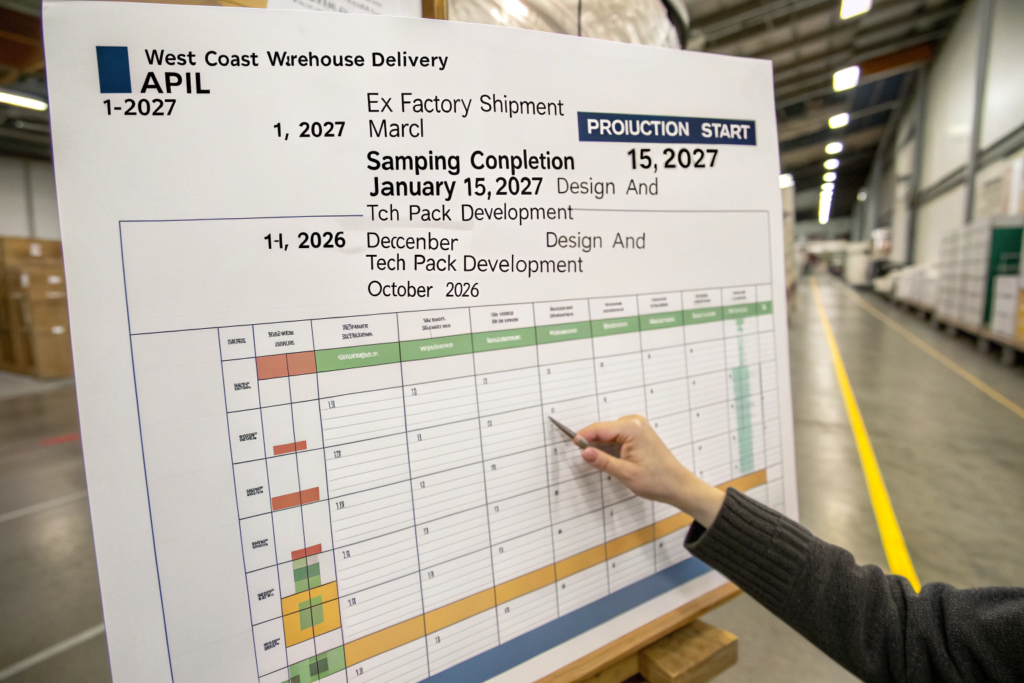
Working backward from an April 1, 2027 in-warehouse date for a West Coast delivery: the ex-factory date is approximately March 1, 2027. The production start date, for a standard order, is approximately January 15, 2027. The sampling phase needs to be complete by January 15, which means sampling should begin by December 1, 2026. The design and tech pack development phase needs to be complete by December 1, which means you should start the design process by October 2026. This backward calendar gives you a realistic, pressure-tested timeline that accounts for the natural pace of development, sampling, production, and logistics.
I provide every brand client with a customized production calendar at the start of our relationship. The calendar is a shared document, visible in the client dashboard, with every milestone dated and every responsible party identified. The calendar is not a static document; it's updated as milestones are completed or delayed. If the client's sample approval takes longer than the planned window, the calendar adjusts and the downstream dates shift visibly. This transparency forces accountability on both sides and prevents the end-of-calendar surprises that happen when delays are ignored until it's too late.
When Should You Start Designing for a Summer Launch?
The short answer: start designing in September or October of the preceding year. For a Summer 2027 launch, you should be in active design development by September or October 2026. This timeline feels early to many brand owners who are accustomed to faster fashion cycles, but for a considered, custom-manufactured denim collection, it's realistic and necessary.
September and October are for concept development. This is when you research trends, gather references, sketch designs, and develop your range plan. You're answering the big strategic questions: How many styles? What silhouettes? What washes? What retail price points? What's the brand story for this season? This phase is internal to your brand, and it benefits from unhurried creative exploration.
November and December are for design finalization and factory engagement. You bring your refined concepts to us. We review the designs for production feasibility, suggest fabric and wash options, and begin the sampling process. The goal is to have the tech pack locked and the first sample in work by mid-December.
January and February are for sampling and refinement. The first fit sample ships to you in early January. You review, provide feedback, and we produce a second sample if needed. The pre-production sample is approved by late February. The bulk production purchase order is issued.
March and April are for bulk production. The sewing lines run your order. The wash house processes the shorts. The QC inspection is completed. The cartons are packed and shipped. The goods are on the water by late April.
May and June are for in-market delivery. The shorts arrive at your warehouse in May. You ship to retail accounts. The collection hits shelves by late May or early June, just as the summer selling season kicks into high gear.
This September-to-May timeline, roughly eight to nine months from concept to delivery, is the rhythm I recommend for a well-executed summer denim collection. It can be compressed to six months if the designs are simple and the decision-making is fast. It should not be compressed below six months for a first-time collection, because the sampling and development phase requires multiple rounds of physical samples and there is no way to rush the fit approval process without introducing quality risk.
How Do We Manage Reorders Mid-Season to Capture Hot Sellers?
The reorder is the most profitable order in the apparel business. The design work is done. The sampling is approved. The fit is validated. The market has voted with its wallets. A reorder converts proven demand into immediate revenue, with none of the development risk of a new style. The challenge is that reorders happen in the middle of the selling season, when time is tight and the window for capturing additional sales is narrow.
Our reorder process is designed for speed. Because we keep digital pattern files for every client, there's no pattern setup time for a repeat style. Because we keep greige fabric inventory for our active clients' base fabrics, there's no fabric procurement delay if the reorder uses the same fabric as the initial order. Because the wash recipe is already dialed in and documented, there's no wash development time. The reorder goes directly into production scheduling.
The standard reorder lead time for an approved style with stocked fabric is 25 to 30 days ex-factory. With air freight, the total door-to-door timeline can be as short as 32 to 37 days. That's fast enough to restock a hot seller within the same summer selling season, provided the reorder is triggered early enough.
The key to successful mid-season reordering is sell-through monitoring. I advise my brand clients to track their weekly sell-through data by style and by wash from the moment the collection launches. The moment a style hits a 50% sell-through rate within the first four weeks, it's a candidate for reorder. Don't wait until the style is 90% sold out, because by then you've lost three to four weeks of potential sales while the reorder is in production. Trigger the reorder at 50% sell-through, and the new stock arrives just as the initial inventory depletes.
I also advise brands to hold a small fabric reserve at the start of the season. If you order 3,000 units for your initial production run, order an additional 500 yards of the base denim and hold it in our warehouse as a reorder reserve. The fabric carrying cost is minimal, and the speed advantage is massive. When the reorder trigger hits, we can cut and sew immediately without waiting for fabric delivery. The 500-yard reserve covers a reorder of approximately 400 units, which is often enough to bridge the gap until a larger restock can be planned.
Conclusion
Building a summer denim shorts collection with Shanghai Fumao is not a transaction. It's a seasonal partnership that starts with a shared vision and ends with a container of shorts arriving at your warehouse, exactly as you imagined them, exactly when you need them. The collection we build together rests on a foundation of smart range planning: three anchor styles that cover your volume, your trend, and your premium positioning, unified by consistent hardware and pocket design but differentiated by fit and wash to serve distinct customer demographics.
The wash story brings the collection to life. A balanced 60/40 split between core and trend washes ensures steady revenue from proven sellers while creating the excitement and differentiation that attracts new customers. The trend details—the raw hems, the utility accents, the branded hardware—justify your premium price points and build a brand identity that customers recognize and return to.
The calendar makes it all happen. An eight-month, backward-planned timeline from concept to delivery, with structured milestones and shared accountability, takes the panic out of seasonal production. And a responsive reorder system, with stocked fabric reserves and a 25-day turnaround, captures the upside when a style exceeds expectations.
If you're a brand owner or a distributor planning a summer denim collection, I invite you to start that conversation early. The brands that reach out to us in September, with a rough concept and an open mind, are the brands that launch in May with a polished, sell-through collection. The brands that reach out in February are the brands that scramble. Our Business Director, Elaine, can walk you through our seasonal calendar, share fabric and wash options for the upcoming season, and begin the collaborative design process that turns your summer vision into a commercial reality. You can contact her directly at elaine@fumaoclothing.com. Let's build your summer together.