I was sitting in my office last March when an email came in from a frustrated brand owner in Atlanta. He had spent three months messaging suppliers on a massive online marketplace. He received 47 quotes for the same hoodie design. The price gap between the cheapest and the most expensive was $7.85. He was lost in a sea of identical stock photos, broken English, and promises of “best quality friend price.” He could not figure out who was real and who was just a trading company with a Photoshop license. He finally called us, exhausted, and said, “I don’t want a quote from ten strangers. I need one factory that actually makes the clothes.” This is the fundamental divide we are talking about today.
Fumao Clothing differs from standard Alibaba suppliers by operating as a verified manufacturer with owned production lines, offering direct technical engineering support, and guaranteeing transactional security through inspection-based payment triggers, rather than just serving as a digital storefront with variable quality and limited accountability.
You are probably comparing us right now. You have a tab open with a marketplace supplier and a tab open with our website. The prices on the marketplace might even look cheaper. But you are not buying a USB cable. You are buying inventory that can make or break your entire brand reputation. I want to walk you through the five critical layers where we are different. This is not just about "we have better quality." It is about ownership, communication speed, financial safety, and whether the person you are texting actually works in the building where your clothes are sewn.
What Are the Real Differences Between a Factory and a Trading Company?
Two months ago, I visited a trade show in Las Vegas. A distributor came to our booth and unloaded his horror story. He had worked with a "factory" found on an online directory. He sent them his tech pack for a structured women’s blazer. They promised they could do it. Ten weeks later, he received a box of shapeless sacks. The lapels were flat. The interlining was missing. When he demanded a refund, the "salesperson" admitted they did not own the production line. They had subcontracted the job to a tiny rural workshop and never visited it. The margin they took paid for a website, not a quality check. This is the trading company gamble.
The real difference lies in what you can touch. A trading company trades paper. A factory owns machines and labor. You need to know how to see the difference, even through a screen.
How Can You Verify If a Supplier Actually Owns the Machines?
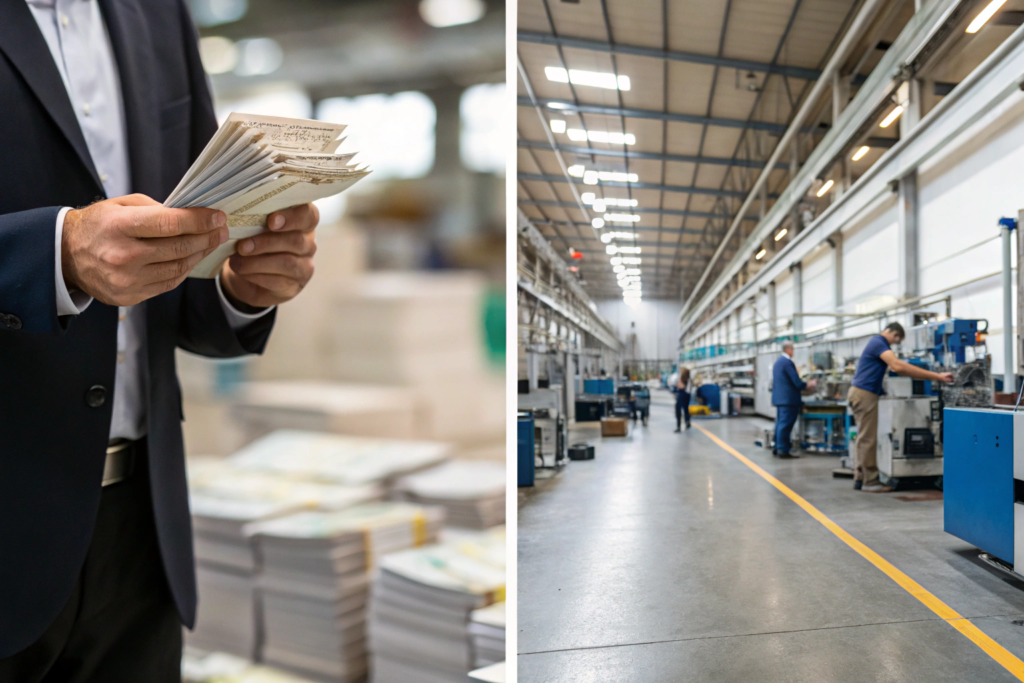
Verification is visual, not verbal. A marketplace badge that says "Verified Supplier" usually means the intermediary paid a fee and passed a basic registration check. It rarely confirms that the entity owns a real manufacturing base.
Here is a simple checklist I tell my clients to use when trying to spot a real factory versus a trading agent:
| Verification Check | Real Factory (Shanghai Fumao) | Typical Alibaba Trading Co. |
|---|---|---|
| Live Video Call | Shows active lines, noise, real-time cutting machines. | Shows a quiet office or a pre-recorded loop. |
| Registration Type | Industrial & Commercial "Production" license. | "Trading" or "Import/Export" license only. |
| Raw Material Stock | Shows physical rolls of fabric in-house. | No stock; relies on "partner" warehouses. |
| Sample Capacity | Can modify patterns on site and give instant feedback. | Takes 24-48 hours to "check with the engineer." |
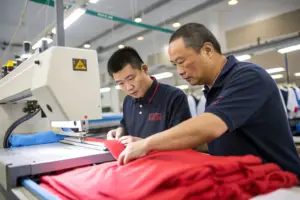
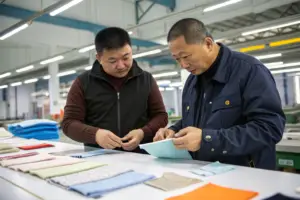
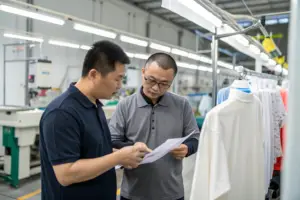
When you ask us for a live tour at Shanghai Fumao, I walk into the stitching floor. You hear the machines. You see the bundles of cut fabric moving down the line. I can show you our Gerber cutter in real-time. A trading company cannot fake the decibel level of a live production hall. We own five lines. We do not rent them for a day to fool you. This physical reality changes everything about the final product. If the sewer has a question about your pocket placement, my pattern maker walks five steps to the floor and fixes it. In a trading company model, that question passes through a sales agent, a middle manager, and a remote workshop owner before an answer comes back, usually wrong.
Can a Middleman Really Guarantee Lower Prices Than a Factory?
Many brands believe that cutting out the middleman automatically means you pay less. This is half true. A trading company can sometimes quote a lower sticker price because they source from extremely low-cost village workshops with no compliance overhead. But you pay for that discount in risk.
A trading company does not pay for social compliance audits. They do not invest in needle detection machines. They do not absorb the cost of fabric testing for restricted substances. They can quote $1.50 for a T-shirt because the workshop uses banned AZO dyes and child labor. If US Customs catches that shipment, you lose everything. We recently took over an account from a brand in Oregon. They were paying a trading company $12.50 per unit for a cotton jacket. Our direct manufacturing price was $13.80. The client was confused why we were "more expensive." I broke down the hidden costs of the trading company’s "cheap" jacket: no bar-tacks at stress points, a zipper that failed after 100 uses, and no audit paper trail. The actual cost per returned jacket was $35. The trading company did not care. They made their markup on the front end. We care because our name is on the zipper tape. A factory’s price reflects the actual material, not just a sourcing fee.
How to Get Lower MOQs and Better Customization Options
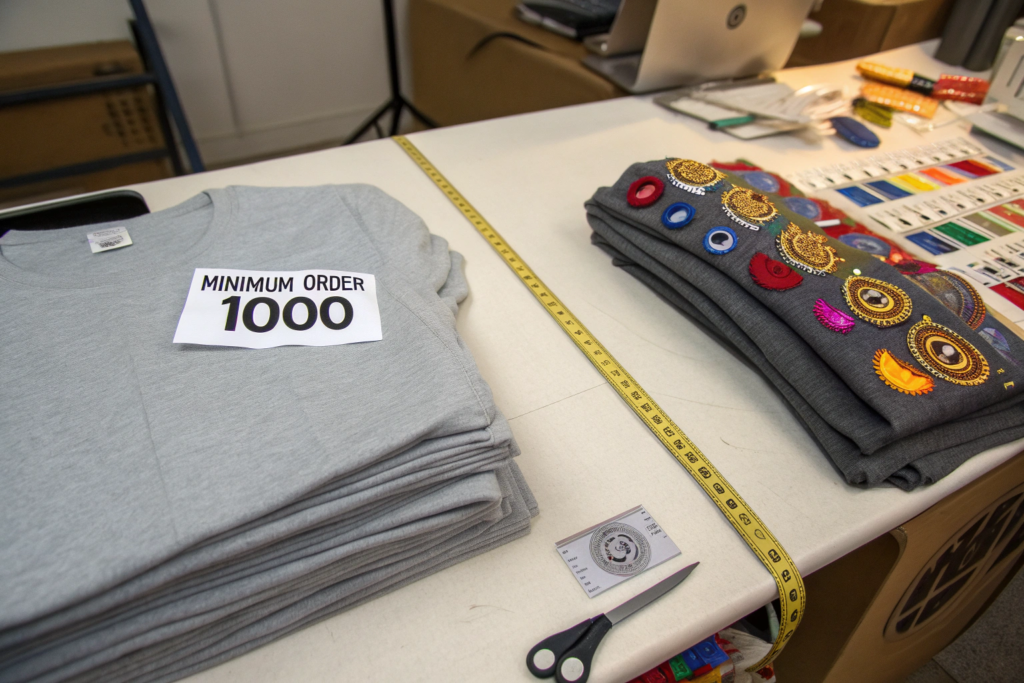
A client in Brooklyn launched a niche brand for tall women last year. She needed 50 pieces in 5 different sizes to test the market. Every Alibaba supplier she contacted replied with the same robotic message: “Dear, MOQ 500 pieces per color.” She was not ready to buy 2,500 units of an untested design. She almost closed her Shopify store before she even started. She was trapped by the economic model of big portals. Those suppliers optimize for standardized bulk. They want to run one fabric for three weeks straight without changing the thread. They are not designed for a brand in its experimental phase.
Customization is not just about printing a logo. It is about a factory bending its production rhythm to fit your business model, not the other way around. This requires a flexible internal setup that volume sellers on mega-platforms rarely have.
Why Do Some Suppliers Set the MOQ So High?
High Minimum Order Quantities are usually a symptom of a factory that does not stock raw materials. If a supplier has to buy a specific fabric for your order, the textile mill demands a minimum buy. If you order 50 jackets, but the mill only sells 500 meters of that fabric, the supplier ends up with 450 meters of dead stock. They pass this risk to you by hiking the MOQ or refusing the order.
Our approach at Shanghai Fumao is different because we operate a pre-stocked raw material inventory system. We buy the most popular greige fabrics in bulk: single jersey cotton, cotton-spandex blends, and standard nylon weaves. Because the base cloth is already on our shelf, we do not need to force you to buy the whole roll. We can run a small low MOQ batch by cutting from our existing stock. Last month, we produced 80 units of a complex yoga set for a start-up in California. The fabric was a moisture-wicking blend we had in-house. The only customized element was the sublimation print panel and the logo elastic band. Because we controlled the grey fabric, the startup paid a small surcharge for the short run, not an impossible penalty. The alternative was ordering 500 units and dumping 420 in a landfill eventually.
How Can I Customize My Brand Without Losing the ‘Designer’ Touch?
You can spot a “catalog brand” from a mile away. They pick a generic blank, slap a rubber logo on the chest, and call it a day. We help brands build real identity through custom trims, and that does not always require a huge budget.
We worked with a menswear brand in Denver focused on vintage workwear. They wanted a unique experience inside the garment, not just on the outside. Here is a breakdown of customization levels we executed for their small batch of 100 heavy-duty overshirts:
| Customization Layer | Generic Factory Offer | Shanghai Fumao Custom Offer |
|---|---|---|
| Main Label | Satin printed label. | Woven jacquard brand label with distressed look. |
| Size Tag | Standard paper tag. | Tear-away custom cotton tag with care instructions. |
| Buttons | Standard resin. | Custom engraved horn-look buttons with brand initial. |
| Internal Neck Tape | Plain black. | Printed twill tape with a hidden brand motto. |
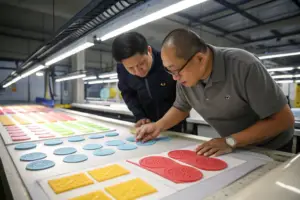
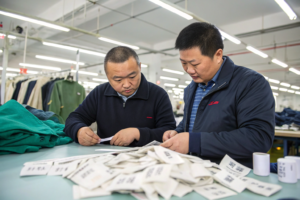
These details are not expensive individually. The jacquard label cost them about $0.15 per piece. The tape was $0.08. The total trim package added roughly $0.60 to the cost of a $28 garment. But the perceived value shot up. Their customers posted unboxing videos specifically showing the hidden motto. A standard marketplace supplier would have charged a $200 "custom setup fee" just for the tape, and then outsourced it anyway. We absorbed the plate-making cost because we want the repeat order. When you control the internal supply chain, you can turn small creative details into a massive brand retention tool without the financial gatekeeping.
Which Supplier Model Guarantees Safer Payment and Delivery Terms?
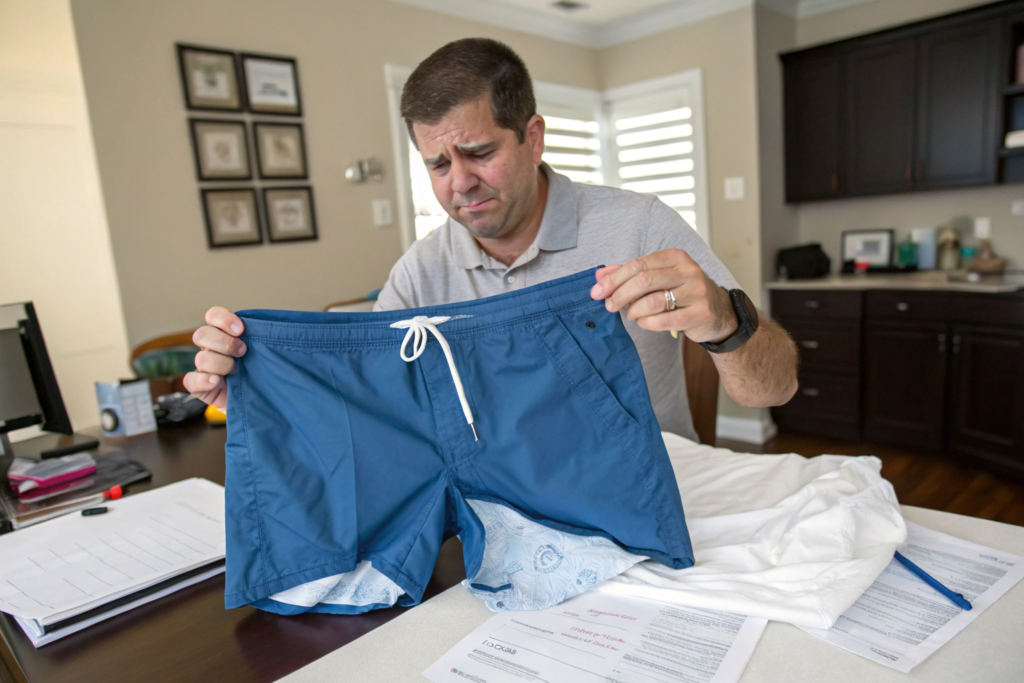
Financial safety is where the comparison gets deadly serious. I got a call recently from a man in Florida. He used a popular online trade platform’s "Secure Payment" feature for a $19,000 order of swim trunks. The goods arrived with the crotch seam completely unraveled. The fabric was paper-thin. He filed a dispute, but the platform ruled in favor of the supplier because the photos in the contract only showed the print, not the seam construction. The "assurance" covered superficial appearance, not structural integrity. He was out of pocket with 1,000 units of unsellable swimwear right before Spring Break.
The platform payment models are designed for simple commodity transactions. They are not sophisticated enough to judge fashion quality. They do not understand the difference between a bartack and a lockstitch.
Is Trade Assurance as Safe as an Inspection-Based Payment?
I do not want to demonize Trade Assurance completely, but you must understand its limits. It is a dispute resolution tool, not a quality guarantee. If a product "looks like" the sample photo, the platform often closes the case, even if the fabric feels like sandpaper. You cannot convey hand-feel through a dispute photo.
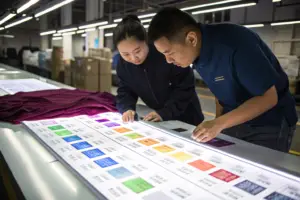
Our payment model at Shanghai Fumao is based on a third-party trigger, not a platform arbitration. We insist on a 30% deposit to secure the production slot and purchase raw materials. However, we do not ask for the 70% balance until a physical third-party inspection occurs. You hire an agency like SGS or Intertek. They go to our warehouse. They count the goods. They pull random pieces and check them against your approval sample and an AQL chart. They send you a report. Only after you read that report and approve it do you release the balance. This flips the power dynamic. The platform holds your money and makes a ruling. In our model, you hold the money and make the ruling. You do not pay until you have photographic evidence from a neutral professional that your goods are correct. In 2024, a client’s inspector found that 12% of a batch had a slight shade variation. We held the shipment, re-dyed the affected units, and only then collected the balance. An algorithmic platform would have likely not caught that subtlety.
Do Platform Suppliers Really Commit to DDP Logistics?
Logistics transparency is another battlefield. On big marketplaces, you often see the price broken down deceptively. The product price is low to attract your click, but the shipping cost is vague or wildly inflated later. Many suppliers refuse Delivered Duty Paid (DDP) entirely, forcing you to handle the port chaos yourself.
We actually advocate for DDP for our US clients, especially on the first few orders. An Alibaba logistics comparison often shows "sea freight" but hides the clearance fees. We give you one single, all-in number: cost, freight, insurance, and US import duties. You pay that final number, and we handle the rest. We use reliable forwarders. If the container gets held up by customs because of a misclassification, that is our mistake, and we pay the demurrage. A platform supplier will often point to their Terms and Conditions and place the liability on you for "destination charges." We recently shipped 300 units DDP air freight to a boutique in Chicago for a fashion week launch. The customs paperwork described the complex viscose blend correctly. Clearance took two hours. A generic trading agent would likely have just written "cotton dress" on the commercial invoice to save effort, risking a seizure. We take the complexity of international logistics on our shoulders because we are the principal, not just a middleman.
How to Get Technical Support That Improves Your Designs?
A childrenswear brand owner in Nashville sent me a sketch last spring. It was a cute organic cotton romper with a dinosaur tail stitched on the back. Beautiful idea, terrible engineering. The tail was so heavy it pulled the back neckline, choking the baby slightly when the garment was worn. A marketplace supplier would have sewn it exactly like the sketch and shipped the unsafe product. They do not argue with a client; they just execute the bad design and collect the money. I called her immediately. I told her she had a liability issue. We spent three days on a video call, using a half-scale mannequin, to re-engineer the tail attachment with a hidden internal support loop.
Real technical support is not about answering a message in one hour. It is about preventing a recall three months after delivery. It is the engineering mind that stands between your sketch and a potential lawsuit.
Why Is a Pre-Production Tech Pack Review Critical?
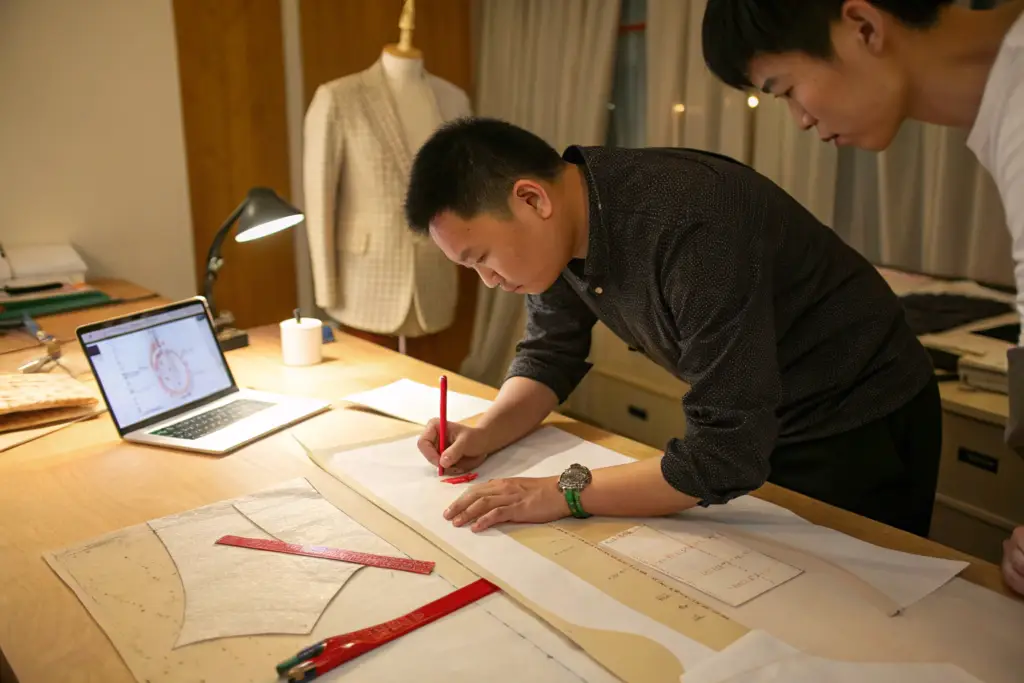
A tech pack is a bible. But even bibles have unclear verses. We have a mandatory step that many volume-based platforms skip entirely: the Pre-Production Sample (PP) with an engineering evaluation call.
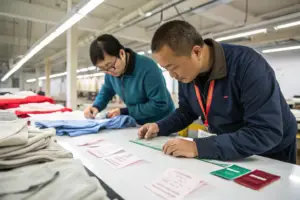
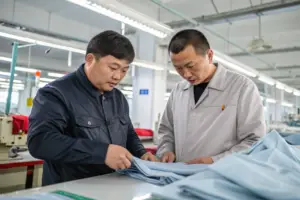
When you send us a file, our pattern maker does not just feed it to the auto-cutter. He reads it. He looks for contradictions. Last season, a sportswear brand sent us a spec with a contradictory tolerance. The armhole curve measurement on the flat sketch did not mathematically match the bicep circumference on the size chart. This happens often with new designers. We created a digital 3D simulation video of the fit. We pointed out the puckering that would occur. We adjusted the armhole depth by 0.6 cm. The client approved the change instantly. This 0.6 cm adjustment saved the style. It meant the difference between a 5-star review for fit and a 1-star review for tight armpits. A salesperson at a trading company does not know how to grade a pattern mathematically. They just forward the email. At Shanghai Fumao, our technical lead has 18 years of experience in activewear construction. That is not a marketing claim; it is a resource you can use to safeguard your design intent.
Can You Actually Trust a Supplier’s Fabric Sourcing Advice?
Fabric failure is the most expensive technical mistake. But fabric sourcing is not just about finding the cheapest CMT quote. It is about matching the textile behavior to the end-use.
We partnered with a luxury resort wear label in Miami. They wanted a crisp, pure white linen for a beach cover-up. Pure linen is notorious for crushing. Our sourcing team suggested a higher-quality Belgian linen blend with a small percentage of BCI cotton. We added a special enzyme wash during finishing. The result was a fabric that held its crisp shape but felt incredibly soft against sun-kissed skin. The client was nervous because the fabric was $0.90 more per meter than a standard Chinese linen. We did a wash test. We sent them a video of the standard linen wrinkling into a tight ball in the dryer versus our blend maintaining a relaxed drape. The proof was visual and tactile. They paid the extra money and sold the cover-up for $140 instead of $89 because the fabric looked expensive. A basic Alibaba textile vendor would have sent them the cheapest "linen look" polyester and called it a day. We understand that the hand-feel is the brand experience. Good technical advice costs slightly more per meter but can double your retail price point. That is the value of a manufacturing engineer over a commodity broker.
Conclusion
The gap between a manufacturing partner like Shanghai Fumao and a generic online marketplace supplier is as wide as the Pacific Ocean. We are not a listing. We are a building with five production lines, a technical pattern team, and a financial model that only succeeds when your inspection passes. While marketplace merchants survive by skimming margins on outsourced production without ever touching the fabric, we survive through long-term repeat orders built on the bedrock of engineering integrity. We looked at the critical differences: owning the machines versus trading a paper contract, turning low MOQs into a reality through smart raw material stocking, securing your cash through inspection-based releases rather than opaque platform algorithms, and leveraging genuine garment engineering to make your designs safer and more profitable.
If you are looking for the absolute bottom price on a generic blank, and you are willing to gamble your timeline and your brand reputation to get it, a bulk Alibaba trader might match your short-term risk appetite. But if you are building a serious brand that needs a partner who will tell you when a pocket is placed wrong, or who will hold a shipment for two weeks to fix a shade issue without asking for a penny until it is right, then the choice is clear.
Let’s stop playing the guessing game with faceless RFQs and stacked sample fees. Reach out to our Business Director, Elaine, at elaine@fumaoclothing.com. Tell her about your concept or your current sourcing headache. She can give you a realistic cost breakdown, a timeline based on actual floor capacity, and a transparent payment structure that protects your cash from day one. Come build something real with us.