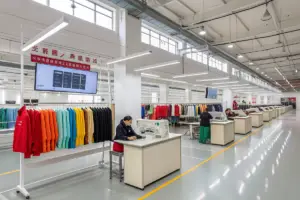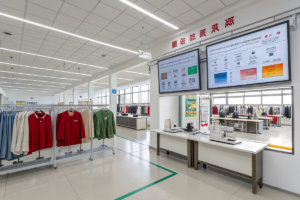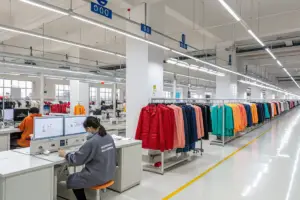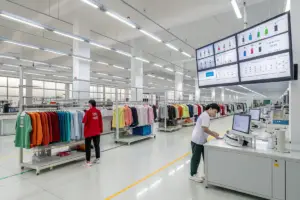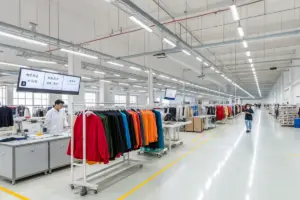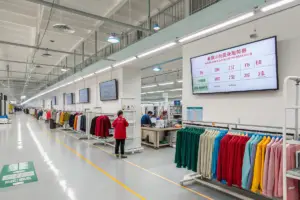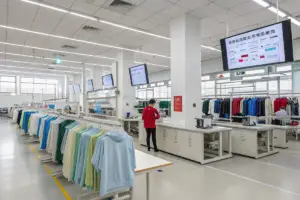
You email your factory contact a question about the status of your fall production order. Twenty-four hours pass. You send a follow-up. Forty-eight hours pass. You wake up at 3 AM to make a phone call, catching someone on the production floor who gives you a vague answer. You hang up uncertain whether your order is on track or delayed, whether the fabric issue was resolved, or whether the shipment will make the vessel. The communication feels like pulling teeth. The distance between you and your factory is not just geographic. It is informational. You are operating in the dark, and the darkness creates anxiety, errors, and missed opportunities.
Building a transparent communication system with an overseas clothing manufacturer requires structuring the flow of information across five dimensions: communication cadence, where regular scheduled updates replace ad-hoc inquiry and response; information hierarchy, where strategic, operational, and tactical information travel through defined channels to the right people; digital platform integration, where a shared production management system provides real-time visibility into order status, quality data, and shipping milestones; cultural and language bridging, where communication protocols are designed for clarity across linguistic and cultural differences; and escalation protocols, where problems are communicated proactively with proposed solutions rather than hidden until they become crises. This system transforms communication from a source of friction into a competitive advantage.
At Shanghai Fumao, we have invested in building a communication infrastructure that serves our brand and distributor partners across multiple time zones, languages, and business cultures. We know that a beautifully sewn garment loses its value if the partner who ordered it does not know when it will arrive. Let me walk you through the specific systems, protocols, and practices that constitute transparent communication, and how you can evaluate and co-build this system with your manufacturing partner.
What Communication Cadence Should a Brand Expect from a Professional Factory?
The single most common communication failure between brands and overseas factories is the absence of a defined cadence. The brand reaches out when they need information. The factory responds when they have time. Communication is reactive, irregular, and driven by anxiety rather than structure. A professional factory replaces this chaos with a predictable rhythm of updates that keeps the brand informed without needing to ask.
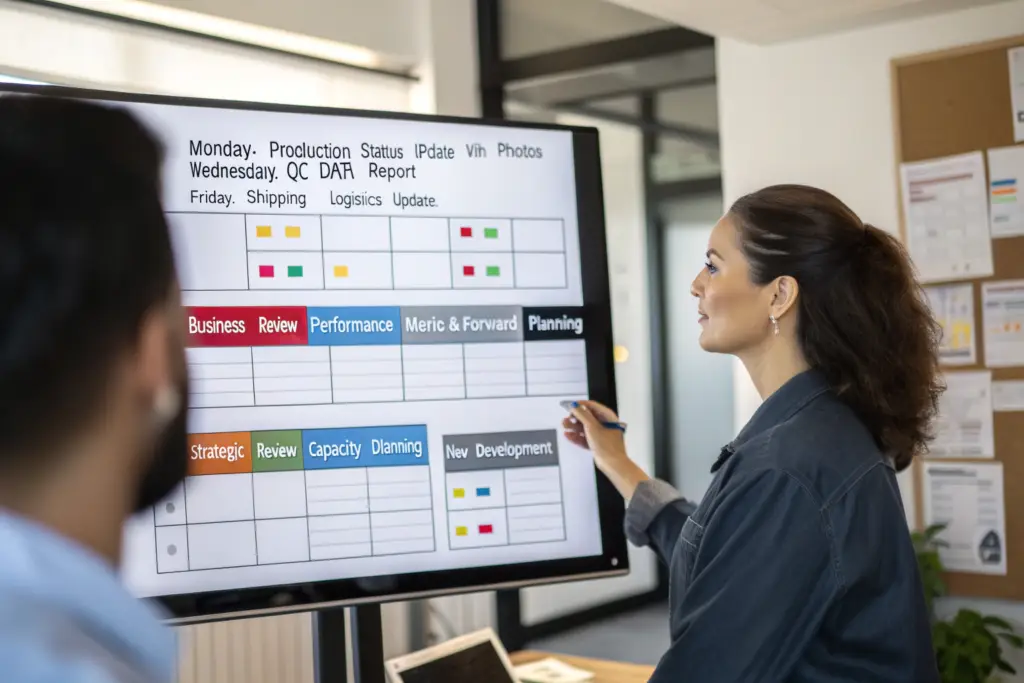
A professional factory communication cadence includes three levels of scheduled communication: weekly operational updates during active production periods, including production progress with percentage completion by style, quality inspection results from the week’s inline checks, photographs of production on the line, and any issues identified with the corrective actions taken; monthly performance reviews covering delivery performance against committed dates, quality metrics against AQL standards, and forward order status for the coming month; and quarterly strategic reviews covering capacity planning, new development opportunities, fabric and trim innovation, and any changes to the factory’s capabilities, certifications, or team. This cadence ensures the brand always knows the status of their orders without needing to chase for information.
What Should a Weekly Production Update Contain?
A weekly production update that says "Everything is on schedule" is not transparent communication. It is a placeholder that provides no actionable information. A meaningful weekly update contains specific, verifiable data points that allow the brand to assess progress independently.
Our standard weekly update includes the current status of each active style—cutting, sewing, finishing, or packed—with the percentage completed against the total order quantity; photographs of the production on the line, showing the actual garments being produced, not generic factory images; the inline quality inspection results for the week, including the sample size inspected, the defect count by category, and the defect rate compared to the acceptable threshold; a summary of any issues encountered during the week—fabric defects identified, machine downtime, trim delays—and the corrective actions taken; and a confirmation of the current estimated completion date against the committed delivery date. This update arrives every Monday for the previous week’s production. The brand does not need to request it. It arrives on schedule, every week, without fail. This weekly production reporting for apparel manufacturing is the heartbeat of transparent communication. A factory that provides it demonstrates operational discipline. A factory that does not is managing production through informal, unaccountable processes.
How Should Communication Frequency Adjust for Different Project Phases?
The communication needs of a brand vary across the lifecycle of a production order. During the sampling and development phase, communication is intensive and iterative. The brand and factory are exchanging design feedback, fit comments, and material approvals. Daily or near-daily communication may be appropriate. During the bulk production phase, communication settles into the weekly cadence described above. During the shipping and logistics phase, communication intensifies again around documentation, booking confirmation, and delivery scheduling.
A professional factory adjusts its communication frequency to match the project phase, with the adjustment communicated explicitly. When a brand enters the sampling phase with us, we schedule a kickoff call to align on the sampling timeline, then provide updates at each milestone: initial pattern complete, first sample cut, sample ready for internal review, sample shipped. The brand always knows the next update point. There is no silence to interpret. This phase-appropriate communication in apparel production respects the brand’s need for information density during critical phases and information efficiency during stable phases.
Email is a terrible project management tool for complex, multi-order production relationships. Information is scattered across inboxes. Attachments are lost in threads. Different team members have different versions of the truth. A shared digital platform consolidates all production information into a single, accessible, always-current source of truth. Both the brand and the factory see the same data at the same time.
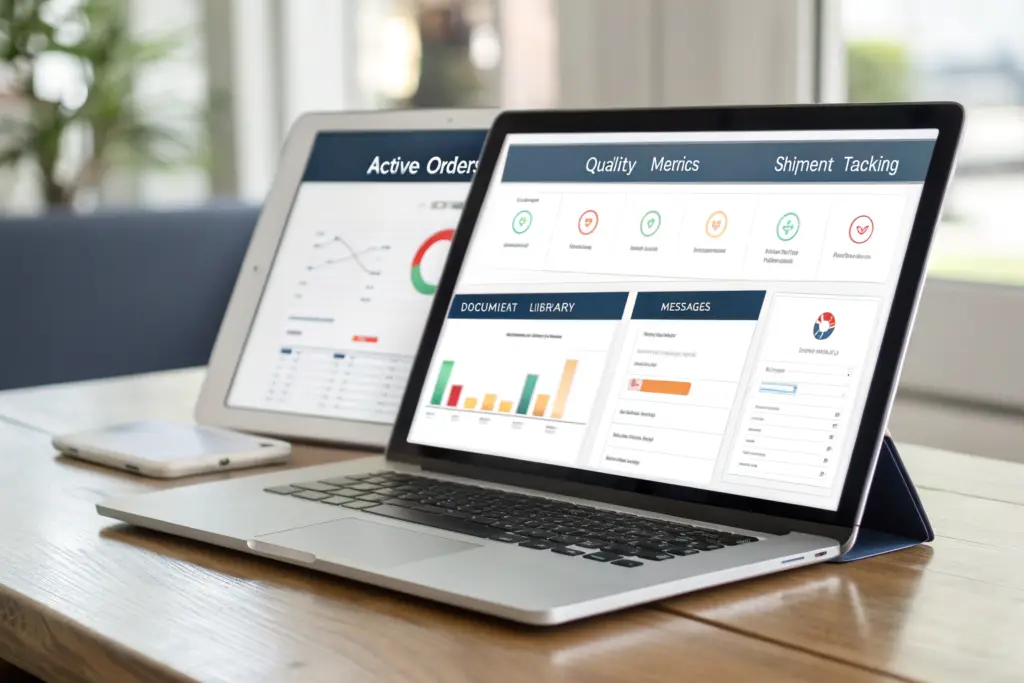
A shared digital platform for apparel production communication should include order status tracking showing the real-time stage of every active order, a document repository containing tech packs, approvals, quality reports, and shipping documents organized by order, a quality data dashboard showing inspection results, defect trends, and corrective actions, a messaging function that keeps communication threaded by order and topic rather than scattered across email inboxes, and a shipment tracker showing vessel details, estimated arrival, and customs clearance status. This platform transforms communication from a series of isolated email exchanges into a continuous, visible, auditable information stream.
What Are the Key Features of an Effective Production Tracking Dashboard?
An effective production tracking dashboard answers the four questions every brand asks about every order: Where is my order right now? Is it on schedule? What is the quality? When will it ship? The dashboard should make these answers visible at a glance without requiring the brand to compose an email or make a phone call.
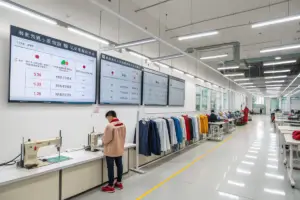
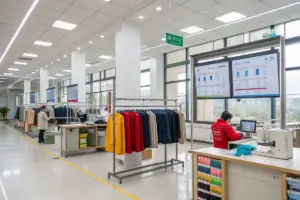
Our production tracking dashboard, accessible to our brand partners via a secure login, displays each active order with its current production stage—Pre-Production, Cutting, Sewing, Finishing, QC, Packing, Shipped—and the percentage complete within that stage. A timeline bar shows the planned schedule versus the actual progress, with visual alerts if a stage is falling behind. The quality panel shows the most recent inline inspection results with the defect rate and a trend indicator. The shipping panel shows the vessel booking status, the estimated departure date, the vessel name, and the estimated arrival date. The brand can access this information at any time, from any device, without waiting for a response from their factory contact. This production tracking software for apparel brands provides the visibility that replaces anxious inquiry with informed confidence.
How Does a Document Repository Prevent Information Loss and Confusion?
A production order generates dozens of documents: the approved tech pack, the sealing sample approval, the fabric test reports, the trim specifications, the packing list, the commercial invoice, the certificate of origin, the bill of lading. When these documents are exchanged via email, they are scattered across inboxes, lost in long threads, and difficult to retrieve when needed. Version confusion arises when an older version of a tech pack is mistakenly used for production.
Our document repository organizes every document by order, with clear version control. The brand uploads the approved tech pack to the platform. The factory accesses it there. If a revision is made, the new version is uploaded and the old version is archived. The factory always works from the current approved version. Quality reports, test certificates, and shipping documents are uploaded as they are generated. The brand can access the complete document history for any order at any time. At the end of the order, the entire document package is archived for future reference. This document management for apparel production eliminates the information loss that plagues email-based communication.
How Do Cultural and Language Bridges Strengthen Communication Accuracy?
Language barriers are the most obvious communication challenge between overseas brands and Chinese factories. Less obvious but equally important are cultural differences in communication style. A direct "no" that is normal in American business communication may be expressed indirectly in Chinese business culture, where preserving harmony and face is valued. An American brand owner who interprets indirect communication as evasiveness, or a Chinese factory manager who interprets direct criticism as aggression, will experience communication friction that damages the partnership.
Bridging cultural and language differences in factory communication requires five practices: visual confirmation where key specifications, approvals, and issues are communicated with photographs, annotated images, and video alongside text to reduce linguistic ambiguity; structured confirmation where critical communications are summarized and confirmed in writing after verbal discussions; a shared glossary of key terms where both parties agree on the specific meaning of terms like "approval sample," "inline inspection," and "shipping ready"; cultural awareness training where both parties learn the communication norms of the other’s business culture; and a single-point-of-contact model where the brand communicates through a dedicated coordinator who understands both the brand’s expectations and the factory’s operational reality.

How Does Visual Communication Reduce Misunderstandings Across Language Barriers?
A text description of a quality issue—"the collar is not sitting correctly"—is open to interpretation. The factory may interpret it differently than the brand intended. A photograph of the collar with an arrow pointing to the specific area of concern and a reference photograph of the approved sealing sample for comparison eliminates the ambiguity. The factory sees exactly what the brand sees.
We use visual communication extensively in our brand interactions. Tech pack comments are annotated on the digital pattern or the sample photograph, not just written in text. Quality issues identified during inspection are documented with photographs showing the defect, compared against the acceptable standard. Fit comments from the brand are marked up on photographs of the sample on a dress form. This visual-first approach reduces the volume of text communication required and dramatically reduces misunderstandings caused by language gaps. A brand partner recently told us that our visual communication protocol was the single most effective practice in our partnership. It removed the anxiety of "I’m not sure if they understood what I meant" that plagued their previous factory relationships. This visual communication in garment manufacturing is a simple practice with profound impact on cross-cultural communication accuracy.
Why Does a Dedicated Brand Coordinator Improve Communication Quality?
In a factory without a dedicated coordinator model, the brand’s inquiry arrives at a general sales or customer service inbox. It is routed to whoever is available. Different people handle different inquiries. Context is lost. The brand must re-explain their needs with every communication. The experience is fragmented and frustrating.
Under our dedicated brand coordinator model, each brand partner is assigned a specific coordinator who manages all communication for that brand. The coordinator knows the brand’s product line, their quality standards, their communication preferences, and their partnership history. When the brand sends a message, it goes directly to their coordinator. The coordinator either answers immediately or sources the information from the relevant department and responds. The brand always communicates with someone who knows them and their business. The coordinator becomes the brand’s advocate within the factory, ensuring their needs are understood and met. This dedicated account management in apparel manufacturing transforms the communication experience from transactional to relational.
How Should Problems Be Communicated to Build Trust Rather Than Erode It?
Problems are inevitable in garment manufacturing. Fabric arrives with a defect. A machine breaks down. A key trim is delayed. The test of a communication system is not whether problems occur but how they are communicated when they do. A factory that hides problems until they become crises, or communicates them without solutions, erodes trust with every incident. A factory that communicates problems early, honestly, and with proposed solutions builds trust with every incident, because the brand learns that the factory will not leave them in the dark when things go wrong.
Problem communication that builds trust follows the E.S.P. protocol: Early—the problem is communicated as soon as it is identified, not after it has escalated; Specific—the communication includes exactly what happened, the root cause, the impact on timeline and cost, and photographs or data documenting the issue; and Proposed Solution—the communication includes the factory’s recommended corrective action with a revised timeline, allowing the brand to respond to a plan rather than just a problem. A factory that communicates problems in this way transforms a negative event into a demonstration of reliability.

What Is the Difference Between Hiding a Problem and Managing It Before Communication?
A factory should not communicate every minor production variance to the brand in real time. A sewing machine that needs a 30-minute repair, with no impact on the delivery timeline, is an operational matter that the factory manages internally. Communicating every such incident would create noise, not transparency. The distinction is between issues that affect the brand’s outcome—delivery date, quality, cost—and issues that the factory resolves within its own operations.
The communication obligation attaches to issues that affect the brand’s outcome. A fabric defect that will reduce the yield and potentially impact the order quantity must be communicated. A trim delay that will push the shipment date must be communicated. A quality trend that requires a design or specification adjustment must be communicated. Issues that the factory resolves internally with no impact on the agreed deliverables do not require brand communication, though they should be documented in the factory’s internal quality system and available for review. This problem escalation protocols in manufacturing clarity prevents both communication overload and communication gaps.
How Should a Factory Present a Revised Timeline After a Production Disruption?
A simple statement that "the shipment will be delayed by one week" is insufficient. It provides no context, no assurance that the new date is reliable, and no options for the brand to consider. A proper revised timeline communication includes the cause of the disruption, the steps taken to resolve it, the new completion and shipment dates, the basis for confidence in the new dates, and options for the brand if the delay impacts their business—such as splitting the shipment with an air freight component for urgent stock.
When a fabric delay pushed a production start by four days, our coordinator communicated the delay immediately to the brand. The communication included the revised production schedule showing how we would recover two of the four days through parallel processing of cutting and sewing preparation, reducing the net delay to two days. We also offered the option of air freighting 20% of the order to ensure the brand’s key wholesale account received their stock on time. The brand accepted the air freight option for the urgent portion and the revised schedule for the balance. A potentially damaging delay was managed collaboratively. This supply chain disruption communication is the standard our partners expect and receive.
How Can a Brand Evaluate a Factory’s Communication System Before Partnering?
A factory’s communication system is not something a brand discovers after placing an order. It is something that can and should be evaluated during the vetting process, before any commitment is made. The factory’s response to communication-related questions during the sales process is itself a sample of their communication quality. A factory that is slow to respond, vague in their answers, or unable to describe their communication processes is unlikely to become more communicative after the order is placed.
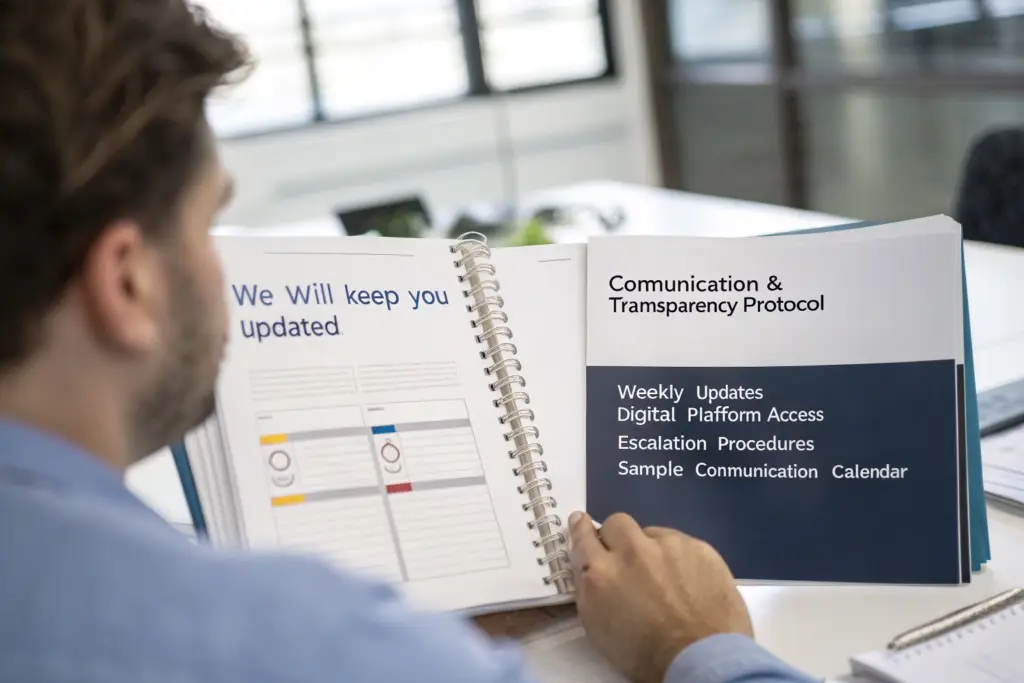
To evaluate a factory’s communication system before partnering, a brand should ask five specific questions: What is your standard communication cadence during active production, and can you show me a sample weekly update? What digital platform do you use for production tracking and document sharing, and can you provide me with a demonstration? Who will be my dedicated point of contact, and what is their experience and language capability? What is your problem escalation protocol, and can you describe a recent production issue and how it was communicated to the brand? Can you provide a reference from a current brand partner who can speak to your communication quality? A factory that answers these questions with specificity and evidence has a communication system. A factory that answers with generalities and promises does not.
What Should a Sample Communication Look Like During the Sales Process?
The sales process itself is a live demonstration of the factory’s communication practices. How quickly does the factory respond to the initial inquiry? Are responses clear, specific, and professional, or vague and generic? Does the factory ask thoughtful questions about the brand’s needs, or simply quote a price? Does the factory provide the information requested, or deflect with sales language?
A factory that responds to an inquiry within 24 hours, with specific answers to specific questions, and with additional relevant information the brand may not have thought to ask, is demonstrating the communication quality the brand can expect as a partner. A factory that takes three days to respond with a one-line email is demonstrating a different standard. We treat every inquiry as an opportunity to demonstrate our communication system in action. Our response time target for initial inquiries is within one business day. Our responses are specific, addressing each point the potential partner raised. We include relevant information about our capabilities, our processes, and our communication practices. We invite the potential partner to experience our digital platform with a guest access demonstration. The sales process is the first chapter of the partnership. We write it carefully. This evaluating factory communication during sourcing principle applies to every brand vetting a new manufacturing partner.
Conclusion
Building a transparent communication system with an overseas clothing manufacturer is not about finding a factory where nothing goes wrong. It is about finding a factory where you are never in the dark about what is happening. The weekly updates that arrive on schedule. The digital dashboard you can check at any time. The coordinator who knows your brand and responds within hours. The problems communicated early with proposed solutions. The cultural bridging practices that prevent misunderstandings. These elements constitute a communication system that transforms the brand-factory relationship from a source of anxiety into a source of competitive advantage.
At Shanghai Fumao, we built our communication system in response to the frustration we heard from brand owners who had experienced the alternative: factories that went silent after the order was placed, that communicated problems only after they became crises, and that treated communication as an interruption to production rather than an integral part of the service. We treat communication as a core deliverable, equal in importance to the garments we produce. A perfectly sewn garment delivered late, or delivered with no warning of the delay, is a failure. A garment delivered on time, with the brand informed at every stage, is a success.
If you have experienced the frustration of opaque, unresponsive factory communication, or if you are evaluating new manufacturing partners and want to experience a different standard, let us demonstrate our communication system in action. Contact our Business Director, Elaine, at elaine@fumaoclothing.com. Ask us the five evaluation questions listed above. Request a demonstration of our digital platform. Speak with a current partner about their communication experience. We will let our communication speak for itself.