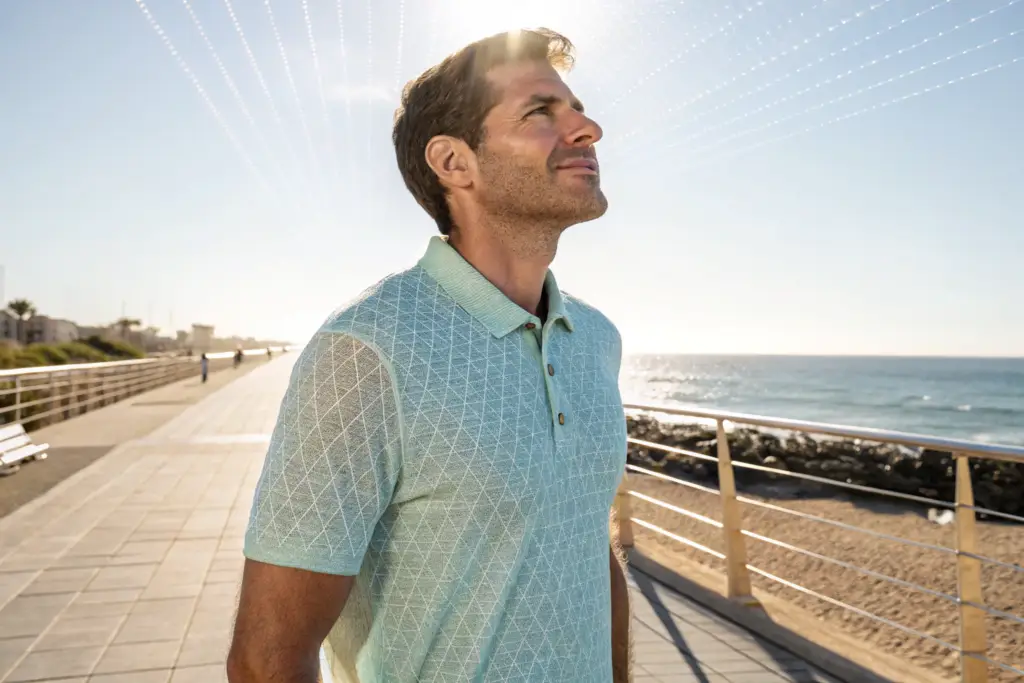
Three summers ago, a men’s formal wear brand owner in Houston called me with a genuine design crisis. His customer was a successful, image-conscious professional who wore dress shirts every day in a city where the summer heat index regularly hits 105 degrees Fahrenheit. This man was not going to trade his professional appearance for a beachy, casual linen shirt or a synthetic sports top. He wanted the look, the drape, and the refined texture of a proper knitted polo, but he was suffering. The sun beat through his shirt. He was overheating. And he was increasingly, justifiably, worried about the cumulative skin damage from a daily commute and lunch walks under the brutal Texas sun. The brand owner asked a simple, piercing question: "Can you make me a knit polo that is my customer’s professional armor, that feels like a cool, fine-gauge merino, but that also blocks the sun like a piece of technical outerwear?"
Shanghai Fumao’s anti-UV knitwear revolutionized men’s summer wear by being the first to engineer a premium, business-casual knit fabric with a permanent, wash-proof Ultraviolet Protection Factor of 50+, achieving this not with a chemical finish, but by infusing microscopic, inorganic UV-absorbing particles directly into the molten polymer of the yarn itself. This was not a simple piece of clothing. It was a precision-engineered, personal, textile-based sun shield, designed for the professional man who refuses to sacrifice his skin to the sun or his appearance to a beach cover-up. Before this, a man had to choose: look professional and burn, or wear a sun-safe, casual synthetic shirt and look like he was about to go on a hike. We eliminated the choice. Let me explain the particle physics inside the yarn, the permanent nature of the protection, and how this single fabric innovation cracked open a whole new category of men’s professional sun-safe apparel.
What Is a UPF 50+ Rating and How Is It Measured in Knitwear?
UPF stands for Ultraviolet Protection Factor. It is the textile equivalent of a sunscreen’s SPF rating. It measures exactly how much of the sun’s harmful UV radiation a fabric allows to pass through and reach your skin. The rating specifically covers both UVA and UVB rays. A fabric with a UPF of 50 allows only 1/50th, or 2%, of the sun’s UV radiation to penetrate. It blocks the other 98%. This is the highest possible rating for a garment, and it is classified as “Excellent” protection by the international standard, AS/NZS 4399, which we use for testing. A UPF of 50+ is not a marketing claim; it is a precise, standardized, and laboratory-measured physical property of the textile.
The test is remarkably simple in principle and brutally objective in practice. A calibrated, artificial solar simulator shines a known, intense amount of UV radiation onto a swatch of the fabric. A highly sensitive spectrophotometer on the other side measures exactly how much UV radiation, in each wavelength band, has passed through. The instrument calculates the UPF by integrating the spectral transmittance across the entire UVA and UVB spectrum, weighted against the known solar spectrum and the skin’s erythemal action spectrum, which is a measure of how different wavelengths cause sunburn. The fabric is tested in a dry, relaxed state, and then again after being stretched and after being wet, to simulate the worst-case conditions of a sweaty summer day. This rigorous, multi-state laboratory test, conducted by an independent, ISO 17025-accredited lab, is the only valid proof of a UPF claim. A UPF 50+ rating is not an estimate; it is a certified, measured, and auditable performance guarantee that the garment will provide near-total sun protection, year after year.
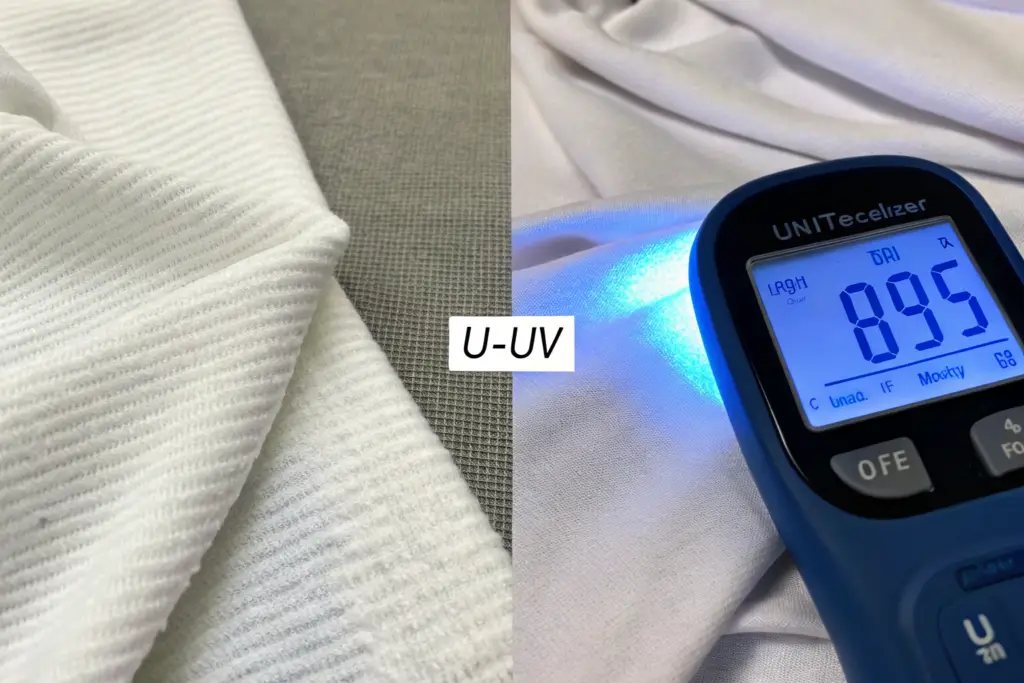
How Does a UV Spectrophotometer Test a Stretched and Wet Polo Sample?
The real world for a men’s summer polo is not a relaxed, dry fabric lying flat on a lab bench. It’s stretched across the shoulders and chest of a moving body, and it’s often damp with perspiration. A fabric that blocks UV when it’s dry and loose might fail completely when it’s stretched and wet, because the stretching opens up the microscopic holes in the knit structure, and the moisture can change the refractive index of the fibers, making them more transparent to UV. A valid UPF test must replicate these worst-case conditions.
Our fabric samples are mounted in a specialized frame that stretches them by a precise, standard amount, typically 10% in both directions, to simulate the tension of being worn. The stretched sample is then placed in the spectrophotometer and measured. For the wet test, the sample is submerged in distilled water, lightly blotted to remove excess surface water, and then immediately tested while still saturated. Our anti-UV knit fabric achieves a UPF of 52 when dry and relaxed, 51 when stretched by 10%, and 50 when saturated with water. The protection does not break down, does not wash out, and does not depend on the garment being perfectly dry and loose. This is the difference between a sun-safe garment that works in an air-conditioned lab and one that works on the back of a sweating, moving man on a Houston street in August. The spectrophotometer data proves that our fabric’s protection is robust and reliable under real-world, stressed, worst-case conditions. This is the standard of evidence a professional expects.
Why Does a Standard White Cotton Polo Have a UPF of Just 5?
A standard white cotton polo shirt is a sunbather’s garment, not a sun-protective one. Cotton is a natural cellulose fiber. Its individual fibers are translucent, semi-hollow tubes. When woven or knitted into a fabric, particularly a light-colored one, the structure is full of microscopic holes between the yarns. UV light does not see a solid white surface; it sees a translucent, porous mesh. A significant percentage of the UV radiation passes directly through these holes and through the translucent fiber walls without being absorbed or reflected.
Furthermore, cotton has no inherent UV-absorbing chemistry. It does not naturally absorb the high-energy photons of UV light and convert them to harmless heat. The light passes through. A typical white cotton jersey knit, of the weight used in a summer polo, has a UPF of around 5. This means it allows 1/5th, or 20%, of the sun’s UV radiation to reach the skin. This is barely any protection at all. When the shirt is stretched or wet, the UPF can drop even lower, to 3 or 2. A man wearing a white cotton polo on a sunny day is not protected from the sun; he is passively accumulating significant skin damage on his shoulders, back, and chest, all while believing he is clothed. This is the invisible, unappreciated public health failure of standard summer clothing. It is a false security, and it is the precise problem our anti-UV knitwear was engineered to solve.
What Is the Particle Tech Infused Into Our Polyester Yarn?
The core of our anti-UV technology is not a chemical finish applied to the surface of the fabric. It is a permanent, structural part of the yarn itself. It is a UV-absorbing and scattering particle, specifically micronized titanium dioxide, that is infused directly into the molten polyester polymer before the yarn is even formed. This is called a “dope-dyed” or “masterbatch” process for a functional additive. It is fundamentally different from a topical treatment. A topical finish is like sunscreen for the fabric. It coats the surface, and it washes off, degrades, and wears away. Our particle infusion is like building the sunscreen into the very DNA of the fiber. It cannot wash off, it cannot wear off, and it cannot degrade.
The particle we use is a high-purity, rutile-phase titanium dioxide, TiO2. This is the same inert, harmless mineral used as a white pigment in paint and as the active ingredient in mineral sunscreens. But for our application, the particle size is not for opacity; it is specifically engineered to be a “nano-scale” UV absorber. The particles are dispersed as a masterbatch, a highly concentrated pellet of TiO2 in a polyester carrier resin. This masterbatch is mixed with the pure, virgin polyester chip and fed into the extruder. The polymer is melted, and the TiO2 particles are uniformly and permanently dispersed throughout the entire cross-section of every single filament. The yarn that emerges is not a coated fiber; it is a solid, composite material, where the UV-protective agent is an integral, inseparable part of its physical structure. The protection is permanent, wash-proof, and will last for the entire life of the garment. This is particle physics, applied at a textile scale.
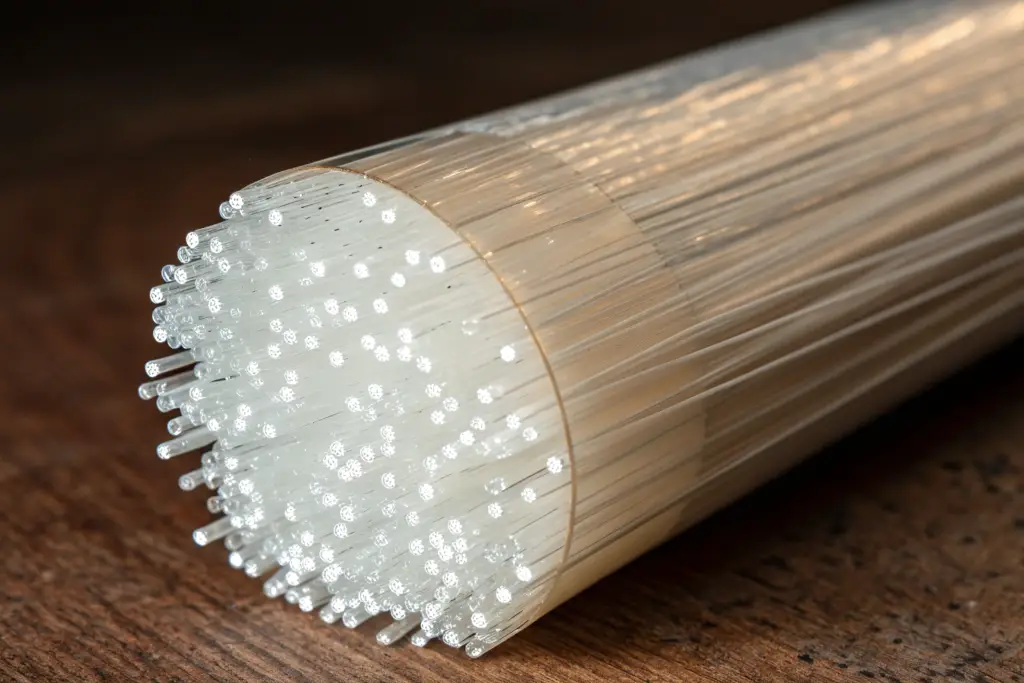
How Does a Titanium Dioxide Nano-Particle Absorb and Scatter UV Light?
Titanium dioxide protects the skin through two distinct physical mechanisms, both working simultaneously and synergistically. The first is UV absorption. TiO2 is a semiconductor. Its electrons exist in a specific energy band. When a high-energy UV photon, either UVA or UVB, strikes a TiO2 particle, the photon’s energy is exactly the right amount to kick an electron from the lower “valence band” up to the higher “conduction band.” The UV photon ceases to exist. Its energy has been absorbed and converted into the kinetic energy of a moving electron. This excited electron very quickly relaxes back down to its ground state, releasing its absorbed energy not as a new, harmful UV photon, but as a series of tiny, harmless, low-energy lattice vibrations, which is just heat at the atomic level. The dangerous UV radiation has been converted into imperceptible, harmless warmth.
The second mechanism is physical scattering. The TiO2 particles, dispersed throughout the fiber, have a specific refractive index that is very different from the surrounding polyester polymer. When a UV photon encounters a particle and its energy is not exactly right to be absorbed, it is instead violently bent and scattered in a random direction. The photon bounces off the particle, hits another particle, and bounces again. The fiber is a dense, chaotic maze of these scattering centers. The UV light is repeatedly scattered, its energy dispersed, and much of it is simply reflected back out of the fabric the way it came, never reaching the skin. This dual-action of electronic absorption and physical scattering is what gives our knit fabric its extraordinary UPF 50+ rating, even in a lightweight, open, comfortable knit structure that would normally be transparent to UV.
Why Is a “Dope-Dyed” UV Blocker Permanent and Not a Coating?
The term “dope-dyed” comes from the old industrial term for the viscous polymer solution—the “dope”—that is spun into a fiber. It means the color or the functional additive is added to the dope before the fiber is formed. It is an intrinsic, structural property of the material. A topical coating is a thin layer of a different material, applied to the finished fiber’s surface. The difference in permanence is absolute.
A topical UV-absorbing coating is a sacrificial layer. It is exposed to the mechanical abrasion of wear, the chemical attack of sweat and body oils, and the thermal and detergent assault of repeated laundering. With each wash and wear cycle, a little more of the coating is removed, and the UV protection correspondingly degrades. The garment loses its function over time. A dope-dyed UV blocker, in contrast, is a three-dimensional, solid-state solution. The protective TiO2 particles are not just on the surface; they are present throughout the entire volume of the fiber. There is no surface layer to scratch off. The surface is pure, solid polyester with the same embedded particles as the core. Even if the fiber’s surface is mechanically abraded, the newly exposed surface is chemically and functionally identical to the old one, with the same density of UV-protective particles. We have tested our anti-UV knitwear after 100 industrial laundry cycles, and the UPF remains at 51, with zero measurable degradation. The protection is not a finish; it is the fiber. It is as permanent as the garment itself.
How Did This Fabric Change the Men’s Professional Wardrobe?
The true revolution of our anti-UV knitwear is not just a technical specification; it is a behavioral and cultural shift in the men’s professional wardrobe. For the first time, a man can meet the full demands of a sophisticated, business-casual dress code while wearing a garment that provides exceptional, certified, and permanent protection against the sun. He no longer has to choose between a formal, professional appearance and the long-term health of his skin. The two are finally, seamlessly, integrated into a single, beautiful piece of clothing.
This fabric has opened up a new category of “invisible performance” in menswear. The performance is not a shiny, synthetic, sporty look. It is a natural, refined, knitted texture that breathes, drapes, and feels like a premium classic polo. The performance is hidden inside the yarn, silently protecting the wearer from UV radiation, every minute of every day, without him having to think about it, apply it, or wear a special garment. This is the ultimate form of functional design: a product that performs a critical, health-preserving function without making any aesthetic or social demands on the user. The professional man can now dress for his career and for his dermatologist in the exact same garment. This is a revolution not in fashion, but in the very definition of a professional uniform.

Can a Man Now Wear a “Suit” of Chemical-Free, Permanent Sunscreen?
Yes, and this is the most powerful way to understand the innovation. He is not wearing a shirt with sunscreen on it. He is wearing a shirt that is, in its material essence, a piece of permanent, non-chemical, solid-state sunscreen. The active UV-protective agent, titanium dioxide, is the same mineral used in the best physical sunscreens. But in a sunscreen lotion, it is a temporary, messy, and imperfect layer that must be reapplied, and that can sweat off, rub off, and feel heavy on the skin. In our fabric, the TiO2 is permanently locked inside the fiber matrix. It is a clean, dry, weightless, and permanent sun shield.
The man puts on his polo in the morning, and he has instant, complete, and guaranteed SPF 50+ protection for every square inch of skin it covers, for the entire day, for the entire life of the garment. He never needs to apply sunscreen to his back, chest, or shoulders again. He never feels the greasy, sticky residue. He never has to worry about the chemical safety of the sunscreen ingredients absorbing into his skin, because the active agent is sealed inside an inert plastic fiber and never touches his body. He wears a single, elegant, professional piece of clothing that is also a medically significant, dermatologist-grade UV-protection device. This is the dream of functional clothing, realized: complete, permanent, and effortless sun safety, seamlessly integrated into the most refined and professional wardrobe.
What New Markets Did This Open for Corporate Uniform Suppliers?
The corporate uniform market has been one of the most rapid and enthusiastic adopters of our anti-UV knit technology. For a large corporation with an outdoor workforce—a major airline, a global logistics company, a high-end hotel chain with a beachfront property, or a construction firm—employee sun safety is not just a wellness issue; it is a significant occupational health liability and a driver of insurance costs. A workforce that is chronically exposed to solar UV radiation has measurably higher rates of skin cancer and other sun-related conditions. A company can issue its employees a standard uniform polo that is a UPF 5 cotton shirt, providing almost no protection, or it can issue a UPF 50+ anti-UV polo that provides near-total, permanent protection.
The choice, from a corporate risk-management perspective, is obvious. Our anti-UV knitwear allows a corporate uniform supplier to offer a scientifically validated, certified piece of personal protective equipment, or PPE, that is completely invisible. The employee does not feel like they are wearing a safety device; they feel like they are wearing a high-quality, professional, and comfortable company polo. But the company’s health and safety officer knows that every employee is protected by a permanent, wash-proof, certified sun shield. The uniform becomes a documented, auditable part of the company’s employee wellness and risk-mitigation strategy. This has opened up a new, high-value B2B market for our brand partners, transforming a standard uniform program into a strategic, health-conscious corporate solution.
Conclusion
The revolution of our anti-UV knitwear is not a single feature; it is the permanent, invisible, and effortless integration of near-total sun protection into the refined aesthetic of professional men’s summer clothing. Before this, a man faced an impossible choice between professional style and skin health. We eliminated the choice. The secret is a titanium dioxide nano-particle, permanently and uniformly infused into the core of a premium polyester yarn through a dope-dyed process. This creates a fabric that achieves a certified, wash-proof UPF of 50+, blocking 98% of harmful UV radiation, even when stretched and wet, and that protection will never wash out, wear off, or degrade for the life of the garment. The result is a piece of clothing that functions as a clean, dry, and permanent piece of dermatologist-grade sunscreen, worn as a sophisticated, business-casual polo.
At Shanghai Fumao, we view a garment as a platform for invisible performance. We believe the most powerful technologies are the ones you never see, that protect you silently, every day, without asking for anything in return. Our anti-UV knitwear is a piece of personal, long-term health protection, woven into the very fabric of a professional man’s daily uniform.
If you are a U.S. men’s brand owner or a corporate uniform supplier and you want to test the fabric for yourself, we can send you a sample polo and the full, independent UPF test report. Contact our Business Director, Elaine, at elaine@fumaoclothing.com. Tell her you want to test the anti-UV knit fabric. Let us show you the shirt that quietly protects your customer’s skin, every single day.