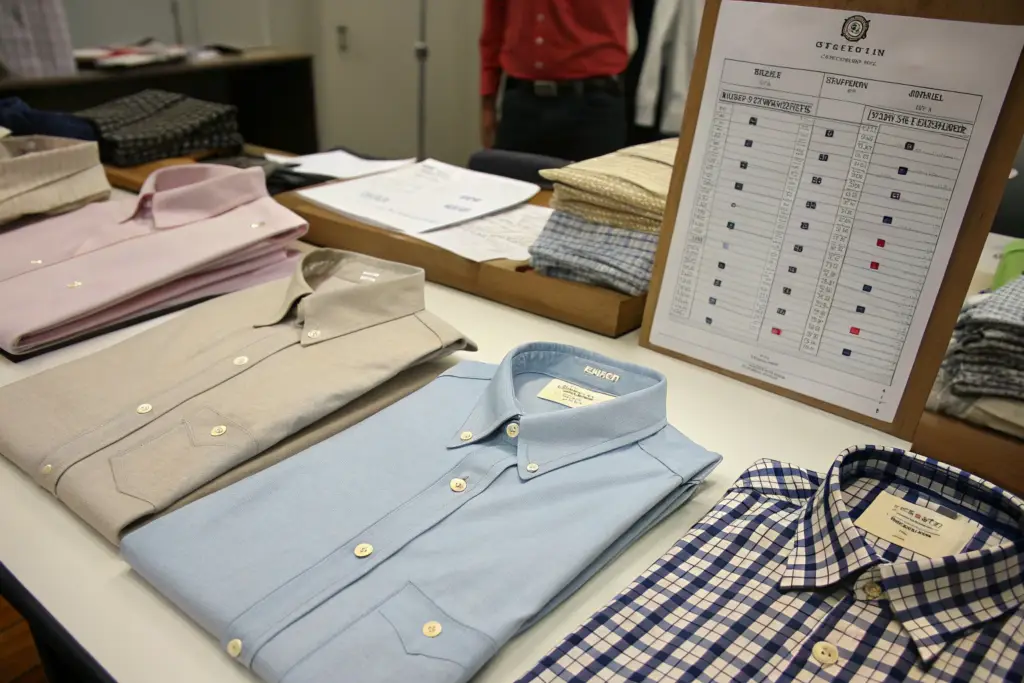
You place an order for 3,000 men's shirts. The pre-production sample is flawless. The bulk shipment arrives, and you discover that shirts from different cartons have different collar shapes, inconsistent button attachment strength, and slight but noticeable color variation. The factory produced your order across multiple lines to meet the delivery deadline. The lines did not produce the same garment. One line had a slightly different press setting. Another line used a different operator who attached buttons with different tension. The result is inconsistency that damages your brand's reputation for quality. You approved one sample, but you received five different versions of the garment.
A Chinese clothing manufacturer guarantees consistent quality across multiple production lines through a centralized quality management system that standardizes the critical production variables: pre-production sealing samples that lock specifications for every line, identical machine settings calibrated against a master reference, unified operator training programs that teach the same methods to every worker, inline quality checkpoints that catch deviations in real-time before they affect entire batches, and a final inspection protocol that verifies cross-line consistency before shipment. Quality across lines is not achieved by hoping each line supervisor does a good job. It is engineered through systems that make consistency the default outcome, not a heroic achievement.
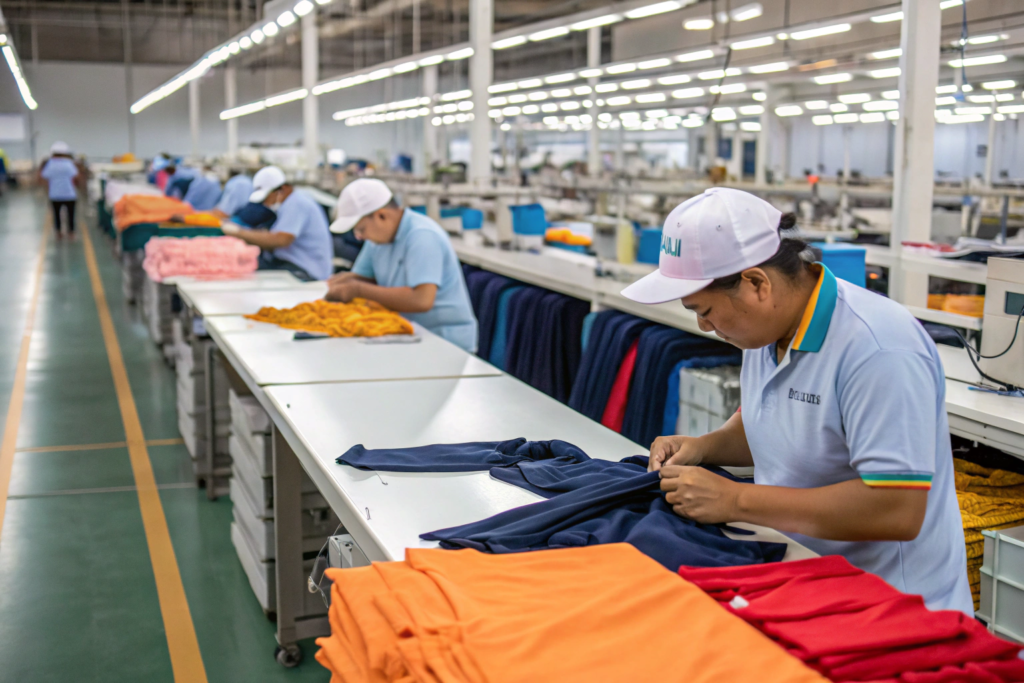
At Shanghai Fumao, our 5 production lines are not five independent factories operating under one roof. They are five synchronized units operating from a single quality playbook. Let me explain the specific systems, processes, and technologies that ensure a garment produced on Line 1 is indistinguishable from the same garment produced on Line 3.
What Is the Centralized Quality Management System That Unifies All Production Lines?
In many factories, each production line operates with its own quality supervisor, its own interpretation of standards, and its own informal practices. The result is line-to-line variation. One supervisor is strict about stitch density. Another is more relaxed. The same garment produced on different lines comes out differently. Centralized quality management eliminates this variation by replacing individual supervisor discretion with standardized, documented, and enforced quality protocols that apply identically to every line.
Our centralized quality management system is built on four pillars: a single quality manual that defines every standard, tolerance, and inspection procedure for every product category, a digital quality data platform that collects real-time inspection data from all five lines into one database, a unified quality leadership team that oversees all lines rather than assigning separate quality managers to each line, and a calibration protocol that ensures measuring tools and machine settings are synchronized across lines. This system means that a quality standard defined in the manual is executed identically whether the garment flows through Line 1 or Line 4.
How Does a Single Quality Manual Standardize Operations Across Different Product Categories?
A quality manual that says "stitches must be consistent" is not a standard. It is a suggestion open to interpretation. A quality manual that specifies "lockstitch seams on woven cotton shirting: 10-12 stitches per inch, measured with a stitch counter at three points per seam, acceptable range 10-12, below 10 is major defect, above 12 is acceptable" is a standard that leaves no room for interpretation.
Our quality manual runs to over 200 pages and covers every product category we produce. It defines the acceptable quality level for each inspection stage. It specifies the measurement points, the measurement tools, and the acceptable tolerances for every garment type. It includes photographic examples of acceptable and unacceptable conditions for common defects. Every quality inspector on every line is trained on this manual and tested on their knowledge. The manual is the single source of truth. When a dispute arises about whether a particular seam is acceptable, the manual provides the answer. Not the supervisor's opinion. Not the inspector's mood. The documented standard. This garment quality manual standards approach ensures that quality expectations are identical across all five lines because the inspectors on all five lines are reading from the same book.
How Does Real-Time Quality Data Enable Cross-Line Consistency Monitoring?
A factory that only reviews quality data at the end of the production run discovers cross-line inconsistency after the entire order is produced. The discovery is too late for corrective action. Real-time quality data, collected digitally at every inspection point and visible on a central dashboard, enables detection of cross-line variation while production is ongoing.
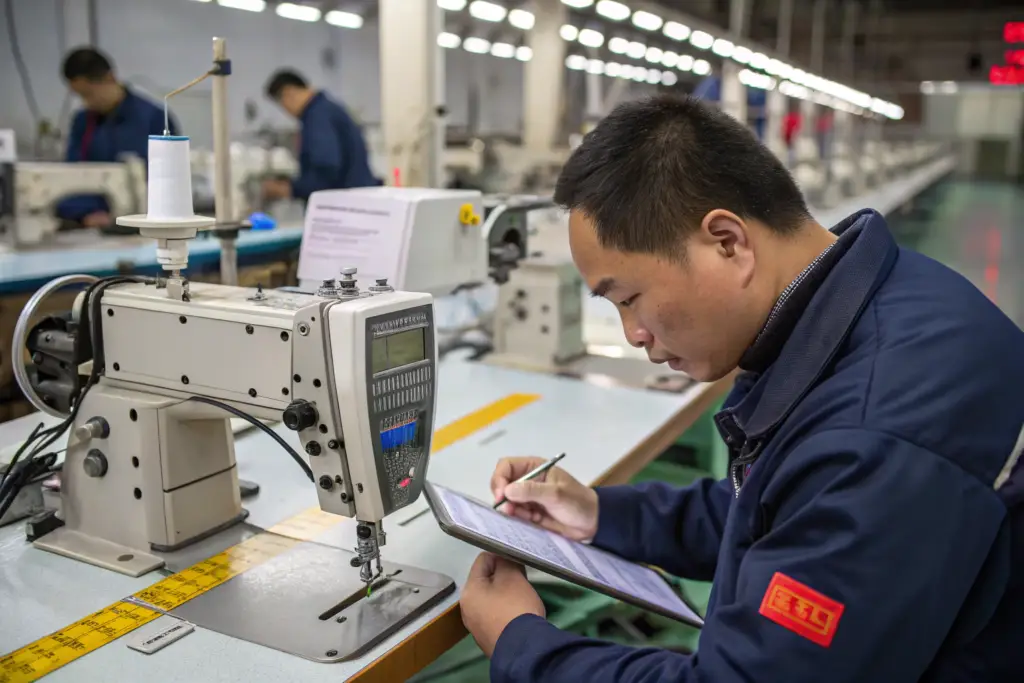
Our quality inspectors enter inspection results into tablets at each checkpoint. The data flows immediately to the central quality dashboard. The quality director can see, in real-time, the defect rate on Line 1 versus Line 3 for the same garment style. If Line 3 shows a collar point symmetry defect rate of 4% while Line 1 shows 1%, the system flags the variance. The quality director investigates immediately. Perhaps the pressing station on Line 3 has a slightly different temperature setting. Perhaps the operator on the collar station needs retraining. The issue is identified and corrected while production continues, not discovered in a post-mortem after the shipment has left. This real-time quality data monitoring capability transforms quality management from a reactive inspection function into a proactive process control function.
How Does the Sealing Sample Process Lock Consistency Before Production Begins?
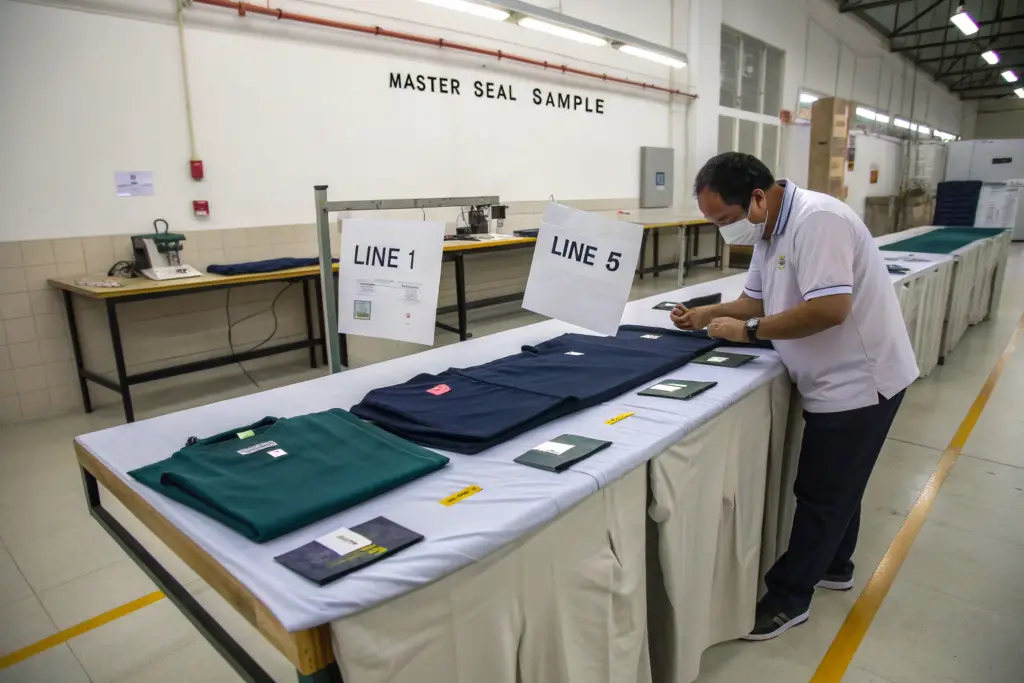
The sealing sample is the physical contract between the factory and the brand. It is the garment that the brand's designer or quality manager has approved as the definitive reference standard. Every garment produced in bulk must match the sealing sample. This sounds straightforward, but in a multi-line factory, the sealing sample must be physically available to every line, and every line must produce a pre-production sample that matches the seal before bulk cutting begins.
Our sealing sample process for multi-line consistency involves three stages: a master seal sample approved by the brand and stored in a controlled-access archive, line-specific pre-production samples produced by each line assigned to the order and compared directly against the master seal, and a line authorization gate where no line begins bulk production until its pre-production sample has been approved by the central quality team. This process ensures that every line has demonstrated its ability to match the standard before a single bulk unit is cut.
What Happens If a Line's Pre-Production Sample Does Not Match the Seal?
A line supervisor who is eager to begin production might be tempted to minimize a small discrepancy between their line's pre-production sample and the master seal. "The collar point is only 0.5mm off. The brand won't notice." This is the thinking that creates cross-line inconsistency. 0.5mm on Line 3, 0.3mm on Line 4, and suddenly the garments from different lines look different.
Our policy is absolute. If a line's pre-production sample does not match the master seal within the defined tolerance, the line does not proceed to bulk production. The discrepancy is documented. The root cause is identified—machine setting, operator technique, pressing parameter. The correction is made. A new pre-production sample is produced and compared against the master seal. Only when the sample matches the seal is the line authorized to begin bulk cutting. This policy has occasionally delayed a production start by a day. It has never allowed an inconsistent batch to reach a customer. The discipline of the gate is what protects the brand's quality consistency. This pre-production sample approval process is a non-negotiable quality control point in our multi-line operation.
How Are Sealing Samples Preserved and Referenced Throughout Production?
A sealing sample that is stored in a drawer and never looked at after production begins serves no purpose. The seal must be physically present at the production line, accessible to operators and inspectors, and actively referenced throughout the production run. Memory fades. The physical reference does not.
We produce multiple copies of the approved sealing sample for each order. The master seal is stored in our quality archive under controlled temperature and humidity to prevent fabric degradation. Reference copies are placed at the end of each production line assigned to the order, at the inline inspection station, and at the final QC station. Operators can compare their work to the seal at any time. Inspectors compare every inspected unit to the seal, not to their memory of the seal. At the end of the production run, the reference seals are returned to the archive. This practice ensures that the approved standard is physically present at every point where quality decisions are made. This sealing sample management in garment production is a simple but powerful practice that prevents the standard drift that occurs when quality decisions rely on memory.
How Are Machine Settings and Tool Calibration Synchronized Across Lines?
A stitch produced with thread tension set to 4 on one machine may look different from a stitch produced with thread tension set to 4 on another machine, if the tension dials are not calibrated identically. Machine settings are not absolute values. They are relative to the specific machine's calibration. Synchronizing quality across lines requires not just setting machines to the same numbers, but calibrating machines so that the same numbers produce the same results.
Our machine calibration protocol ensures cross-line consistency through three practices: a master calibration schedule where every machine on every line is calibrated by a dedicated technician on a fixed schedule, cross-line calibration verification where the same fabric and thread are run on machines from different lines and the output is compared, and a calibration log system that records every calibration event with the technician's identity, the date, and the measured values. These practices ensure that a tension setting on a Line 1 machine produces the identical stitch quality as the same setting on a Line 3 machine.
How Often Are Machines Calibrated, and What Triggers an Immediate Recalibration?
A fixed calibration schedule—for example, every machine calibrated monthly—is the baseline. But certain events trigger immediate recalibration regardless of the schedule. A needle break can knock a machine out of calibration. A change in fabric type may require different settings that need to be precisely dialed in. A quality inspection finding that suggests a machine-related defect—such as inconsistent stitch tension—triggers an immediate investigation and recalibration if needed.
Our calibration schedule varies by machine type and usage intensity. High-use lockstitch machines on our woven line are calibrated biweekly. Specialized machines like buttonholers and bartack machines are calibrated weekly because small deviations in these operations are highly visible to the customer. After any machine maintenance, repair, or needle change, a calibration check is performed before the machine returns to production. This industrial sewing machine calibration discipline ensures that machine-related quality variation is detected and corrected before it affects garments. It is a preventive quality practice, not a reactive one.
How Do We Verify That Calibration Translates to Identical Output Across Lines?
Calibrating machines is necessary but not sufficient. The proof of calibration is in the output. Two machines can be individually calibrated and still produce slightly different results due to subtle differences in wear, vibration, or environmental conditions. Cross-line output verification closes this loop.
For critical quality operations—collar setting, button attachment, topstitching—we periodically run a test fabric through the same operation on machines from different lines and compare the output under magnification. The stitch density, tension balance, and appearance are compared. If differences are detected, the machines are recalibrated until the output matches. This cross-line verification is performed at the beginning of each new production order that runs on multiple lines. It is a final check that the calibration process has produced genuinely consistent machine performance across the lines assigned to the order. This cross-line quality verification practice is what separates factories that calibrate machines from factories that guarantee consistent output.
How Does Operator Training and Standardization Prevent Human Variation?
The most perfectly calibrated machine in the world will not produce consistent quality if the operator feeds the fabric differently, handles the garment differently, or inspects their work to a different standard. Human variation is the largest source of quality inconsistency in multi-line production. Standardizing operator methods through training, certification, and ongoing monitoring is as important as standardizing machine settings.
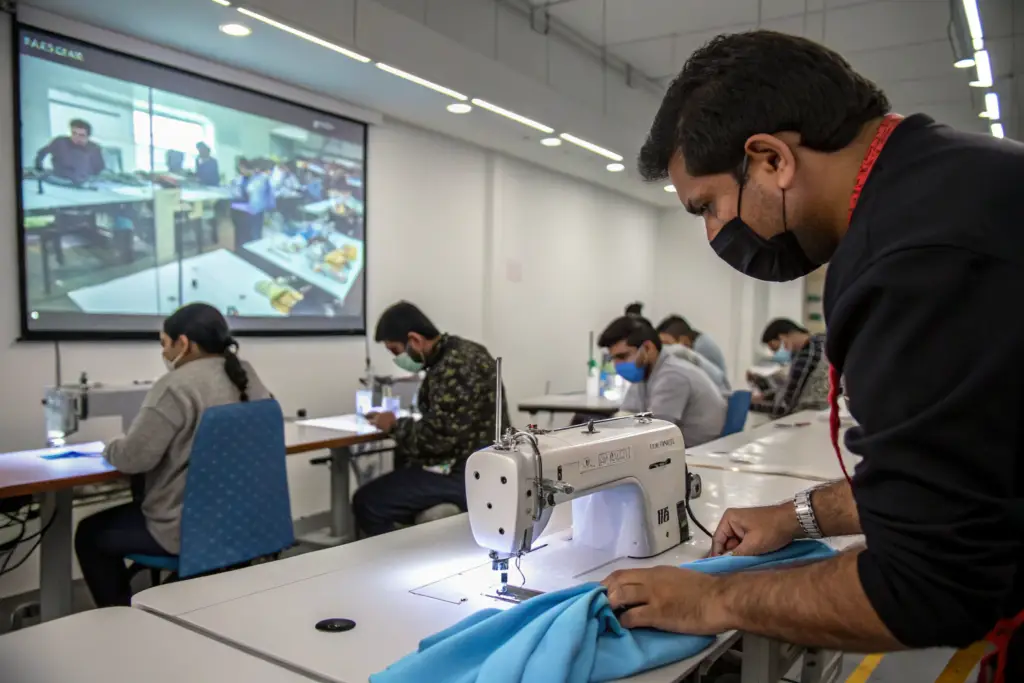
Our operator standardization program ensures cross-line consistency through three mechanisms: a standardized methods training program where every operator learns the identical technique for each operation they perform, an operator certification system where operators must demonstrate competence on each operation before working independently on production orders, and an ongoing performance monitoring system where each operator's quality data is tracked and compared to line and factory benchmarks. An operator on Line 2 performs a collar setting operation using the exact same method as an operator on Line 5.
How Does the Operator Certification System Work for Critical Quality Operations?
Not every operator is qualified to perform every operation. A newly hired operator may be skilled at basic overlock seaming but not yet qualified to set a collar on a dress shirt. The operator certification system defines which operations each operator is certified to perform and ensures that only certified operators work on quality-critical operations.
Our certification process involves a training period supervised by a master trainer, a practice period where the operator produces sample work under supervision, and a certification test where the operator must produce a specified number of units that meet the quality standard. The test is evaluated by a quality inspector, not the trainer. Certification is operation-specific, not machine-specific. An operator certified for collar setting is certified to set collars on any line, using any machine of the appropriate type. When an order requires production on multiple lines, we allocate certified operators across the lines to ensure that critical operations on every line are performed by equally qualified personnel. This operator training and certification in garment manufacturing system ensures that skill level is not a source of cross-line variation.
How Does Individual Operator Quality Data Drive Continuous Improvement?
If quality data is only tracked at the line level, a consistently underperforming operator can hide within the line average. Other operators compensate for their work during subsequent operations. The problem persists, and cross-line consistency suffers when that operator's work is compared to work from a line without an underperformer.
Our digital quality system tracks defect data to the individual operator level. When an inspector identifies a defect, the system records which operator performed the operation. Over time, each operator's quality performance data accumulates. Operators with consistently high quality are recognized and rewarded. Operators with below-standard quality receive targeted retraining on the specific operations where defects are occurring. If retraining does not resolve the issue, the operator's certification for that operation is reviewed. This operator-level quality tracking creates accountability and provides data for continuous improvement. It also ensures that when operators are allocated across multiple lines for a large order, the quality performance distribution is balanced across the lines.
How Does Final Inspection Verify Cross-Line Consistency Before Shipment?
Inline inspection catches defects during production. Final inspection verifies that the completed order, as a whole, meets the quality standard. For orders produced across multiple lines, final inspection has an additional responsibility: verifying that the output from different lines is consistent with itself. A garment from Line 1 should be indistinguishable from a garment from Line 4. The final inspector is the last line of defense against cross-line inconsistency reaching the customer.
Our final inspection protocol for multi-line orders includes a cross-line consistency check. The inspector pulls samples from cartons produced by each line and compares them side by side against the sealing sample and against each other. Key comparison points include color consistency, measurement consistency, construction detail consistency, and branding placement consistency. If variation between lines is detected, the affected cartons are quarantined, the root cause is identified, and a full re-inspection is conducted before the order is released for shipment.
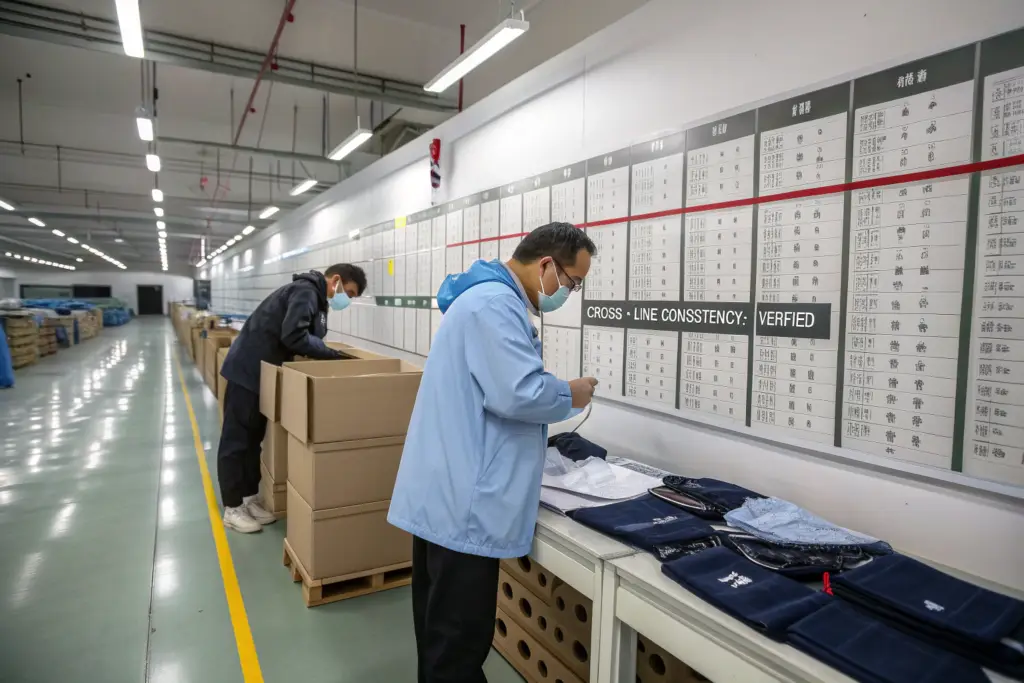
What Specific Checks Detect Cross-Line Color and Measurement Variation?
Color variation between production lines is one of the most common and most visible quality failures in multi-line production. A shirt produced on Line 1 and a shirt produced on Line 3 may use fabric from different dye lots, or may have been pressed at slightly different temperatures affecting the appearance of the dye.
Our cross-line color check uses a light booth with standardized D65 lighting. Garments from each line are placed in the booth side by side and compared by a trained color assessor. If visible color variation is detected, the extent is measured using a spectrophotometer. Garments that exceed the Delta E tolerance are quarantined. Measurement variation is checked by measuring key points on garments from each line using the same calibrated tools and comparing the measurements. If Line 3's collar points average 7.2cm and Line 1's average 7.4cm, the discrepancy is investigated even if both are within the individual tolerance range. The goal is not just conformance to specification. It is cross-line uniformity. This color consistency and measurement verification at final inspection is the last quality gate before the shipment leaves the factory.
What Happens When Cross-Line Inconsistency Is Detected at Final Inspection?
Detection of cross-line inconsistency at final inspection is a failure of the upstream processes. The inconsistency should have been caught at the pre-production sample gate, the inline inspection, or the cross-line calibration check. When it reaches final inspection, the response must be thorough because the upstream defenses have already been breached.
The affected cartons from the deviating line are immediately quarantined. The quality director conducts a root cause investigation before the line is allowed to continue production on any order. The full order is subjected to an expanded AQL inspection, with a larger sample size and a specific focus on the parameters where variation was detected. If the variation is minor and the majority of units meet the standard, the conforming units are released and the non-conforming units are reworked or replaced. If the variation is significant, the entire batch from the affected line may be rejected and reproduced. The brand or distributor is informed of the finding, the root cause, and the corrective action. This final inspection quality gates transparency ensures that the brand knows what happened and what was done to fix it, even if the issue was caught before shipment and the delivered product meets the standard.
Conclusion
Guaranteeing consistent quality across five production lines is not a matter of hiring good supervisors and hoping they do their jobs well. It is a matter of building a centralized quality infrastructure that standardizes every variable that affects garment quality: the documented standards in the quality manual, the physical reference of the sealing sample, the calibrated settings on every machine, the certified skills of every operator, the real-time data that detects variation as it happens, and the final inspection that verifies cross-line consistency before the goods leave the factory.
At Shanghai Fumao, this infrastructure is not a set of policies in a binder. It is the daily operating reality of our factory. Our quality manual governs every line. Our sealing sample process locks the standard before production begins. Our calibration protocols ensure machines perform identically. Our operator certification system ensures people perform identically. Our digital quality platform provides real-time visibility into variation. Our final inspection catches what upstream processes miss. The result is a factory where a brand can place a 5,000-unit order, have it produced across three lines to meet the delivery deadline, and receive garments that are indistinguishable regardless of which line produced them.
If you have experienced cross-line quality inconsistency with previous manufacturing partners, or if you are evaluating a factory for a high-volume program that will require multi-line production, let us demonstrate our quality consistency infrastructure. Contact our Business Director, Elaine, at elaine@fumaoclothing.com. Request our quality manual, our calibration records, and a live video walkthrough of our quality management system in action. We will show you exactly how we ensure that every garment, on every line, meets the same standard.