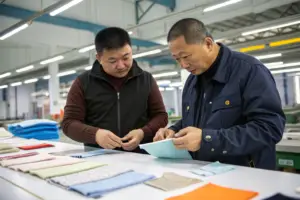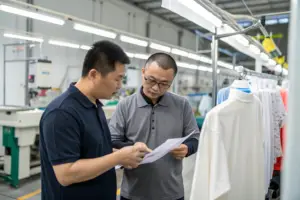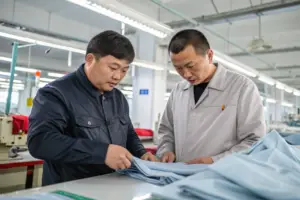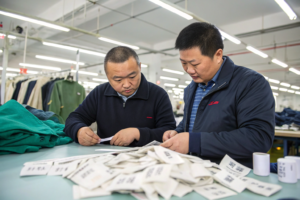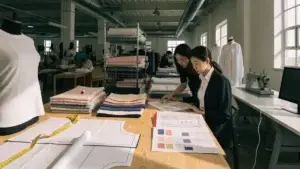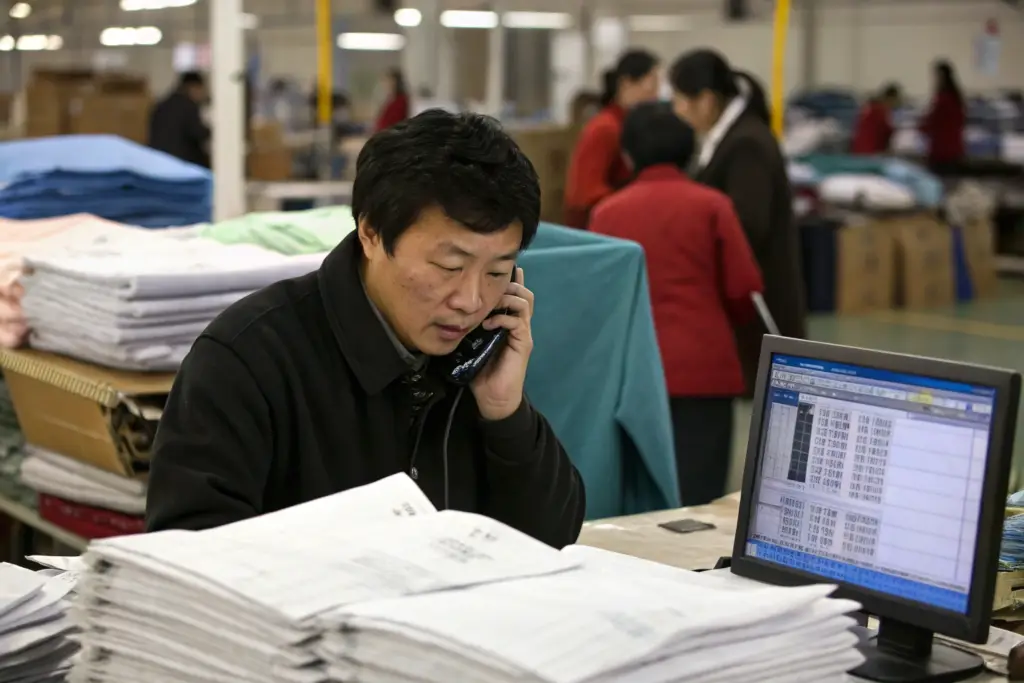
A wholesale account just called. Their best-selling linen wide-leg pant sold out in two weeks. They need 300 units restocked in six weeks, not the standard twelve. Or a celebrity was photographed wearing your pants, and your DTC site exploded with orders. You need inventory now, not next season. Or a competitor just dropped out of a key boutique account, and the shelf space is yours if you can fill it within sixty days. Rush orders are the highest-stakes moments in a brand's relationship with its supply chain. A supplier who can execute a rush order without sacrificing quality becomes a strategic partner for life. A supplier who says "yes" and then delivers late, or delivers garbage, becomes a former supplier. The question is not just "can they do it fast?" It is "can they do it fast without destroying the thing that made the pants sell out in the first place?"
Yes, Shanghai Fumao Clothing can handle rush orders for high-quality linen wide-leg pants, and we do so by activating three specific operational capabilities that most factories either lack or are unwilling to deploy: a greige fabric bank that holds pre-sourced, undyed premium linen in stock, cutting weeks off the longest lead time component; a dedicated flexible production line reserved specifically for rush orders and small-batch runs that would disrupt standard production flow; and an overtime and parallel-processing protocol that can compress a standard 60-day production cycle into 30 to 35 days for qualifying orders without compromising our French seam, enclosed edge, and multi-point QC quality standards. The quality does not change. The timeline does.
My name is Elaine. At Shanghai Fumao, I have built our production system with the explicit understanding that the fashion industry is not a steady, predictable machine. It runs on moments. A viral post. A sellout trunk show. A buyer's sudden opening. A brand that cannot capture these moments because its supply chain is too rigid is a brand that leaves money on the table. I want to explain exactly how our rush order system works, what qualifies as a rush order, what timelines are realistic, what trade-offs exist, and how we protect quality when the clock is accelerated. This is not a marketing claim. It is an operational description of a capability we have deliberately invested in.
What Is the Fastest Realistic Timeline for a Rush Order of Linen Wide-Leg Pants?
The standard production cycle for a custom linen wide-leg pant order, from fabric sourcing to ex-factory, is 55 to 65 days. This timeline is driven primarily by fabric lead time. The mill needs time to spin the yarn, weave the fabric, dye the fabric to your specific color, and ship it to the factory. This fabric procurement stage alone consumes 25 to 35 days. The remaining 25 to 30 days are for cutting, sewing, finishing, QC, and packing. To compress the total timeline, you must address the fabric stage first and the production stage second. A factory that does not have fabric in stock cannot rush an order, no matter how fast their sewing line moves.
The fastest realistic timeline for a rush order of high-quality linen wide-leg pants from Shanghai Fumao is 30 to 35 calendar days from order confirmation to ex-factory, assuming the order quantity is 500 units or fewer, the color is selected from our pre-stocked greige fabric that can be dyed within 5 days, the silhouette is a standard or adapted pattern from our existing library, and the client provides a complete, approved tech pack or selects from our in-house design catalog. This timeline can be further compressed to 25 days if the client accepts our in-stock, pre-dyed fabric colors, eliminating the dyeing stage entirely.
How Does the Greige Fabric Bank Eliminate the Longest Lead Time?
Greige fabric, pronounced "gray," is fabric that has been woven but not yet dyed or finished. It is the raw, off-loom state of the textile. The greige stage is the ideal point to hold buffer inventory because it is versatile. A roll of greige linen can become oatmeal, sage green, black, or terracotta, depending on the dye bath it enters. Once fabric is dyed, it is committed to a specific color and can only be used for orders in that color.
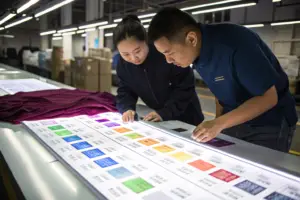
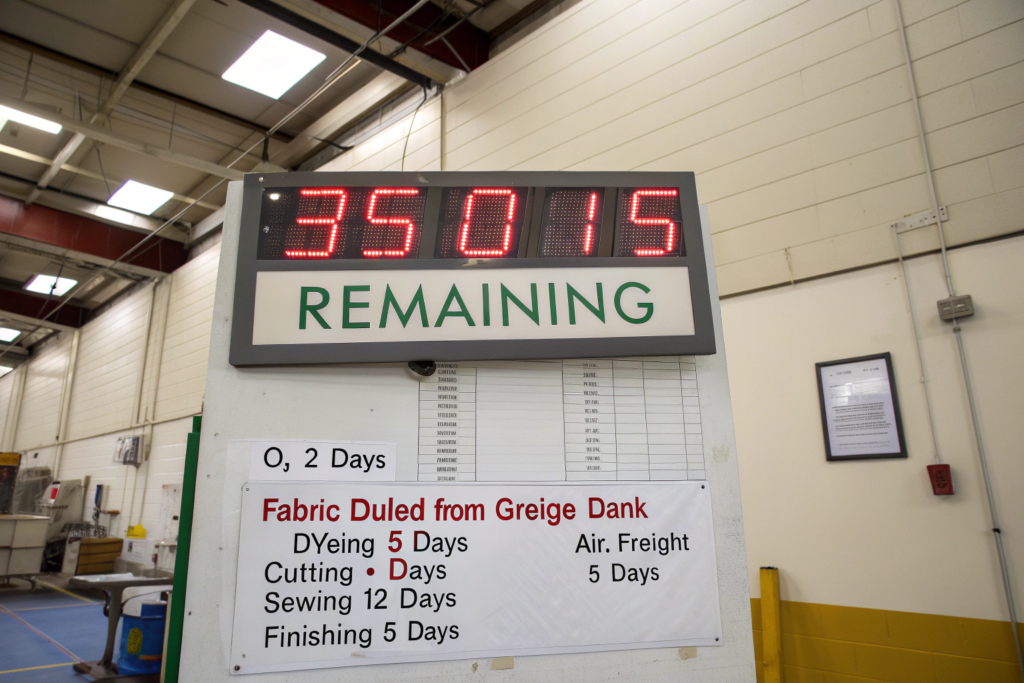
We maintain a greige fabric bank of our most popular linen qualities: a 200 GSM standard weave, a 230 GSM heavy twill, and a 180 GSM lightweight open weave. We stock these in sufficient volume to cover multiple rush orders simultaneously. When a rush order is confirmed, we pull the required meterage from the greige bank and send it to our dye house partner with a rush dyeing request. The dyeing process, which normally takes 15 to 20 days including lab dip approval, is compressed to 5 to 7 days because we use existing, pre-approved color formulations from our library. The client selects from our pre-approved color palette rather than developing a new custom lab dip. This single operational asset—the greige bank—cuts 20 to 25 days out of the standard lead time. It is the physical foundation of our rush order capability. A factory without a greige bank cannot rush an order unless they happen to have your specific dyed fabric already in stock, which is a coincidence, not a capability. The greige fabric inventory management in garment manufacturing explains how buffer stock at the greige stage optimizes flexibility and responsiveness. This is a deliberate investment in working capital. The fabric sitting on our shelves is cash we have spent in advance of orders. We make this investment because we know responsiveness is a competitive advantage our clients value.
What Order Parameters Make a Rush Order Feasible Versus Impossible?
Not every order can be rushed. The laws of physics and the limits of industrial capacity impose hard constraints. Understanding these constraints allows you to structure a rush request that is feasible, rather than demanding a timeline that is physically impossible and receiving a "yes" from a supplier who knows they will fail.
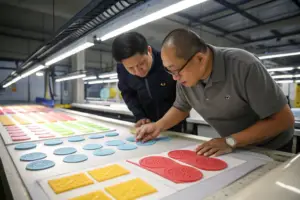
A rush order is feasible when: the order quantity is 500 units or fewer, because larger quantities cannot physically move through cutting and sewing in a compressed timeline; the color is selected from our pre-approved palette, eliminating lab dip development time; the silhouette is a standard pattern from our library or a minor adaptation of an existing pattern, eliminating pattern drafting and multiple sampling rounds; and the trim requirements are standard—YKK zippers, corozo buttons, basic labels—from our in-stock trim inventory rather than custom-developed trims that have their own lead times. A rush order is not feasible when: the order quantity exceeds 1,000 units; the client requires a custom-developed color that needs multiple lab dips; the silhouette is a completely new design requiring pattern development, muslin fitting, and multiple sample iterations; the trim requirements include custom-developed buttons, custom-printed labels, or specialized hardware with long supplier lead times. When a client requests a rush order that falls outside the feasible parameters, I do not say "yes" and hope for a miracle. I explain which parameters are breaking the timeline and offer alternatives. "We cannot rush 1,000 units. We can rush 400 units now and deliver the remaining 600 on the standard timeline." Honesty about constraints is a form of reliability. A supplier who says "yes" to everything is a supplier who will fail you when it matters most.
How Does the Rush Production Process Work Without Sacrificing Quality?
The biggest fear a brand has when requesting a rush order is that the factory will cut corners to meet the deadline. The fear is rational. Many factories, when pressured for speed, reduce stitch density, skip the relaxation stage, use a faster but weaker seam type, or rush the QC inspection. The product looks acceptable in the polybag but fails after three washes. The brand's reputation absorbs the damage. A rush order capability that destroys quality is not a capability. It is a liability.
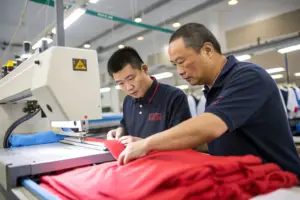
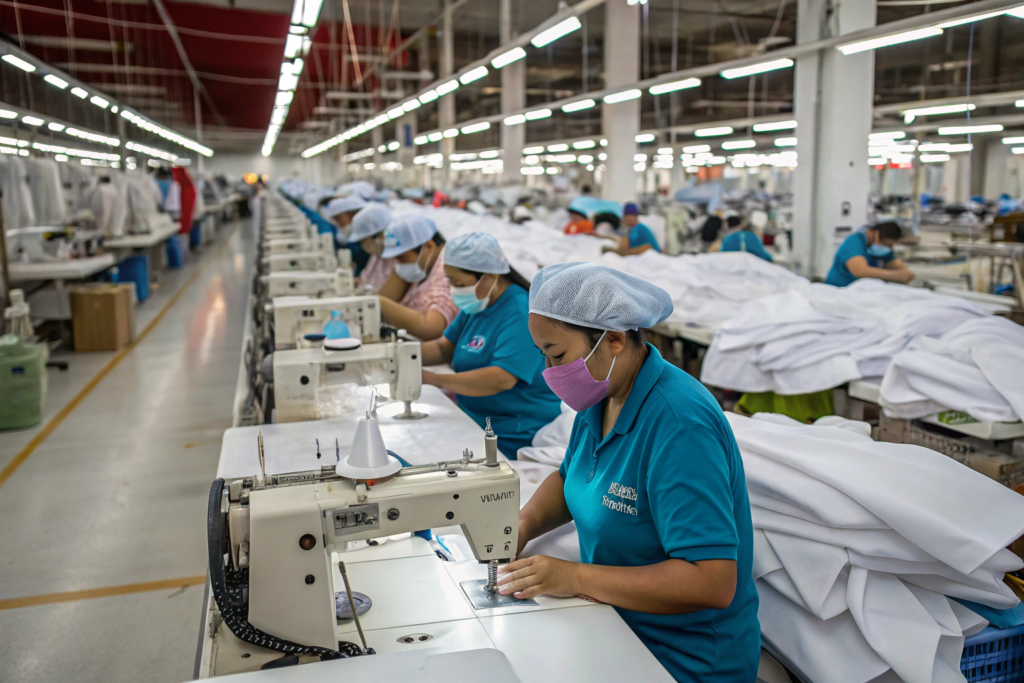
Our rush production process protects quality through structural separation, not through hoping that workers will "try harder." Rush orders are assigned to a dedicated small-batch production line that is not shared with standard orders. The rush line is staffed by our most experienced sewers, who are cross-trained on complex linen constructions. The line supervisor performs in-line QC checks at double the standard frequency. The final QC inspection uses the same AQL 2.5 standard and the same checklist as standard orders. The only thing that changes is the allocation of dedicated, premium resources. The quality standard is non-negotiable.
When a standard production line is asked to absorb a rush order on top of its scheduled work, the line supervisor faces an impossible choice: meet the rush deadline by speeding up all work, including the standard orders, or protect the standard orders and let the rush order fail. Either choice produces a quality problem. The line is not designed for variable speed. It is designed for a steady, optimized pace.
A dedicated rush line solves this by isolating the time pressure. The rush line has its own machines, its own workers, its own supervisor, and its own QC inspector. It runs at an accelerated but controlled pace, with the supervisor authorized to slow down any operation that is producing defects. The standard lines continue at their normal pace, unaffected. This separation is expensive. It means we maintain a small production line that is not always fully utilized. It sits idle or runs small replenishment orders when there are no rush orders. The cost of this idle capacity is an investment we make in our ability to say "yes" to rush requests without compromising our existing commitments. When a brand places a rush order with us, they are not stealing capacity from another client. They are using capacity that was deliberately held in reserve for exactly this purpose. The dedicated small-batch production lines in agile manufacturing concept explains how separating high-variability, high-urgency work from standard production protects quality across both streams. It is a structural solution, not a motivational one. You cannot motivate quality into a system that is designed for conflict. You have to design the conflict out of the system.
What In-Line QC Adjustments Protect Quality at Accelerated Speed?
Standard production runs one in-line QC check per day per line. The QC inspector walks the line, pulls samples from each operation, checks critical measurements and seam quality, and provides feedback to the supervisor. On a standard timeline, a defect that emerges at 10 AM is caught by 3 PM, and perhaps 20 defective units are produced in the interim.
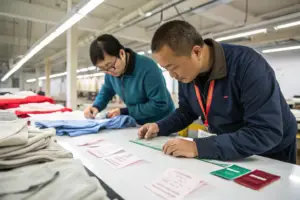
On the rush line, the in-line QC frequency is doubled. The inspector checks the line every two hours instead of once per day. This means a defect is caught within two hours and within a much smaller batch of affected units. The corrective feedback loop is tighter. The supervisor adjusts the machine setting or retrains the operator immediately. This tighter feedback loop is what prevents the accumulation of defects that happens when speed increases. It is a statistical quality control principle: the faster the production rate, the higher the inspection frequency must be to maintain the same outgoing quality level. We also increase the percentage of garments receiving a full measurement audit. On standard orders, we measure 10% of finished garments against the spec sheet. On rush orders, we measure 20%. This higher audit rate catches size drift earlier, before it affects the entire order. The statistical process control in garment manufacturing explains the relationship between production speed, inspection frequency, and outgoing quality. The principle is simple, but implementing it requires a QC team that is resourced and authorized to slow down production if quality deviates. In many factories, the QC team reports to the production manager, whose bonus depends on output volume. In our factory, the QC team reports independently to the quality director, whose bonus depends on defect rate. This organizational separation is as important as the inspection frequency. A QC inspector who can be overruled by a production manager chasing a deadline is not a quality control. They are a quality spectator.
What Rush Order Options Exist for Different Budget and Timeline Scenarios?
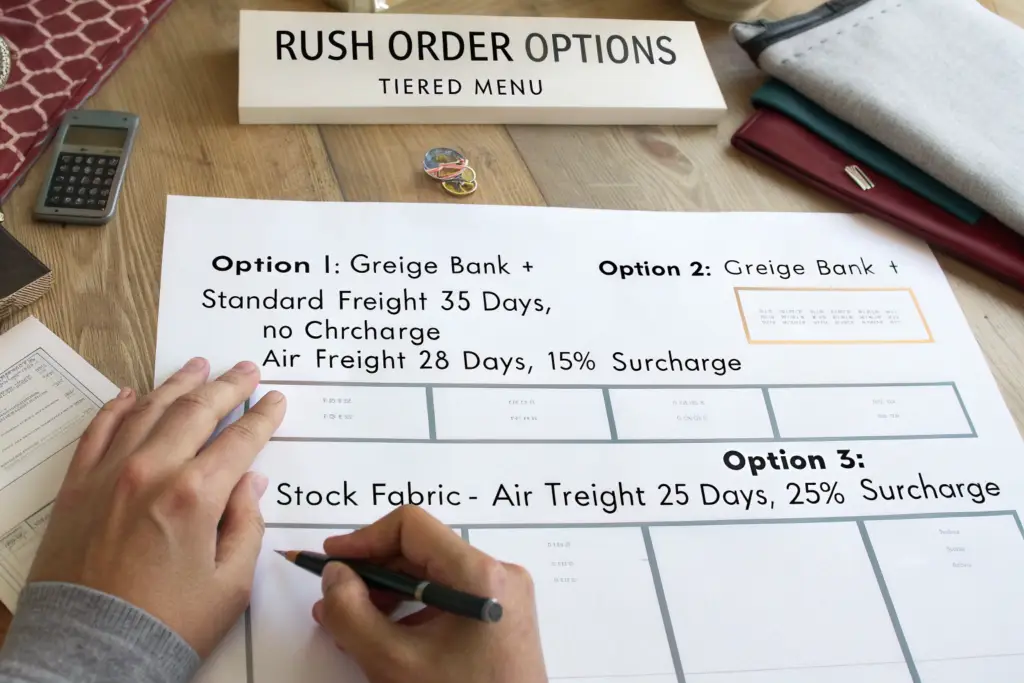
Not every rush is equally urgent, and not every brand has the same budget flexibility. A brand facing a six-week gap in inventory has different needs and different willingness to pay than a brand facing a three-week gap. A binary "yes we can" or "no we can't" is not a useful supplier response. A useful response is a menu of options, each with a different timeline, a different cost, and a different trade-off. The brand chooses the option that best fits their specific situation. The supplier executes the chosen option without renegotiation.
Shanghai Fumao offers three rush order tiers. Tier One: Greige Bank + Standard Ocean Freight. Timeline is 30 to 35 days to ex-factory, plus 25 to 35 days ocean transit. No rush surcharge on the production cost. Best for brands with a 60 to 70-day window. Tier Two: Greige Bank + Air Freight. Timeline is 30 to 35 days to ex-factory, plus 5 to 7 days air transit. A 15% rush surcharge applies to cover overtime labor and dedicated line allocation. Best for brands with a 35 to 42-day window. Tier Three: Stock Fabric + Air Freight. Timeline is 20 to 25 days to ex-factory if the client accepts our in-stock, pre-dyed fabric colors, plus 5 to 7 days air transit. A 25% rush surcharge applies. Best for absolute emergencies with a 25 to 32-day window.
What Are the Cost Implications of Each Rush Tier?
Speed costs money. The question is how much, and whether the cost is justified by the revenue or brand protection the speed enables. A transparent cost structure allows you to make that calculation rationally.
Tier One, the Greige Bank with standard ocean freight, has no rush surcharge on the production cost. The greige bank is a pre-existing asset. The dyeing is accelerated but uses existing color formulations. The sewing line is the standard line, not the dedicated rush line. The only accelerated component is the fabric dyeing. We absorb this acceleration cost as a service to regular clients. The FOB price is the standard FOB price. The total cost is the FOB plus ocean freight. Tier Two, the Greige Bank with air freight, adds two cost components. The production surcharge of 15% covers the overtime wages for the dedicated rush line workers and the supervisor, plus the expedited dyeing. The air freight cost is separate and is charged at cost based on the volumetric weight of the shipment. Air freight typically costs four to eight times more than ocean freight. For a 300-unit order of linen wide-leg pants, the air freight might be $1,200 to $1,800 compared to $300 to $500 for ocean freight. Tier Three, the Stock Fabric with air freight, has the highest surcharge because the stock fabric was pre-dyed at our cost and held in inventory, tying up working capital. The 25% surcharge covers this inventory carrying cost, the overtime production labor, and the priority scheduling that may defer another client's order. The air freight cost is additional. A brand should only choose Tier Three when the revenue opportunity or brand protection need is existential. The rush order cost structure in apparel manufacturing explains the components that drive rush premiums. A transparent supplier will show you these components. An opaque supplier will quote a high number and hope you do not ask how it is calculated.
How Do You Decide Which Tier Is Right for Your Specific Situation?
The decision framework is a calculation of the cost of being out of stock versus the cost of the rush premium. If a stockout costs you $5,000 in lost profit and a Tier Two rush order costs you $1,500 in surcharges and air freight, the decision is financially straightforward. You place the rush order.
If the stockout cost is less clear—perhaps it is a new style and you are uncertain of the demand—then Tier One, which has no surcharge, is the safer financial choice even if it means being out of stock for a few additional weeks. The product will arrive, the quality will be uncompromised, and you will have paid no premium. The framework also depends on the nature of the sales channel. A DTC brand with a waitlist of customers who have already paid has an urgent need and a clear revenue number attached to the rush. Tier Two or Tier Three is easily justified. A wholesale brand with a boutique account that is willing to wait four weeks for a replenishment can choose Tier One. The boutique values the relationship and the product quality over the speed. The inventory stockout cost calculation for fashion brands guide provides a methodology for quantifying the cost of being out of stock. Assign a dollar value to the stockout. Compare it to the rush surcharge. Make a data-driven decision. A good supplier will help you with this calculation, not pressure you into the most expensive option. At Shanghai Fumao, I often advise clients to choose a slower, less expensive tier when the rush premium is not justified by the stockout cost. I want clients who are profitable and long-term, not clients who pay a high surcharge once and then regret it.
Conclusion
Rush orders for high-quality linen wide-leg pants are feasible when the supplier has invested in the structural capabilities that make speed possible without sacrificing quality. A greige fabric bank that holds undyed premium linen in stock cuts the longest lead time component by twenty days. A dedicated, separate rush production line staffed by experienced sewers and supervised with double-frequency in-line QC protects quality from the corner-cutting that happens when speed is imposed on a standard line. A transparent, tiered menu of rush options—ranging from a no-surcharge, greige-bank-plus-ocean-freight tier to a premium, stock-fabric-plus-air-freight tier—allows brands to match their urgency and their budget to the appropriate solution.
At Shanghai Fumao, we built these capabilities because we understand that the fashion business is not a steady, evenly paced machine. It is a series of moments. The brand that can capture a moment—a sellout, a viral post, a buyer opening—builds momentum. The brand that watches the moment pass because its supply chain is too rigid loses more than a single order. It loses the compounding energy of sequential wins. We want our clients to capture their moments.
If you are facing a stockout emergency, or an unexpected wholesale opportunity, or a sudden spike in demand, and you need a realistic, honest assessment of what is possible, contact me. My name is Elaine. My email is elaine@fumaoclothing.com. Tell me the quantity, the silhouette, the color, and the date you need the goods in your warehouse. I will give you a clear answer, a tiered menu of options with costs and timelines, and a commitment to deliver what I promise. Your moment is waiting. Let's capture it together.