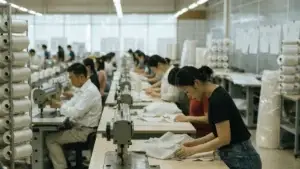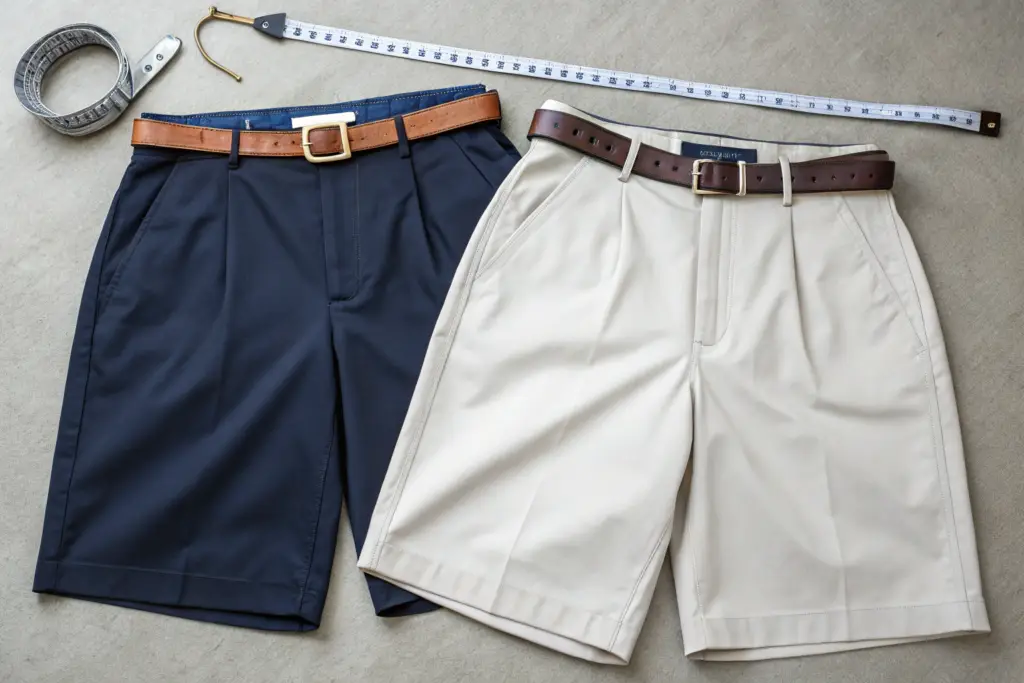
A few months ago, I was on a video call with a brand owner from Texas. He had built a successful e-commerce label selling casual, elastic-waist shorts. Comfortable, easy, and selling steadily. He called me because he wanted to expand into a "classic tailored short" for an older demographic. I sent him a tech pack with a standard waistband, a zipper fly, and five belt loops. He stared at the drawing and said, "Do I really need the belt loops? My customer hasn't worn a belt in ten years." I paused. It was a genuinely good question. For decades, we have treated belt loops as an automatic, non-negotiable component of any short positioned as "classic." But the American male consumer is not a monolith. His waistband expectations are splitting along lines of age, occasion, and regional culture, and a brand that blindly adds belt loops without understanding these fractures is designing for a customer who may no longer exist.
Belt-loop shorts remain a non-negotiable requirement for a large and commercially powerful segment of the American male consumer, specifically men over 40 who wear shorts in smart-casual and golf-adjacent social settings, but a rapidly growing younger demographic has abandoned belt loops entirely in favor of drawstring and elastic waistbands, meaning that a brand's decision must be driven not by a universal rule but by a precise analysis of their target customer's age, geographic region, and the social context in which the shorts will be worn.
At Shanghai Fumao, we cut and sew thousands of pairs of shorts every month for American brands, and our order book tells a story that flat fashion trend reports miss. We see regional demand patterns that show belt-loop shorts dominating the Southeast and Midwest, while West Coast and Northeast brands increasingly request completely unstructured waistbands. This is not a simple yes or no question. It is a market segmentation problem. Let me unpack the data, the psychology, and the manufacturing trade-offs so you can make this decision with clarity.
Why Do Belt Loops Still Dominate Traditional Men's Shorts?
I have a clear memory from 2015. We were producing a run of classic chino shorts for a department store private label. The buyer sent back an entire pre-production sample because we had placed the belt loops at five centimeters apart instead of the standard six. I was frustrated at the time, but he explained something that stuck. His customer, a 55-year-old man in Georgia, would try the shorts on in a fitting room. He would thread his leather belt through the loops. If the spacing felt off, if the belt bunched the fabric, he would put the shorts back on the rack. The belt loop was not a design detail to this customer. It was a functional requirement as essential as the zipper fly.
Belt loops persist as a dominant feature in classic men's shorts because they serve an unspoken psychological function for an older demographic, signaling formality, preparedness, and a visual completion of the outfit that is inextricably linked to the habit of tucking in a shirt, a practice that remains common among men over 40 in professional and Southern social environments.
How Does the "Tucked-In Shirt" Habit Drive Belt Loop Demand?
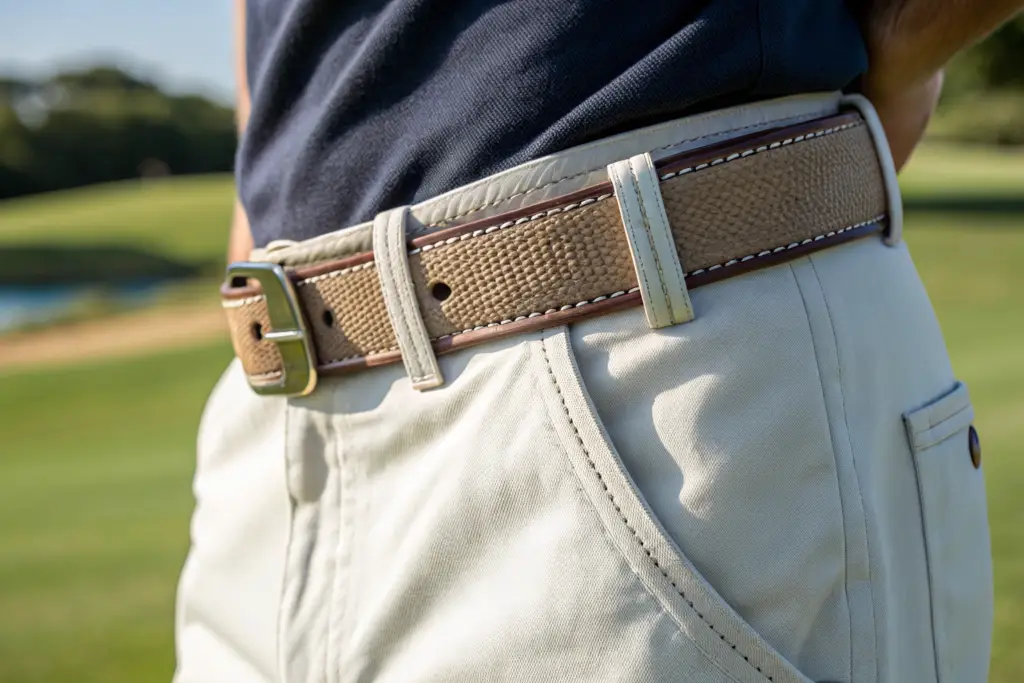
The single most predictive factor for whether a man demands belt loops is whether he tucks in his shirt. This habit is generational. Men who entered the workforce in the 1980s and 1990s were socialized into a dress code where a tucked-in shirt, held in place by a belt, was the baseline standard for any situation above poolside casual. Even when those same men retired or shifted to casual settings, the habit remained physically ingrained.
When a man tucks a polo shirt or a casual button-down into a pair of shorts, the waistband becomes a focal point. It is the visual transition line between the upper and lower body. An exposed elastic waistband with a drawstring looks, to this customer, like underwear. It signals incompleteness. A flat waistband with belt loops, even without a belt, looks intentional and finished. The belt also serves a functional body-shaping purpose. As men age, their waist-to-hip ratio often changes. The waistband of a short may fit comfortably while standing but gap slightly when sitting. A belt solves this instantly, providing adjustable tension that an elastic waistband cannot match in terms of a clean, tailored look. Research into menswear dressing habits consistently affirms the belt as the foundational accessory of classic menswear. For a brand targeting the over-45 demographic in regions like the American South, where the classic menswear rules are still strongly observed, a short without belt loops is not a design innovation. It is a product that fundamentally does not meet the customer's minimum functional requirement.
What Regional Differences Exist in Belt Loop Preference?
If you overlay a map of belt-loop demand on a map of the United States, the pattern is striking. Our order data at Shanghai Fumao shows that brands selling into the Southeast, Texas, and the Midwest order belt-loop shorts at a ratio of roughly eight to one over loop-free styles. Brands selling into California, Oregon, Washington, and the urban Northeast order loop-free or elastic-waist shorts at nearly the inverse ratio.
This is not random noise. It reflects deep cultural differences in social signaling. In the South, dressing well is a communal value. Men dress for church, for Sunday brunch, for football tailgates, and for the golf course. In each of these settings, a tucked-in shirt and a leather belt are part of the uniform. The shorts are expected to complete that uniform faithfully. In Southern fraternity culture on college campuses, the uniform of a tucked-in oxford shirt, a needlepoint belt, and chino shorts is so standardized that a short without belt loops would simply not be purchasable by that market segment. Conversely, in Los Angeles or Brooklyn, the social signaling runs in the opposite direction. Effortless, unbelted ease is the aesthetic ideal. A belt, to this customer, can read as stuffy or trying too hard. These regional fashion differences mean that a national brand with a single SKU strategy faces a real trade-off. A brand must analyze its core geographic customer base using zip code data from its e-commerce platform. The answer to the belt-loop question is likely sitting in the order history. If 70% of revenue comes from Texas, Florida, and Alabama, belt loops are a requirement. If the coastal cities dominate, they are optional.
When Did Elastic and Drawstring Waistbands Become Mainstream?
I remember the exact year the drawstring short broke out of gym locker rooms and into mainstream casual fashion. It was around 2017. Before that, our factory produced elastic-waist shorts almost exclusively for athletic brands and private-label pajama programs. Then, almost simultaneously, three of our streetwear-leaning brand clients asked us to develop a tailored-looking short with a chino-weight cotton fabric and a full elastic waistband with a drawstring. My pattern maker was confused. "So, dress shorts with pajama waistbands?" He was not wrong. But the customers loved them.
The mainstream acceptance of elastic and drawstring waistbands on classic shorts is a direct consequence of three converging cultural forces: the post-pandemic permanent shift toward hybrid work and home-centric lifestyles, the sneakerhead and streetwear culture that elevated comfortable silhouettes to high-fashion status, and the athleisure industry's success in marketing stretch comfort as a premium innovation rather than a cheap shortcut.
How Did the Pandemic Accelerate the Death of the Rigid Waistband?
The COVID-19 pandemic did not just change where people worked. It changed the physical sensations they would tolerate on their bodies. Millions of American men spent two years working from home in elastic-waist joggers and drawstring shorts. Their bodies adapted to a new baseline of physical comfort. When they eventually returned to social settings and retail shopping, the old rigid waistband felt, for the first time, restrictive and uncomfortable.
Retail data confirms this shift. The market for comfort-driven apparel exploded during and after 2020, and it has not retracted. Men who discovered that they could wear a short with the tailored appearance of a chino but the comfort of a sweatpant were reluctant to go back. This created a massive opening for hybrid designs. At Shanghai Fumao, we developed a short with a flat front, a buttoned closure, and side pockets that looked identical to a classic chino from the front, but with a fully elasticated back waistband hidden underneath a fixed waistband front. The customer sees a belt-loop short. His body feels an elastic short. This type of hybrid waistband design is now one of our most requested constructions for brands targeting men aged 30 to 50 who want to maintain a polished appearance without physical discomfort. The rigid waistband is not extinct, but its monopoly is broken.
What Role Did Sneaker Culture Play in Waistband Trends?
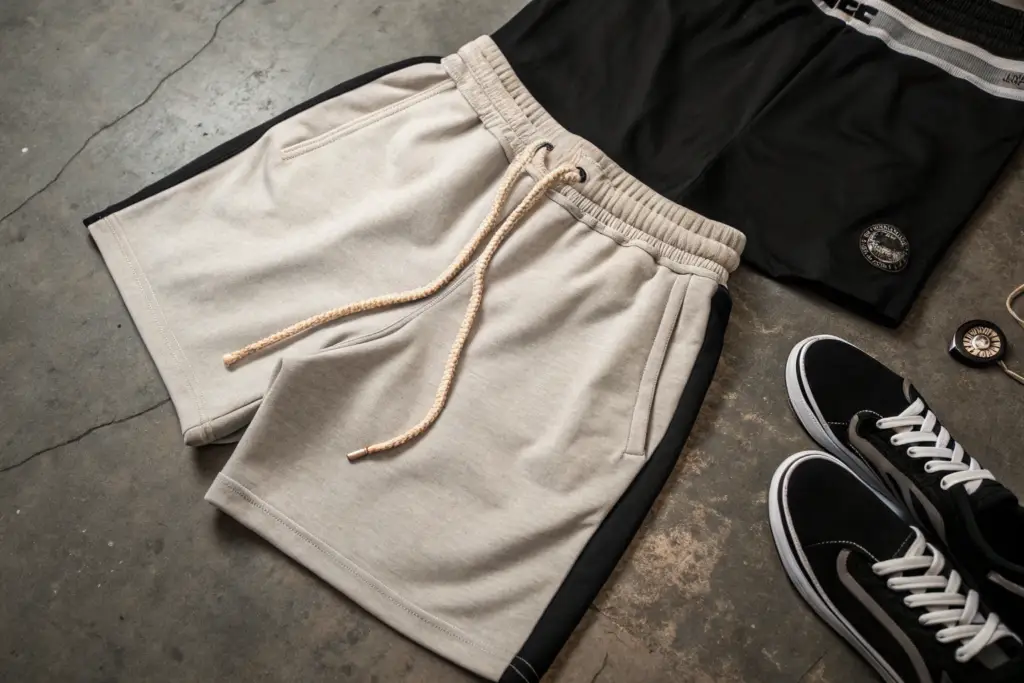
The belt has always been the companion of the leather shoe. The drawstring is the companion of the sneaker. As sneaker culture ascended from subculture to global dominant fashion force, it dragged waistband design along with it. A limited-edition Air Jordan or a Yeezy does not look right when paired with a stiff leather belt and a structured waistband. The visual language of sneakers demands ease, flow, and a slight drop-crotch silhouette that rigid shorts cannot deliver.
Young men who invest heavily in sneakers build their entire outfit around the footwear. The short must be a quiet canvas, not a competing structured element. A drawstring waistband achieves this subordination. It also aligns with the oversized, relaxed fit trends that dominate streetwear fashion. This cultural shift has pushed brands like Fear of God Essentials and Represent to build entire short programs around heavyweight cotton jersey, dropped crotches, and prominent drawstrings. These are not gym shorts. They retail for $80 to $150 and are worn to brunch, to casual dates, and in creative workplaces. The drawstring has become a legitimate design signifier, not a cost-cutting compromise. The sneaker and fashion connection has permanently blurred the line between athletic and casual wear, and the waistband is the primary architectural element where this blurring is most visible. A brand ignoring drawstrings is ignoring the largest fashion trend of the last decade.
How Does Waistband Choice Affect Production Cost and Retail Price?
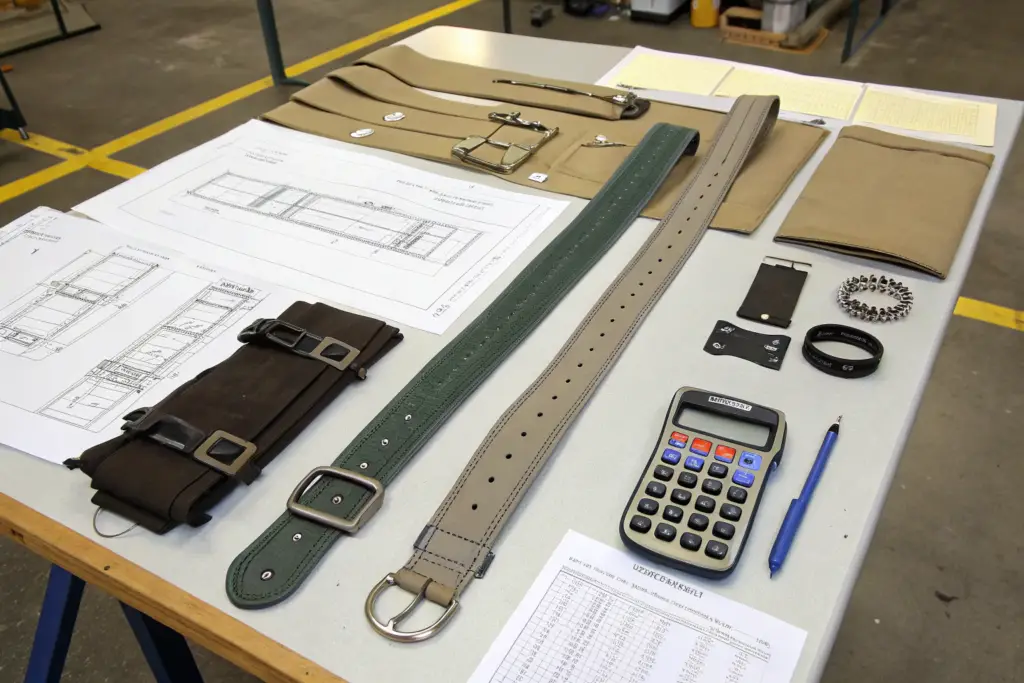
I have watched brand owners agonize over a 50-cent difference in fabric cost while ignoring a $2.00 difference sitting right on the waistband. The waistband of a pair of shorts is the most labor-intensive component to construct. When you choose between a belt-loop waistband and an elastic waistband, you are not just making a design decision. You are making a significant cost decision that flows directly to your FOB price and your retail margin. I have seen brands make the wrong choice for their target market simply because they did not understand the manufacturing math.
The choice between a belt-loop waistband and an elastic drawstring waistband directly impacts production cost, with a traditional belt-loop waistband requiring roughly 30% to 40% more sewing labor minutes, more components including interlining, buttons, and zippers, and more complex quality control checks, typically adding $1.50 to $3.00 to the FOB cost of the short compared to a simple elastic waistband, a difference that can either erode margin or justify a higher retail price depending on the brand's positioning.
What Are the Labor Costs of Constructing a Belt-Loop Waistband?
To understand why belt loops cost more, you have to walk onto the sewing floor and count the operations. A standard five-loop waistband on a classic short is not one sewing step. It is a sequence of independent operations, each requiring a different machine, a different operator, and a different quality check.
Let me break down the actual production sequence. First, the waistband fabric strip must be cut, fused with interlining, folded, and topstitched. Second, the belt loops are cut, folded, edge-stitched, and then cut into individual five-inch lengths. Each loop end must be folded under and pressed. Third, each individual belt loop must be positioned precisely on the waistband and secured with a bar tack machine, a specialized heavy-duty machine that stitches a dense zigzag to hold the loop against tension. For five loops, that is ten individual bar tacks. Fourth, the waistband is attached to the short body with a lockstitch machine, and the zipper fly is inserted in a separate operation. Finally, the waistband is closed, the buttonhole is created on a dedicated buttonhole machine, and the button is attached with a button-sewing machine. Each of these steps requires a skilled operator. The total sewing time for a belt-loop waistband assembly can range from 12 to 18 minutes per unit, depending on the complexity. An elastic waistband, by contrast, is cut, joined into a circle, inserted into a casing, and topstitched. Total time: 4 to 6 minutes. The garment manufacturing cost breakdown between the two styles is not marginal. It is transformative. The labor differential alone can be $1.00 to $2.00 per unit in a Chinese factory with competitive but fair labor rates.
How Do Trims and Components Multiply the Cost Difference?
The labor is only part of the equation. The bill of materials for the two waistband types reads like a different product entirely. A belt-loop waistband consumes more fabric, both in the waistband facing itself and in the additional material required for the five belt loops. It requires a woven fusible interlining to give the waistband structure and prevent curling after washing. This interlining is a separate material purchase, and a good quality one costs money.
The trim list tells the rest of the story. A belt-loop waistband typically requires a zipper, a button, and often a secondary interior button or hook-and-bar closure. Each of these trims has a purchase cost and an attachment labor cost. A YKK zipper is not free. A branded metal shank button adds cost. Below is a simplified comparison of the component differences between the two waistband types for a classic cotton twill short:
| Waistband Component | Belt-Loop Waistband | Elastic Drawstring Waistband |
|---|---|---|
| Zipper Fly | Required (YKK metal or coil) | Not required |
| Button & Buttonhole | Required (metal or resin) | Not required |
| Belt Loops | 5 loops, 10 bar tacks | 0 |
| Interlining | Woven fusible required | None required |
| Drawstring & Eyelets | Not required | Required (cotton cord + metal eyelets) |
| Sewing Labor Minutes | 12–18 minutes | 4–6 minutes |
An elastic waistband requires a drawstring and two metal or plastic eyelets, but these components are significantly cheaper and faster to install than a full zipper-and-button closure system. The total component cost for a belt-loop waistband can easily be $0.80 to $1.20 more than an elastic alternative. When you add the labor differential, the total FOB increase per unit is frequently in the $2.00 to $3.50 range. For a brand with a low target retail price, this difference is prohibitive. For a brand selling at a premium price point, this difference is a feature, not a bug, because it justifies a higher perceived value. At Shanghai Fumao, we provide both options and walk our brand partners through this manufacturing cost comparison transparently. The right choice is not the cheaper choice or the more expensive choice. It is the choice that aligns the cost structure with the brand's retail positioning and the customer's willingness to pay for traditional construction.
Which Waistband Design Fits Your Target Consumer Profile?
I have seen brands fail by trying to please everyone. They design a short with belt loops, an elastic back panel, a drawstring, and a zipper, all in one garment, hoping to capture the entire market. The result is a confused product that satisfies nobody. The belt-loop traditionalist sees a drawstring and thinks it looks cheap. The drawstring minimalist sees belt loops and thinks it looks fussy. The most profitable shorts in our order book are not the ones that try to bridge the divide. They are the ones that commit decisively to one customer and execute that choice flawlessly.
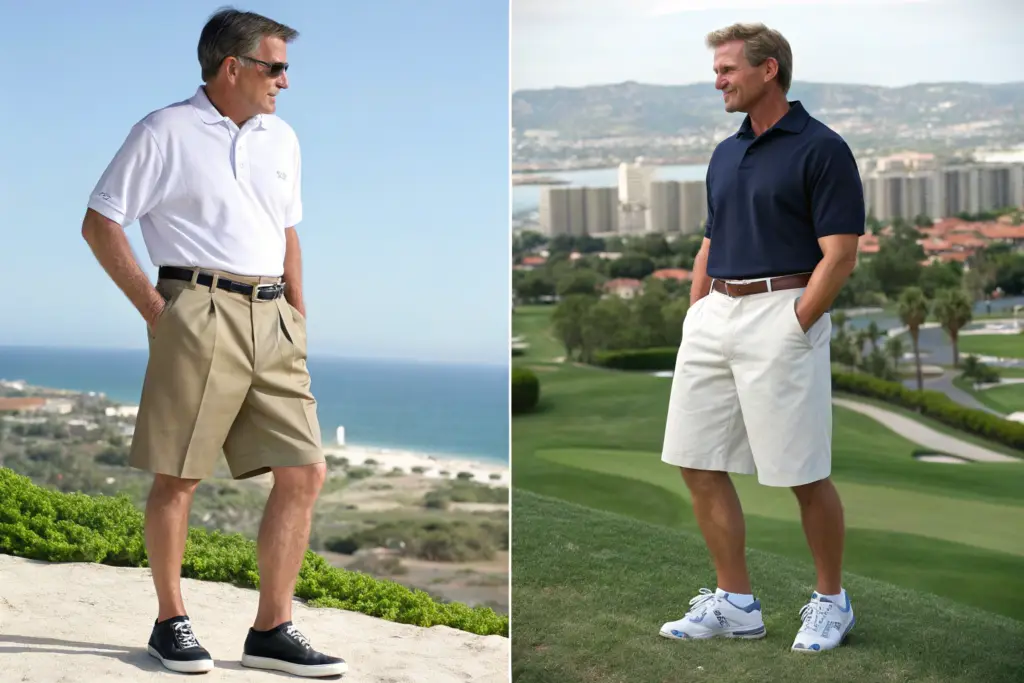
Selecting between a belt-loop and an elastic waistband requires matching the design to a clearly defined consumer avatar based on age, occasion of use, and geographic culture, with the belt-loop short serving the over-40, Southern and Midwestern, golf-and-brunch customer who tucks in his shirt, and the elastic or drawstring short serving the under-35, coastal urban, sneaker-centric customer who prioritizes comfort and a relaxed silhouette above all else.
What Customer Avatar Demands a Traditional Belt-Loop Short?
The belt-loop customer is not a fashion follower. He is a habit purchaser. He has been buying the same style of short for twenty years, and he replaces them when they wear out. He is likely over 40, though many men in their 30s with traditional professional roles also fit this profile. He lives in a warm climate where shorts are worn socially, not just at the beach. This customer's geographic center of gravity is the Southeast, from South Carolina through Georgia and Alabama to Texas.
His occasions for wearing shorts are specific and predictable. He wears them on the golf course, where a tucked-in polo and a belt are standard dress code. He wears them to casual Friday at a business-casual office. He wears them to a Saturday barbecue where other men his age are present and a certain standard of appearance is expected. For this customer, a traditional shorts styling guide would show a 9-inch to 10-inch inseam, a flat front, and belt loops. The belt loops are not negotiable because he owns several belts and rotates them as part of his outfit. He views an unbelted short the way a younger customer views a short without pockets: incomplete. The price sensitivity of this customer is moderate. He will pay $65 to $85 for a well-made short that fits his expectations. He is not seeking bargains. He is seeking familiarity and reliability. Brands like Peter Millar, Southern Tide, and vineyard vines have built substantial businesses serving this customer with belt-loop shorts as a core category. A new brand entering this space without belt loops would face an uphill battle against established expectations.
What Customer Avatar Prefers the Elastic or Drawstring Short?
The elastic-waist customer came of age in a different fashion era. He is under 35, though the age range extends upward for men in creative fields and major coastal cities. He lives in Los Angeles, New York, San Francisco, Portland, or Austin. His aesthetic vocabulary was shaped by streetwear, skate culture, and the tech industry uniform of hoodies and sneakers.
This customer does not tuck in his shirt. Ever. He wears his shorts slightly lower on the hip, and the visual emphasis is on the overall silhouette, not on the waistband transition. The belt is either absent entirely or is a purely decorative streetwear accessory worn loosely. His shorts must be compatible with a rotation of expensive sneakers, and the relaxed, slightly tapered silhouette of an elastic or drawstring short frames the footwear better than a structured chino short. This customer values comfort, but not the comfort of old age. It is the comfort of physical freedom and modern design. He is willing to pay a premium for high-quality materials and construction, but that premium is assigned to the fabric hand feel, the dye treatment, and the brand's cultural cachet, not to traditional tailoring details. Brands like Aime Leon Dore, John Elliott, and Rhude have built cult followings with modern men's casual shorts that feature drawstrings and elastic waists at price points exceeding $200. The message is clear: this customer is not looking for a cheaper product. He is looking for a product that reflects his cultural identity. Offering him belt loops is offering a solution to a problem he does not have. At Shanghai Fumao, we help brands define this avatar precisely before a single pattern is cut, because the entire product design flows from a clear understanding of the end consumer's identity.
Conclusion
The question of whether classic belt-loop shorts are a requirement for the American male consumer cannot be answered with a single word. The American male consumer is not one person. He is a collection of distinct, culturally defined purchasing tribes. The belt-loop short remains an absolute requirement for a large and commercially valuable tribe: the over-40 man in the South and Midwest who tucks in his polo, wears a leather belt to brunch, and would no sooner leave the house in a drawstring short than in his pajamas. For this customer, belt loops are a functional necessity and a visual signal of completeness. The drawstring and elastic waistband have, however, conquered a different and equally valuable tribe: the under-35 urban consumer whose aesthetic is rooted in streetwear and sneaker culture, and whose body has been retrained by two years of pandemic comfort to reject rigid waistbands.
The manufacturing implications of this choice are substantial. The belt-loop waistband adds real labor, real components, and real cost per unit, and a brand must price accordingly, either absorbing the margin impact or passing the value on to a customer who appreciates it. The brand that succeeds is the one that picks a lane with clarity.
If you are developing a classic shorts program and are wrestling with this exact decision—belt loops or no belt loops—we can help you ground the choice in market data and customer profile analysis rather than guesswork. At Shanghai Fumao, we have manufactured every waistband configuration imaginable for American brands across every region and demographic. For a direct conversation about matching your product design to your specific target consumer, contact our Business Director, Elaine, at elaine@fumaoclothing.com. Let's build shorts that your customer cannot leave the store without.