A few years ago, a brand owner who specializes in travel apparel came to me with a problem. He had sourced a pair of shorts from another factory that were marketed as "wrinkle-resistant." The fabric was a cotton-polyester blend with a claimed easy-care finish. He took the shorts on a trip, packed them in a suitcase, and wore them to a dinner meeting straight from the bag. The shorts were a crumpled mess. He looked like he had slept in them. He was embarrassed, and his customers were complaining. He asked me a question that gets to the heart of how wrinkle resistance actually works. "Is there a specific thread count I should be specifying so this never happens again?"
The standard thread count for a genuinely wrinkle-resistant classic travel short is not a single number but a specification range, typically 130 to 160 threads per square inch in a balanced plain weave construction for a polyester-cotton blend fabric, where the high thread density physically constrains the fibers from bending and creasing, working in combination with the fiber's inherent resilience and a mechanical or chemical easy-care finish to produce a garment that can be packed in a suitcase and worn with minimal pressing.
At Shanghai Fumao, I have developed travel shorts for brands that specialize in performance and convenience. Wrinkle resistance is one of the most requested and most misunderstood fabric properties. The relationship between thread count and wrinkle resistance is real, but it is not simple. Let me explain exactly how it works, and exactly what specification will get you a short that actually resists wrinkles.
How Does Thread Count Actually Affect Wrinkle Resistance?
Thread count is a measure of fabric density. It counts the number of yarns per square inch, adding the number of warp yarns to the number of weft yarns. A fabric with 80 warp yarns and 80 weft yarns per square inch has a thread count of 160. Thread count became a consumer-facing metric primarily through the bedding industry, where it was marketed as a measure of sheet quality. Its application to wrinkle-resistant apparel is real but requires a nuanced understanding of what the number actually means and does not mean.
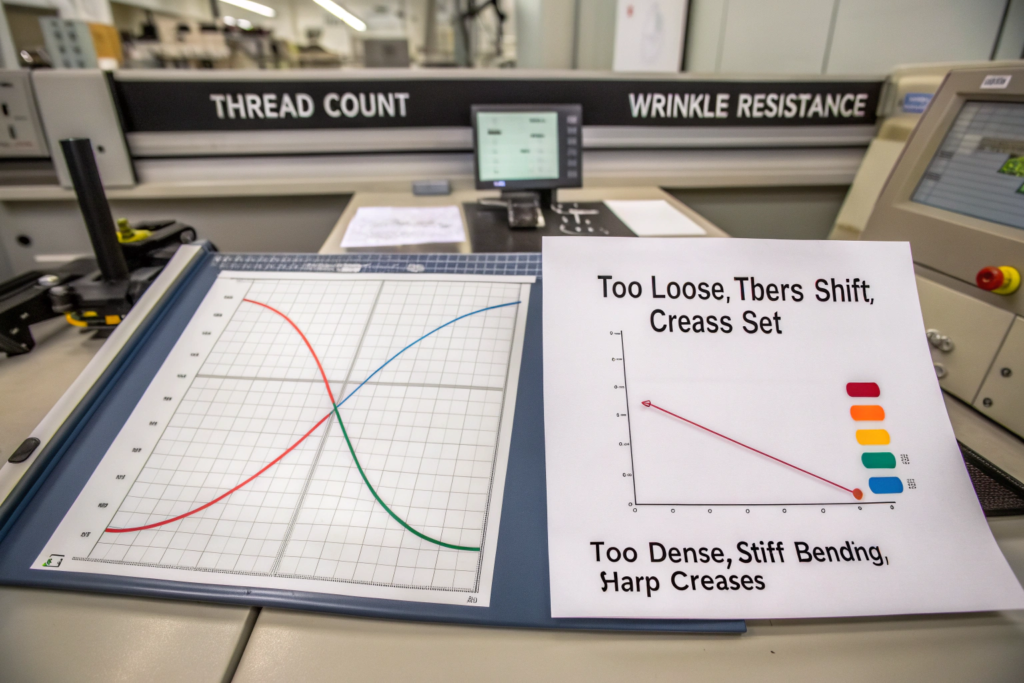
Thread count affects wrinkle resistance through a physical mechanism: a higher thread count means the yarns are packed more tightly together, and this tight packing physically constrains the yarns from bending, folding, and creasing under compression, functioning like a dense brush that resists being bent out of shape, but thread count is only one of three interdependent variables that determine wrinkle performance, with fiber type and fabric finish being equally important, and a thread count that is too high can actually make wrinkling worse by creating a stiff fabric that holds sharp creases rather than recovering from them.
What Is the Physical Mechanism That Makes a Dense Weave Resist Wrinkles?
When a fabric is folded, compressed, or crushed, the individual yarns are forced to bend. A wrinkle is a yarn that has been bent past its elastic recovery point and remains deformed. The tighter the weave, the less room each yarn has to bend. The yarns are held in place by the surrounding yarns, which press against them and restrict their movement.
Think of a fabric with a very loose weave, a low thread count. The yarns have plenty of space to slide, bend, and deform. When the fabric is crushed in a suitcase, the yarns shift and crease easily. Now think of a fabric with a tight weave, a high thread count. The yarns are packed closely. When the fabric is crushed, the yarns cannot easily bend because their neighbors are blocking them. The energy of the crushing force is distributed across many tightly packed yarns rather than concentrated on a few loose ones. The fabric resists creasing because the yarns physically cannot move enough to form a permanent crease. This fabric wrinkle resistance mechanism is the fundamental physical principle.
Why Can Too High a Thread Count Actually Increase Wrinkling?
The relationship between thread count and wrinkle resistance is not linear. It is a U-shaped curve. As thread count increases from a low base, wrinkle resistance improves. The yarns become more constrained, and the fabric becomes more resilient. But beyond an optimal point, further increasing thread count begins to reduce wrinkle resistance.
The reason is fabric stiffness. A very high thread count fabric, 200 threads per square inch and above, is densely packed with yarns. The fabric becomes stiff, like a board. When a stiff fabric is folded, it does not gently bend. It forms a sharp, defined crease, like folding a piece of paper. The yarns on the crease line are bent sharply, past their elastic recovery limit, and they stay bent. The crease is permanent. A slightly less dense fabric, in the optimal range, has enough flexibility to bend without sharp creasing, and enough density to recover from the bend. This fabric stiffness and wrinkle recovery balance is the reason thread count specification must be precise, not simply maximized.
What Is the Ideal Blend of Fibers for Wrinkle-Free Travel Shorts?
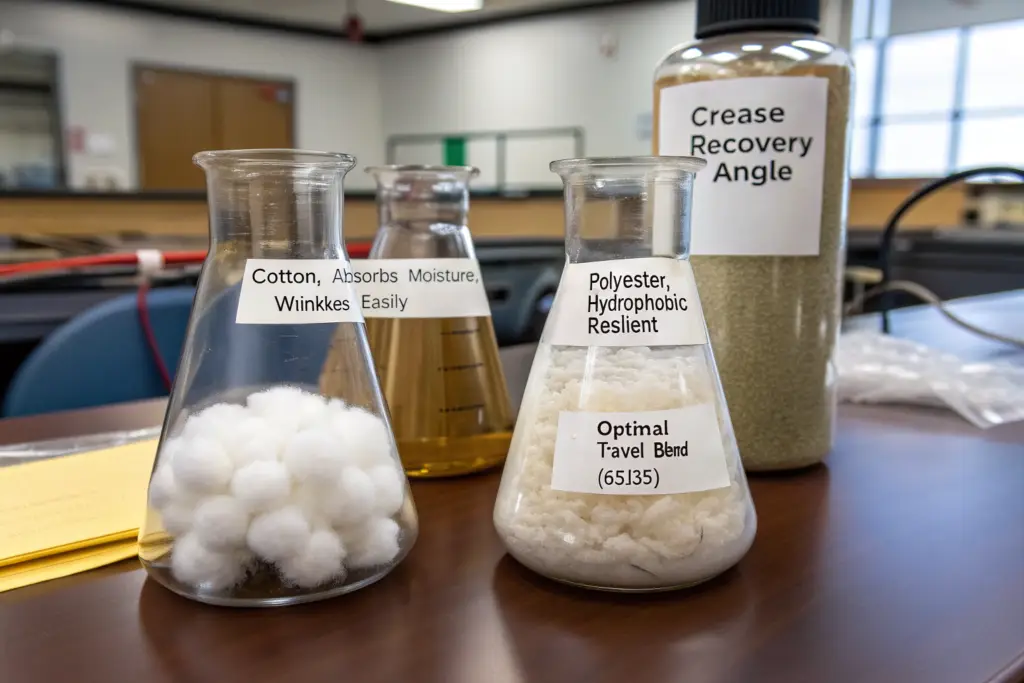
Thread count is the structural factor. Fiber content is the material factor. A high thread count fabric made from 100% cotton will still wrinkle. Cotton fibers absorb moisture, and when they absorb moisture, they swell and lose their shape. When the moisture evaporates, the fibers are left in a deformed state. That is a wrinkle. Polyester fibers are hydrophobic. They do not absorb moisture. They maintain their shape regardless of humidity. The optimal travel short fabric balances the comfort and breathability of cotton with the resilience and wrinkle resistance of polyester.
The ideal fiber blend for a wrinkle-resistant classic travel short is a 65% polyester and 35% cotton blend, or a 70/30 variation, where the polyester provides the structural resilience, the wrinkle recovery, and the shape retention, while the cotton provides moisture absorption for comfort against the skin, breathability, and a natural, matte appearance that avoids the shiny, synthetic look of 100% polyester, with this blend representing the optimal compromise between the consumer's desire for a natural feel and the functional requirement of wrinkle resistance.
Why Does Polyester Provide the Structural Memory That Cotton Lacks?
Polyester is a thermoplastic polymer. At the molecular level, polyester fibers can be heat-set into a specific shape. When the fabric is finished at the mill, it is heated to a specific temperature and then cooled while held flat. The polyester molecules are set in this flat configuration. When the fabric is bent or creased, the polyester molecules want to return to their heat-set flat state.
Cotton, as a natural cellulose fiber, does not have this thermoplastic property. Cotton fibers absorb moisture, swell, and lose their shape. When the moisture evaporates, the fibers are left in whatever shape they were in when wet. There is no molecular memory pulling them back to flat. This fundamental difference in fiber behavior is why a 100% cotton shirt will always wrinkle, and a 100% polyester shirt, while wrinkle-resistant, will feel clammy and synthetic against the skin. The blend combines the structural memory of polyester with the comfort of cotton. This polyester wrinkle resistance fiber properties is the core material science behind travel apparel.
How Does Moisture Regain Affect Wrinkle Performance in Travel Conditions?
The traveler packs shorts in a suitcase. The suitcase sits in a hot car. The traveler arrives at a humid destination. The shorts are exposed to body heat and perspiration. These real-world conditions dramatically affect wrinkle performance because moisture is a primary driver of wrinkling in natural fibers.
Cotton has a moisture regain of approximately 7% to 8.5%, meaning it absorbs that percentage of its weight in water from the surrounding air. Polyester has a moisture regain of approximately 0.4%. It is essentially hydrophobic. When a cotton-polyester blend short is exposed to humidity, the cotton fibers absorb moisture and swell. The polyester fibers do not. The polyester fibers act as a structural skeleton that resists the swelling forces of the cotton and maintains the fabric's flat configuration. The higher the polyester content, the stronger this structural skeleton. The 65/35 blend provides sufficient polyester to maintain shape in humid conditions while retaining enough cotton for comfort. This fiber moisture regain and wrinkle recovery relationship is a critical specification for travel apparel.
What Finishing Treatments Enhance Wrinkle Recovery Beyond Thread Count?
The fiber blend and the thread count are the starting points. The finishing treatment is the multiplier. A properly applied wrinkle-resistant finish can take a fabric that would otherwise wrinkle moderately and make it genuinely packable. The chemistry of these finishes is complex, and the application process must be precisely controlled. A poorly applied finish washes out after a few laundry cycles. A properly applied finish is durable for the life of the garment.
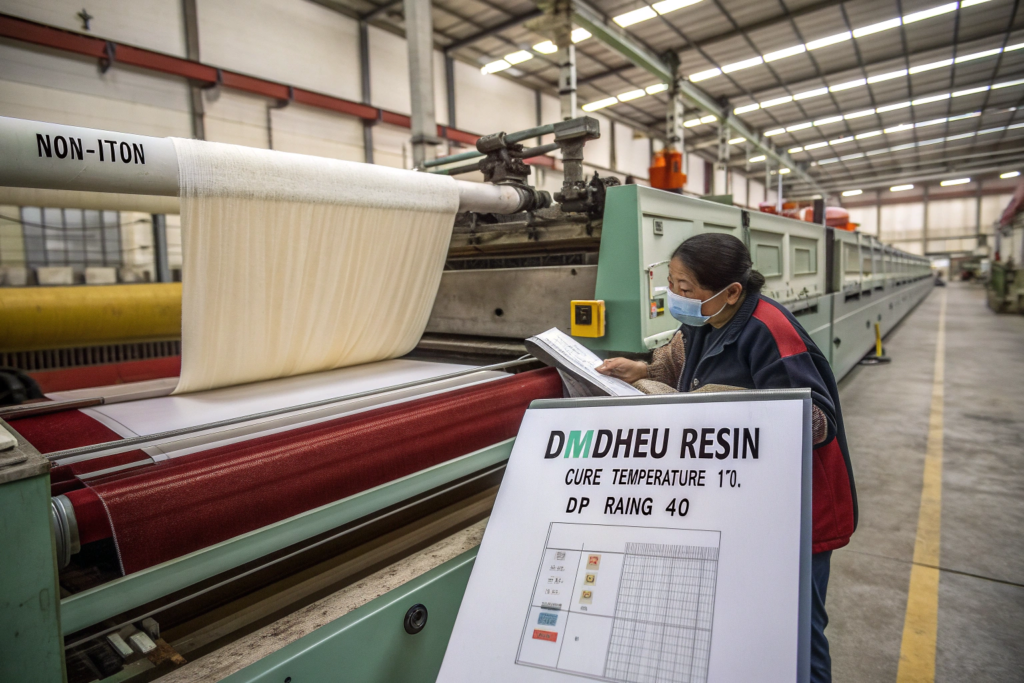
The standard finishing treatment for wrinkle-resistant travel shorts is a durable press resin finish, typically a DMDHEU resin, which chemically cross-links the cellulose molecules within the cotton fibers, locking them into a flat configuration that resists deformation and creasing, with the treatment being applied at the fabric stage under controlled heat and pressure conditions that cure the resin, producing a garment that can achieve a DP, durable press, rating of 3.5 to 4.0, where a rating of 3.5 indicates a smooth appearance requiring minimal ironing and 4.0 indicates a completely smooth appearance with no ironing required.
How Does DMDHEU Resin Chemically Prevent Wrinkles?
DMDHEU stands for dimethylol dihydroxyethyleneurea. It is a cross-linking agent. When applied to cotton fabric and cured under heat with a catalyst, the resin molecules form chemical bridges between the cellulose polymer chains within the cotton fibers. These cross-links act like internal springs.
When the fiber is bent, the cross-links are stretched. When the bending force is released, the cross-links pull the fiber back to its original position. The fiber has been given an artificial structural memory, similar to the thermoplastic memory of polyester. The cotton fibers, which would normally absorb moisture, swell, and lose their shape, are now locked into a flat configuration by the cross-links. The treatment is permanent. It does not wash out. This durable press resin finish chemistry is the standard technology for wrinkle-resistant and non-iron cotton apparel.
What Are the Potential Trade-offs of Resin Finishing?
The cross-linking that prevents wrinkles also has side effects that must be managed. The cross-links stiffen the cotton fibers, reducing the fabric's tear strength and abrasion resistance. A heavily cross-linked fabric can be brittle. The formaldehyde-based chemistry of traditional DMDHEU resins has been the subject of consumer health concerns, driving the development of ultra-low formaldehyde and formaldehyde-free alternatives.
The modern approach manages these trade-offs. The resin concentration and curing conditions are optimized to balance wrinkle resistance with strength retention. The fabric is tested for tear strength after finishing to ensure it meets minimum standards. Ultra-low formaldehyde resins are used, and the fabric is after-washed to remove any unreacted chemicals. The consumer receives a garment that is safe, strong, and wrinkle-resistant. This formaldehyde-free easy care finishing is the current best practice for responsible manufacturing. At Shanghai Fumao, we specify these finishes with our mill partners and verify the performance through independent lab testing.
How Can You Test and Validate Wrinkle Resistance Before a Bulk Order?
A supplier's claim that a fabric is wrinkle-resistant is not enough. The claim must be verified through standardized, repeatable testing before a bulk order is placed. The test methods exist and are well-established. The testing can be performed by the factory, by the mill, or by an independent third-party laboratory. The results provide an objective basis for approving or rejecting the fabric.
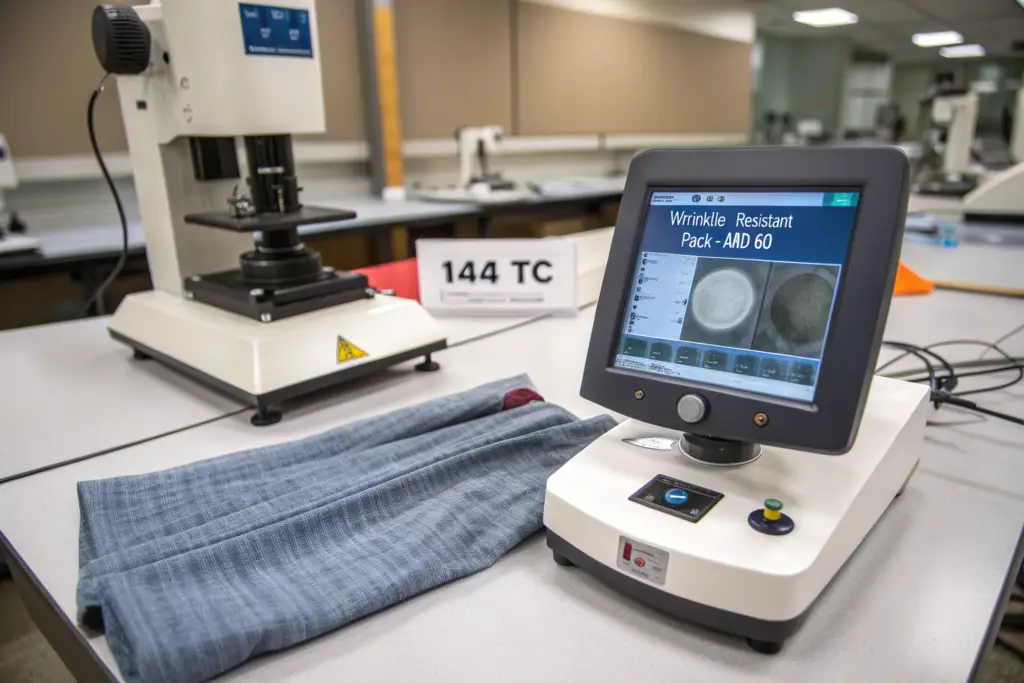
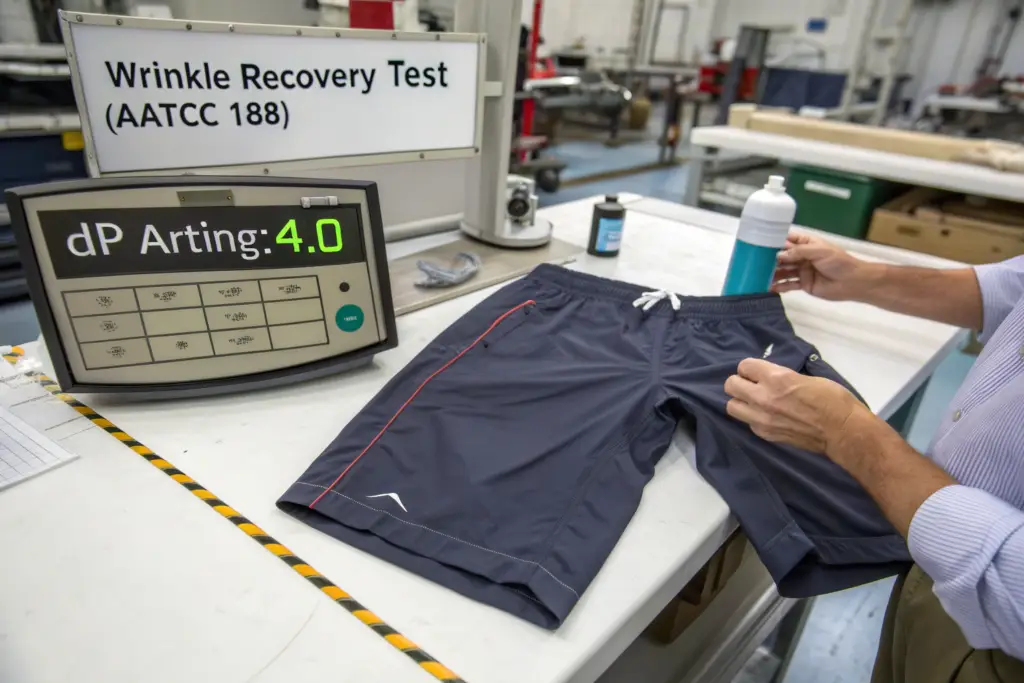
The standard test method for evaluating the wrinkle resistance of travel shorts fabric is the AATCC 128 Wrinkle Recovery test, which uses a standardized wrinkling device to apply a controlled crushing force to a fabric specimen for a specified time, after which the specimen is removed and evaluated against a set of standard three-dimensional wrinkle reference replicas under standardized lighting, with the result expressed as a DP, Durable Press, rating on a scale of 1 to 5, where a rating of 3.5 or higher is generally acceptable for a garment marketed as wrinkle-resistant.
What Is the AATCC 128 Wrinkle Recovery Test Procedure?
The AATCC 128 test is designed to simulate the wrinkling that occurs when a garment is packed in a suitcase or worn for extended sitting. A standardized fabric specimen is placed in a wrinkling device, which consists of a cylindrical tube into which the fabric is inserted and then compressed by a plunger with a specified weight.
The fabric is held under compression for a specified time, typically 20 minutes. The plunger is then removed, and the fabric is extracted from the tube. The wrinkled fabric is placed on a flat surface under standardized lighting and conditioned for a specified recovery period. The wrinkled appearance is then compared to a set of standard three-dimensional wrinkle reference replicas. The replicas represent DP ratings from 1, very heavily wrinkled, to 5, completely smooth. The specimen is assigned the rating of the replica it most closely matches. This AATCC 128 wrinkle recovery test is the industry standard for wrinkle resistance evaluation.
How Can You Simulate Real-World Packing Conditions in a Pre-Production Test?
The AATCC 128 test is a standardized laboratory procedure. It provides repeatable, comparable results. But a brand may also want to validate wrinkle resistance under conditions that more closely simulate the consumer's experience. A simple pre-production test can be conducted by the brand itself.
Take the pre-production sample of the shorts. Pack them tightly into a suitcase, folded as a consumer would fold them. Place additional clothing items on top to simulate a fully packed bag. Leave the suitcase closed for twenty-four hours. Remove the shorts and hang them in a bathroom while a hot shower runs, simulating a humid hotel environment. After thirty minutes, evaluate the appearance. The shorts should look presentable enough for a casual dinner without ironing. This test is not standardized and does not replace AATCC 128, but it provides a real-world confirmation that the laboratory results translate to actual consumer experience. This garment wrinkle resistance field test is a valuable final check before bulk production.
Conclusion
The standard thread count for a wrinkle-resistant classic travel short is not a magic number. It is a range, typically 130 to 160 threads per square inch in a balanced plain weave, that represents the physical sweet spot where the fabric is dense enough to constrain yarn movement and resist creasing, but not so dense that it becomes stiff and holds sharp creases. Thread count alone, however, does not deliver wrinkle resistance. It works in combination with fiber content and fabric finish.
The optimal fiber blend is a 65% polyester and 35% cotton blend, where the polyester provides structural memory and wrinkle recovery while the cotton provides comfort, breathability, and a natural appearance. The finishing treatment, typically a durable press DMDHEU resin, cross-links the cotton fibers and locks them into a flat configuration, amplifying the wrinkle resistance of the blend and the weave. The performance is validated through the AATCC 128 wrinkle recovery test, with a target DP rating of 3.5 or higher.
At Shanghai Fumao, we develop travel shorts fabrics with our mill partners to achieve specific wrinkle resistance targets. We test every fabric lot for thread count, fiber content, and DP rating before cutting. If you are developing a travel shorts program and want to ensure your product performs as promised when your customer pulls it out of a suitcase, contact our Business Director, Elaine, at elaine@fumaoclothing.com. Let's build a short that arrives as crisp as it left.