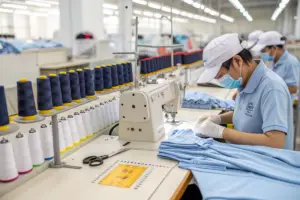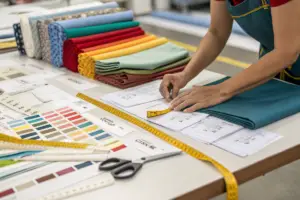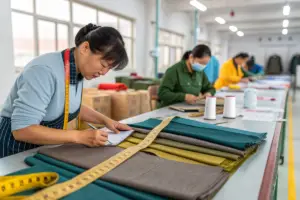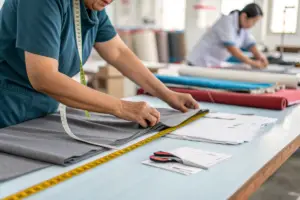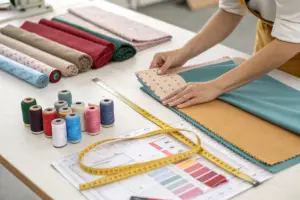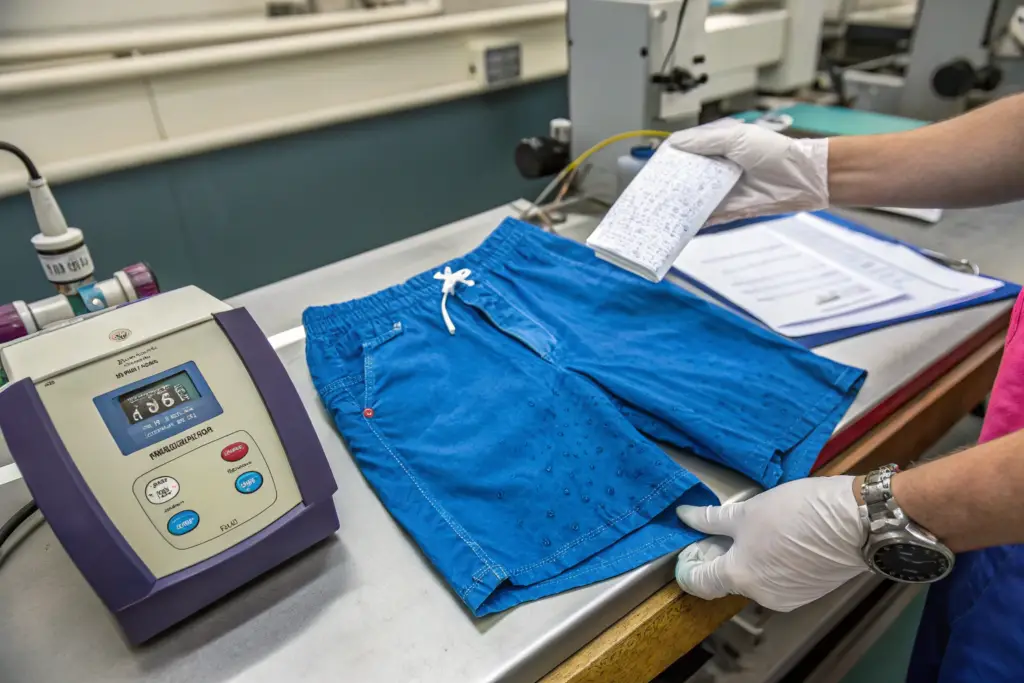
Last summer, a brand owner called me in a state of quiet panic. She had just received a batch of custom-dyed classic shorts in a beautiful coral pink, a color she had spent weeks perfecting with our dye house. The shorts looked perfect in the box. They sold out within the first week online. Then the emails started. Customers were sending photos of their hands, their white handbags, their car seats, all stained pink. The dye was transferring onto everything it touched. Within three weeks, her return rate on that SKU hit forty percent. Her brand's Instagram comments filled with complaints. She had to pull the product, issue a blanket refund, and absorb a financial loss that nearly sank her business. The dye house had delivered a beautiful color. They had not delivered a color that stayed on the fabric.
Colorfastness testing for custom-dyed classic shorts is the critical quality gate that prevents the catastrophic commercial failure of a dyed garment by measuring the fabric's resistance to color transfer under the specific conditions the shorts will encounter during the consumer's use, including crocking from friction, bleeding during washing, fading from perspiration, and degradation from sunlight, with each test providing a standardized grade that must be specified and verified before bulk production can be approved.
At Shanghai Fumao, we have integrated colorfastness testing into every custom-dyed production run. I learned the hard way, through early mistakes and expensive lessons, that the beauty of a custom color means nothing if that color does not stay where it belongs. The testing is not complicated, but it is non-negotiable. Let me walk you through exactly what each test measures, why it matters, and how to specify the standards that will protect your brand.
What Are the Different Types of Colorfastness That Affect Shorts?
Colorfastness is not a single property. It is a family of related but distinct performance characteristics, each measuring the fabric's resistance to color loss or transfer under a different type of stress. A fabric that performs beautifully in a wash fastness test may fail catastrophically in a crocking test. A dye that holds fast under dry friction may bleed instantly when exposed to sweat. Understanding the different types of colorfastness is essential because each one corresponds to a real-world failure mode that your customer will experience and blame you for.
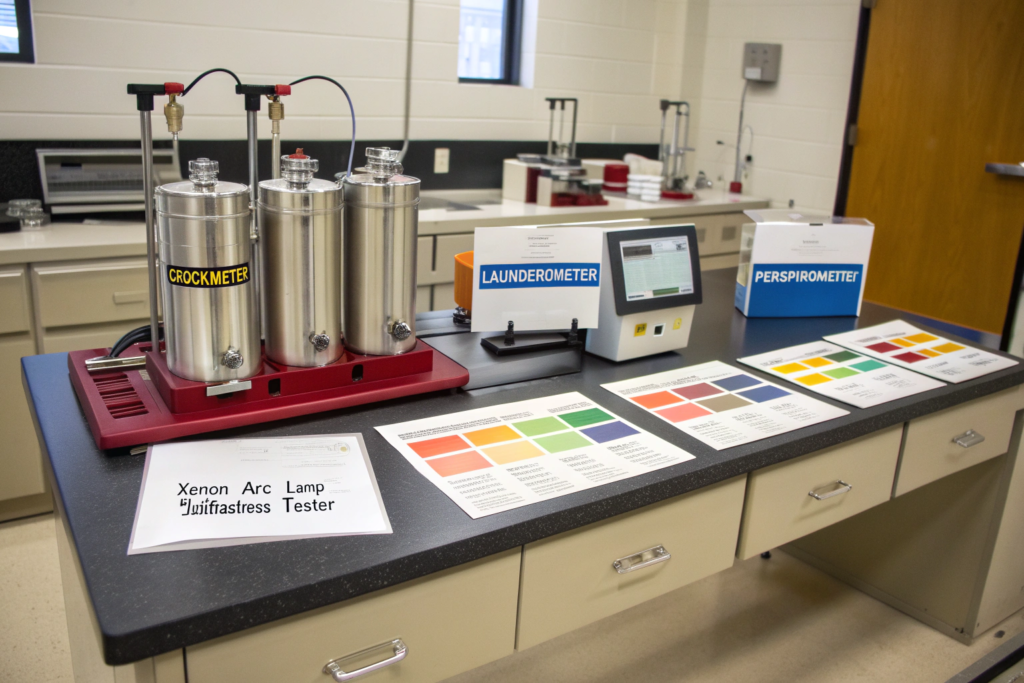
The four types of colorfastness that most critically affect custom-dyed classic shorts are crocking fastness, which measures color transfer from dry and wet rubbing; wash fastness, which measures color bleeding during home laundering; perspiration fastness, which measures color degradation from contact with acidic and alkaline sweat; and light fastness, which measures fading from exposure to sunlight, with each test simulating a specific consumer use condition that can independently generate returns and brand damage.
How Does Crocking Fastness Predict Dye Transfer to Other Surfaces?
Crocking is the technical term for color transfer by friction. When a person sits on a white leather car seat while wearing a pair of indigo-dyed shorts, the friction between the shorts and the seat is a crocking event. If the dye crocks, the seat is now indigo. The customer is furious. The dry cleaning bill and the negative review are incoming.
The crocking test uses a standardized machine called a Crockmeter. A white cotton rubbing cloth is attached to a weighted finger that moves back and forth across the dyed fabric in a controlled motion. The test is performed dry and wet. After the rubbing cycles, the amount of color transferred to the white cloth is evaluated against a standard grey scale, which rates staining from grade 1, severe staining, to grade 5, no staining. For custom-dyed classic shorts, the minimum acceptable crocking fastness is typically grade 4 dry and grade 3 wet. A deep, saturated color like indigo or coral will often have lower wet crocking fastness due to the high dye concentration, which is why deep custom colors require particular attention. This crocking fastness test is the single most predictive test for the most common customer complaint about dyed garments: the color rubbed off onto something else. At Shanghai Fumao, we test crocking fastness on every custom dye lot before approving it for cutting.
Why Does Perspiration Fastness Matter for Summer Shorts?
Classic shorts are worn in summer. Summer means heat. Heat means sweat. Human perspiration is a complex chemical solution containing water, salts, amino acids, and lactic acid. It is slightly acidic on the skin surface and can become alkaline as it degrades. Both acidic and alkaline conditions can strip poorly fixed dyes from fabric.
The perspiration fastness test simulates this chemical assault. Fabric samples are wet with an artificial perspiration solution, either acidic or alkaline, and then placed under a specified pressure between glass plates in a perspirometer at an elevated temperature for a set duration. After the test, the color change of the fabric and the staining on adjacent multi-fiber test strips are evaluated against the grey scale. A pair of shorts worn on a hot day against bare skin will be exposed to perspiration for hours. A dye that fails perspiration fastness will fade unevenly, particularly in high-contact areas like the waistband and the inner thigh, creating a blotchy, cheap appearance after only a few wears. This perspiration fastness test is especially critical for the waistband area, where the fabric is in direct, constant contact with skin. At Shanghai Fumao, we require a minimum perspiration fastness grade of 4 for all custom-dyed shorts, because the seasonal use case of the product makes this test directly predictive of mid-season customer satisfaction.
How Do You Specify and Interpret Colorfastness Standards?
I have received dye house lab reports that looked impressive at first glance, filled with numbers and technical terminology, only to discover on closer inspection that the tests were performed against standards that were irrelevant, or that the grading was done subjectively rather than against the standard grey scale. A buyer who does not know how to read these reports is at the mercy of the dye house's honesty. A buyer who can specify the correct test method, the correct evaluation standard, and the minimum acceptable grade controls the conversation and the outcome.
Specifying colorfastness standards for custom-dyed classic shorts requires naming the exact test method by its international standard code, the ISO or AATCC number, defining the minimum acceptable grade for each test, typically grade 4 on the grey scale for color change and staining for premium apparel, and confirming that the evaluation will be performed instrumentally using a spectrophotometer or visually by a trained technician under standardized D65 lighting rather than subjectively under ambient room light.
What Do ISO and AATCC Test Method Numbers Mean?
The international textile industry operates under two major testing standards bodies. ISO, the International Organization for Standardization, publishes test methods that are widely used in Europe and Asia. AATCC, the American Association of Textile Chemists and Colorists, publishes test methods that are standard in the United States. The test methods are similar but not identical, and a buyer should specify which standard applies to their order.
A crocking test can be performed per ISO 105-X12 or per AATCC 8. A wash fastness test can be performed per ISO 105-C06 or per AATCC 61. The standards specify the exact apparatus, the exact procedure, the exact temperature and duration, and the exact evaluation method. When a purchase order simply says "colorfastness to be tested," without a standard reference, the factory or dye house can choose whichever method gives the most favorable result. A lazy dye house might use a less aggressive wash cycle, resulting in a passing grade that would be a fail under the correct standard. Specifying the exact ISO textile testing standards or AATCC test methods on the purchase order closes this loophole. At Shanghai Fumao, we standardize on ISO methods for our European and Asian clients and AATCC methods for our US clients, and we specify the method code on every quality control document.
How Do You Read a Grey Scale and a Lab Report Correctly?
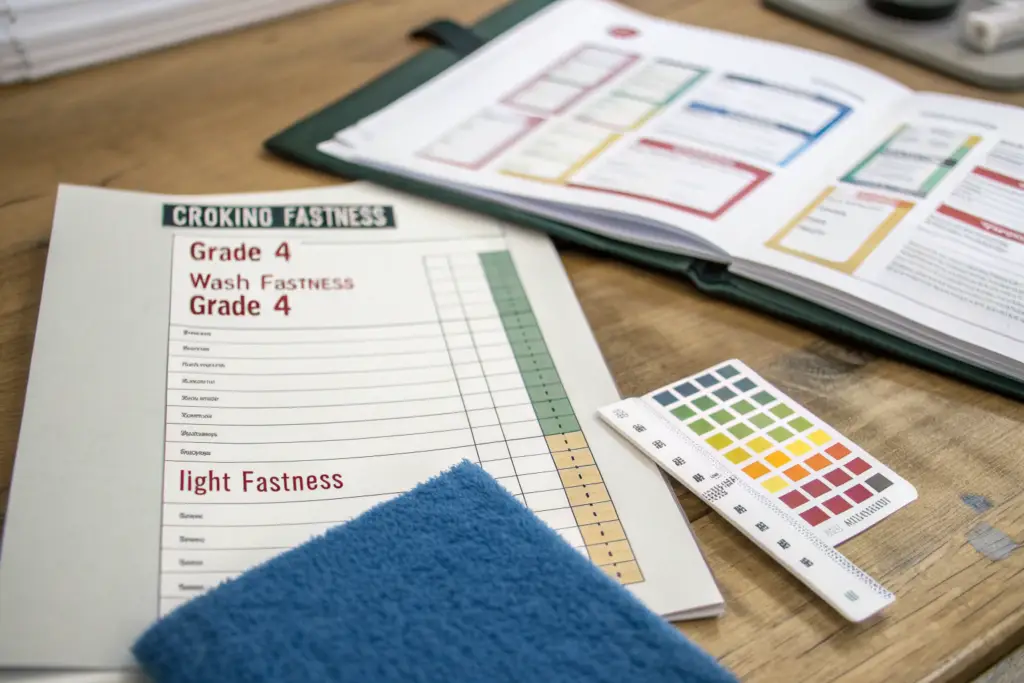
The grey scale is the universal evaluation tool for colorfastness. It consists of pairs of grey color chips showing increasing degrees of contrast, from grade 1, where the contrast is so large that the two chips appear completely different, to grade 5, where there is no visible contrast at all. A technician compares the color change of the tested fabric or the staining on the adjacent fabric to these standard pairs and assigns the grade that most closely matches the observed contrast.
A lab report that states "Pass" without a numerical grade is incomplete. A report that states "Grade 4-5" is precise and actionable. The buyer should understand the difference between these grades in practical terms. Grade 5 is perfect, no visible change or staining. Grade 4-5 is excellent, a change or stain that is barely perceptible to the trained eye and invisible to the consumer. Grade 4 is good, a slight change or stain that would be noticeable to a consumer only under close inspection. Grade 3-4 is borderline, a change or stain that a consumer would likely notice and that could generate complaints from the most discerning customers. Grade 3 and below is a commercial failure for premium apparel, a clearly visible defect that will generate returns. This textile colorfastness grading system is the language in which acceptable quality is defined. At Shanghai Fumao, we provide the numerical grade for every test on every lab report, and we train our QC team to verify the dye house's grades with an independent evaluation under our own D65 light booth.
How Do You Prevent Colorfastness Failures in Production?
Colorfastness failures are almost never random. They are the predictable result of specific process failures in the dye house. The dye concentration was too high for the fiber to absorb. The fixation temperature was too low. The washing-off process was inadequate, leaving unbound dye molecules sitting on the fabric surface like a powder waiting to be rubbed off. The dye house was under time pressure and cut a corner. These failures are preventable, but preventing them requires the buyer or their agent to insert verification steps into the process, not just at the end.
Preventing colorfastness failures in custom-dyed classic shorts requires a three-stage quality intervention: approving the lab dip not just for color accuracy but for colorfastness by requesting a crocking and wash fastness test on the lab dip itself before bulk dyeing begins, conducting an inline inspection during bulk production to verify the fixation and washing-off processes are being correctly executed, and performing a final colorfastness test on a bulk production sample before the fabric is released for cutting.
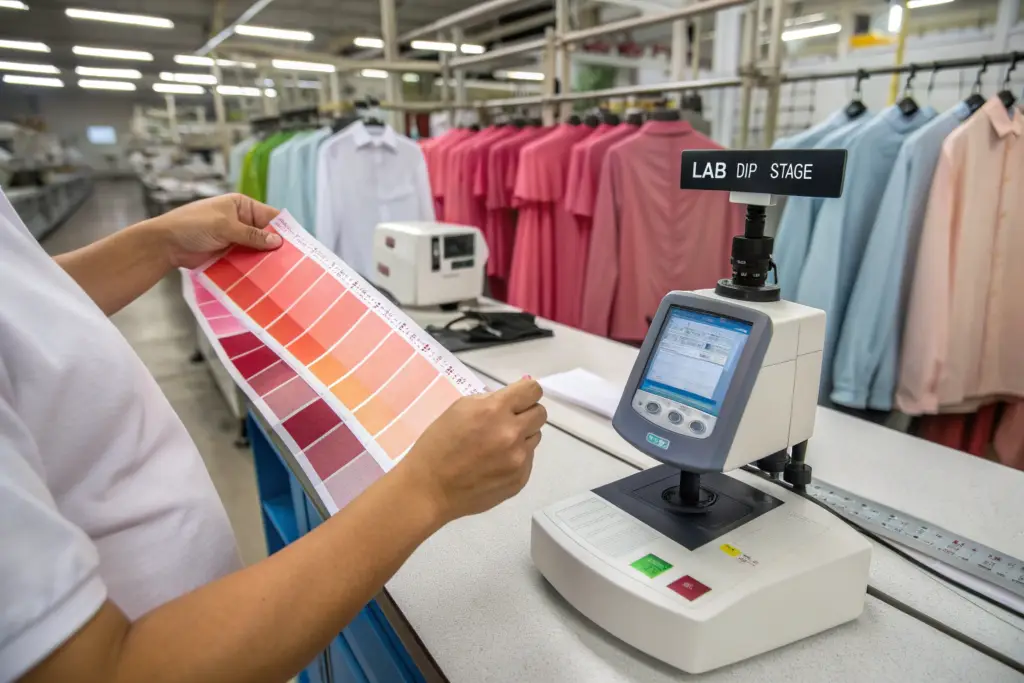
Why Should Colorfastness Be Tested at the Lab Dip Stage?
The lab dip is the small sample of fabric that the dye house dyes to match your target color. Traditionally, the lab dip is approved based on color accuracy alone. The buyer looks at the color under a light booth, compares it to the Pantone reference, and says yes or no. The colorfastness is assumed to be acceptable, and it is only tested later, on the bulk fabric, when a failure means the entire lot is already dyed and unusable.
Testing colorfastness at the lab dip stage changes the equation. If the lab dip achieves the target color but fails crocking fastness, the dye house knows that the current dye recipe is problematic and can reformulate before scaling up to bulk. The cost of reformulating at lab dip stage is measured in hours and tens of dollars. The cost of reformulating after a bulk lot of 2,000 meters has been dyed incorrectly is measured in days and thousands of dollars. This lab dip approval process with integrated fastness testing is a best practice that every brand should insist on. At Shanghai Fumao, we require a full colorfastness report, including crocking, wash, and perspiration fastness, alongside every lab dip we submit for approval. If the color is beautiful but the fastness is marginal, we flag it and propose an alternative dye formulation.
What Inline Process Checks Prevent Dye Fixation Problems?
The most common root cause of poor colorfastness is incomplete fixation. Reactive dyes, the most common dye class for cotton shorts, work by forming a chemical bond with the cellulose fiber. This bond formation requires specific conditions: the correct temperature, the correct pH, the correct time. If the dye house rushes the fixation stage, or if the alkali concentration in the fixation bath is too low, the dye does not fully react with the fiber. Unreacted dye sits on the surface of the fabric, not chemically bound, and it will rub off, wash off, and bleed at the slightest provocation.
The inline process check verifies that fixation conditions are correct. This can be as simple as a temperature and pH log for each dye batch, reviewed by a QC supervisor. The more critical check is the washing-off process after fixation. A properly washed-off fabric has had all unbound, hydrolyzed dye removed. A quick test for washing-off effectiveness is a cold water rinse test. A swatch of the dyed fabric is agitated in a beaker of cold water. If the water discolors, unbound dye is still present, and the washing-off process is incomplete. This garment dyeing quality control inline check catches the problem before the fabric leaves the dye house. At Shanghai Fumao, our QC team performs this cold water rinse test on a random sample from every bulk dye lot.
What Are the Commercial Consequences of a Colorfastness Failure?
The cost of a colorfastness failure is not the cost of the test you skipped. It is the cost of the returns, the chargebacks, the negative reviews, the lost wholesale accounts, and the brand damage that persists long after the defective inventory has been written off. I have watched a single dye failure erase an entire season's profit. The shorts themselves cost a few dollars to manufacture. The commercial consequences cost orders of magnitude more.
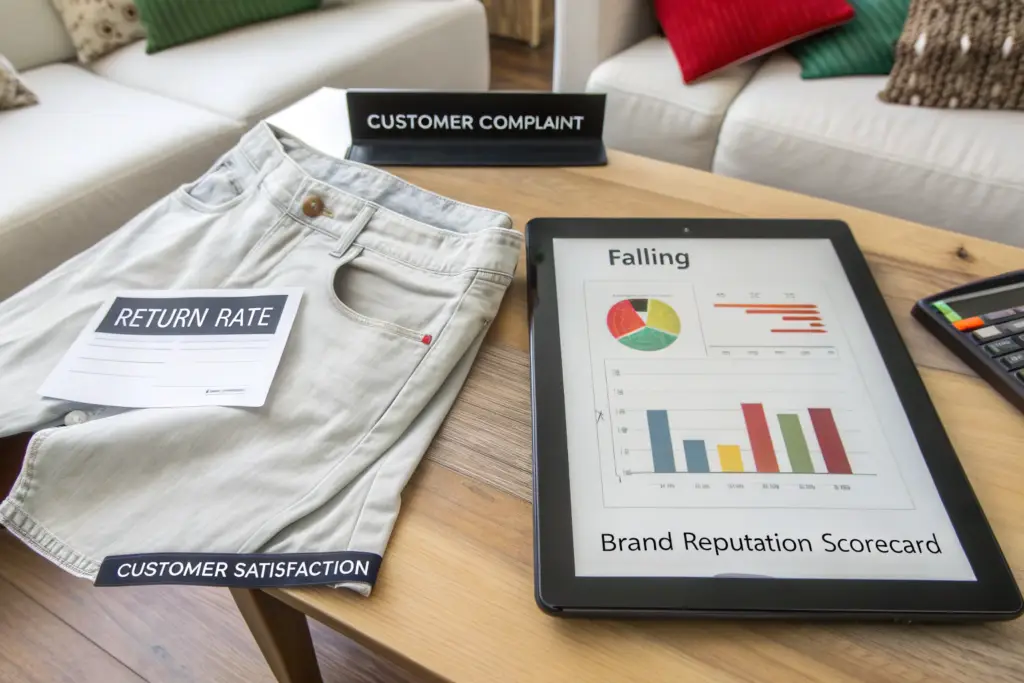
The commercial consequences of a colorfastness failure cascade through the business in a predictable sequence, beginning with the direct costs of customer returns and chargebacks, escalating to the wholesale channel consequences of chargebacks from retailers and potential delisting by major accounts, and culminating in the long-term brand damage of negative reviews, social media complaints, and a customer trust deficit that can suppress sales of future collections even after the quality issue has been resolved.
How Do Returns and Chargebacks Compound the Financial Damage?
A customer who receives a pair of shorts that bleeds dye onto their other clothing does not just return the shorts. They return everything that was stained. Some retailers will accept a claim for a $200 white linen shirt ruined by dye transfer from an $80 pair of shorts. The customer also leaves a one-star review, often with a photograph of the damage. That review sits on the product page permanently.
The return itself incurs costs. The return shipping label. The warehouse labor to process the return. The inspection to determine if the item can be restocked. If the item cannot be restocked, which is the case with a colorfastness failure because the defect is inherent, the entire unit cost is written off. Then there are chargebacks. If the customer disputes the charge with their credit card issuer, the merchant pays a chargeback fee, typically $15 to $25, win or lose. If the chargeback rate on a product exceeds a threshold, the payment processor may flag the merchant as high-risk, increasing processing fees or withholding reserves. This e-commerce returns management financial cascade transforms an $8 manufacturing defect into a $100-plus total cost per incident.
How Does Brand Reputation Damage Affect Future Sales?
The financial damage that is visible on a spreadsheet is only part of the story. The brand reputation damage is harder to quantify but often more severe. A customer who has a negative experience with a dye transfer problem does not just not buy that brand again. They tell people. They post on social media. If the brand is carried by wholesale accounts, the retail buyers see the negative reviews and the return data. A buyer at a multi-brand retailer who sees a 15% return rate on a brand's shorts will reduce or cancel future orders.
The trust deficit persists. Even after the brand has fixed the dye issue with a new supplier, the customer who had the bad experience does not know that. They just remember that the brand's shorts ruined their car seat. Regaining that customer's trust requires discounting, guarantees, and time. The lost revenue from customers who silently churn, who never buy again and never say why, is the largest cost of all. This brand reputation management challenge is the ultimate argument for investing in colorfastness testing. The test costs a few hundred dollars per dye lot. The brand damage costs a percentage of future revenue that is unknowable until it is too late. At Shanghai Fumao, we treat colorfastness as an insurance policy. The premium is the testing cost. The coverage is the avoidance of the catastrophic brand damage scenario that I have seen unfold too many times.
Conclusion
Colorfastness testing for custom-dyed classic shorts is not a bureaucratic hurdle or a technical nicety. It is the quality control checkpoint that separates a beautifully colored short that builds customer loyalty from a beautifully colored short that destroys customer trust. Crocking fastness predicts whether the dye will transfer to car seats, handbags, and other clothing. Wash fastness predicts whether the color will survive the laundry cycle. Perspiration fastness predicts whether the shorts will fade unevenly after a few wears on a hot day. Light fastness predicts whether the sunny window display will bleach the color before the shorts are even sold.
These tests are standardized, affordable, and accessible. They should be specified by their ISO or AATCC method code on every purchase order, performed at the lab dip stage as well as on the bulk production, and evaluated against the standard grey scale with a minimum grade of 4 for premium apparel. The cost of skipping this testing is not the money saved on the lab fees. It is the cost of the returns, the chargebacks, the negative reviews, the lost wholesale accounts, and the brand reputation damage that can take years to repair.
If you are developing custom-dyed classic shorts and want a manufacturing partner who treats colorfastness as a non-negotiable quality standard, we are ready to support you. At Shanghai Fumao, we have built our dye approval process around integrated, documented, and independently verifiable colorfastness testing at every stage. Contact our Business Director, Elaine, at elaine@fumaoclothing.com. Let's make sure your beautiful custom color stays exactly where it belongs, on the shorts and nowhere else.