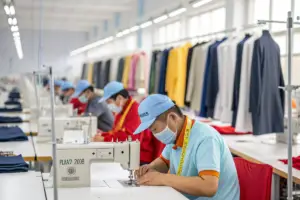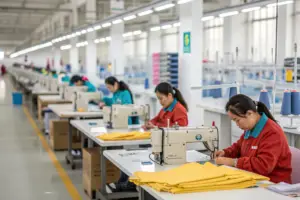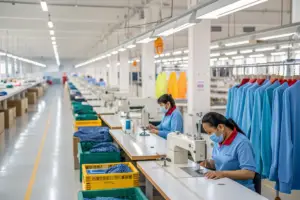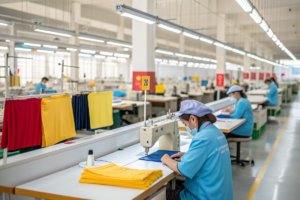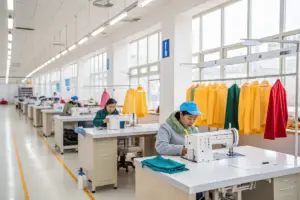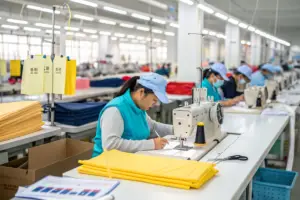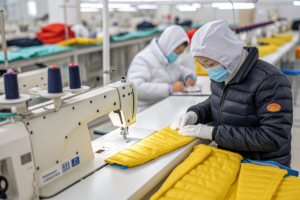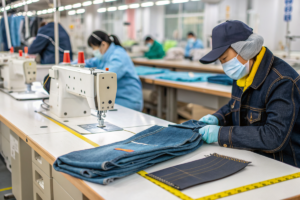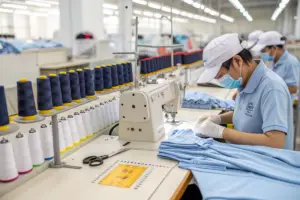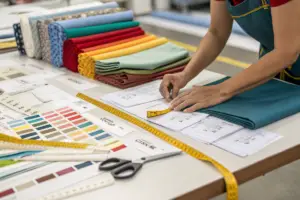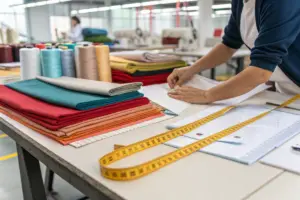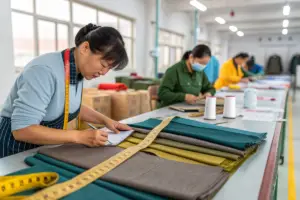
A brand owner from Stockholm sat in my Shanghai showroom in late July with a look of pure stress. It was 32 degrees outside, sweltering, but he was thinking about snow. He needed 1,500 units of heavy wool overcoats delivered to his Stockholm warehouse by October 1st. He had the tech pack. He had the purchase order. He had the marketing campaign ready. He thought he was on time. I had to tell him he was at least six weeks too late. The Italian wool mill needed eight weeks for the fabric alone. The cutting, sewing, finishing, and sea freight would take another ten weeks. His October 1st deadline was impossible. His coats would arrive in mid-November, missing the prime selling window. He lost three weeks of peak season sales because he placed his order based on his internal calendar, not the mill's calendar.
The seasonal deadlines for placing Fall/Winter garment orders with Chinese mills are driven backward from the retail delivery date, with the fabric mill as the critical path constraint. For a September retail delivery, the bulk fabric order must be placed by early May. For an October delivery, the fabric order deadline is early June. These deadlines are not flexible. Mills operate on fixed production schedules. A wool mill in Jiangsu will not delay its entire production run for a late order. The brand owner who misses the mill's deadline misses the season. The deadline is not a negotiation. It is a physical fact of the textile supply chain.
The Fall/Winter season is the most demanding production cycle of the year. The garments are more complex. The fabrics are heavier and often require longer lead times for weaving and finishing. The supply chain is more constrained. Every brand in the Northern Hemisphere is trying to get their winter coats, their holiday party dresses, and their cashmere sweaters made in the same compressed window. The factory's capacity is finite. The mill's capacity is finite. The port's capacity is finite. The deadlines are not arbitrary. They are the result of the physical limits of the supply chain. At Shanghai Fumao, our Fall/Winter planning begins in March. Let me walk you through the exact timeline so your next season does not arrive late.
What Is the Critical Path Timeline from Fabric Mill to Final Shipment?
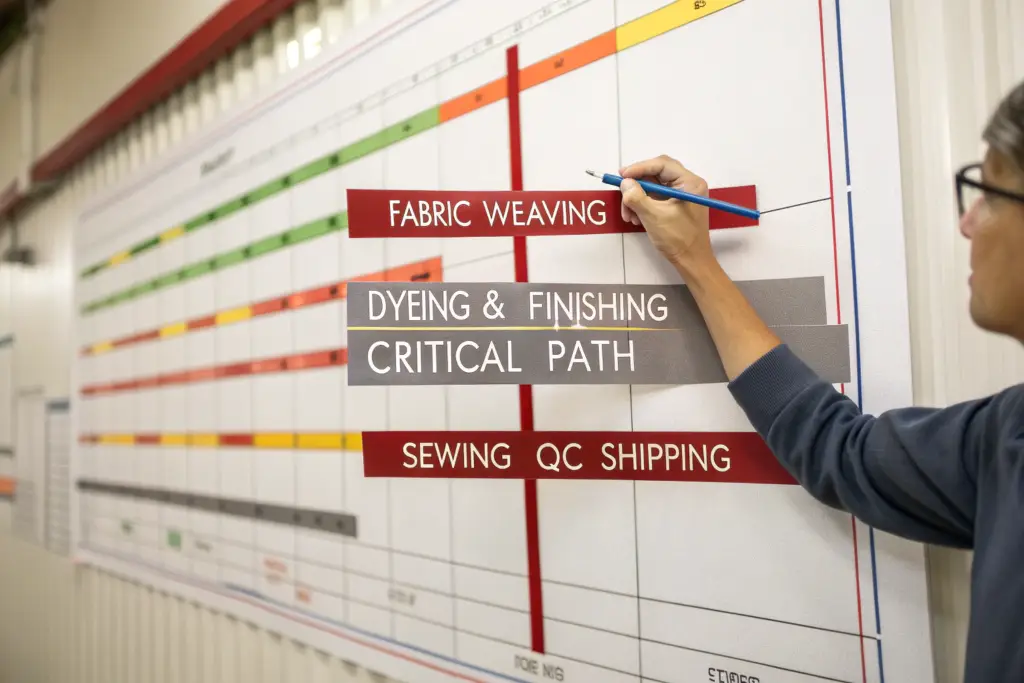
The critical path is the longest sequence of dependent tasks in a production timeline. For a Fall/Winter garment, the critical path almost always runs through the fabric mill. The mill cannot weave the fabric until the yarn is spun. The dye house cannot dye the fabric until it is woven and prepared. The factory cannot cut the fabric until it is dyed, finished, inspected, and delivered. Each step depends on the completion of the previous step. The total time is the sum of the individual step times. There is no shortcut.
The critical path timeline for a typical Fall/Winter garment begins with the fabric mill's yarn procurement and weaving, which takes four to six weeks. Fabric dyeing and finishing takes two to three weeks. Fabric inspection and delivery to the garment factory takes one week. Bulk cutting takes one week. Sewing and finishing takes three to four weeks. Final quality control and packing takes one week. Sea freight to Europe takes four to five weeks, to the US West Coast takes three to four weeks. The total timeline from fabric order placement to delivery at the destination port is typically 16 to 20 weeks for a standard woven garment, and can be longer for garments with complex finishing like heavy wool coatings or special washes.
This timeline is for a straightforward garment made from a standard fabric. If the fabric is a custom-developed jacquard, add weeks for the pattern development. If the garment requires a special wash, like a garment-dyed finish, add two to three weeks. If the trims, the custom buttons, the special zippers, are on long lead times, the critical path might shift to the trims. The brand owner must identify the longest pole in the tent and plan the entire timeline around it.
Why Does Fabric Weaving and Dyeing Set the Hard Deadline for Everything Else?
Fabric production is the most time-consuming and least flexible step in the garment supply chain. A weaving mill has a fixed number of looms. Each loom produces a fixed amount of fabric per day. The mill's production schedule is booked weeks or months in advance. A brand owner cannot call a wool mill in July and expect an August weaving slot. That slot was allocated in May to a brand that placed its order on time.
Dyeing is similarly constrained. A dye house has a fixed number of dyeing machines. Each machine has a fixed capacity and a fixed cycle time. The dye house also has environmental constraints. Wastewater treatment capacity is limited. Chemical usage is regulated. The dye house cannot simply double its output for a month to accommodate late orders.
The hard deadline is the date the fabric must be ordered to secure a production slot at the mill. This date is determined by the mill's current order book. In a busy season, the order book fills earlier. The deadline moves forward. A brand owner who was able to order fabric with a six-week lead time in April might find the same mill quoting a ten-week lead time in June. The deadline is not a fixed date on a calendar. It is a function of mill capacity and demand.
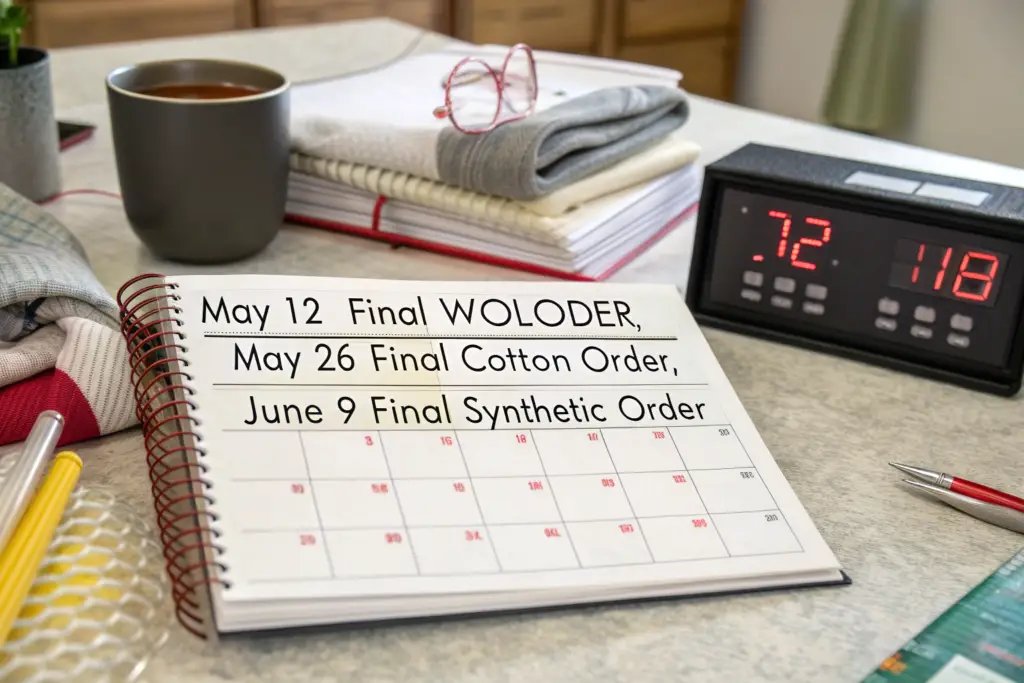
For Fall/Winter 2026, the fabric order deadlines for our key mills were as follows. Wool and wool blends: order by May 15th. Heavy cotton twills and canvases: order by June 1st. Synthetic performance fabrics: order by June 15th. Specialty jacquards and custom-developed fabrics: order by April 30th. These dates were not chosen by us. They were communicated by the mills based on their capacity projections. The brand owner who orders after these dates is taking a schedule risk.
How Does the Chinese New Year Factory Shutdown Reshape the Winter Calendar?
Chinese New Year is the single most disruptive event in the global garment supply chain. For approximately two to four weeks, depending on the factory and the region, the entire Chinese manufacturing sector shuts down. Workers travel to their hometowns. Factories are empty. Mills are silent. No fabric is woven. No garments are sewn. No shipments are loaded. The shutdown is absolute and predictable. It happens every year, in late January or early February, based on the lunar calendar.
The shutdown reshapes the winter calendar because it creates a hard stop on production. Any Fall/Winter production that is not completed before the Chinese New Year shutdown will be delayed by the duration of the holiday, plus the ramp-up time as workers return gradually. A garment that was supposed to ship on January 20th but slips to January 25th might actually ship on February 25th because the factory closed on January 26th and did not fully resume production until February 20th.
The shutdown also affects the mills. A fabric order placed in late December with an expected delivery in early January is at high risk. If the mill encounters any delay, the fabric will not be delivered until after the holiday. The garment factory loses four to six weeks of production time waiting for that fabric.
The practical implication for Fall/Winter ordering is a "pre-Chinese New Year" deadline. For a collection delivering to retail in September, the production typically runs from May to July, well before the holiday, and Chinese New Year is not a factor. But for a collection delivering in November or for the holiday season, or for a reorder, the Chinese New Year shutdown becomes a critical planning constraint. Any order with a factory ship date in January or February must account for the holiday shutdown.
A brand owner producing a holiday party dress collection needed a ship date of January 15th for a November retail delivery. We scheduled his cutting for early December, sewing for mid-December to mid-January, and finishing for the week of January 10th. We built in a one-week buffer specifically for Chinese New Year risk. The dresses shipped on January 16th. Without that buffer, a minor sewing delay would have pushed the ship date into late February, and the holiday season would have been missed entirely. The Chinese New Year shutdown is not a surprise. It is a scheduled event. The schedule must be built around it.
What Are the Latest Order Placement Dates for a Safe October Retail Delivery?
October is the pivotal month for Fall/Winter retail. The weather has turned. The consumer is shopping for warmth. The holiday gift-buying season is about to begin. A brand that has its collection on the floor by October 1st captures the full season. A brand that arrives on October 25th loses almost a month of peak selling. The difference in sell-through between an October 1st delivery and an October 25th delivery can be 20% or more. The delivery date determines the financial outcome of the entire collection.
For a safe October retail delivery, with goods arriving at the destination port or distribution center by late September, the latest order placement dates are as follows. For heavy woven garments, wool coats, structured jackets, the factory must receive the confirmed purchase order and deposit by May 15th. For mid-weight woven and knit garments, cotton trousers, merino sweaters, the deadline is June 1st. For lightweight knit and synthetic garments, performance fleece, base layers, the deadline is June 15th. These dates assume standard sea freight. Air freight can compress the timeline by three to four weeks but adds a cost that often eliminates the margin on the order.
These deadlines are not conservative. They are realistic, based on current mill lead times and factory throughput. A brand owner who places an order on the deadline date will receive their goods on time, assuming no unforeseen delays. A brand owner who places an order two weeks after the deadline is gambling. The odds of an on-time delivery drop significantly with each passing week.
How Do Lead Times Differ Between Heavy Wovens, Knits, and Performance Synthetics?
The lead time differences between fabric categories are driven by the inherent production speeds of the different textile technologies. Weaving is slower than knitting. Dyeing heavy fabrics takes longer than dyeing lightweight fabrics. Finishing processes for performance synthetics are more complex than for basic cotton.
Heavy wovens, the wool melton for a winter coat, the heavy cotton twill for a structured jacket, have the longest lead times. The weaving process is slow. The looms produce fewer meters per day than a knitting machine. The dyeing and finishing of heavy wool fabrics require careful control of shrinkage, hand feel, and surface finish. The total mill lead time for a heavy wool coating is typically six to eight weeks.
Mid-weight knits, the merino wool for a sweater, the cotton cashmere blend for a cardigan, have intermediate lead times. The knitting process is faster than weaving. The panels can be knitted directly to shape, reducing material waste. The dyeing and finishing are relatively standard. The total mill lead time for a merino knit is typically four to six weeks.
Performance synthetics, the recycled polyester fleece, the nylon-spandex softshell, have the shortest lead times for the base fabric, but the finishing processes, the water-repellent coating, the anti-odor treatment, the mechanical brushing, add time. The base fabric can be knitted quickly. The finishing adds one to two weeks. The total mill lead time is typically four to five weeks.
A brand owner developing a multi-category Fall/Winter collection with wool coats, cotton trousers, and fleece jackets cannot place all three orders on the same date and expect them to arrive together. The wool coat order must be placed first, in early May. The cotton trouser order follows in late May. The fleece jacket order can be placed in mid-June. The staggered ordering reflects the staggered lead times. The brand owner who understands this sequencing can manage their development calendar to front-load the longest-lead-time items.
When Should You Switch to Air Freight to Rescue a Late-Season Reorder?
Air freight is the emergency lever for late-season production. It compresses the transit time from the factory to the destination distribution center from four to five weeks by sea to one week by air. The time saving is significant. The cost premium is also significant. Air freight for a carton of wool coats can cost four to six times the sea freight cost. The decision to use air freight is a financial calculation: does the margin on the additional units sold during the peak selling window exceed the incremental freight cost?
The decision point for switching to air freight is typically six to seven weeks before the retail delivery date. If the goods are not ready to ship by sea at that point, they will not arrive in time. The switch to air freight must be made. The calculation is cold-blooded. If air freight costs an additional $4 per unit, and the unit sells at a margin of $25, the $4 air freight cost is a good investment if it enables the sale to happen. If the unit is a low-margin basic with a margin of $8, the $4 air freight cost eats half the margin, and the decision is more painful.
The air freight decision is not always triggered by factory delay. It is sometimes a deliberate strategy for a late-season reorder. A bestselling style sells out in early October. The brand owner places a reorder. The standard production timeline plus sea freight would deliver in late December, too late for the holiday season. The brand owner pays for air freight and receives the reorder in mid-November, capturing the last six weeks of peak selling. The air freight cost is a marketing investment that extends the selling life of a proven winner.
A brand owner with a bestselling women's cashmere-blend sweater sold out by October 10th. We had greige yarn in stock. We prioritized a reorder run on our feeder line. The sweaters were finished by November 1st. Sea freight would have delivered them on December 5th. Air freight delivered them on November 8th. The air freight cost was $3.80 per sweater. The sweater's margin was $42. The air freight was an easy decision.
How Should You Plan Your Sampling Calendar Backwards from the Bulk Order Deadline?
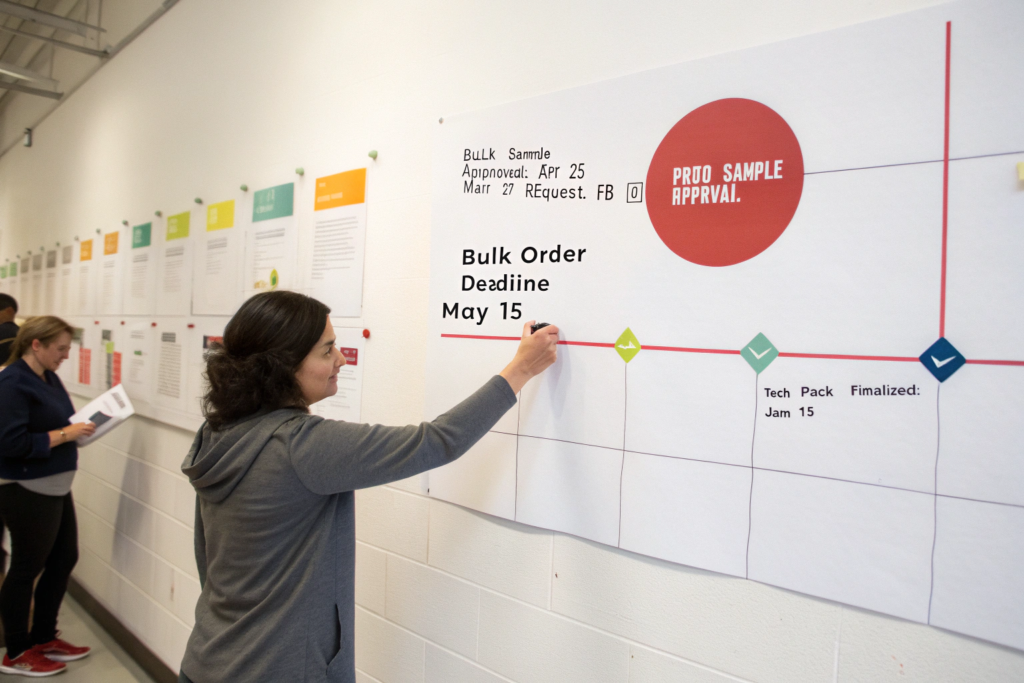
The bulk order deadline is the fixed point. The sampling calendar is built backwards from that point. The sampling process, proto sample, fit sample, pre-production sample, must be completed before the bulk fabric can be ordered and cut. The time required for sampling is often underestimated by brand owners who are new to the seasonal production cycle. They assume a sample can be made in two weeks. A complex wool coat with custom trim development can take six to eight weeks of sampling before the bulk order is confirmed.
The sampling calendar for a Fall/Winter collection with a May 15th bulk order deadline begins in January. The tech pack must be finalized by late January. The first proto sample is requested in early February and received by late February. The fit sample is revised and approved by late March. The pre-production sample, made in the actual bulk fabric with the actual trims, is approved by late April. The bulk fabric order is placed immediately upon pre-production sample approval. This four-month sampling timeline is not excessive. It is the minimum required to develop a quality garment without rushing decisions that will affect the entire bulk production run.
A rushed sampling process leads to a poor bulk outcome. A fit issue that is not caught in sampling because the sample was rushed will be replicated across thousands of units. The cost of the rework dwarfs the time that would have been invested in a proper sampling process. The sampling calendar is an investment in bulk quality.
Why Does the Pre-Production Sample Need to Be Made in Actual Bulk Fabric?
The pre-production sample, the PP sample, is the final sample before bulk production begins. It must be made in the exact fabric that will be used for the bulk order. A sample made in a similar, available fabric is not a valid PP sample. The purpose of the PP sample is to verify that the design, the fit, and the construction work correctly in the specific bulk fabric.
Different fabrics behave differently on the cutting table, under the sewing machine, and on the body. A wool melton from Mill A has a different drape, a different shrinkage rate, and a different response to pressing than a wool melton from Mill B. A sample made in Mill B's fabric, because Mill A's fabric was not yet available, is not a valid test of the Mill A garment. The bulk order must wait until the actual fabric is in hand and the PP sample is approved.
The PP sample also verifies the trims. The actual buttons, the actual zippers, the actual interlining are used. The PP sample is the garment exactly as it will be produced in bulk. Any issues with the fabric, the trims, or the construction must be identified and resolved at the PP sample stage. After the PP sample is approved, the design is frozen. Changes made after PP approval are expensive and delay the bulk production.
A brand owner developing a wool overcoat was under pressure to place the bulk fabric order before the mill's deadline. The bulk wool had not yet arrived. He considered approving the PP sample made in a similar substitute fabric so the mill order could be placed. We advised against it. We waited for the bulk wool. The PP sample revealed that the bulk wool had a slightly firmer hand feel than the substitute, which affected the collar roll. We adjusted the collar interlining to compensate. The adjustment delayed the bulk order by one week, but it prevented a collar issue that would have affected 1,200 coats. The PP sample in actual bulk fabric did its job.
How Much Buffer Time Should You Add for Unexpected Sampling Iterations?
Sampling is an iterative process. The first sample is rarely perfect. The second sample may have lingering issues. The third sample is usually correct. Each iteration takes time, the time to communicate the revisions, remake the sample, and ship it for approval. A sampling calendar that assumes one iteration is a calendar that will fail.
The buffer for sampling iterations depends on the complexity of the garment. A basic t-shirt in a standard fabric might require one or two iterations. A structured blazer with a complicated lining system might require three or four. A good rule of thumb is to budget for three iterations and celebrate if only two are needed.
The buffer time is not just for the factory's sewing. It includes the shipping time for the sample from the factory to the brand owner, the brand owner's internal review time, and the communication of the revision comments back to the factory. With international shipping, each sample round can take one to two weeks just in transit and review. Three iterations can easily consume four to six weeks of calendar time.
The sampling calendar should also include a "design freeze" date, after which no further design changes are accepted. This date is typically two weeks before the bulk fabric order deadline. Design changes requested after the design freeze date will delay the bulk order. The brand owner must understand that the design freeze is a commitment point. Creativity after the freeze is expensive.
We advise our clients to build a two-week "contingency buffer" at the end of the sampling calendar, just before the bulk order deadline. This buffer absorbs the unexpected, the fabric mill that ships a week late, the courier that loses a sample package, the brand owner who catches a cold and cannot review the sample for three days. The buffer is not wasted time. It is insurance. If nothing goes wrong, the bulk order is placed two weeks early, and the production schedule gains a cushion. If something goes wrong, the buffer absorbs the problem, and the bulk order is placed on time.
What Are the Critical Checkpoints for November Black Friday and Holiday Shipments?
Black Friday and the December holiday season are the Super Bowl of retail. The sales volume concentrated in late November and December can represent 30% to 40% of a brand's annual revenue. Missing these delivery windows is catastrophic. The goods that arrive on December 26th are not late for the season. They are dead for the season. The markdown cost is enormous. The Black Friday and holiday deadlines are the most unforgiving dates on the garment calendar.
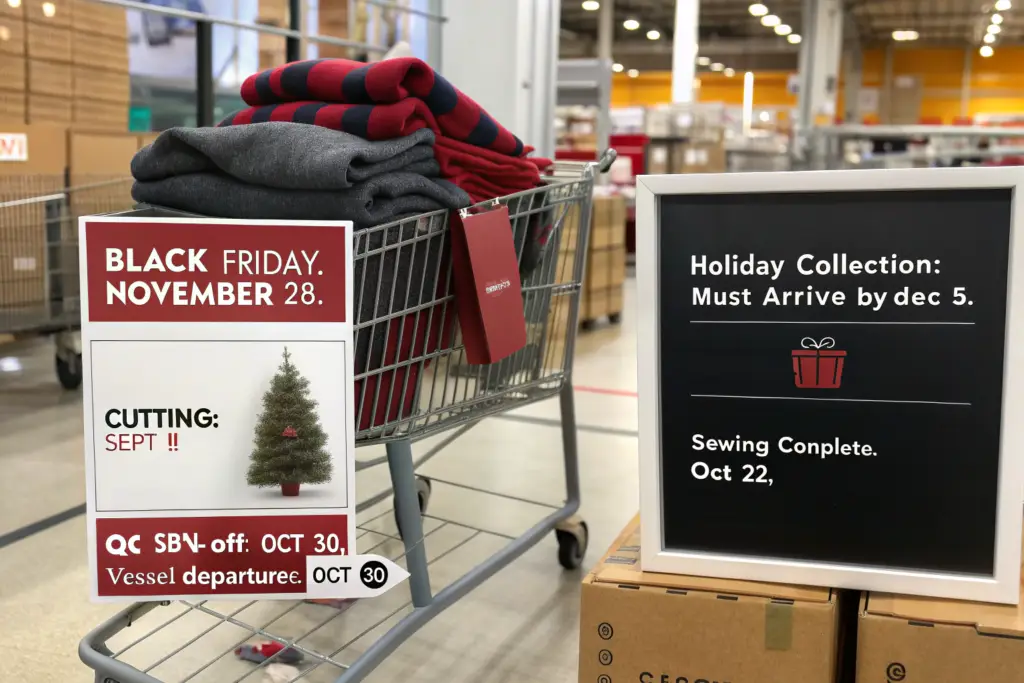
The critical checkpoints for a Black Friday delivery, with goods on the retail floor by November 20th, are as follows. Bulk fabric must be in-house by August 15th. Cutting must be complete by September 1st. Sewing must be complete by October 10th. Final QC and packing must be complete by October 20th. The container must depart the port by October 30th for US East Coast delivery, or by November 7th for US West Coast delivery. For a holiday delivery, with goods on the floor by December 10th, all dates shift forward by approximately two to three weeks. The bulk fabric deadline for holiday delivery is early September.
The Black Friday and holiday deadlines are so critical that we designate specific production lines for Black Friday orders starting in September. These lines are protected. Their capacity is not diverted to other orders. The weekly output is tracked against a precise schedule. Any deviation triggers an immediate recovery plan. The Black Friday order is treated with the same operational seriousness as a medical procedure. The deadline is non-negotiable.
How Do You Prioritize Which Styles to Put on the Fast-Track Feeder Line?
The feeder line concept we discussed in a previous article is a dedicated small-batch production cell for urgent orders. During the pre-Black Friday period, the feeder line is in constant operation. The question is which styles get priority access to this scarce, high-speed resource.
The prioritization is based on sell-through data. If a style is selling faster than forecast, the reorder goes to the feeder line. If a style is a proven bestseller from the previous season, the initial production run is partially allocated to the feeder line to accelerate the delivery. If a style is a new design with uncertain demand, it goes to the standard production line.
The feeder line is not for every style. It is for the 20% of styles that will generate 80% of the Black Friday revenue. The brand owner and the factory must agree on this prioritization in advance. The brand owner designates the "A" styles, the priority styles. The factory allocates the feeder line capacity accordingly. The "B" and "C" styles run on the standard lines and have later delivery dates.
A brand owner with a bestselling men's flannel shirt, a proven Black Friday winner for three consecutive years, designated it as an "A" style. We pre-positioned the fabric and trims in August. When his full purchase order arrived in early September, we immediately loaded the flannel shirt onto the feeder line. The shirts were finished, packed, and shipped three weeks before his other styles. They arrived in his warehouse on November 1st, giving him a full three weeks of pre-Black Friday selling. The shirt sold out by November 22nd, at full price. The feeder line priority turned his bestseller into an even better seller.
What Is the Final "Ship-or-Cancel" Date for a Holiday Collection?
The "ship-or-cancel" date is the date beyond which shipping the goods is worse than canceling the order. For a holiday collection, the ship-or-cancel date is the date at which the goods, if shipped, will arrive after the holiday selling season. The goods would be received into the warehouse, counted, and immediately moved to the markdown section. The brand owner pays the full cost of the goods plus the freight, and recovers a fraction of the cost through clearance sales. It is often financially better to cancel the order and avoid the additional freight and warehousing costs.
The ship-or-cancel date is calculated based on the transit time and the retail calendar. For a US East Coast holiday delivery, with goods needed by December 10th, the sea freight transit time is four weeks. The goods must ship by November 12th. If the goods are not ready to ship by November 12th, sea freight is no longer viable. Air freight can compress the transit time to one week, pushing the ship-or-cancel date to approximately December 1st. If the goods are not ready by December 1st, even air freight cannot deliver them in time for the holiday season. The order should be canceled, or the goods diverted to a later-season delivery at a renegotiated price.
The ship-or-cancel conversation is the most difficult conversation in garment manufacturing. The factory has produced the goods. The brand owner needs the goods. But the calendar has run out. The decision must be made on cold financial logic, not hope. A clear, pre-agreed ship-or-cancel date in the purchase contract makes this conversation slightly less painful. Both parties knew the date when the order was placed. The date has arrived. The decision is made.
A brand owner had a holiday collection of women's velvet blazers scheduled to ship on November 5th. A fabric delay pushed the completion date to November 19th. The sea freight ship-or-cancel date for his East Coast warehouse was November 12th. Sea freight was impossible. The air freight cost was calculated at $5.20 per blazer, against a margin of $38. Air freight was viable but tight. We shipped the blazers by air on November 21st. They arrived at his warehouse on November 29th, in time for the final two weeks of holiday shopping. The ship-or-cancel analysis saved the collection. Without it, he would have canceled the order and lost the entire season's margin.
Conclusion
The seasonal deadlines for Fall/Winter garment orders are not suggestions. They are the hard, physical boundaries of a supply chain that spans continents and involves dozens of specialized processes. A brand owner who treats these deadlines as flexible will experience them as inflexible in the most painful way possible, with a container arriving after the season has ended.
We have mapped the critical path from fabric mill to final shipment, identifying the mill's weaving and dyeing schedule as the ultimate constraint that sets all downstream deadlines. We have defined the specific order placement dates for a safe October retail delivery, with May 15th as the pivotal date for heavy woven garments. We have built the sampling calendar backward from the bulk order deadline, showing that Fall/Winter development must begin in January, not May. And we have set the critical checkpoints for Black Friday and holiday shipments, with ship-or-cancel dates that must be agreed upon before the order is placed.
The entire system runs on lead times. The brand owner who respects the lead times, who places orders by the mill's deadlines, who builds buffer into the sampling calendar, who prioritizes styles for the feeder line, ships on time. The brand owner who ignores the lead times ships late. The difference is not luck. It is planning.
At Shanghai Fumao, our seasonal planning process is a structured, calendar-driven discipline. We publish our mill deadlines to our clients in March. We build our production schedule around the critical path. We communicate proactively when a deadline is approaching or at risk. We do this because our success is measured by our clients' sell-through, and sell-through depends on on-time delivery.
If you are planning a Fall/Winter collection and you want a manufacturing partner who treats the seasonal calendar with the seriousness it deserves, I invite you to contact our Business Director, Elaine. She can provide you with a detailed seasonal planning calendar specific to your product category, walk you through the critical deadlines for your target delivery dates, and help you build a development timeline that gets your collection to the floor on time. Reach Elaine at elaine@fumaoclothing.com. The calendar is already ticking. Let's get started.