Two years ago, a buyer from a major US children's brand sat in my office and told me a story that still makes me check every single needle detection log twice. Her previous supplier had shipped a container of toddler fleece jackets to their US distribution center. A mother in Ohio bought one of the jackets for her three-year-old daughter. The little girl put her hand in the pocket and screamed. A broken sewing machine needle tip, razor-sharp and an inch long, had been left inside the pocket lining. The mother found it before the child was seriously hurt. The brand recalled the entire production run. The cost of the recall, the refunds, the logistics, the legal settlement, was over $400,000. The brand's reputation for safety, built over fifteen years, was damaged in a single news cycle. The buyer told me, "Needle detection is not a quality step. It is a life-or-death step."
Shanghai Fumao ensures needle detection safety for kids' wear shipments through a three-stage protocol. Stage one is a proactive broken needle management system on every sewing machine. Stage two is a mandatory 100% garment-by-garment metal detection pass using calibrated conveyor and handheld systems. Stage three is a documented chain of custody that records every test result, links it to a specific carton, and travels with the shipment. No children's garment leaves our factory without passing through all three stages and generating a verifiable safety record.
The needle is the most dangerous object in a garment factory. It moves at thousands of stitches per minute. It can break. When it breaks, the tip can disappear into the fabric, into the lining, into a seam fold. It becomes a hidden weapon inside a garment made for a child. The only defense is a system that assumes a needle will break, and ensures that when it does, every piece of the broken needle is found, and every garment is independently verified as needle-free before it enters a carton. At Shanghai Fumao, this system is not a machine. It is a culture. Let me show you how it works.
What Is a Broken Needle Management Protocol on the Sewing Floor?
The most effective needle detection is the one that never needs to find a needle. The best defense is to prevent broken needle fragments from ever entering the production flow. This is the purpose of the broken needle management protocol on the sewing floor. It is a set of strict procedures that every sewing operator must follow every time a needle breaks. The protocol is designed to account for every millimeter of the broken needle before the operator resumes sewing.
A broken needle management protocol requires the sewing operator to immediately stop work when a needle breaks. They must collect all visible fragments and place them in a designated broken needle recovery tray. A supervisor is called to verify that the recovered fragments, when reassembled, account for the entire original needle. The machine is inspected. The surrounding area is swept with a handheld magnet. The garment being sewn at the moment of breakage is immediately removed from the line and quarantined for secondary screening. Only when the supervisor signs off on the recovery report can the operator resume work with a new needle, which is issued and logged.
This protocol is expensive in terms of lost production time. A needle break can stop a workstation for ten to fifteen minutes. A factory focused only on output will pressure operators to quickly grab a new needle and keep sewing. That factory will ship garments with broken needle fragments. A factory focused on safety will accept the production loss as a non-negotiable cost of making children's clothing.
How Does a Needle Log Book Create Individual Accountability?
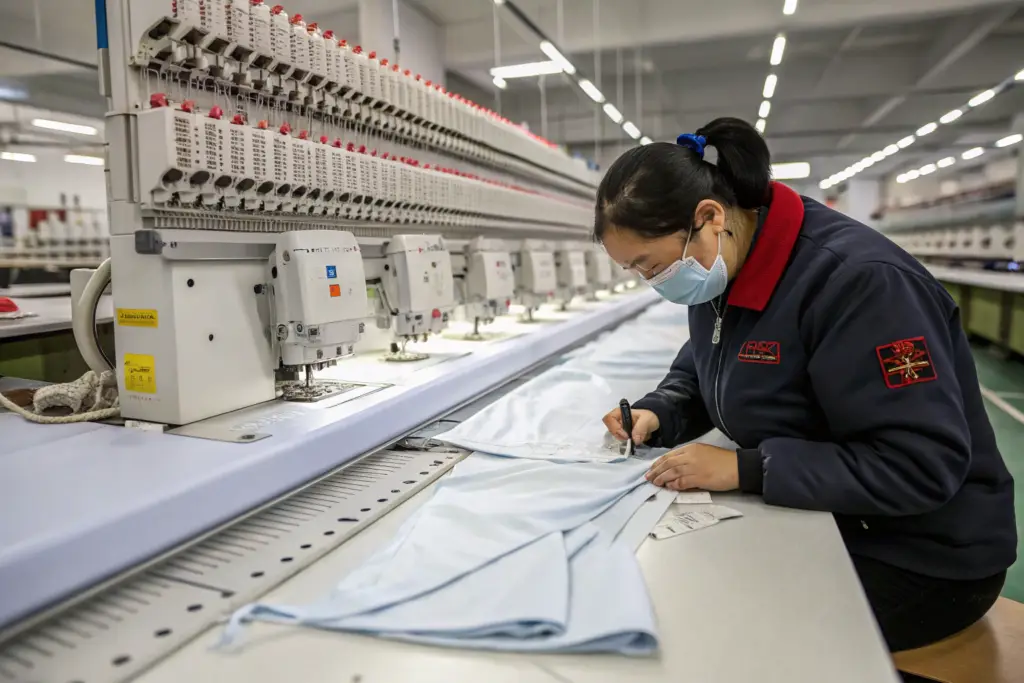
A needle log book is a physical or digital record that tracks every needle issued to every sewing machine. Each machine has a designated needle type and size. When a new needle is issued, the date, time, machine number, operator name, and needle specification are recorded. The operator signs to acknowledge receipt of the needle.
When a needle breaks, the breakage is recorded in the log. The recovery of the fragments is documented. The supervisor signs to confirm that all fragments were recovered and the needle was whole. If a fragment is missing, the log shows a red flag. The machine is not released back to production. The search continues until the fragment is found or the affected garments are quarantined and scanned.
The log book creates a chain of custody for every needle. An auditor can trace the history of a specific needle from its issuance to its eventual retirement. A gap in the log, a missing entry, a breakage recorded but not signed off, is an immediate audit finding. The log book makes the needle management process visible, auditable, and accountable to the individual operator and supervisor.
At Shanghai Fumao, our needle log books are reviewed daily by the production manager and weekly by the quality assurance manager. Any pattern of frequent breakages on a specific machine triggers a maintenance inspection. A dull blade on the cutting table, a misaligned feed dog, a worn needle bar, can cause repeated needle breaks. The log book is not just a safety record. It is a diagnostic tool that identifies machine maintenance issues before they cause a quality or safety failure.
What Happens to the Garment That Was Under the Needle When It Broke?
The garment being sewn at the exact moment of needle breakage is the highest-risk garment in the factory. The broken tip, if not recovered, is most likely embedded in that specific garment. The protocol for this garment is absolute. It is immediately removed from the production line. It is placed in a sealed red quarantine bag with a label describing the incident, the machine number, the operator name, and the time. It is not mixed with other garments. It is not sent to the next operation. It is isolated.
The quarantined garment is taken to a dedicated inspection station. It is passed through a high-sensitivity handheld metal detector, separate from the main conveyor system. Every seam, every pocket, every fold is scanned. If the detector does not locate the fragment, the garment may be carefully seam-ripped in the area where the needle broke to visually search for the fragment. If the fragment is found, it is matched with the recovered fragments from the needle tray. If the fragment is still not found, the garment is destroyed. It is cut into pieces and discarded. No quarantined garment is ever shipped until the missing fragment is found or the garment is destroyed.
A broken needle incident occurred on a line producing toddler corduroy overalls. The operator heard the snap and immediately stopped. The supervisor recovered two fragments. A third fragment, the very tip, was missing. The overalls were quarantined. The handheld detector located the tip embedded in the thickness of the corduroy seam allowance. The tip was recovered. The three fragments were reassembled on the supervisor's desk, forming a complete needle. The recovery report was signed. The overalls were released back to the line. The incident added 22 minutes to the production time for that single garment. The alternative was shipping a toddler overall with a needle tip in the seam. The 22 minutes was not a cost. It was a child's safety.
How Do Conveyor and Handheld Detectors Differ in Sensitivity and Purpose?
The metal detection stage is the gate. Every garment, regardless of how it was sewn or who sewed it, passes through a metal detector before it is folded, tagged, and packed. The detection stage is the final, independent verification that the garment is free of metal contamination. It catches what the broken needle management protocol may have missed, a needle tip from a break that was not reported, a stray pin from the sample room, a fragment of a scissor blade. It is the safety net beneath the safety net.
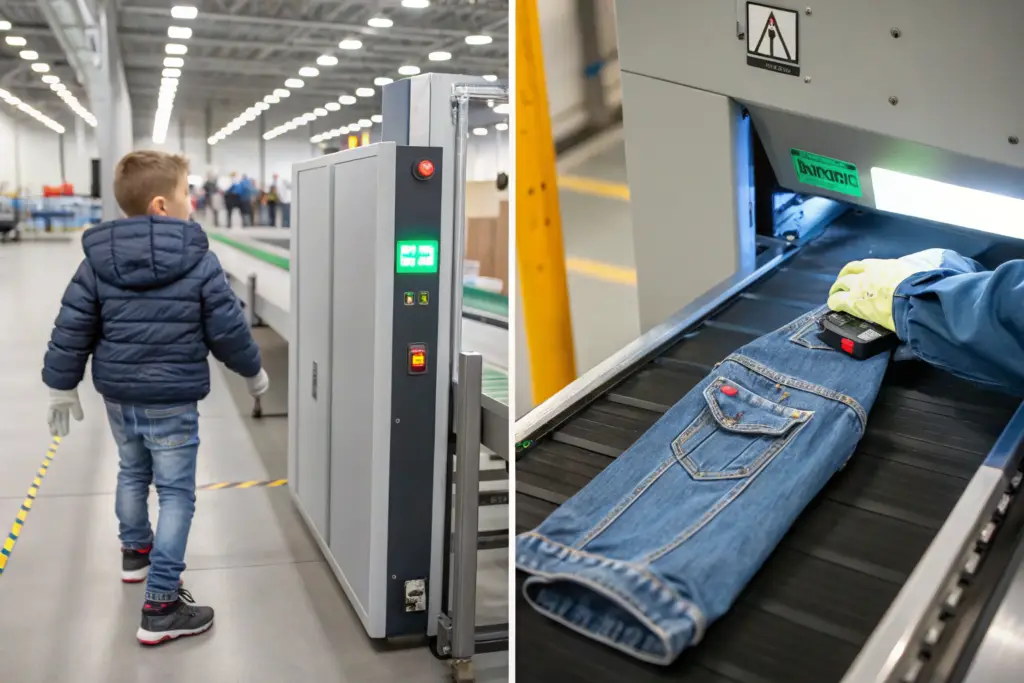
Conveyor detectors are high-speed, high-capacity machines that scan entire garments as they pass through a magnetic field on a moving belt. They are calibrated to detect ferrous metal fragments as small as 1.0mm in diameter. Handheld detectors are high-sensitivity wands used for targeted re-scanning of suspect garments or for inspecting areas the conveyor may not fully penetrate, such as thick seams, multiple fabric layers, or metal-free zones near non-removable metal components. The conveyor provides the primary 100% screen. The handheld provides the secondary, high-precision investigation.
The two technologies are complementary. The conveyor is the efficient, automated screening tool. The handheld is the precise, manual diagnostic tool. A garment that passes the conveyor is cleared for packing. A garment that triggers the conveyor alarm, or a garment that was quarantined from a needle break incident, is inspected with the handheld to locate and identify the metal object.
What Are the Calibration Standards for Kids' Wear Versus Adult Apparel?
The sensitivity requirement for a metal detector used on children's wear is higher than for adult apparel. The standard test piece for a children's wear detector is a ferrous metal sphere with a diameter of 1.0mm. This is the smallest fragment size the machine must reliably detect. For adult apparel, the standard test piece may be 1.2mm or 1.5mm. The difference reflects the higher vulnerability of children, their thinner skin, their tendency to mouth fabrics, and the catastrophic consequences of a missed fragment.
The calibration procedure is performed at the start of every shift and every two hours during production. A certified test card, containing the 1.0mm ferrous sphere, is passed through the detector on the conveyor belt. The machine must alarm reliably. If the test card passes without alarm, the machine has lost sensitivity. The line is stopped. The machine is recalibrated. All garments that passed through since the last successful calibration test are quarantined and re-screened.
The calibration records are maintained in a log. The date, time, test result, and technician signature are recorded. An auditor can review the calibration log and verify that the machine was functioning correctly at the time a specific garment was screened. A gap in the calibration log, a failed test without a documented recalibration, is a critical audit finding.
We tested our conveyor detector calibration standards against the requirements of a major US children's retailer's compliance manual. Our 1.0mm standard exceeded their minimum requirement of 1.2mm. We chose to maintain the stricter standard across all our children's wear lines. The sensitivity margin is an extra layer of safety. It means a fragment that might pass through a detector calibrated to the retailer's standard will be caught by our more sensitive calibration.
Why Is a "Dummy Run" Test Essential at Shift Start and Every Two Hours?
A dummy run is a test where a known contaminant, the 1.0mm test card, is placed inside a garment and passed through the detector. The garment is a "dummy" because it simulates a real contaminated garment. The test verifies not just the machine's sensitivity in isolation, but its ability to detect a contaminant inside the actual garment types being produced.
A detector might pass its calibration test with the test card alone but fail to detect the same test card when it is placed inside a heavy, multi-layer garment like a padded winter coat. The fabric density, the metal zipper, the snaps, can interfere with the magnetic field and mask the signal from a small fragment. The dummy run test verifies that the detector is sensitive enough to overcome the interference of the specific garment being screened.
The dummy run is performed with the heaviest, most complex garment in the current production batch. If the detector can find the 1.0mm test card inside a thick, insulated jacket, it can find it in a lightweight t-shirt. The test is repeated every two hours to ensure the machine's performance has not drifted.
During a production run of children's quilted vests, our shift-start dummy run detected an issue. The vest's metallic zipper was creating a consistent interference signal that slightly reduced the detector's effective sensitivity. The test card was detected, but the signal strength was lower than normal. We adjusted the detector's phase setting to compensate for the zipper interference, re-ran the dummy test successfully, and continued production. Without the dummy run, we would not have known the zipper was degrading the screening sensitivity. The vests produced in the two hours before the adjustment were re-screened with the corrected settings.
How Do You Prevent Metal Contamination from Trims, Snaps, and Zippers?
Needles are the most dangerous metal contaminant, but they are not the only one. Snaps, buttons, zippers, rivets, and eyelets are all metal components that can break, shed fragments, or arrive from the trim supplier already damaged. A burr from a poorly finished snap can break off during wear and become a sharp metal particle. A zipper tooth can crack and detach. These trim-originating metal fragments are just as dangerous as a needle fragment, but they are harder to detect because they are chemically identical to the intentional metal components on the garment.
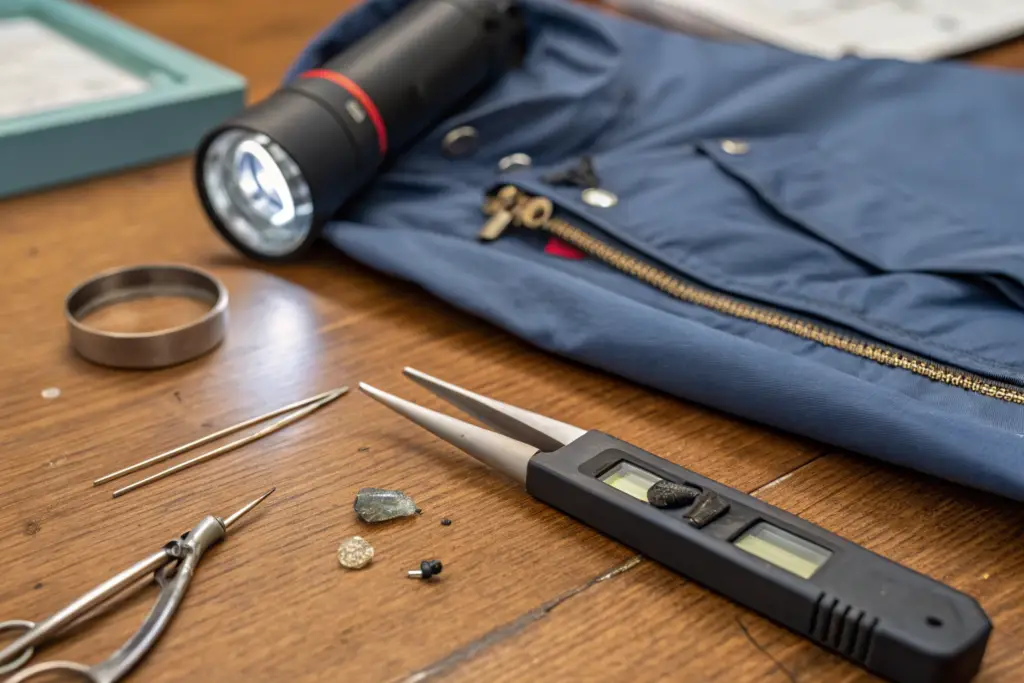
Preventing metal contamination from trims requires a multi-point inspection process. Trims are inspected upon arrival from the supplier, before they are released to the sewing line. A random sample from each batch is visually inspected under magnification for sharp edges, burrs, and cracks. A pull test is performed on snaps and buttons to ensure they do not detach or fracture under stress. During production, in-line QC inspectors check garments for loose or damaged trims. After the garment is complete, the final metal detection screen catches any detached fragments that may have been generated during the assembly process.
The trim inspection is as important as the needle detection. A snap that shatters into sharp fragments during the first wash is a safety failure that occurs after delivery, in the customer's home. The needle detector cannot prevent this. Only incoming trim quality control can prevent it.
What Incoming Trim Inspection Protocols Prevent Supplier Defects?
When a shipment of metal snaps arrives from the trim supplier, it is not immediately sent to the sewing line. It goes to the incoming quality control station. A sample is drawn according to AQL sampling standards. The sample size depends on the lot size. A batch of 10,000 snaps might have a sample of 200 pieces inspected.
The inspection is visual and mechanical. Each snap in the sample is examined under a magnifying lamp. The inspector looks for burrs, sharp edges, incomplete forming, cracks, and corrosion. Any snap that shows a defect is a rejection for that piece. If the number of defective pieces exceeds the AQL threshold for the lot, the entire batch is rejected and returned to the supplier.
The mechanical test is a snap attachment and pull test. Sample snaps are attached to a piece of the actual production fabric. A force gauge is used to pull the snap apart. The snap must withstand a specified force without breaking and without detaching from the fabric. The spring mechanism in a snap can fail, leaving a sharp metal edge exposed. The pull test identifies weak springs and weak fabric attachments.
A children's jacket order used custom metal logo snaps from a trim supplier. Our incoming inspection found that 4% of the snaps in the sample had a small burr on the edge of the cap, a manufacturing defect from the stamping process. The AQL threshold for this component was 2.5%. The lot was rejected. The supplier re-polished the entire batch and resubmitted it. The re-inspected lot passed. If we had missed the burrs, 400 jackets would have been produced with snaps that had a sharp edge, uncomfortable for the child and a potential cut risk. The incoming inspection prevented a safety failure before it reached the sewing line.
How Do You Handle Garments with Non-Removable Metal Components During Scanning?
A garment with a large metal zipper, multiple metal snaps, or a metal logo plate presents a challenge for the conveyor metal detector. The intentional metal component creates a strong signal that can mask the weak signal from a small needle fragment. The detector cannot distinguish between the "good" metal of the zipper and the "bad" metal of the needle fragment. The garment might pass the detector even if a fragment is present, because the fragment's signal is lost in the noise of the zipper.
The solution is a combination of detector settings and manual inspection. The conveyor detector is operated in a "reverse" or "metal-free zone" mode. The operator positions the garment so that the metal zipper or snaps pass through the detector first. The detector registers the intentional metal and "learns" its signal. The rest of the garment is then expected to be metal-free. If a fragment is present in the fabric away from the zipper, the detector will see a new, unexpected metal signal and alarm.
For garments with extensive metal components, a full-length zipper, multiple snaps, metal adjusters, the conveyor screen is supplemented with a thorough handheld wand inspection. The handheld wand is small and maneuverable. The inspector can isolate specific areas of the garment, the pocket bags, the collar points, the hem, and scan them individually. The wand can be positioned closer to the fabric than the conveyor detector, increasing sensitivity.
A child's denim jacket with a full metal front zipper and metal button closures is one of the most challenging garments to screen. Our procedure for this garment type is a two-pass conveyor screen with a specific orientation, followed by a handheld wand scan of every pocket and every seam intersection. The combined protocol is slower, but it provides coverage that neither method alone can achieve. The extra screening time is built into the production cost for the garment.
What Documentation Links a Specific Carton to a Passed Needle Detection Test?
A needle detection test that is not documented did not happen. This is the standard applied by US and EU retailer compliance auditors. If a brand owner cannot produce a verifiable record that a specific carton of children's garments passed a needle detection test, the auditor will assume the test was not performed. The carton may be rejected. The shipment may be held. The brand may be fined. Documentation is the legal evidence of safety.
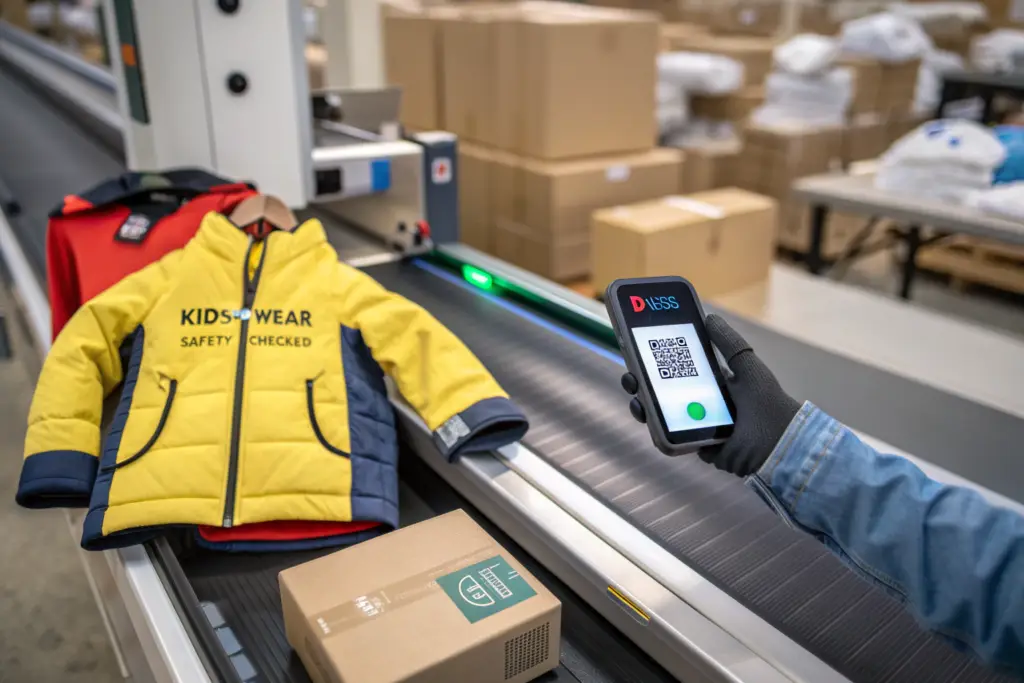
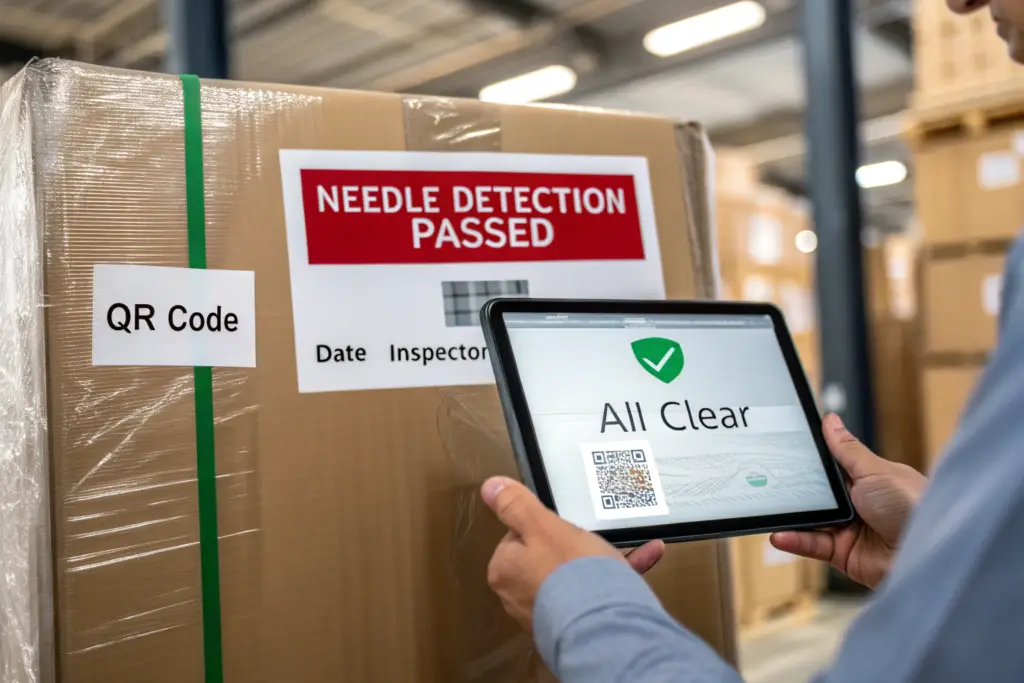
Every carton of children's wear shipped from our factory carries a unique carton barcode that is scanned and linked to the digital needle detection records for the garments inside that carton. The record includes the date and time of the test, the machine ID, the operator name, the test result, and the calibration status of the machine at the time of the test. This data is stored in our production database and is accessible to the client for audit purposes. The carton itself carries a tamper-evident "Safety Checked" seal with the carton barcode and the inspection date.
The documentation chain creates backward traceability. If a safety concern is raised about a specific garment, the brand can trace the garment to the carton it was packed in, and the carton to the needle detection record. The record proves the garment was screened and passed. The alternative, a factory that cannot produce this record, leaves the brand defenseless in the event of a customer complaint or a legal claim.
What Does a Compliant Needle Detection Report Look Like for a Retailer Audit?
A compliant needle detection report is a formal document that meets the specific requirements of the retailer's compliance manual. Major US retailers publish detailed vendor compliance guides that specify the exact content and format of the needle detection report.
The report must identify the factory and the production order. It must list the garment style numbers and the total quantity screened. It must specify the type of detector used, the conveyor model and the handheld wand model, and the calibration standard applied. It must state the test frequency, every garment, and the calibration frequency, every two hours. It must include the calibration log for the production period, showing the date, time, test result, and technician signature for each calibration check.
The report must be signed by a responsible factory manager, typically the Quality Assurance Manager or the Production Director. The signature is a legal attestation that the information in the report is true and accurate. A false report is not just a compliance violation. It is fraud.
A client preparing for a vendor audit by a major US department store requested our needle detection report for their previous season's order. We provided the report within an hour. It included the 100% screening confirmation, the calibration logs, and the carton-level traceability records. The auditor reviewed the report and approved it without a physical inspection of our factory. The completeness and organization of the report demonstrated our compliance maturity. The audit was closed with a green rating. The retailer's auditor commented that our report was one of the most thorough they had received.
How Do You Digitally Track and Store Inspection Data for Future Traceability?
Paper records are fragile. They can be lost, damaged, or altered. Digital records are durable, searchable, and auditable with an electronic trail. We have invested in a digital quality management system that captures needle detection data in real-time and stores it securely.
The conveyor detector and the handheld wand are connected to the system. When a garment passes the detector, the result, pass or fail, is logged with a timestamp and the machine ID. When a calibration check is performed, the result is logged. The data is associated with the specific production order and the specific operator.
When a carton is packed, the packer scans the carton barcode and scans each garment barcode as it enters the carton. The system links the garment barcodes to the carton barcode. Because the garment barcodes are already linked to the needle detection records, the system creates a complete, auditable chain: carton to garments to needle detection results to machine calibration status. The entire chain is queryable by carton number, by order number, or by production date.
A brand owner whose customer found a small metal fragment in a child's garment would face a crisis. With our digital traceability, the crisis is manageable. The brand provides us with the carton number from the garment's packaging. We query the database. Within minutes, we produce the needle detection record for that specific carton. The record shows the date and time of screening, the machine used, the calibration status, and the test result, which was a pass. This record does not prove the fragment was not present, but it proves the brand exercised due diligence, which is the legal standard for liability protection. Without the record, the brand has no defense.
Conclusion
Needle detection safety for children's wear is a system built on the assumption that a failure will occur. A needle will break. A sharp edge will be missed. A metal fragment will embed itself in a seam. The question is not whether these events will happen. The question is whether the system catches them before the garment reaches a child. The system we have described catches them.
The broken needle management protocol on the sewing floor is the first line of defense. It prevents fragments from entering the production flow. The needle log book creates individual accountability and generates a maintenance diagnostic record. The quarantined garment procedure isolates the highest-risk garment and ensures it is cleared or destroyed. The conveyor and handheld detectors are the independent verification stage, calibrated to a 1.0mm sensitivity standard and verified every two hours with a dummy run. The incoming trim inspection prevents defective metal components from reaching the sewing line. And the digital traceability system links every carton to a verifiable safety record.
At Shanghai Fumao, we treat children's wear safety as a sacred responsibility, not a compliance checkbox. We know that behind every garment we ship is a parent who trusts that the product is safe, and a child who is too young to protect themselves. We honor that trust with a system that is redundant, documented, and constantly verified.
If you are a children's wear brand owner, and you want to understand exactly how your products will be protected in our factory, I invite you to contact our Business Director, Elaine. She can provide a sample of our needle detection report, a video walkthrough of our detection and calibration procedures, and a detailed explanation of how our traceability system links your cartons to your safety records. Reach Elaine at elaine@fumaoclothing.com. Let's ensure that every garment you sell is as safe as we can possibly make it.