A children's wear brand owner from Portland sat in my showroom last April with a stack of lab reports. Her previous supplier had assured her that the organic cotton pajamas she ordered were "chemical free." A routine spot check by a US retailer revealed trace formaldehyde levels above the acceptable threshold. The retailer canceled a $120,000 purchase order on the spot. She had a warehouse full of pajamas she could not sell. She had a legal bill from the retailer's compliance department. And she had a broken trust with the customers who had already bought and worn the first batch. She looked at me and said, "I will never buy another inch of children's fabric without an OEKO-TEX certificate I can verify myself."
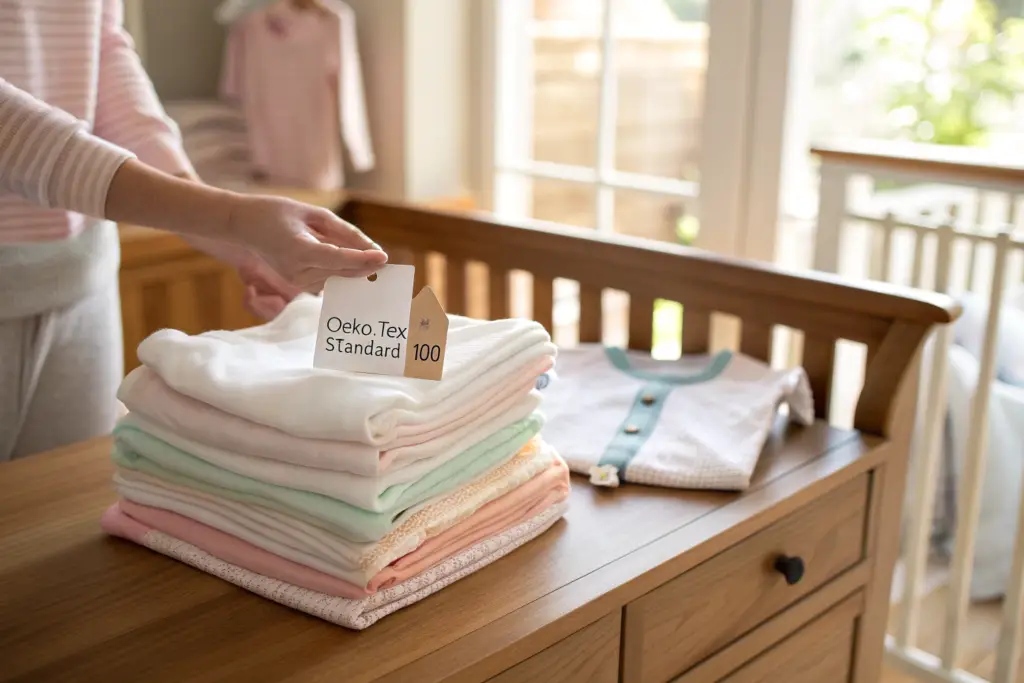
US buyers are increasingly demanding OEKO-TEX Standard 100 certification for children's apparel because it is the most recognized independent guarantee that every component of a garment, from the fabric to the thread to the snaps, has been tested for harmful substances. American parents are more educated about chemical safety than ever before. Retailers are responding by making OEKO-TEX certification a hard requirement in their vendor manuals. And US consumer protection law, while less comprehensive than EU REACH, is evolving toward stricter chemical safety standards, with several states enacting their own regulations that align closely with OEKO-TEX criteria.
This shift is not a passing trend. It is a structural change in the US children's wear market. The days of a supplier saying "trust me, it's safe" are over. The days of a brand printing "non-toxic" on a hangtag without independent proof are over. The OEKO-TEX certificate has become the currency of trust in children's apparel safety. At Shanghai Fumao, we have responded to this demand by certifying our children's wear production lines and maintaining a fully traceable, OEKO-TEX compliant supply chain for our kids' apparel clients. Let me explain why this certification has become so essential, and what it means for your brand if you are selling children's clothing in the US market.
What Is OEKO-TEX Standard 100 and What Does It Actually Test For?
There is a lot of confusion in the market about what OEKO-TEX actually means. I have heard brand owners use "OEKO-TEX" as a synonym for "organic." It is not. I have heard them say it means the fabric is "sustainable." It does not, at least not directly. OEKO-TEX Standard 100 is a product safety certification. It is laser-focused on one question: does this finished textile product contain any substance that is harmful to human health? The answer is determined by laboratory testing, not by a review of farming practices or manufacturing processes. It is a chemical safety label, not an environmental or organic label.
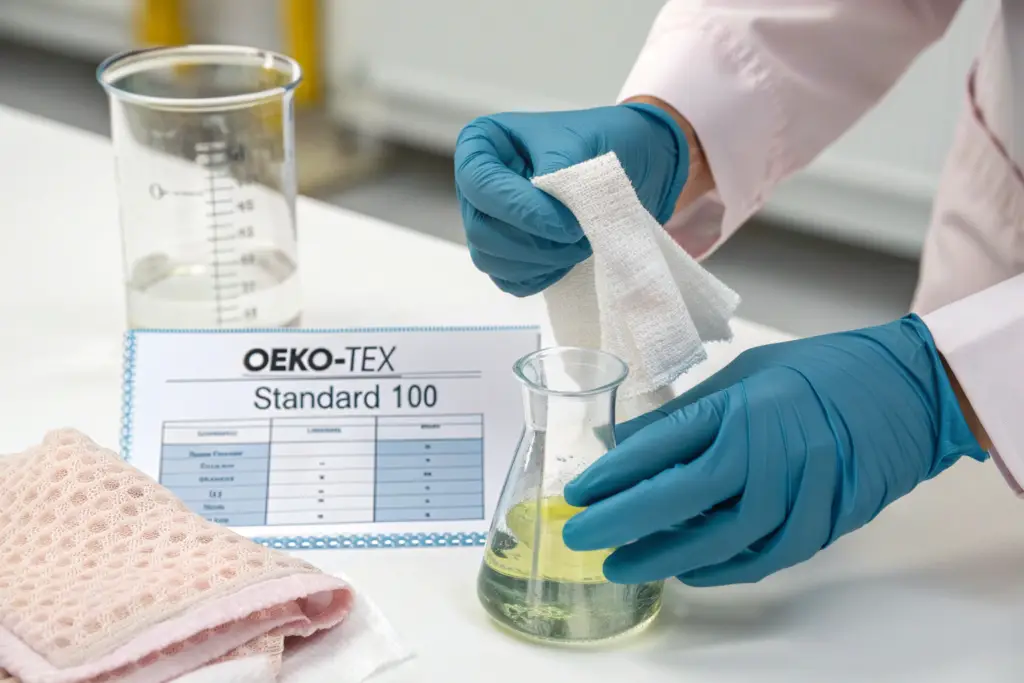
OEKO-TEX Standard 100 tests for over 100 harmful substances, grouped into four categories: legally banned substances like carcinogenic azo dyes, substances regulated by law like formaldehyde and heavy metals, substances that are known to be harmful to health but not yet legally regulated, and parameters that safeguard health like a skin-friendly pH value. The test is conducted on every individual component of the finished product. The fabric, the sewing thread, the buttons, the zipper, the printed label, the interlining. Every single piece is tested.
The testing criteria are updated annually based on new scientific research and regulatory changes. A certificate issued in 2025 may not cover a substance that is added to the restricted list in 2026. This is why the certificate has an expiry date, typically one year, and why brands must ensure their supplier's certificate is current. An expired OEKO-TEX certificate is not a valid safety guarantee.
Why Does OEKO-TEX Test "Every Component" and Not Just the Main Fabric?
The most common chemical safety failure in children's clothing is not the main fabric. It is the small, hidden components. A printed label sewn into the neck seam. The elastic in a waistband. The coating on a metal snap button. The dye in a contrast stitching thread. A brand owner tests the cotton jersey body fabric and gets a clean result. They assume the entire garment is safe. They are wrong.
I have seen a shipment of baby rompers fail a retailer's chemical safety audit because the tiny embroidered logo on the chest, a decorative detail no bigger than a thumbnail, was stitched with a thread dyed with a restricted azo dye. The main fabric was clean. The thread was the problem. The entire shipment was rejected. The brand owner had tested the fabric but never thought to test the embroidery thread.
OEKO-TEX Standard 100 requires testing of every component because a garment is only as safe as its most dangerous part. A baby chews on the collar. The collar fabric must be safe. The baby sucks on the sleeve cuff. The cuff fabric, the elastic inside it, and the thread stitching it must all be safe. The baby's sensitive skin is in contact with the printed size label on the neck. The label, the printing ink, and the adhesive must all be safe. The "every component" requirement is not excessive. It is physiologically necessary because a baby interacts with all parts of the garment, not just the main body fabric.
When we source materials for a children's wear order, our trim supplier must provide an OEKO-TEX certificate for every single item they supply. The zipper tape, the zipper slider, the button, the snap, the thread, the interlining, the care label. If one component cannot be certified, we cannot use it. The chain is only as strong as its weakest link. The certification is only as valid as its least tested component.
What Is the Difference Between Product Class I, II, III, and IV?
OEKO-TEX Standard 100 divides textile products into four product classes based on their intended use and the intensity of skin contact. The class determines the strictness of the test limits. A substance allowed in a Class IV furnishing fabric at 100 parts per million might be allowed in a Class I baby garment only at 10 parts per million, or might be banned entirely.
Product Class I is for items for babies and toddlers up to three years old. This is the strictest class. The test limits are the lowest. The range of tested substances is the broadest. Every children's garment we produce that is intended for a child under three must achieve Class I certification. Baby bodysuits, crib sheets, toddler pajamas, infant bibs. Class I means the product is safe for the most sensitive skin and for mouthing behavior.
Product Class II is for items with direct skin contact. This includes children's t-shirts, underwear, leggings, and dresses for ages three and up. The test limits are slightly less strict than Class I but still very rigorous. Most of our children's apparel for the 4 to 12 age range targets Class II certification.
Product Class III is for items with little or no skin contact. This includes jackets with a full lining, where the lining is Class II but the outer shell is Class III. It also includes things like backpack fabrics. Product Class IV is for furnishing materials like upholstery and curtains. These are not relevant to children's apparel.
A common mistake I see is a brand owner thinking an OEKO-TEX certificate for Class II adult clothing applies to their children's line. It does not. The certificate clearly states the product class. If you are selling clothing for a two-year-old, the certificate must say Class I. If it says Class II, the garment has not been tested to the stricter limits required for baby and toddler safety. The class distinction is as important as the certificate itself.
Why Are US State Regulations Now Catching Up with European Chemical Standards?
For many years, US chemical safety regulation for textiles lagged far behind the European Union. The EU had REACH. The US had a patchwork of federal laws that did not specifically address many of the chemicals of concern in clothing. Brands that sold in both the EU and the US would produce a clean, REACH-compliant version for Europe and a less regulated version for the American market. That dual standard is collapsing. US states, frustrated with the lack of federal action, are passing their own laws.
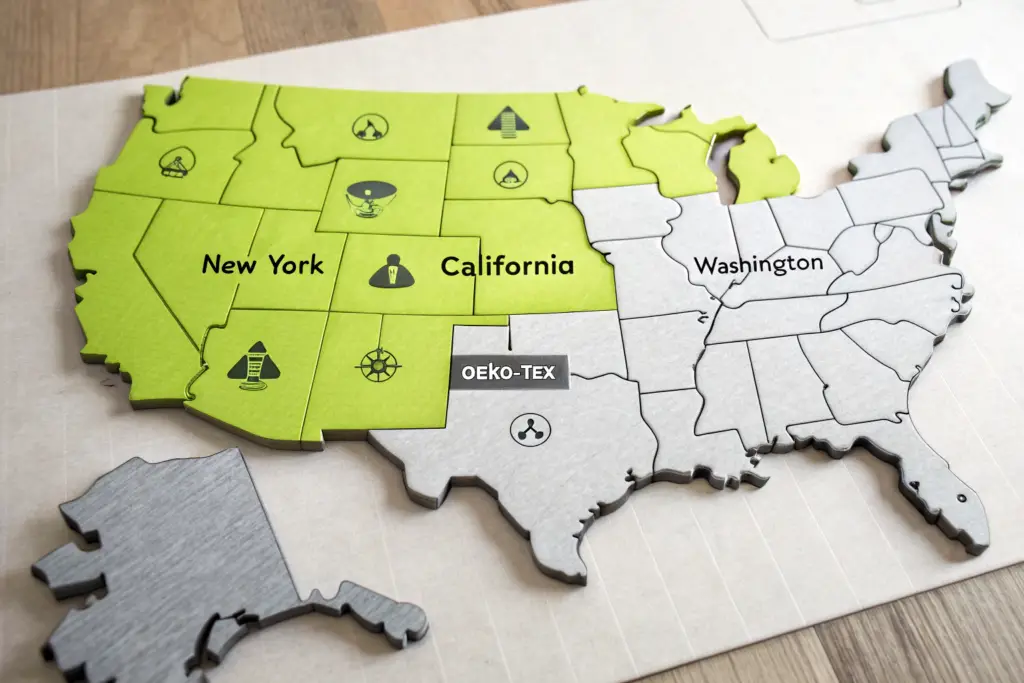
US state regulations are catching up with European chemical standards because states like California, New York, and Washington have enacted their own legislation restricting substances like formaldehyde, certain flame retardants, and perfluoroalkyl substances (PFAS) in children's products. These state laws, combined with retailer mandates that often exceed legal requirements, are creating a de facto national standard that closely mirrors OEKO-TEX criteria. A children's apparel brand selling nationally must now meet the strictest state-level standards to avoid liability.
For a brand owner, tracking 50 different state regulations is a nightmare. The practical solution is to adopt a single, comprehensive standard that meets or exceeds the strictest state law. OEKO-TEX Standard 100 Class I is that standard. If your children's garment passes OEKO-TEX Class I testing, it will pass the chemical safety requirements of every US state and every major US retailer. It is a single certification for a multi-jurisdictional market.
What Specific Substances Are Now Restricted by State Laws Like California's Prop 65?
California's Proposition 65, formally the Safe Drinking Water and Toxic Enforcement Act of 1986, is the most famous and most impactful state-level chemical safety law affecting textiles. It requires businesses to provide a clear and reasonable warning before exposing individuals to chemicals known to cause cancer, birth defects, or reproductive harm. The Prop 65 list currently contains over 900 chemicals. For children's apparel, the most relevant restricted substances are lead, phthalates, formaldehyde, and certain flame retardants.
Lead is a heavy metal that can be present in zippers, snaps, buttons, and screen printing inks. Prop 65 sets a very low maximum allowable dose level for lead exposure from consumer products. A children's garment with a cheap, non-certified metal snap is a significant lead exposure risk.
Phthalates are plasticizers used to make plastics, like vinyl raincoat material and plastisol prints, soft and flexible. Several phthalates, including DEHP, DBP, and BBP, are on the Prop 65 list. Children's apparel with a soft, rubbery printed graphic or a synthetic leather patch is a phthalate risk.
Formaldehyde is used in anti-wrinkle finishing and in some dyes. It is a known carcinogen and a skin irritant. Children's clothing labeled "wrinkle-free" or "easy care" should be scrutinized for formaldehyde levels.
A brand owner I work with sells children's dresses in a major California boutique chain. The chain's compliance department requires Prop 65 testing on every shipment, randomly sampling units and sending them to an independent lab. She was using a supplier who did not have OEKO-TEX certification. One shipment failed the Prop 65 lead test on the metal buttons. The chain canceled the order and suspended her vendor account pending a full supply chain audit. She switched to us because we provide an OEKO-TEX certificate that covers all these substances. Her shipments have passed every Prop 65 test since.
Washington State's Children's Safe Products Act restricts lead, cadmium, and phthalates in children's products and requires manufacturers to report the presence of any chemical on a designated high-priority list. New York is considering legislation restricting PFAS, the so-called "forever chemicals," in textiles, including children's apparel. PFAS are used for water and stain repellency. A rain jacket treated with a PFAS-based waterproofing will soon be unsaleable in several states. OEKO-TEX Standard 100 already restricts PFAS and has been ahead of US legislation on this issue for several years. The California Office of Environmental Health Hazard Assessment maintains the official Prop 65 list and is the authoritative source for compliance requirements.
How Are Major US Retailers Driving This Change Faster Than Legislation?
Legislation is slow. A bill takes years to pass, and years more to implement. Retailers move much faster. A children's buyer at a major department store does not want to read a chemical safety bill. They want to avoid a headline that says "Toxic Children's Clothes Sold at [Retailer Name]." That headline destroys shareholder value overnight. The retailer's risk tolerance is zero. Their compliance manual is stricter than any law.
Target, Walmart, Amazon, Nordstrom, all of them have vendor compliance manuals that specify restricted substance lists and testing requirements for children's apparel. Many of these manuals explicitly name OEKO-TEX Standard 100 as an accepted, and in some cases preferred or required, certification. The retailer is not a chemist. They cannot test every garment themselves. They rely on the OEKO-TEX certificate as a third-party guarantee that the product meets their safety standards.
A children's brand that wants to sell into a major US retailer will be asked for their OEKO-TEX certificate during the vendor onboarding process. If they cannot produce it, the conversation often stops there. The retailer does not have the resources to manually audit every small brand's supply chain. The certificate is the gate. Without it, the gate does not open.
A client of mine launched a line of organic cotton baby blankets. She sold direct-to-consumer for the first year. When she was ready to approach a major online retailer, the first document they requested was her OEKO-TEX certificate. She had it because we had certified the entire production run. She was onboarded within a week. Her competitor, who had not certified, was asked to provide extensive supplementary testing that took two months and cost several thousand dollars. The certificate was not just a safety guarantee. It was a competitive advantage in retail distribution.
What Are the Long-Term Brand Benefits of OEKO-TEX Certification for Kids' Wear?
Certification is a cost. The testing, the compliant materials, the annual renewal. It adds a percentage point or two to the FOB price. A brand owner focused only on unit cost will see that increase and resist it. A brand owner focused on long-term brand equity will see the cost as an investment with a measurable return. OEKO-TEX certification is not just a defensive shield against regulatory problems. It is an offensive tool for building brand value, customer loyalty, and pricing power.
The long-term brand benefits of OEKO-TEX certification include reduced product liability risk and associated legal costs, enhanced brand trust that translates into higher customer lifetime value, and premium pricing power supported by a credible, third-party verified safety claim. The certificate transforms an invisible quality, chemical safety, into a visible, communicable brand asset. A parent who sees the OEKO-TEX label on your garment feels a moment of reassurance that builds loyalty and drives repeat purchase.
The children's wear market is unique. The purchaser, the parent, is not the end user, the child. The parent is making a safety decision on behalf of a vulnerable person they love more than themselves. The emotional weight of that decision is enormous. A brand that demonstrably and credibly reduces the parent's safety anxiety has a powerful competitive advantage that no amount of stylish design can replicate.
How Does Certification Reduce Your Product Liability and Recall Risk?
Product liability is the silent killer of small children's wear brands. A single recall triggered by a chemical safety failure can bankrupt a company. The cost of the recall itself, the customer notifications, the returned product processing, the disposal of hazardous goods, is devastating. The legal costs of defending against liability claims from parents whose children experienced skin reactions are even more devastating. And the reputational damage is often permanent. A brand that poisoned children is a brand that does not recover.
OEKO-TEX certification is a powerful legal defense. If a liability claim is filed, the brand can present the independent, third-party certificate as proof that it exercised due diligence in ensuring product safety. The brand did not simply trust the supplier. It required a globally recognized safety certification. It verified the certificate number. It acted responsibly. This defense is not impenetrable, but it is far stronger than "we thought the factory was doing it right."
The certification also reduces the probability of a recall occurring in the first place. The tested garment is far less likely to contain harmful substances than an untested garment from an uncertified supply chain. The best recall is the one that never happens.
A children's sleepwear brand that works with us had a customer complaint last year. A parent reported that her child developed a rash after wearing the pajamas. The parent was angry and threatened legal action. The brand owner was able to respond within hours with the OEKO-TEX certificate for that specific batch. She explained that the garment had been independently tested for skin irritants and formaldehyde and had passed the Class I criteria. She offered a full refund and a replacement, but she stood by the product's safety. The parent calmed down. The rash was later attributed to a change in laundry detergent. The OEKO-TEX certificate gave the brand owner the confidence and the evidence to handle the situation without panic. It protected the brand from a social media escalation that could have caused real damage.
What Premium Pricing Can a Verified "Safe" Garment Command?
Parents will pay more for safety. This is a documented, consistent finding across consumer research in the children's product market. A parent who sees two identical-looking baby onesies on a shelf, one with an OEKO-TEX label priced at $22 and one without priced at $18, will choose the certified one in significant numbers. The $4 premium is an insurance policy for their child's health. It is an easy purchase decision.
The premium is even more achievable online, where the brand can tell the certification story in detail. The product page can explain the OEKO-TEX testing process, show the certificate, and describe the peace of mind it provides. The story builds value that justifies the higher price.
A direct-to-consumer children's brand I work with explicitly uses OEKO-TEX certification as their primary differentiator. Their tagline is "The Safest Pajamas on the Internet." Their product pages feature a video explaining the testing process. They charge a 25% premium over comparable non-certified competitors. Their return rate is under 3%. Their customer reviews are filled with comments about "peace of mind" and "trust." The certification is the foundation of their entire brand positioning. It has allowed them to build a profitable business in a crowded market.
The premium is not infinite. The garment still needs to be well-designed, well-made, and well-fitting. But within the range of comparable quality, the OEKO-TEX label tips the purchase decision and justifies a higher price. The certification pays for itself through higher margin and lower price sensitivity.
How Can a Factory Prove Its OEKO-TEX Certificate Is Genuine and Current?
A printed OEKO-TEX certificate is a piece of paper. A determined fraudster can forge a piece of paper. I have seen fake OEKO-TEX certificates that look indistinguishable from the real thing. The logo is correct. The layout is professional. The certificate number looks plausible. The only way to know if a certificate is genuine is to verify it on the OEKO-TEX website. If a brand owner does not do this verification, they are trusting a piece of paper, not a certification.
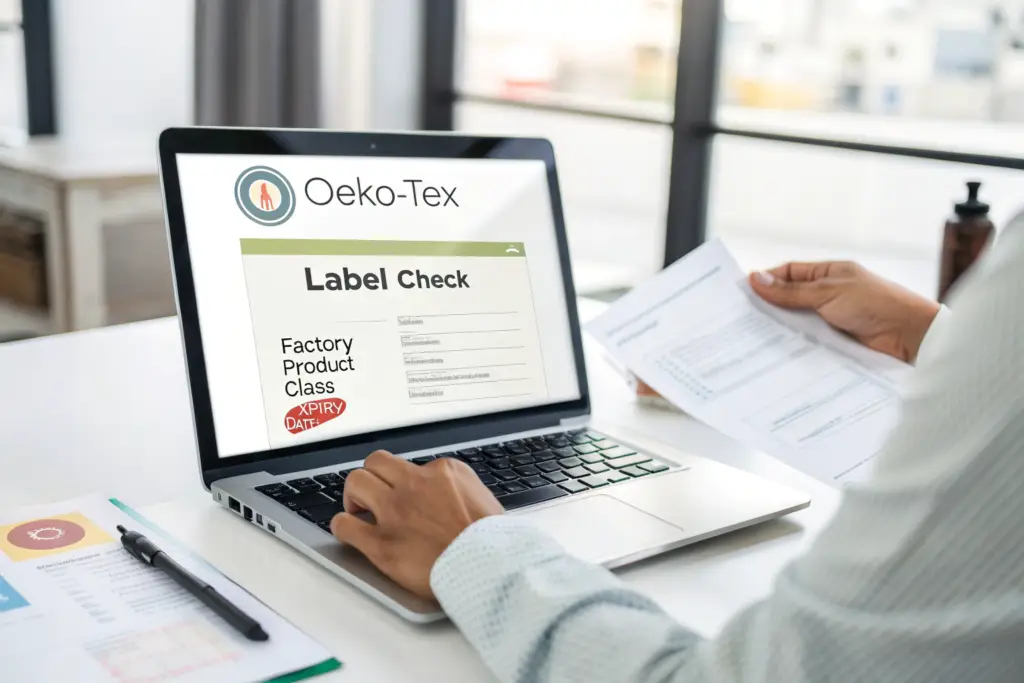
A factory can prove its OEKO-TEX certificate is genuine and current by providing the certificate number and directing the buyer to the free, public Label Check tool on the OEKO-TEX website. The buyer enters the number and immediately sees the certificate holder's name, the certified product categories, the product class, and the certificate's valid-from and expiry dates. A genuine certificate matches the factory's legal business name exactly. An expired certificate shows as invalid. A fake certificate returns no result.
The verification process takes less than sixty seconds. There is no excuse for a professional brand owner to skip it. At Shanghai Fumao, we proactively provide our certificate number to every client and encourage them to verify it before placing an order. We want them to check. The verification builds trust. A factory that is reluctant to provide the certificate number, or that provides a number that does not match their business name, is a factory that is hiding something.
How Do You Use the OEKO-TEX Label Check Online Tool Step by Step?
The process is straightforward and designed for consumer as well as professional use. Go to the OEKO-TEX website. Navigate to the "Label Check" page. The page will have a search field where you enter the certificate number exactly as it appears on the supplier's certificate.
The certificate number is a string of numbers, sometimes with a hyphen. It is usually found near the top of the certificate, clearly labeled "Certificate Number" or "Cert. No." Enter the number and click search.
The result page will display the certificate holder's name. This name must match the factory's legal business name exactly. Not a similar name. Not a trading name. The registered legal entity name. If the certificate says "Shanghai ABC Textile Co., Ltd." and your supplier's contract says "ABC Garment Trading Co.," there is a mismatch. The certificate may be for a different company in the same corporate group, which is acceptable if the relationship is disclosed, or it may be stolen. You must clarify the discrepancy before proceeding.
The result page will also display the certified product categories. For children's apparel, you should see "Garments (Baby)" or "Garments (Children)" and the product class, which should be Class I for items intended for children under three. The page will show the issuing institute, such as Hohenstein or Testex, and the valid dates. If the current date is after the expiry date, the certificate is no longer valid, even if it was genuine. The factory must renew their certification annually.
I perform this check live during video calls with new clients. I share my screen, navigate to the Label Check page, enter our certificate number, and show them the result. They see our factory name, Shanghai Fumao Garment Co., Ltd., appear on the official OEKO-TEX database. They see the product categories and the valid dates. The check takes less than a minute. It closes any doubt permanently.
What Are the Red Flags of a Forged or Expired OEKO-TEX Document?
A forged certificate often has telltale signs that are visible even before the online check. The first red flag is a certificate that lists the issuing body as "OEKO-TEX" itself. OEKO-TEX is the standard, not the testing institute. Genuine certificates are issued by independent, accredited member institutes like Hohenstein, Testex, or Centexbel. The issuing body's logo and contact details will be clearly displayed.
The second red flag is a certificate that has no expiry date, or an expiry date more than one year from the issue date. OEKO-TEX certificates are valid for one year. If a certificate claims to be valid for three years, it is fake.
The third red flag is a certificate that uses generic language like "all textile products" in the certified product category. Genuine certificates are specific. They list the product groups, like "woven fabrics made of cotton" or "knitted garments for babies." Vagueness is a sign of a template document, not a tested product.
The fourth red flag is a supplier who is evasive when you ask for the certificate number. They send a PDF but obscure the number. They promise to send it later and never do. They claim the number is "confidential." The number is not confidential. It is designed to be shared and verified. An evasive supplier is a fraudulent supplier.
A brand owner I know was given a certificate by a prospective supplier. The certificate looked perfect. She ran the number through the Label Check tool on the OEKO-TEX website. The tool returned "No result found." She called the supplier. The supplier claimed there was a "database error" and promised to resolve it. The brand owner did not place the order. A week later, the supplier's website was offline and their phone number disconnected. The Label Check tool had saved her from a fraudulent supplier.
Conclusion
The demand for OEKO-TEX certified children's apparel in the US market is not a temporary trend driven by marketing departments. It is a permanent structural shift driven by three powerful forces that are all moving in the same direction. The first force is parental awareness. American parents have access to more information about chemical safety than any previous generation. They are reading labels. They are asking questions. They are choosing brands based on safety credentials.
The second force is retailer mandate. Major US retailers have made OEKO-TEX certification a de facto requirement in their vendor compliance manuals. A brand that does not have the certificate is locked out of the largest and most profitable distribution channels. The certification is no longer a differentiator. It is a ticket to entry.
The third force is regulatory convergence. US state laws, led by California, Washington, and New York, are rapidly catching up to European chemical safety standards. A patchwork of strict state regulations makes a single, comprehensive federal standard increasingly likely. OEKO-TEX certification is already aligned with the strictest state laws and anticipates future federal regulation.
For a children's wear brand owner, the conclusion is clear. Investing in OEKO-TEX certified production is not an optional premium. It is a necessary foundation for doing business in the US market in 2026 and beyond. The cost of certification is a fraction of the cost of a failed retailer audit, a rejected shipment, or a product recall.
At Shanghai Fumao, we have invested in building and maintaining a fully OEKO-TEX compliant children's wear supply chain. Our certification is current, verifiable, and covers Class I product requirements. We provide our certificate number to every client before the first order. We encourage every client to verify it independently. We do this because we believe that trust is built on verification, not on claims.
If you are developing a children's apparel line for the US market, or if you are facing retailer certification requirements and need a manufacturing partner who is already compliant, I invite you to contact our Business Director, Elaine. She can provide our current OEKO-TEX certificate number for your immediate verification, share our children's wear compliance documentation, and discuss your specific product safety requirements. Reach Elaine at elaine@fumaoclothing.com. Your customer's child deserves a garment that is not just beautiful, but proven safe. Let's build that garment together.