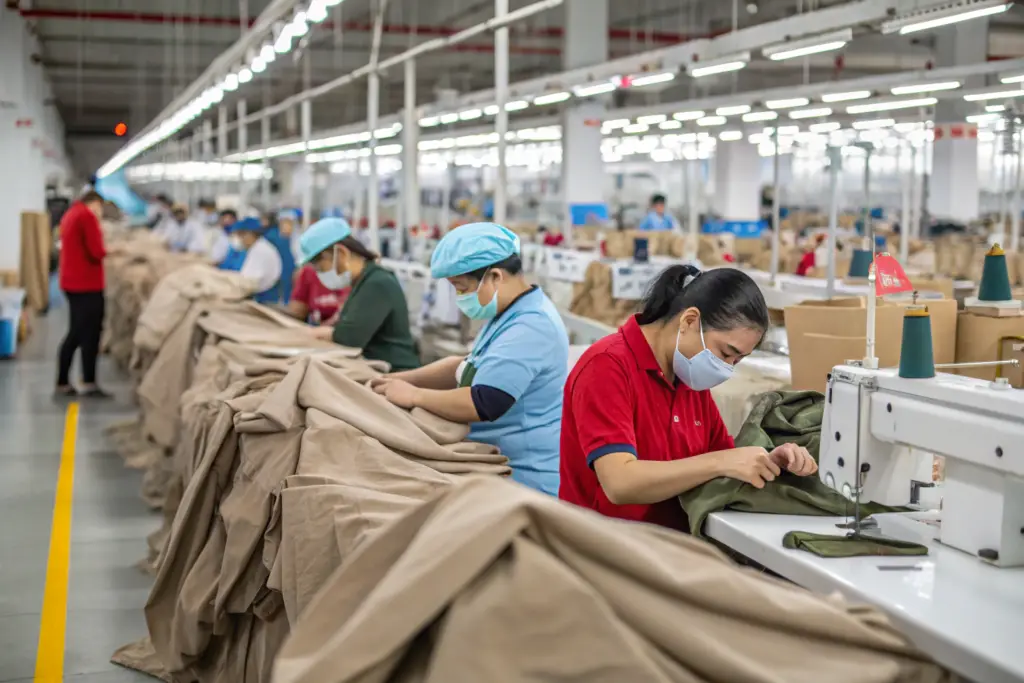
It is September. Your factory is running at full capacity, producing the holiday collections that must ship by early October. Then the call comes. Your best wholesale account has just confirmed a reorder of 3,000 units of the season's surprise hit style. They need delivery in four weeks. You ask your factory contact if it is possible. The response is what you dread: "All lines are fully committed. The earliest we can start is November." You have just lost the reorder, disappointed your wholesale partner, and left significant revenue on the table because your factory could not handle a rush order during peak season.
A factory with 5 lines handles rush orders during peak seasons without delays by maintaining reserved surge capacity within its production architecture. This is not about working faster or asking operators to do overtime. It is about structural preparation: dedicating one flexible line that is never fully booked during peak periods, maintaining a cross-trained workforce pool that can be deployed to urgent orders without disrupting existing production, prepositioning greige fabric for recurring programs so material sourcing does not delay rush orders, and using real-time production data to identify and reallocate underutilized capacity within hours rather than days. The ability to absorb rush orders is designed into the factory's operating model, not improvised when the request arrives.
At Shanghai Fumao, our 5-line configuration was specifically designed to handle the tension between planned production and urgent demand. We know that the apparel business is not perfectly forecastable. Hits emerge. Reorders are needed. Wholesale partners demand responsiveness. Let me explain the specific mechanisms that enable us to say "yes" to rush orders when other factories say "impossible."
How Does Reserved Flexible Capacity Absorb Peak Season Rush Orders?
Most factories measure success by utilization rate. A factory running at 95% capacity is considered efficient. Every line is fully booked. Every machine is running. Every operator is fully allocated. This appears to be optimal management. But a factory running at 95% capacity has zero ability to absorb a rush order. Any unexpected demand must either be declined or must displace an existing order, delaying another customer. The efficiency metric has been optimized at the expense of responsiveness.
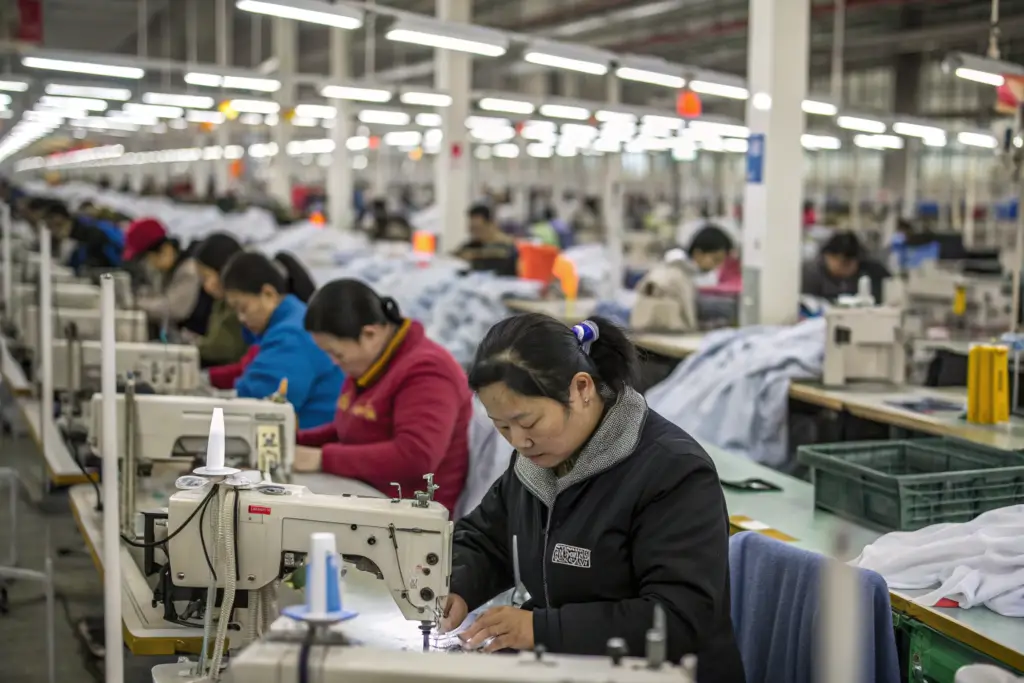
Reserved flexible capacity is the deliberate practice of maintaining one production line, or a portion of a line's capacity, below full utilization during peak seasons specifically to absorb rush orders. At Shanghai Fumao, our Line 4 operates as the flexible line. During peak seasons, Line 4 is booked to approximately 60-70% of its maximum capacity. The remaining 30-40% is reserved surge capacity, available for rush orders, emergency reorders of high-performing styles, and production issues that require rapid reallocation. This reserved capacity is not idle capacity. It is strategic capacity, providing the responsiveness that our brand and distributor partners value.
Why Don't Most Factories Maintain Reserved Capacity?
The answer is economics, viewed through a short-term lens. A factory that runs every line at maximum utilization generates more revenue in the current quarter than a factory that holds capacity in reserve. The reserved capacity appears on the balance sheet as underutilized assets. The factory that maximizes utilization appears more profitable and more efficient by standard manufacturing metrics.
The problem with this view is that it ignores the value of responsiveness to the customer. The factory that can absorb a rush order enables the brand to capture revenue that would otherwise be lost. That revenue capture strengthens the brand's business and deepens the partnership. The brand places more orders with the responsive factory. The short-term revenue sacrificed by holding reserve capacity is returned many times over through increased order volume, partnership longevity, and premium pricing for rush-order capability. This strategic capacity reserve in manufacturing is an investment in partnership value, not an inefficiency. Our brand partners know that we maintain surge capacity. They factor our ability to handle their rush reorders into their decision to consolidate more production with us.
How Is Reserve Capacity Allocated When Multiple Rush Orders Compete?
If a factory holds 30% reserve capacity and receives one rush order that consumes 20%, the math works. If two rush orders arrive simultaneously, each requiring 20% of capacity, a conflict arises. Prioritization is necessary. The key is having a transparent prioritization framework that is communicated to partners in advance, not improvised under pressure.
Our rush order prioritization uses a pre-communicated framework. First priority goes to reorders of proven styles where the brand has sell-through data demonstrating urgent demand and the risk of stockout is real. Second priority goes to existing long-term partners over newer or transactional accounts. Third priority, when all other factors are equal, goes to the order received first. If the reserve capacity is fully consumed by higher-priority rush orders, we are transparent with the lower-priority requester about the timeline. We do not overpromise and underdeliver. This rush order prioritization in garment manufacturing framework ensures fairness and maintains trust even when we cannot accommodate every request.
How Does Cross-Trained Workforce Deployment Enable Rush Order Execution?
A rush order needs operators to produce it. If every operator is assigned to a specific operation on a fully committed production line, there is no labor available for the rush order. The factory would need to hire temporary workers, who lack training and produce lower quality, or force existing workers into overtime, which increases cost and risks burnout. The structural solution is a cross-trained workforce where a portion of operators are qualified on multiple operations and can be redeployed to urgent orders without disrupting the lines they normally support.
Cross-trained workforce deployment enables rush order execution by creating a pool of operators who are qualified on multiple operations across different product categories. These operators are typically assigned to the flexible line or to support roles during normal production periods. When a rush order arrives, they are concentrated onto the rush order without needing to pull operators from committed production lines. The quality of the rush order is maintained because the operators are trained and certified, not temporary hires learning on the job.
How Does the Cross-Training Program Build Multi-Skilled Operators?
Operator cross-training is a deliberate investment. It takes time and resources to train an operator on a new operation, and during that training period, the operator is not producing at full efficiency. The short-term productivity cost of training is the reason many factories keep operators narrowly specialized. The long-term benefit of a flexible workforce is lost.
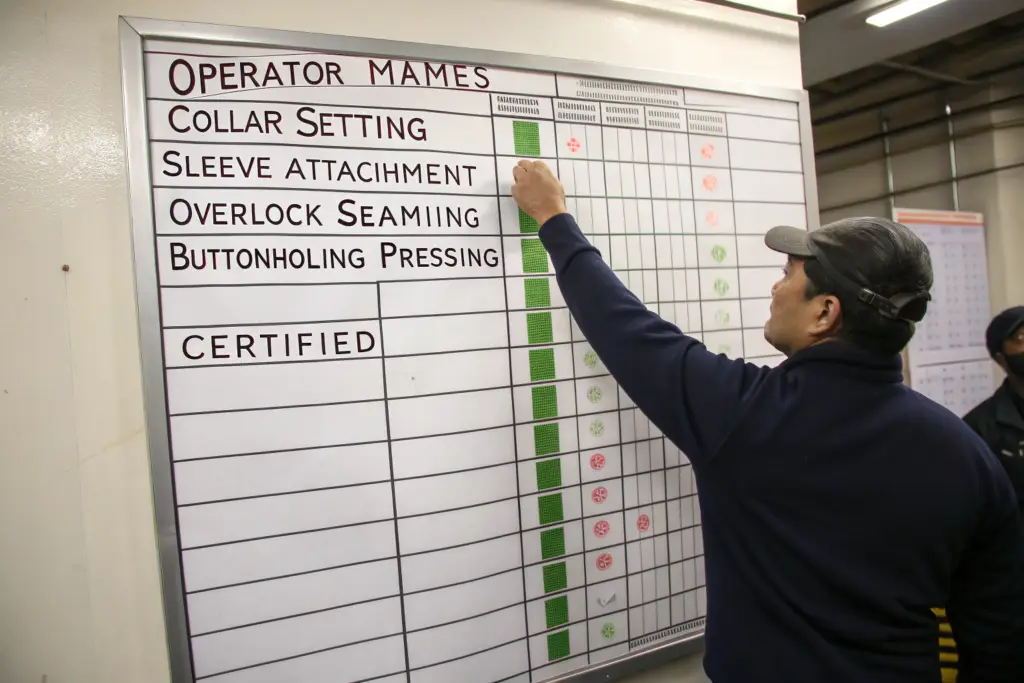
Our cross-training program is a continuous process, not a one-time initiative. Each operator is initially trained and certified on a primary operation. After demonstrating proficiency, they are offered the opportunity to train on a secondary operation. The training is conducted by a master trainer during normal production hours, using sample materials. The operator practices until they can produce at an acceptable quality and speed level, then takes a certification test. Certified cross-trained operators receive a skill premium in their compensation, creating an incentive to expand their capabilities. Over time, we have built a workforce where approximately 40% of operators are certified on two or more operations. This cross-trained pool provides the labor flexibility to staff rush orders without disrupting existing production. This cross-training in garment manufacturing is a structural workforce strategy that directly enables peak-season responsiveness.
How Are Cross-Trained Operators Deployed Without Disrupting Existing Production?
The cross-trained operator pool is not sitting idle waiting for rush orders. These operators are productively employed on the flexible line during normal operations. The flexible line runs small-batch orders, replenishment programs, and new development samples during non-peak periods. When a rush order arrives, a portion of the cross-trained operators on the flexible line are reallocated to the rush order. The flexible line's non-urgent work is temporarily slowed or paused.
The key is that operators are moved from the flexible line to the rush order, not from the dedicated lines that are producing committed orders for other partners. The dedicated lines continue uninterrupted. The rush order is absorbed within the flexible capacity that was designed for exactly this purpose. The flexible line's non-urgent work resumes when the rush order is complete or when the cross-trained operators are no longer needed. This flexible workforce deployment in manufacturing approach ensures that rush order responsiveness does not come at the expense of other partners' delivery commitments.
How Does Material Prepositioning Eliminate the Sourcing Delay for Rush Orders?
A rush order for a proven style should be fast to produce. The pattern is approved. The construction is established. The operators have made the garment before. The longest remaining lead time component is often fabric sourcing. If the specific fabric is not in stock, the mill must produce it, dye it, finish it, and ship it. That process can take four to six weeks, which eliminates any possibility of a true rush order.
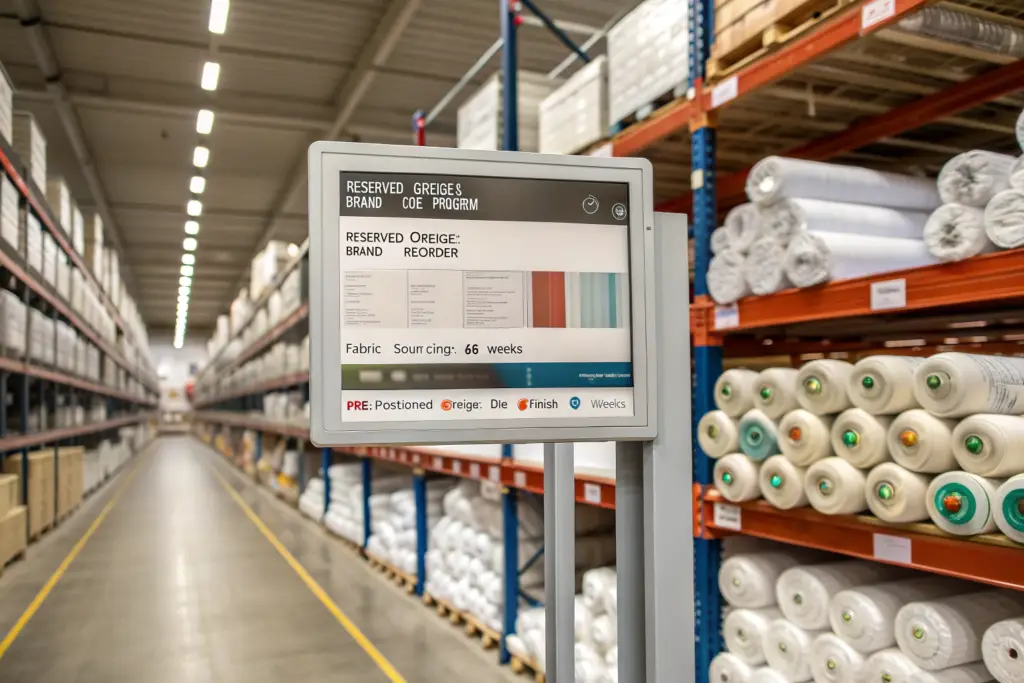
Material prepositioning eliminates the fabric sourcing delay for rush orders by maintaining greige goods inventory of the base fabrics used in recurring programs. When a rush order is confirmed, the greige fabric is pulled from inventory and sent for dyeing and finishing—a process that takes one to two weeks instead of four to six. The fabric delay is collapsed. The rush order moves directly into cutting and production. This capability depends on the factory's willingness to invest in greige inventory and the brand partner's willingness to share forecast data that justifies the inventory investment.
What Is the Difference Between Greige Stock and Finished Fabric Stock for Rush Orders?
Greige fabric is raw, undyed, unfinished fabric. It is a blank canvas that can be dyed to any color and finished to any specification. Finished fabric has been fully processed to a specific color, hand feel, and performance characteristic. For rush order purposes, greige stock provides flexibility. If a brand needs a rush reorder of their best-selling polo in Navy and White, and the factory holds greige stock of the base pique fabric, both colors can be produced from the same greige inventory.
Finished fabric stock is more restrictive for rush orders. If the factory holds finished fabric in Navy but not White, the Navy reorder can proceed immediately but the White reorder still requires dyeing. If the factory holds finished fabric in Navy but the brand needs Midnight Blue for the new season, the Navy inventory is useless. Greige stock provides maximum flexibility with minimum inventory investment. We maintain greige inventory of our most frequently used base fabrics: cotton jersey in multiple weights, cotton pique for polos, cotton twill for chinos, and poly-cotton fleece for sweats. This greige fabric inventory for rush orders is the material foundation of our rush order capability.
How Does the Brand-Factory Forecast Partnership Enable Material Prepositioning?
A factory will not invest in greige inventory for a brand's programs without confidence that the inventory will be consumed. That confidence comes from forecast sharing. The brand provides a rolling forecast of expected reorder volumes by fabric type. The factory purchases and holds greige inventory to cover the forecast. Both parties share the risk and the benefit.
Our prepositioning agreements with brand partners are structured as mutual commitments. The brand shares a quarterly forecast of anticipated reorder needs. We purchase greige inventory to cover the forecast, typically at a level of 70-80% of the projected need to avoid over-commitment. If the brand's actual reorders are within the forecast range, the greige is consumed and the rush orders are fulfilled rapidly. If the brand's reorders significantly undershoot the forecast, the brand may share in the carrying cost of the unused greige. If reorders exceed the forecast, we expedite additional greige procurement. This collaborative forecasting for apparel supply chain aligns incentives and enables the speed that rush orders demand.
How Does Real-Time Production Data Enable Dynamic Capacity Reallocation?
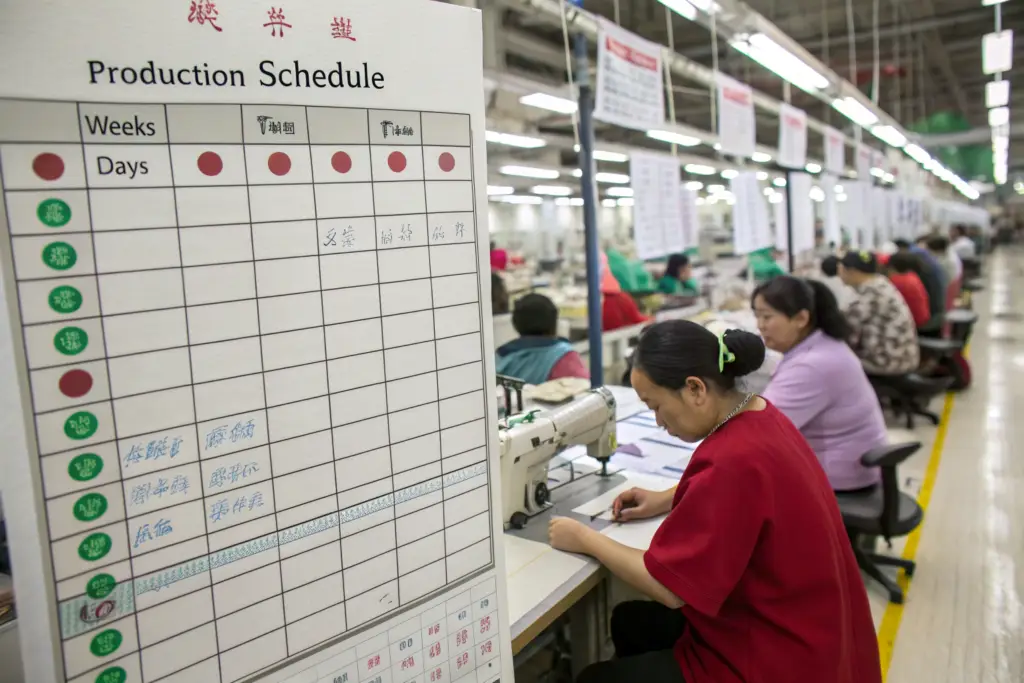
A production schedule created a month in advance is a plan, not a prediction. In the dynamic environment of a factory floor, some lines run ahead of schedule due to higher-than-expected operator efficiency or simpler-than-expected production. Other lines run behind schedule due to machine downtime or fabric issues. A factory that only reviews production status weekly misses the opportunity to reallocate capacity from lines that are ahead to absorb rush orders. A factory with real-time production visibility can identify and act on these opportunities within hours.
Real-time production data enables dynamic capacity reallocation by providing continuous visibility into the actual versus planned output of every production line. When a line is running ahead of schedule, the production manager can see the surplus capacity forming and can allocate that capacity to a rush order before the surplus is absorbed by schedule slippage elsewhere. This is not about stealing capacity from committed orders. It is about capturing efficiency gains and deploying them strategically to meet urgent demand.
How Do Production Tracking Systems Identify Surplus Capacity in Real Time?
Our production lines are equipped with digital tracking that records output at each operation in real time. Every garment that passes through a sewing operation is scanned, and the timestamp is logged. The system compares actual output against the planned output for that time period. The production manager's dashboard shows a live status for each line: green for ahead of plan, yellow for on plan, red for behind plan.
When a line shows green—producing more units per hour than the schedule assumed—the production manager can calculate the surplus capacity. If Line 1 is producing woven shirts at 105% of planned output and has been doing so consistently for two days, the manager knows that Line 1 will complete its committed order approximately half a day early. That half-day of capacity can be allocated to a rush order without impacting the committed delivery date. The key is that the surplus is identified and captured in real time. A factory that only reviews production data weekly would not see the surplus until it was already in the past. This real-time production tracking in garment manufacturing capability transforms capacity management from a static, plan-based exercise into a dynamic, data-driven process.
How Are Reallocation Decisions Made Without Compromising Committed Orders?
The guiding principle of capacity reallocation is that no committed order is delayed to accommodate a rush order. The surplus capacity that is reallocated is genuine surplus—capacity that exists because a line is performing above its planned efficiency. The committed order on that line still completes on or ahead of schedule.
The production manager verifies the surplus before reallocation. The system calculates the estimated completion time for the committed order based on current output rates. If the estimate shows completion ahead of the scheduled date, the surplus is confirmed. A portion of the line's remaining capacity—equivalent to the surplus—is reallocated. The committed order is not affected. This discipline protects the trust of all partners. The partner whose line efficiency created the surplus benefits from faster completion of their own order. The partner with the rush order benefits from the reallocated capacity. No partner is harmed. This dynamic capacity reallocation in production planning is a win-win that is only possible with real-time visibility and disciplined reallocation rules.
How Is Quality Maintained When Rush Orders Accelerate Production Timelines?
The fear that every brand buyer has about rush orders is that speed will compromise quality. The factory will cut corners on inspection. Operators will rush their work. Defects will increase. The rush order will arrive on time but with a return rate that damages the brand. This fear is legitimate if the factory achieves speed by accelerating the production process itself. It is unfounded if the factory achieves speed by eliminating waiting time and reallocating capacity, while leaving the production and quality control processes unchanged.
Quality is maintained during rush orders by keeping the production and quality control processes identical to standard production. The speed gain comes from eliminating waiting time through material prepositioning and from allocating dedicated capacity through reserved flexible lines and dynamic reallocation. The sewing operations take the same time. The quality inspections are conducted at the same frequency and to the same standard. Operators are not asked to work faster. They are asked to produce the same quality on a line that was made available for the rush order. Quality is not compromised because the production process itself is not accelerated.
How Does the Inline QC Process Remain Unchanged During Rush Orders?
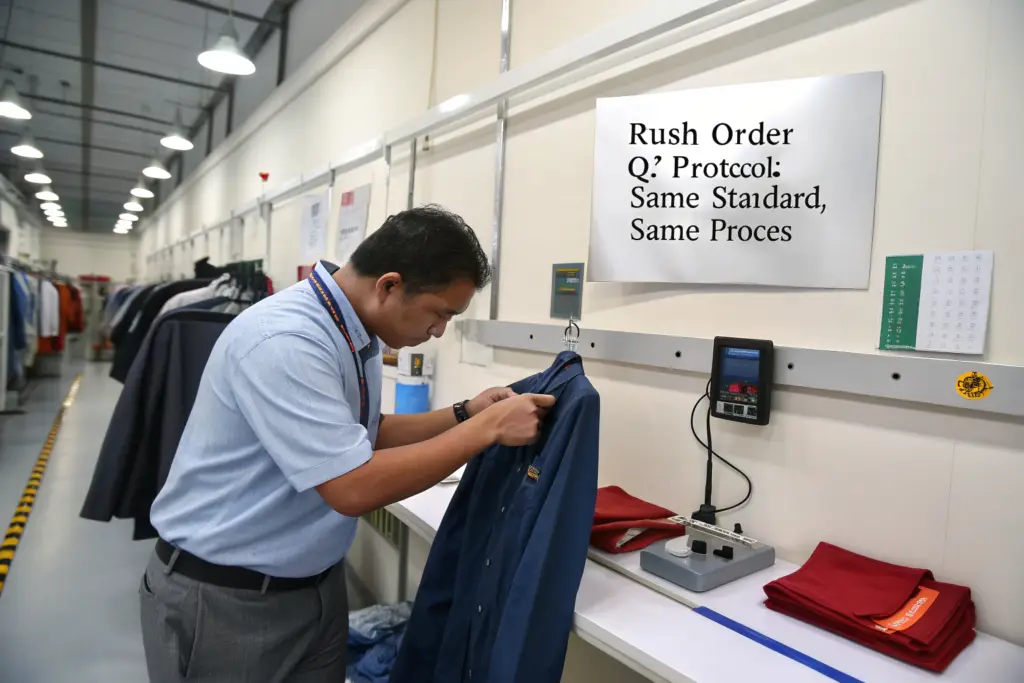
Our inline quality control system operates on a fixed protocol regardless of the order's urgency. Inspectors are stationed at defined checkpoints on every production line. They inspect a specified percentage of units at each checkpoint. The inspection criteria, the measurement tools, and the defect classification are defined in the quality manual. These parameters do not change when an order is designated as a rush.
The rush order moves through the flexible line, which has the same inline QC checkpoints as every other line. The inspectors apply the same AQL sampling standard. The defect data is recorded in the same digital quality system. If the defect rate on the rush order exceeds the acceptable threshold, the line is stopped and corrective action is taken, exactly as it would be for a standard order. The rush designation does not override the quality system. This maintaining quality during rush production orders is a non-negotiable principle. A rush order that arrives on time with quality issues is a failure, not a success.
How Are Rush Order Operators Selected to Ensure Skill Match?
The operators assigned to a rush order are not randomly selected from whoever is available. They are selected from the cross-trained operator pool based on their certification in the specific operations required by the rush order garment. If the rush order is a men's woven shirt, the operators assigned are those certified in collar setting, sleeve attachment, buttonholing, and pressing for woven shirts.
This skill-matching ensures that the rush order is produced by operators who are qualified and experienced in the specific garment category. The rush order does not suffer from a learning curve or quality ramp-up because the operators already know the construction. A brand partner who places a rush reorder of a style they have produced with us before benefits from the fact that the operators who produced the original order may be available for the reorder, or that equivalently skilled operators are assigned. This operator skill matching for production orders is a workforce management discipline that directly protects rush order quality.
Conclusion
A factory with five production lines handles rush orders during peak seasons without delays by designing responsiveness into its operating model. Reserved flexible capacity ensures there is always a line available to absorb urgent demand without displacing committed orders. A cross-trained workforce provides the skilled labor to staff rush orders without pulling operators from other partners' production. Material prepositioning eliminates the fabric sourcing delay that is the longest lead time component for reorders. Real-time production data enables dynamic capacity reallocation that captures efficiency gains and deploys them strategically. And through all of this, the quality control system operates unchanged, ensuring that rush orders meet the same standard as every other order.
At Shanghai Fumao, this is not an aspirational capability. It is how our factory operates every day, and it is especially visible during peak seasons when our competitors are turning away reorder requests that we are accepting and fulfilling. Our brand and distributor partners know that when they have a hit on their hands, we have the structural capacity to help them capture the demand. That confidence is worth more than a slightly lower FOB price from a factory that will say no when they need yes.
If you have experienced the frustration of having your best-selling styles out of stock because your factory could not handle a peak-season reorder, or if you are evaluating manufacturing partners and want to understand their rush order capability before you commit, let us discuss how our flexible capacity model would support your business. Contact our Business Director, Elaine, at elaine@fumaoclothing.com. Share your product categories, your typical reorder patterns, and your peak season requirements. We will show you exactly how our five-line configuration would handle your rush orders when you need them most.