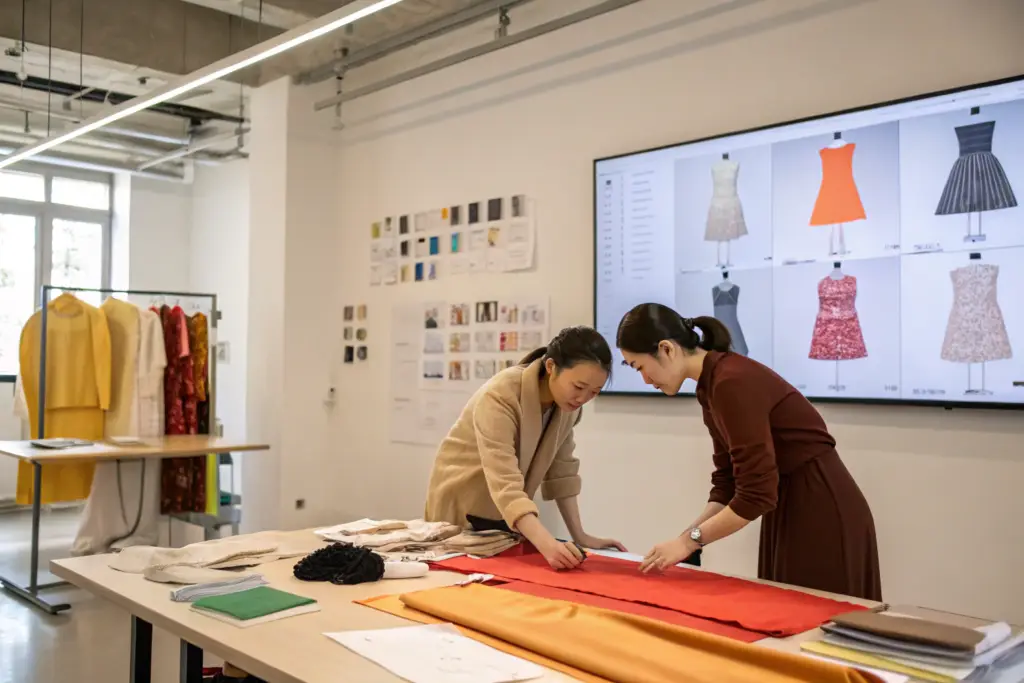
Missing a trend by one season can leave you sitting on 5,000 units of inventory that no buyer wants. I watched this happen to a promising womenswear brand three years ago. They ordered a massive run of bodycon dresses just as the market pivoted hard toward oversized, relaxed silhouettes. The dresses went on clearance at 70% off, and the brand barely survived. The factory that produced those dresses took the order without asking a single question about the trend risk. They just sewed what they were told. That is not partnership. That is transactional manufacturing.
The 2026 women's apparel trends that a top clothing manufacture must know center on four shifts: the dominance of adaptive comfort construction, the mainstreaming of circular design principles, the rise of AI-co-created aesthetics, and the demand for radical size inclusivity with personalized fit. These are not surface-level fashion trends; they are structural changes to how garments are designed, cut, sewn, and marketed.
At Shanghai Fumao, we do not just wait for tech packs to arrive. We track these shifts so we can advise our brand partners before they commit to a production run that might feel outdated upon arrival. Understanding these trends is not about chasing fads. It is about protecting your inventory investment and positioning your brand where the market is going, not where it has been. Let me walk you through what we are seeing from our position on the factory floor.
Why Is Adaptive Comfort Construction Dominating Women's Apparel in 2026?
The rigid structured blazer and the stiff high-waist trouser are not dead, but they are competing with a new expectation. Women who spent two years in hybrid work arrangements are refusing to return to clothing that punishes them by 2 PM. They want garments that move with the body, that breathe during a commute, that do not dig into the waist during a long strategy meeting. This is not loungewear. This is engineered comfort applied to professional and elevated casual categories.
Adaptive comfort construction refers to garments built with stretch woven fabrics, articulated seams, and internal construction that prioritizes mobility without sacrificing silhouette. This requires a fundamental rethinking of pattern making and material selection. A top manufacture in 2026 must understand how to combine the polish of tailored clothing with the ease of performance wear.
How Are Stretch Wovens Replacing Rigid Tailoring in Workwear Categories?
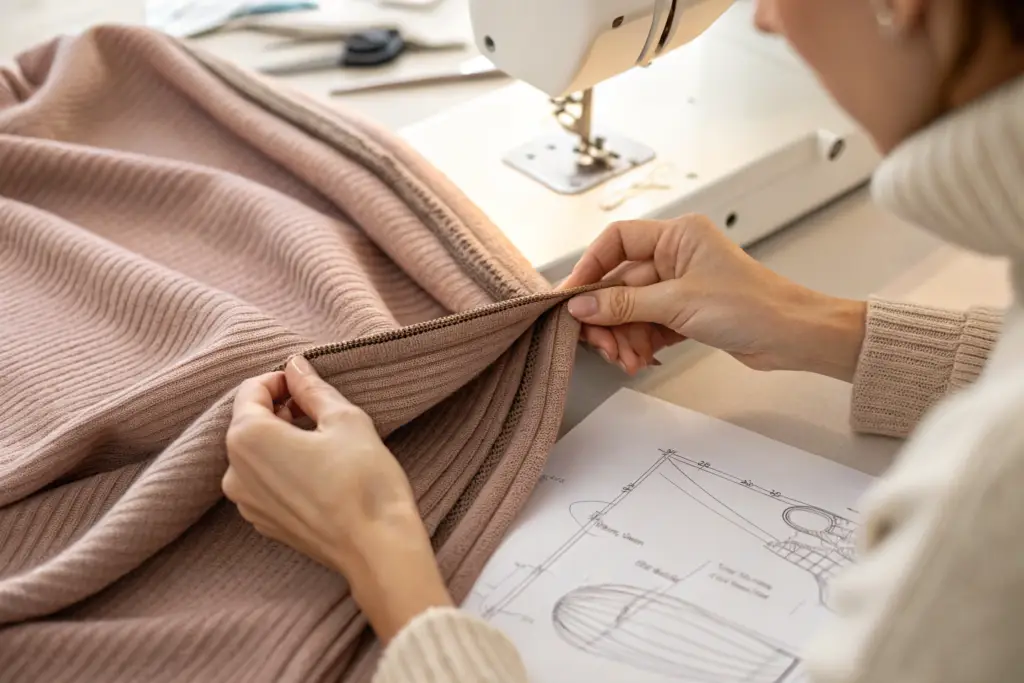
The traditional women's suit jacket used a rigid cotton-poly shell fused to a stiff interlining. The result looked sharp on a hanger but restricted arm movement and wrinkled at the elbow crease by lunchtime. The 2026 version uses a high-twist stretch woven with 3-5% spandex content. The interlining is a lightweight knit fusible that moves with the shell. The armhole is cut slightly higher and the sleeve pitch is adjusted forward to allow a full range of motion without the shoulder lifting.
We developed a prototype blazer for a New York-based womenswear brand last fall using a Japanese stretch twill. The pattern included a back yoke with a hidden elasticated pleat that expanded when the wearer reached forward. In wear tests, the blazer scored higher on "all-day comfort" than the brand's previous unstructured cardigan. This is the new standard. A factory that does not understand the technical requirements of stretch woven construction will produce garments that look like the sample but fail in real-world wear. They will use the wrong needle type, causing skipped stitches on the stretch seam. They will apply too much heat during fusing, killing the stretch recovery. The result is a garment that bags out after three wears. The 2026 women's apparel market demands factories that treat comfort engineering as seriously as they treat seam strength. We train our sewing line supervisors on specific stretch fabric handling techniques to preserve the mechanical stretch properties of each material through the entire production process.
What Role Do Seamless and Bonded Construction Methods Play in 2026?
Seams create friction points. A seamless or bonded garment eliminates the stitch line that rubs against skin, creating a second-skin sensation that traditional cut-and-sew cannot match. This technology, once limited to activewear, is now entering everyday dresses, tops, and even lightweight outerwear. Bonding uses adhesive films and heat to join fabric panels without needle holes. The result is a clean, modern aesthetic with no visible stitching.
We invested in ultrasonic cutting and bonding equipment last year specifically to serve this trend. For a contemporary brand's spring collection, we produced a bonded wrap dress using a double-layer modal jersey. The edges were finished with a raw-cut bonded hem that will not curl or fray. The dress has no stitching visible from the outside. The buyer reported that the bonded construction was the top-selling feature in customer reviews. Women described the dress as "weightless" and "floating." This technology requires significant capital investment and specialized training, which is why it separates top manufacturers from commodity factories. We pair our bonded garment technology with rigorous wash testing to ensure the adhesive holds through repeated laundering. A factory offering bonded construction without a documented wash test protocol is guessing. We test every new bonded seam through 30 wash cycles before approving it for bulk production. This is the level of technical rigor that adaptive comfort demands in 2026.
How Are Circular Design Principles Reshaping Women's Garment Manufacturing?
Sustainability is no longer a marketing buzzword. In 2026, it is a purchasing requirement for a growing segment of female consumers, particularly Gen Z and Millennial buyers. But they are no longer satisfied with a hang tag that says "made with recycled polyester." They are asking harder questions. What happens to this garment when I am done with it? Can the buttons be removed for recycling? Is the thread polyester on a cotton garment, making the whole piece unrecyclable? These are design-level questions, and they demand answers from the manufacturing stage.
Circular design principles in garment manufacturing mean designing for disassembly, using mono-material construction where possible, selecting biodegradable trims for natural fiber garments, and offering take-back or recycling-compatible production. A top manufacture in 2026 must guide brands toward circular choices and have the production capability to execute them.
What Is Mono-Material Construction and Why Does It Matter for Recyclability?
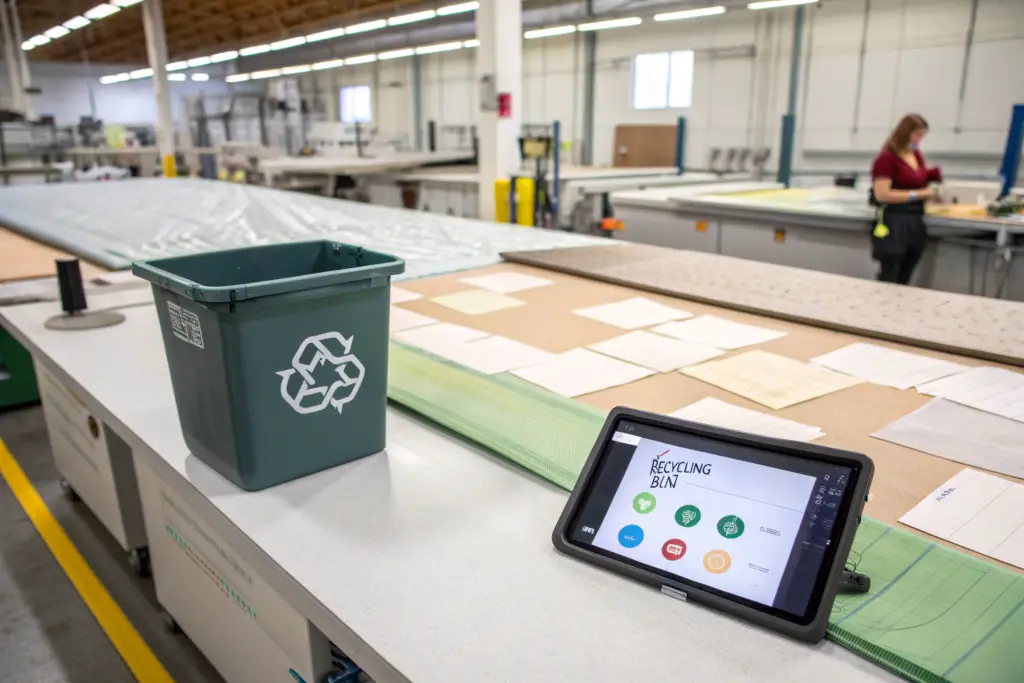
A typical blouse contains a cotton shell, polyester thread, a nylon zipper, a metal snap, and a polyester care label. At the end of its life, separating these components for recycling is economically impossible. The garment goes to landfill. Mono-material construction solves this by building the entire garment from a single fiber family. A 100% cotton blouse uses cotton sewing thread, corozo nut buttons instead of plastic, and a cotton care label. Every component can be processed in the same textile recycling stream.
We produced a mono-material cotton dress for a sustainable womenswear label last season. The challenge was finding a cotton zipper tape that matched the durability requirements of a dress closure. Standard cotton zipper tapes are weaker than polyester, so we sourced a reinforced cotton tape from a Japanese supplier. The cost was 40% higher than a standard polyester zipper, but the brand marketed the dress as "fully recyclable" and sold out the run at full price within three weeks. This is the circular economy in action. It requires a factory that has done the legwork to source sustainable trim alternatives and can present brands with verified options rather than vague promises. We now offer a standardized mono-material trim package for cotton, wool, and recycled polyester garment programs. Brands can select it as an option without having to source each component themselves. The shift toward circular fashion manufacturing is accelerating, and factories without a clear mono-material capability will find themselves locked out of RFPs from sustainability-committed brands.
How Can Zero-Waste Pattern Cutting Reduce Fabric Consumption?
Traditional pattern cutting lays out pattern pieces like a jigsaw puzzle, leaving roughly 15-20% of the fabric as unusable scraps on the cutting room floor. Zero-waste pattern cutting designs the garment shapes to interlock perfectly, using the entire width of the fabric with no waste. This requires a complete rethinking of garment design, where seam lines and style details are placed to accommodate the puzzle fit rather than pure aesthetic preference.
We collaborated with a zero-waste pattern designer to develop a capsule collection of woven tops for a U.S. boutique brand. The pattern pieces were geometrically interlocking, with design details like color-blocking placed where the puzzle joints naturally fell. The fabric utilization rate was 98%, compared to our standard 82%. The tops had a distinctive, architectural look that became the brand's signature aesthetic. Customers responded to the story behind the cut as much as the cut itself. This approach is not feasible for every style, but for brands that make sustainability central to their identity, zero-waste patterns offer a compelling point of differentiation. We invested in marker making software that optimizes pattern layout for minimal waste. For standard production, we achieve 85%+ utilization rates, which is above the industry average of 80%. This reduces cost and environmental impact simultaneously. A top manufacture helps brands navigate the trade-offs between zero-waste ideals and commercial scalability.
What Role Does AI-Co-Created Aesthetic Play in 2026 Women's Fashion?
AI-generated fashion imagery flooded social media in 2025. Consumers quickly learned to spot the synthetic perfection and grew skeptical. The 2026 trend is not AI replacing designers. It is designers using AI as a collaborative tool to explore variations, generate unexpected combinations, and accelerate the ideation process. The output is AI-co-created: human taste and storytelling directing machine exploration. This is changing how brands develop collections and what they demand from manufacturing partners.
AI-co-created aesthetics in 2026 are characterized by unexpected texture combinations, algorithmic print patterns that blend cultural references in novel ways, and silhouette explorations that human pattern makers refine into wearable garments. A top manufacture must be comfortable receiving AI-generated design references and translating their often complex, unconventional details into production-ready tech packs.
How Can Factories Translate AI-Generated Designs Into Production-Ready Samples?
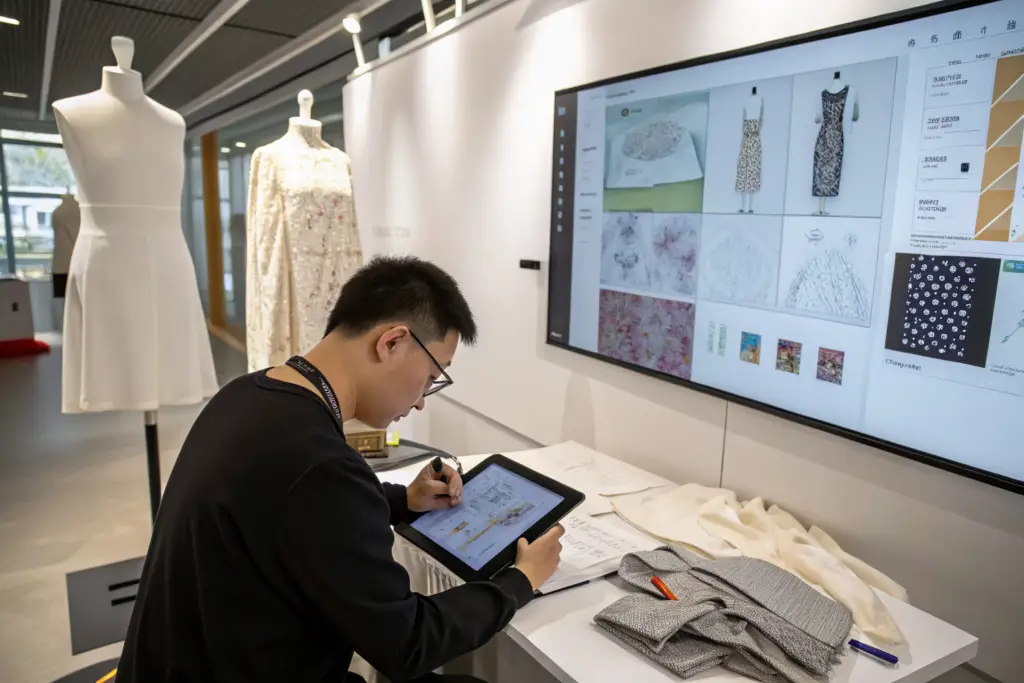
An AI image generator can produce a stunning dress concept: a sculptural sleeve that defies gravity, a draping effect that flows like water, a print that wraps seamlessly across a three-dimensional form. But the AI does not understand seam allowances, grain lines, or the physical properties of fabric. Translating these concepts into a garment that can be cut and sewn requires deep technical knowledge.
We received an AI-generated mood board from a brand last year that featured a dress with a wave-like cascading ruffle that spiraled around the body. The digital image was beautiful and physically improbable. Our pattern maker studied the image and identified that achieving a similar effect required a circular-cut flounce attached along a curved seam line, graded in width as it spiraled. We created three physical toiles in different fabric weights to show the brand how the ruffle behaved in muslin versus silk charmeuse versus a mid-weight crepe. The brand selected the crepe version for its structure, and we engineered the final pattern with French seams to finish the curved edges cleanly. This iterative translation between digital concept and physical reality is a new core competency for 2026. It demands a factory team that is visually literate in AI aesthetics and technically expert in traditional pattern engineering. Brands that work with manufacturers who treat AI concepts as impossible will stall. Brands partnered with manufacturers who see AI concepts as an exciting translation challenge will lead the market with genuinely novel product.
What New Print and Embellishment Techniques Are Enabled by Digital Design Tools?
Digital design tools are enabling print placement with surgical precision. Engineered print placement, where a floral motif is positioned exactly on a specific part of the garment, was once a luxury-level technique. Now, AI-assisted layout software makes it accessible for mid-tier production. A floral pattern can be mapped onto a 3D garment model, and the print file is automatically adjusted so that the motif aligns perfectly at center front and the side seams.
We offer digital engineered placement printing for our brand partners. The process uses a digital textile printing system that prints directly onto fabric panels after they are cut but before they are sewn. The camera system on the printer recognizes the cut panel shape and aligns the print file with micron-level accuracy. A women's resort wear brand used this service for a collection of printed silk kaftans. Each kaftan featured a panther motif exactly centered on the back panel, with the tail wrapping around to the front. The print registration across the side seams was flawless. The garments sold at a premium price point because the precision of the print communicated luxury. Beyond prints, laser etching on denim, bonded embellishments, and 3D-embroidery using programmable thread paths are all techniques that digital tools are making more accessible. A top manufacture invests in these technologies and trains the production team to operate them. We view digital manufacturing technologies as the bridge between creative ambition and commercial reality.
How Is Radical Size Inclusivity Changing Pattern Making and Grading?
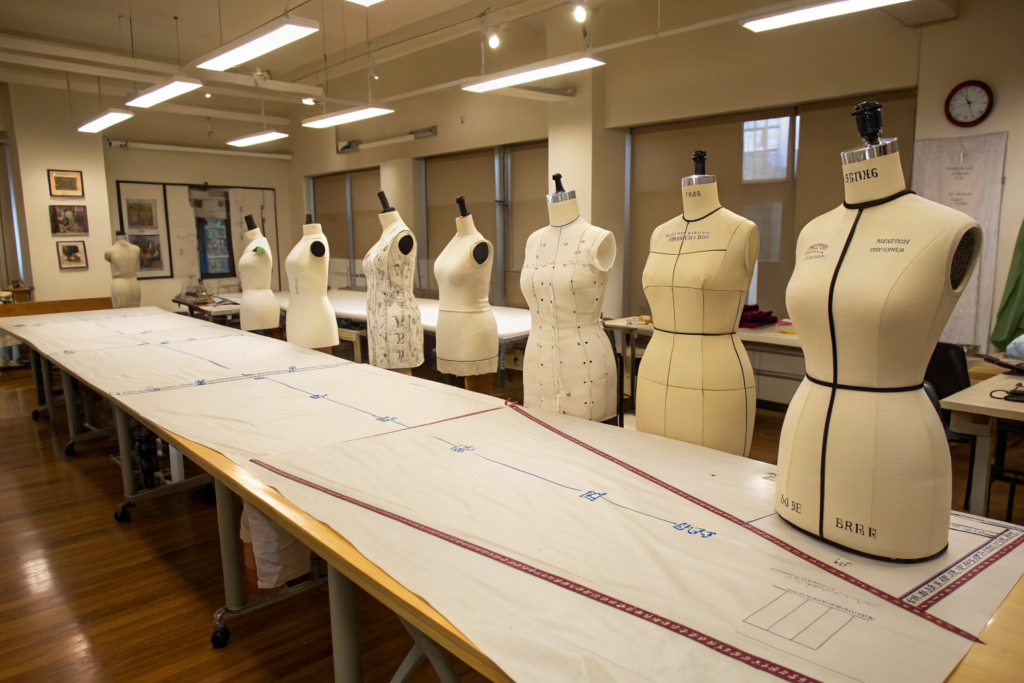
Size inclusivity is no longer a niche marketing angle. In 2026, it is a baseline consumer expectation. Women are demanding that brands offer the same styles across a broad size range, from 00 to 4X and beyond, without segregating the extended sizes into a separate, often uglier collection. This is fundamentally a manufacturing challenge. Traditional grading mathematically scales a size 8 pattern up to size 24 using linear formulas. The result on a larger body is often a garment that fits poorly because body proportions do not scale linearly.
Radical size inclusivity requires abandoning linear grading tables in favor of multi-size fit development, where separate base patterns are created for different body shape categories. A top manufacture in 2026 must have the pattern making expertise, the diverse fit model roster, and the production flexibility to execute this without making extended sizes an afterthought with degraded design quality.
Why Does Linear Grading Fail for Extended Sizes?
Grading a size 8 to a size 24 using a standard 2-inch grade between sizes assumes that a size 24 body is simply a linearly enlarged version of a size 8 body. It is not. The relationship between bust, waist, and hip circumference changes. The shoulder slope angle changes. The bust apex position shifts. A sleeve that fits a size 8 armhole will pull and distort on a size 24 if the armhole depth and bicep circumference are not adjusted proportionally, which standard grading often overlooks.
A brand we work with learned this the hard way. They used a different factory for their first extended-size launch and the return rate for sizes 18-24 was 40%, driven by poor fit. When they moved the program to Shanghai Fumao, we built separate base patterns for their 0-14 curve and their 16-26 curve. We fit the samples on two different fit models who represented the median body shape of each range. The design elements—the neckline shape, the sleeve length, the hem curve—were maintained identically, but the underlying pattern geometry was different. The return rate dropped to 8%, in line with their core size range. This required double the pattern development time, but it preserved the brand's reputation for fit. Our pattern grading expertise includes both traditional linear grading for core sizes and multi-base pattern development for extended size ranges. We advise brands during the design phase about style elements that grade poorly—like specific pocket placements or horizontal seam lines at the widest hip point—and suggest modifications that maintain the aesthetic while improving fit across the size curve. This proactive consultation prevents costly post-sample fit corrections.
How Do We Use Fit Technology to Validate Size Inclusivity Before Bulk Production?
Physical fit models provide essential feedback, but one model cannot represent the diversity of bodies within a size range. We supplement physical fittings with 3D virtual fit analysis. Using 3D garment simulation software, we map our patterns onto a library of digital avatars representing different body shapes within each size: rectangular, pear, apple, and hourglass proportions. The software simulates fabric tension, highlighting areas of excessive pulling or gaping that would cause fit complaints.
For a women's outerwear brand's trench coat launch, the virtual fit analysis revealed that the belt placement on the size 20 pattern hit below the natural waist on the pear-shaped avatar, creating an unflattering proportion. We raised the belt loops by 2 inches on that specific size grade, and the final fit was praised in customer reviews for being "shockingly flattering" on curvier bodies. This technology allows us to test fit across dozens of body variations in hours rather than weeks of physical sampling. It is not a replacement for human fit assessment, but it is a powerful supplement that catches issues early. We share the virtual fit reports with our brand partners, giving them data-driven confidence that their inclusive size offering will deliver on its promise. This commitment to size inclusive manufacturing is integrated into our standard development process for every womenswear program, not treated as a special request.
Conclusion
The 2026 women's apparel market rewards brands that understand the difference between a surface trend and a structural shift. Adaptive comfort construction is not a style you apply; it is a way you engineer a garment from the first pattern draft. Circular design is not a hang tag claim; it is a set of material and trim decisions made at the sourcing stage. AI-co-created aesthetics are not a gimmick; they are a new collaborative design process that demands technical translation skill. Radical size inclusivity is not a marketing campaign; it is a pattern making and production methodology that respects the diversity of women's bodies.
At Shanghai Fumao, our value to womenswear brands in 2026 is not just our sewing lines or our competitive pricing. It is our ability to serve as a trend-informed technical partner who can guide a collection from concept to delivery with an understanding of where the market is heading. We invest in stretch woven construction knowledge, mono-material sourcing networks, AI translation workflows, and multi-base pattern grading because we know these capabilities separate the factories that build enduring brands from the factories that just fill orders.
If you are developing a women's apparel collection for 2026 and want a manufacturing partner who can advise on these trends while executing at the highest quality standard, let us start a conversation. Share your concept, your mood boards, or your full tech packs. We will respond with trend-relevant feedback, technical solutions, and a transparent production plan. Contact our Business Director, Elaine, at elaine@fumaoclothing.com. Let us build the garments that position your brand exactly where 2026's female consumers are ready to spend.