
You negotiate a great price per unit for your custom hoodies. You budget your retail markup carefully. Then, a month after the goods leave China, you receive an invoice from a customs broker you never hired. Demurrage fees, customs exams, bond charges, and a surprise tariff reclassification have added $2,800 to your landed cost. Your margin has evaporated before a single hoodie reaches your warehouse. This is the hidden tax of sourcing without understanding delivery terms. I have heard this story from too many brand owners who thought they were saving money by managing freight themselves.
DDP mode, or Delivered Duty Paid, means that the clothing manufacturer takes full legal and financial responsibility for the entire shipping journey, from the factory floor in China to the address you specify in North America. This includes export clearance, ocean or air freight, import duties, customs brokerage, and final trucking. You pay one all-inclusive price and receive goods at your door with no surprise charges.
But DDP is more than a shipping term on an invoice. It is a complete operational philosophy that separates top-tier manufacturers from basic suppliers. At Shanghai Fumao, DDP is not an add-on service we reluctantly offer. It is the backbone of how we serve U.S. brands, large distributors, and company owners who demand certainty. Let me explain exactly how this model works and why it might be the most important term in your next purchase order.
Why Is DDP Considered the Most Buyer-Friendly Incoterm for U.S. Importers?
Incoterms determine who pays for what and who owns the risk at each stage of the journey. FOB (Free On Board) sounds cheap, but it leaves you holding the risk the moment the container touches the ship's rail. EXW (Ex Works) is even worse: you own the problem from our loading dock onward. Most factory owners love FOB and EXW because their responsibility ends at the port. They collect their money and walk away. You inherit the chaos of international logistics.
DDP is the most buyer-friendly Incoterm because it transfers all logistics complexity, customs liability, and cost unpredictability from the buyer to the seller. The U.S. importer receives a single invoice covering the product and its complete journey. This allows for accurate retail margin calculation, eliminates the need for the buyer to hire a customs broker, and removes the risk of unexpected port fees destroying profitability.
What Hidden Costs Does DDP Eliminate for a Brand Owner?
The invoice you see is rarely the price you pay under FOB. A shipment of 2,000 men's polo shirts might have an FOB price of $12,000. Attractive. But then the hidden costs begin: the ocean freight quote of $1,800 jumps to $2,400 due to a peak season surcharge. Customs bonds cost $500. The broker charges $350 for filing. The container gets flagged for an x-ray exam at the port, adding $800 in exam fees and three days of storage at $150 per day. A fuel surcharge hits the trucking invoice for another $200. Your $12,000 FOB order has quietly become a $15,000 nightmare.
DDP eliminates this death by a thousand cuts. When we quote a DDP price for those same polo shirts, we have already calculated every one of those variables into the final number. We use historical data from our freight partners to model the exact landed cost. The price we give you is the price you pay. Period. This predictability is not a luxury. It is a requirement for any brand setting a retail price months before the goods arrive. You cannot run a business when your cost of goods sold fluctuates based on port traffic in Long Beach. Last year, a children's wear distributor told us our DDP quote was $0.80 higher per unit than an FOB competitor. We showed him a detailed breakdown of his likely hidden costs. He chose us. Three months later, the competitor's client got hit with a $4,000 surprise bill due to a CBP agricultural inspection. The distributor called us to thank us for being transparent. Working with a customs bonded carrier ensures that even unforeseen inspections are financially covered within our quoted price.
How Does DDP Simplify Cash Flow and Inventory Planning?
Predictability enables planning. When you know your total landed cost to the penny, you can set your wholesale price with confidence. You can calculate your return on ad spend for a product launch. You can book your warehouse receiving team weeks in advance without worrying about rescheduled deliveries. Cash flow stabilizes because you have a single payment to make, not a series of unpredictable invoices from a broker, a trucking company, and a customs agency you have never met.
DDP also consolidates your payment timeline. Under FOB, you pay the factory before the goods ship. Then you pay the freight forwarder at origin. Then you pay the customs broker upon arrival. Then you pay the trucker after delivery. Four separate payments, four separate invoices to reconcile, four opportunities for billing errors. Under DDP with Shanghai Fumao, you pay one invoice. We manage the payments to our logistics partners. Your bookkeeping is simplified to a single line item. This is especially valuable for larger distributors managing dozens of SKUs across multiple shipments. The administrative overhead of tracking freight invoices against individual POs disappears. We handle the entire transaction including supply chain finance coordination, which allows our clients to focus their accounting resources on revenue-generating activities rather than auditing shipping invoices.
How Does Shanghai Fumao Handle Customs Clearance Under DDP?
Customs clearance is where DDP promises either hold firm or collapse. A manufacturer who offers DDP but lacks in-house customs expertise is simply gambling with your shipment. They rely on an external broker they barely know, crossing their fingers that the HS code classification is correct and the duty rate is accurate. When the shipment gets flagged, they have no direct relationship with CBP to resolve the issue. You are stuck in the middle, powerless and furious.
Shanghai Fumao handles customs clearance through a dedicated in-house compliance team that prepares and files all documentation directly, combined with a long-standing partnership with a licensed U.S. customs broker. We classify every garment using our proprietary HS code engine that cross-references material composition, construction method, and intended use against the latest HTSUS rulings, ensuring legal accuracy and duty optimization.
What Happens When a DDP Shipment Gets Flagged for Inspection?
Inspections happen. A CBP officer selects a container for a VACIS scan or a physical tailgate exam. The difference between a DDP partner and a basic FOB supplier is what happens next. With an FOB supplier, you receive a panicked email from the broker saying the container is on hold. You call the factory. They shrug and say "shipping is your responsibility now." You are alone, bleeding storage fees.
With our DDP service, we own this moment. Our compliance team receives the CBP alert simultaneously with the broker. Within hours, we provide the exact packing list with corresponding production records, the mill certificate for the specific fabric batch, and the lab test report for fiber content if requested. We do not scramble because we archive all this documentation digitally before the container leaves our dock. In a recent shipment of women's woven blouses, CBP queried the cotton content percentage on the commercial invoice. We immediately uploaded the SGS lab report and the fabric purchase order showing the exact fiber specification. The hold cleared in four hours. The shipment delivered on time. The client never knew there was an inspection until we told him after the delivery confirmation. That is the service standard DDP demands. Our customs brokerage partnership with a CTPAT-certified firm further reduces the frequency of inspections by ensuring our shipments meet the highest security filing standards. When inspections do occur, the pre-established compliance history speeds resolution.
How Do We Calculate Duties and Tariffs Accurately for Your Specific Garments?
Duty calculation is not guesswork. It is a precise legal determination. A knitted wool sweater has a different duty rate than a woven cotton shirt. A men's jacket with 52% polyester and 48% cotton lining might have a completely different classification than one with 52% cotton and 48% polyester. The difference can be 5% or more in duty rate. Multiply that across 5,000 units, and an incorrect classification costs thousands.
We built an internal tariff engine for this exact reason. When we receive your tech pack, our compliance team breaks down the garment by component: shell fabric fiber content, lining fiber content, pocketing material, and trims. The system cross-references these breakdowns with the Harmonized Tariff Schedule of the United States (HTSUS). It identifies the applicable general duty rate and checks for any special trade agreement benefits. For a recent order of hybrid outdoor vests, our engine identified a classification nuance that legally allowed a 7.2% duty rate instead of the 12.5% rate a competitor had quoted. The savings were $2.10 per unit. We shared the full classification rationale and the relevant HTSUS ruling with the client for complete transparency. This is not a secret trick. It is competent compliance. The duty amount is then locked into your DDP quote. We absorb the risk if the rate increases between quote and shipment. You never receive a post-delivery invoice for "additional duties assessed." The price we agree upon is the price you pay, because our trade compliance process treats accuracy as a baseline requirement, not a negotiation tactic.
What Is the Step-by-Step Journey of a DDP Shipment with Fumao?
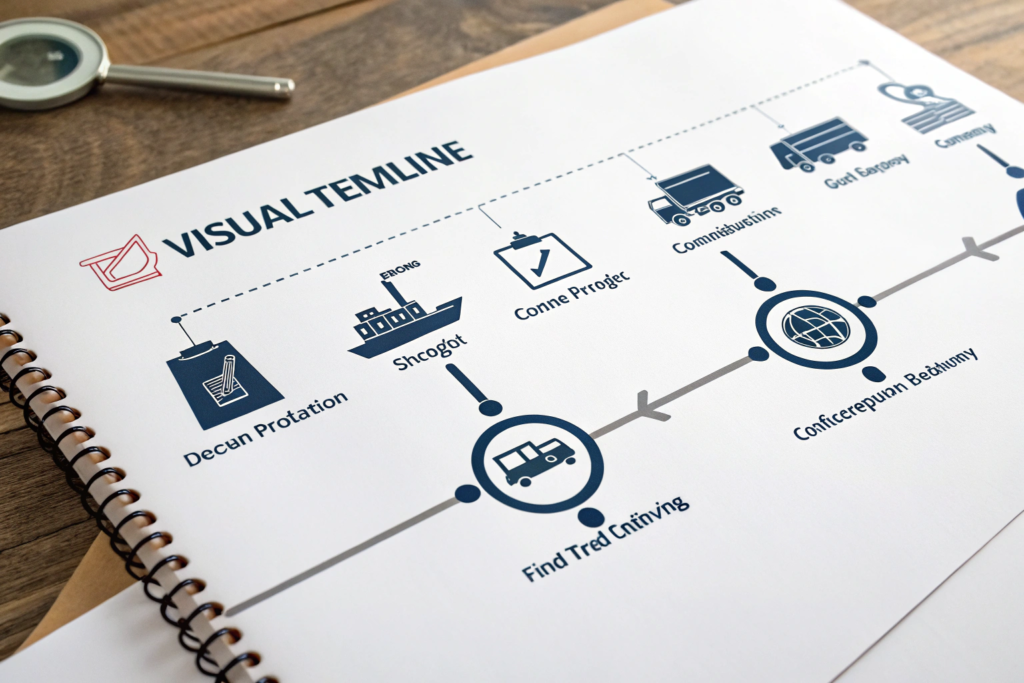
Understanding the process removes fear. When you do not know what is happening to your $50,000 order between Shanghai and your warehouse in Dallas, your mind fills in worst-case scenarios. You imagine the container lost at sea, the documents forgotten in a drawer, the delivery truck hijacked. Transparency is the antidote. We map every DDP shipment through a documented six-stage process, and we give you visibility into each stage.
The Fumao DDP journey consists of six defined stages: Pre-Shipment Documentation, Export Clearance, Ocean or Air Transit, U.S. Customs Clearance, Deconsolidation, and Final Mile Delivery. At each stage, the client receives a notification with a status update and, where applicable, photographic proof. The process turns an opaque, stressful wait into a predictable, observable timeline.
What Happens During the Pre-Shipment and Export Clearance Phase?
Two weeks before the ship date, our logistics team pulls your order file. We verify the final carton count against the packing list. We open three random cartons and photograph the contents: the folding quality, the hang tag placement, the polybag seal. These photos are uploaded to your client portal. This is your final visual confirmation before the container doors close.
Then we prepare the export declaration with China Customs. This requires the commercial invoice, packing list, and export license. Our team submits these documents electronically. China Customs reviews the declaration, and typically within 24 hours, the goods receive export clearance. The container is then trucked to the port of Shanghai, where it is loaded onto the vessel. You receive an "On Board" notification with the vessel name, voyage number, and estimated arrival date. We primarily use ocean carriers with proven on-time reliability on the trans-Pacific route. For urgent orders, we offer air freight DDP options through our partnerships with air cargo providers, which compress transit time from 18 days to 5 days while maintaining the same door-to-door responsibility. The trade-off between speed and cost is always presented transparently. The documentation packet is also shared with our U.S. customs broker at this stage, ensuring they can pre-file the Importer Security Filing (ISF) well before the vessel departure deadline, eliminating any risk of late-filing penalties.
How Do We Manage the Final Delivery Appointment at Your Facility?
The journey does not end when the ship docks at Los Angeles or New York. The final mile is often where logistics partnerships fail. A truck shows up unannounced. The warehouse turns it away because there is no loading dock appointment. The container sits in a holding yard, accruing daily storage fees, waiting for a new delivery window. This is the frustrating reality of disconnected logistics.
We prevent this entirely. As soon as the container is discharged and deconsolidated at the destination port, our domestic logistics partner contacts your receiving team directly. We request specific delivery parameters: preferred delivery window, dock height, whether a pallet jack or liftgate is required, and any special receiving hours. We schedule a firm appointment and communicate the exact two-hour delivery window. On delivery day, we monitor the truck's GPS. If traffic threatens the window, we call your warehouse before the window closes to adjust the timing. A streetwear brand we serve in New Jersey has a receiving dock open only from 7 AM to 10 AM. Our last 15 shipments have arrived within that window, confirmed by signed delivery receipts. After delivery, you conduct a carton count and visual inspection. If any carton shows damage, you note it on the delivery receipt, and we file a claim with the carrier immediately. You are never responsible for chasing a trucking company for damage compensation. We handle that. Once you confirm receipt, the DDP shipment is officially complete. This warehouse delivery coordination level of care turns a complex international transaction into an experience as predictable as receiving a domestic UPS package, just on a much larger scale.
Is DDP More Expensive Than FOB When Sourcing from China?
The sticker price comparison between FOB and DDP is the most misleading number in apparel sourcing. A factory quoting FOB $5.00 per unit will almost always appear cheaper than our DDP quote of $5.80 per unit. The $0.80 difference feels significant when you multiply it by 5,000 units. Many buyers stop the comparison right there and choose FOB, believing they are saving $4,000. This is a mathematical error, not a sourcing decision.
DDP is rarely more expensive than FOB when the total landed cost is calculated honestly. The DDP price simply makes visible all the costs that FOB hides. When you add ocean freight, customs bonds, brokerage fees, duty payments, port handling charges, and trucking to the FOB price, the total almost always lands within 2-3% of the DDP quote. The premium you pay for DDP buys certainty, reduced administrative labor, and the transfer of risk to the party best equipped to manage it.
What Is the Real Cost of Managing Freight Yourself as a Brand Owner?
Consider the hidden labor cost. How many hours will you spend finding a freight forwarder, comparing quotes, verifying their credentials, and managing their communication? How many hours will your accountant spend reconciling freight invoices against purchase orders? How many hours will you spend on the phone with a customs broker explaining what a "fully fashioned knit" is so they can classify it correctly? Your time has a dollar value. If you spend 20 hours managing logistics for a single shipment, and your hourly rate as a business owner is $150, you have spent $3,000 in labor before a single container has moved.
Add that labor cost to the FOB price. Now add the wire transfer fees for paying three different parties. Now add the markup a small-volume freight forwarder charges because you are not a major shipper. The gap between FOB and DDP shrinks dramatically. A mid-sized menswear brand in Chicago switched from managing their own FOB freight to our DDP service last year. They calculated that the administrative overhead, the occasional storage fees from missed truck appointments, and the time spent resolving customs queries added 8% to their landed cost annually. They now pay a fixed DDP rate and have redirected their operations manager's time to sales and marketing. Their landed cost dropped by 3% overall, despite the DDP quote being nominally higher per unit. The elimination of freight cost variability was the primary driver of their savings.
Why Does Factory Volume Make DDP Rates Competitive?
We ship containers to North America every week. Our aggregate shipping volume gives us negotiated rates with ocean carriers, customs brokers, and domestic trucking networks that a single brand owner cannot access. When you book one container, you pay the retail freight rate. When we book fifty containers a month, we pay a significantly discounted contract rate. We pass these savings into the DDP price.
A distributor ordering two containers a year has zero leverage with a trucking company. We have a master service agreement with a national drayage provider covering all major U.S. ports. Our per-container trucking cost is 30-40% lower than the spot rate a solo shipper would receive. This buying power, combined with our internal compliance efficiency, means our DDP quote is often at parity with your FOB quote plus your own estimated logistics costs. The shipping volume advantage allows us to build a DDP model that benefits both parties. You get a predictable, all-inclusive price. We earn a sustainable margin by managing logistics efficiently through scale. It is a genuine win-win structure that makes DDP the financially rational choice for all but the largest enterprise brands with their own dedicated logistics departments.
Conclusion
DDP mode is not a shipping option. It is a commitment. When a clothing manufacturer offers true DDP, they are telling you they have mastered their internal production, their export procedures, their customs compliance, and their global logistics network. They are telling you they are willing to absorb the risks that other factories refuse to touch. They are putting their money and their reputation behind the promise that your goods will arrive at your door, on time, at the exact price you agreed upon, with no surprises.
At Shanghai Fumao, DDP is how we have built lasting relationships with U.S. brands and distributors. It forces us to be excellent at everything, not just sewing. It forces us to maintain accurate HS code databases, to nurture strong broker relationships, and to negotiate aggressively with shipping lines on your behalf. It aligns our incentives completely with yours. We do not profit from logistics chaos; we profit from eliminating it. The faster and smoother your goods arrive, the faster you reorder. That is the business model.
If you are tired of the hidden costs, the unpredictable timelines, and the administrative burden of managing freight across an ocean, let us show you how simple DDP can be. Whether you are sourcing custom men's wear, women's wear, or children's apparel, we will provide a transparent, binding DDP quote that covers every step from our production floor to your warehouse. Contact our Business Director, Elaine, at elaine@fumaoclothing.com. Give us your specifications, and receive a single number that includes your product and its complete, guaranteed journey. That is the peace of mind DDP delivers.