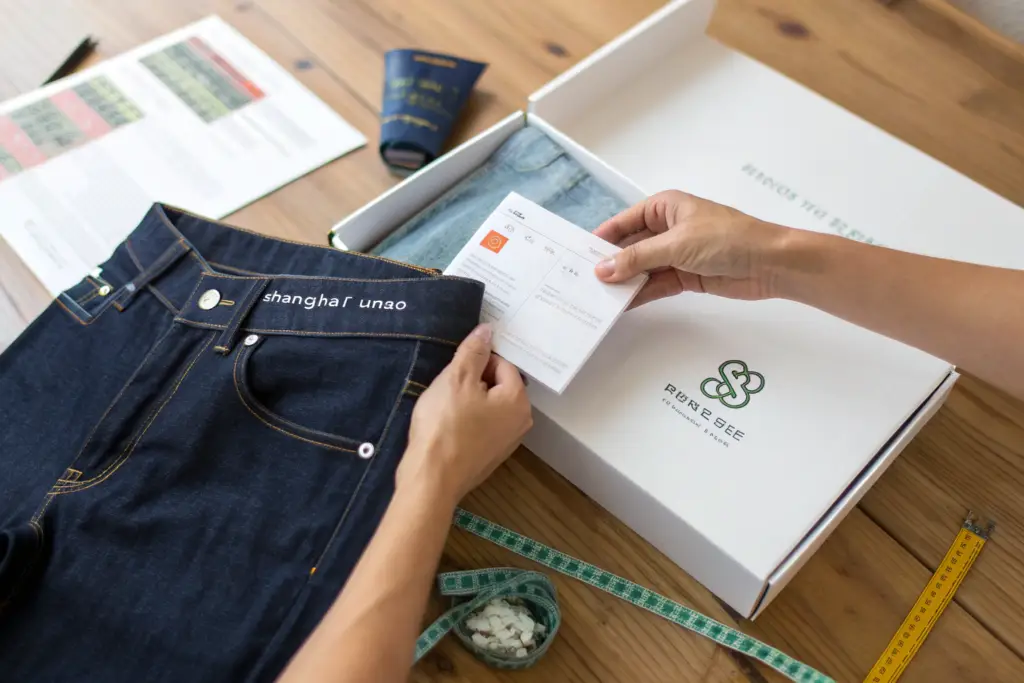
You have read about our factory. You have seen our LinkedIn posts. You have heard about our quality control systems, our fabric testing lab, our YKK zippers, and our DDP shipping. But reading is not believing. You need to hold a pair of our denim shorts in your hands. You need to feel the fabric weight. You need to zip the fly. You need to check the stitching. You need to wash them three times and see if the color holds and the waistband does not shrink. You need to put them on a fit model and check the rise, the leg opening, and the seat curve. You need to know if these shorts are as good as we say they are before you commit to a 3,000-unit order. You need a sample.
Ordering samples from Shanghai Fumao is a structured, four-step process. Step one, you contact our Business Director, Elaine, with your product requirements, your brand information, and your design references if you have them. Step two, Elaine sends you our existing stock samples for evaluation of our standard quality, fabric, and construction, or if you need a custom sample, she initiates the development process with our R&D team. Step three, we produce the sample, either pulled from our sample inventory within 48 hours or custom-made within two to three weeks, and ship it to you via international courier. Step four, you evaluate the sample, provide feedback if adjustments are needed, and when approved, we lock the sample as the sealed standard for your bulk production order.
I run Shanghai Fumao. I know that a sample is the bridge between curiosity and commitment. A good sample experience gives you confidence. A bad sample experience sends you back to Google to search for another factory. I designed our sampling process to be transparent, fast, and collaborative. In this article, I will walk you through exactly how to order samples, what to expect at each stage, what it costs, how long it takes, and how to evaluate the sample when it arrives. No secrets. No hidden fees. Just the process.
What Types of Samples Can You Order from Fumao Clothing?
Not all samples are the same. A stock sample, a custom proto sample, and a pre-production sample serve different purposes in the sourcing process. Understanding the difference prevents confusion and ensures you order the right type of sample for your current stage.
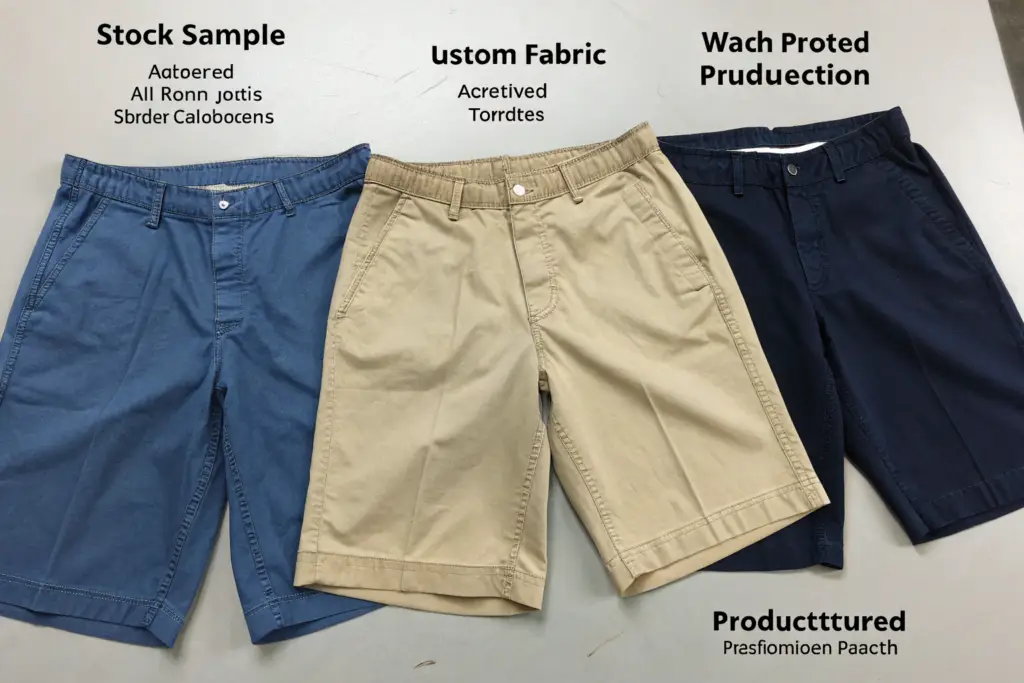
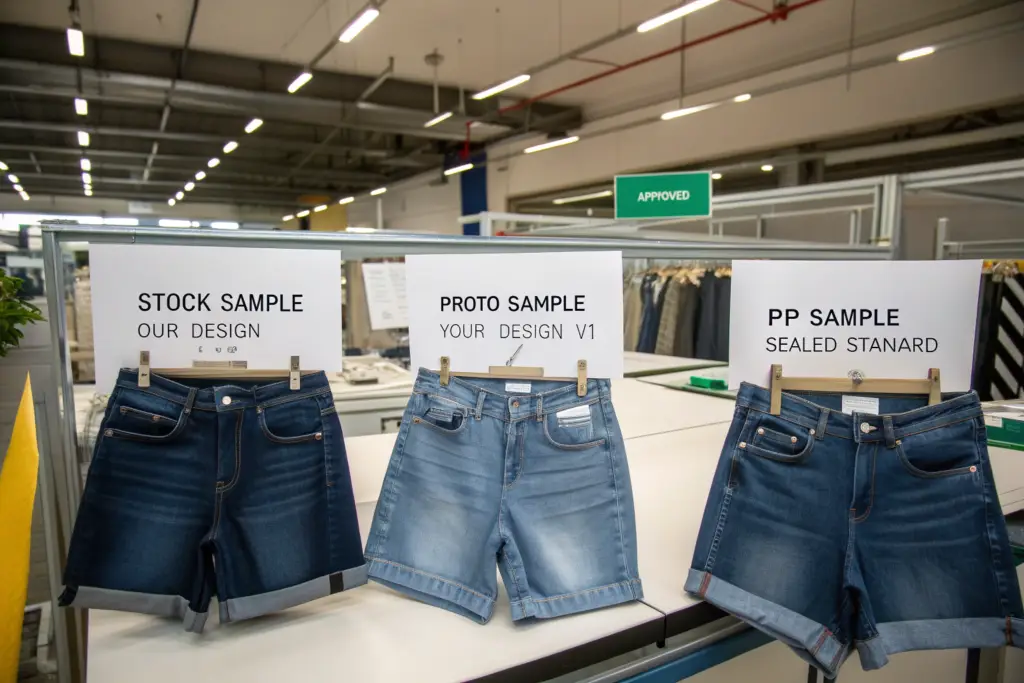
A stock sample is an existing pair of shorts from our standard collection. It represents our baseline quality, our standard fabric, our standard construction, and our standard wash. You order a stock sample when you are evaluating a new factory and want to see their general quality level before committing to a custom development project. A custom proto sample is the first physical version of your specific design. It is made to your measurements, your fabric specification, your wash request, and your branding requirements. You order a custom proto sample when you are ready to develop your own product. A pre-production sample is the final sample, made from your approved proto with all adjustments incorporated, in the exact production fabric with the exact production wash and trims. It is the sealed standard that the bulk production must match. You approve a pre-production sample before the factory cuts your bulk order.
Let me explain each sample type in detail, including what they cost and how long they take.
What Is the Difference Between Stock, Proto, and Pre-Production Samples?
A stock sample is our product, not your product. It comes from our existing sample inventory. We keep a range of our standard denim shorts in various fits, washes, and fabric weights. You tell us what you are interested in. "I am looking at high-rise, relaxed-fit denim shorts in a medium vintage wash, 10.5 oz." We pull the closest match from our inventory. The stock sample shows you our sewing quality, our fabric hand feel, our wash consistency, and our hardware quality. It does not have your branding. It does not have your specific measurements. It is an evaluation tool, not a production sample.
A proto sample is your product, version one. You send us your design requirements. A sketch, a reference photo, a tech pack if you have one, a description of the fit, the fabric, the wash, and the branding. Our R&D team creates a pattern, cuts the fabric, sews the short, applies the wash, and attaches the trims. The proto sample is made from a fabric similar to your specification, not necessarily the exact production fabric if that fabric has not been sourced yet. The purpose is to test the fit and the design concept. You evaluate the proto on a fit model. You send us feedback. We adjust.
A pre-production sample, or PP sample, is your product, final version. It incorporates all the adjustments from the proto feedback. It is made with the exact production fabric, the exact production wash recipe, the exact production hardware, and the exact labels and packaging. This sample is the contractual standard. When you approve the PP sample, you are saying "make the bulk order exactly like this." The apparel sampling stages are standard across the industry. Each stage serves a different purpose in the development cycle.
How Much Do Samples Cost and How Long Do They Take?
Stock samples cost $50 to $100 per pair, including international courier shipping. This is a nominal fee that covers the sample cost and the shipping. It is not a profit center for us. We ship stock samples within 48 hours of your order confirmation. Delivery takes three to five business days to the U.S. via DHL or FedEx.
Custom proto samples cost $150 to $250 per style, including shipping. The cost covers the pattern making, the cutting, the sewing, the wash development, and the trims. This is significantly below our actual cost. We subsidize sampling because we view it as a business development investment. A client who invests in a custom sample is a serious client. The development time for a proto sample is two to three weeks from order confirmation to shipment, depending on the complexity of the design and the availability of the fabric. Delivery adds three to five days.
Pre-production samples are usually provided at no additional charge when they follow a proto sample order and are part of a confirmed bulk production timeline. If a PP sample is requested without a proto sample having been made, for example, if you are re-ordering a previous style with modifications, the cost is $100 to $150 including shipping. The timeline is one to two weeks from order confirmation. The garment sample costs and timelines vary by factory and product complexity. Our costs are transparent and competitive for a factory with in-house R&D capability.
How Do You Place a Stock Sample Order to Evaluate Our Baseline Quality?
If you are new to Shanghai Fumao, the stock sample is the logical first step. It is low cost, fast, and gives you a tangible sense of our quality without requiring you to develop a custom product. It answers the fundamental question: "Is this factory's quality level a fit for my brand?"
Placing a stock sample order is simple. You contact Elaine, our Business Director. You tell her what you are generally looking for. The product category, denim shorts. The fit preference, high-rise, mid-rise, relaxed, slim. The fabric weight preference, lightweight, midweight, heavyweight. The wash preference, dark rinse, medium vintage, light wash, raw. The target retail price range, which helps us select a sample with the appropriate cost structure. Elaine selects the closest match from our stock sample inventory and confirms with you before shipping. You pay the sample fee via PayPal, bank transfer, or Trade Assurance. We ship within 48 hours. You receive the sample within a week.
Let me explain what to look for when you receive the stock sample and how to interpret what you see.
What Specific Details Should You Inspect on a Stock Sample?
When the stock sample arrives, do not just look at it. Inspect it systematically. I will give you a checklist of ten specific things to examine.
One, the fabric hand feel. Is it soft or rigid? Does it feel substantial or flimsy? Does it match the weight we specified? Two, the stitching. Look at the inseam, the outseam, the waistband, the hem. Are the stitches straight? Is the stitch density consistent? Are there any skipped stitches or loose threads? Three, the zipper. Zip and unzip the fly ten times. Is it smooth? Does the auto-lock hold? Is it a YKK or SBS zipper as specified? Four, the button and rivets. Pull on them. Are they securely attached? Do they have sharp edges? Five, the pocket bags. Turn them inside out. Is the fabric a decent quality twill, not a flimsy poly-cotton? Are the edges finished or raw? Six, the bar tacks. Look at the pocket corners, the belt loops, the fly base. Are the bar tacks dense and secure? Seven, the wash. Look at the color in natural daylight. Is it even? Is there any blotchiness? Is the color consistent across different panels? Eight, the fit. Try the shorts on a fit model or a dress form if you have one. How does the rise feel? How does the leg hang? Is the waistband comfortable? Nine, the labels and branding. If this is a stock sample, it will have our generic labels. Check the quality of the label attachment. Ten, the overall impression. After inspecting all the details, what is your gut feeling? Does this feel like a short you would be proud to sell under your brand name?
Take notes. Take photos. Send your feedback to Elaine. If you like the quality but want a different fit or wash, we can discuss a custom proto sample. If something is not right, tell us. We want to know. The garment sample evaluation checklist is a useful reference. Your own eyes and hands are the most important inspection tools.
Can You Wash and Wear the Stock Sample to Test Real-World Durability?
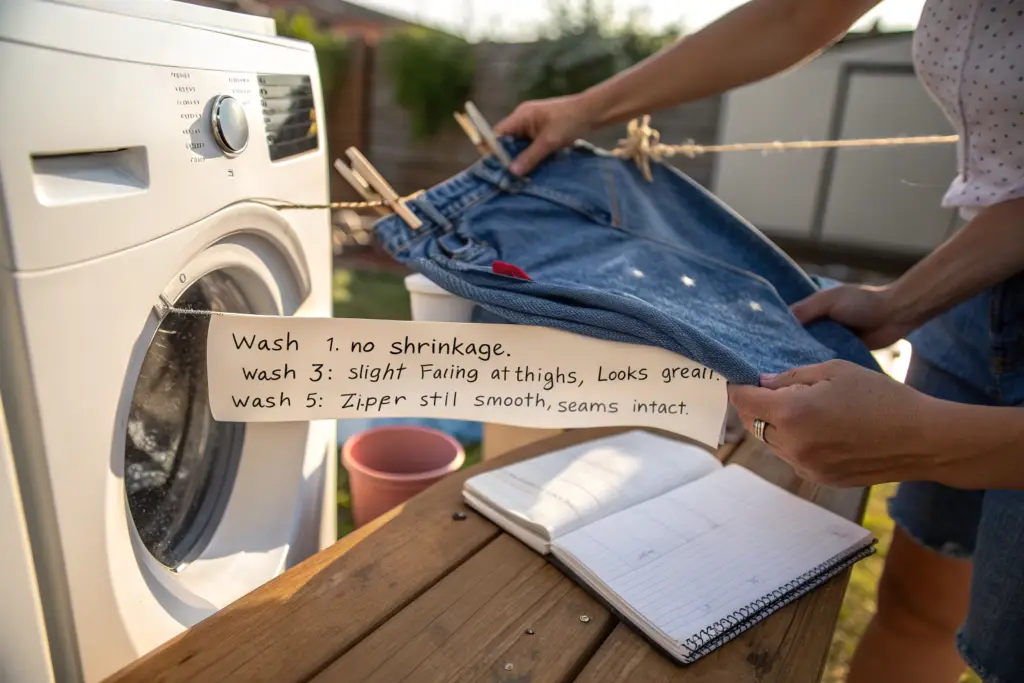
Yes. We encourage it. A sample is not a museum piece. It is a test unit. Wash the shorts five times. Wear them. See how the fabric breaks in. See if the color fades attractively or unattractively. See if the seams hold. See if the zipper continues to function smoothly. See if the waistband stretches out or holds its shape.
This real-world testing reveals things that a visual inspection cannot. A short can look perfect on day one and develop problems by day ten. The indigo might bleed onto your white t-shirt. The waistband might lose its elasticity. The hem might start to fray. These are the failure modes that generate customer returns. Testing the sample under real conditions exposes these failure modes before you order 3,000 units.
After your real-world test, you will have a much deeper understanding of our quality than you could get from any website, any article, or any video. You will know, not just believe, whether our shorts meet your brand's standard. That knowledge is worth far more than the $50 to $100 sample cost. It is the cheapest insurance policy you can buy against a bad bulk order. The product durability testing at home principle applies to apparel. Use the product as your customer would use it. See what happens. That is the ultimate quality test.
What Is the Process for Custom Sample Development?
When you are ready to develop your own design, the process becomes more collaborative. You are no longer evaluating our product. You are creating your product, with our help. This is where the factory relationship becomes a true partnership.
The custom sample development process starts with a detailed design consultation. You share your vision with our R&D team. We ask questions, propose options, and translate your ideas into a technical specification. Then we make the sample. You evaluate it. We adjust it. The cycle repeats until the sample matches your vision. This process is iterative and requires your active participation. The more specific your feedback, the faster we can reach the approved sample.
Let me walk you through the development process step by step.
What Design Information Should You Provide for a Proto Sample?
The quality of the proto sample depends on the quality of the information you provide. Vague instructions produce vague results. Specific instructions produce specific results.
Provide as much of the following as possible. A design sketch or a reference photo of a short with a similar fit. Annotate the photo. "We want this rise, but we want the leg opening to be 2 cm wider." A description of the desired fit. High-rise, mid-rise, or low-rise? Slim, straight, relaxed, or oversized? What inseam length? A fabric specification. What weight? 8 oz, 10.5 oz, 12 oz? What composition? 100% cotton rigid, 99% cotton 1% spandex stretch, 98% cotton 2% spandex super-stretch? Any special requirements? Organic cotton, selvedge, specific mill source? A wash reference. A photo of a wash you like. "We want a medium vintage wash similar to this reference, with subtle whiskering at the front thigh and no heavy distressing." A branding specification. Where do you want your logo? Leather patch on back waistband, embroidery on back pocket, woven label inside waistband, custom button engraving? If you have logo artwork, send the vector file. A measurement chart if you have one. If you have established size specifications, provide them. If not, we will use our standard U.S. size block as a starting point. A target retail price. This helps us make fabric and construction recommendations that fit your margin requirements. The design brief for clothing manufacturers guide provides a template. The more complete your brief, the closer the first proto sample will be to your vision.
How Many Rounds of Sampling Are Typically Needed to Approve a Design?
A new design with a new fit block typically requires two to three rounds. Round one is the proto sample. It tests the basic pattern and construction. The fabric may be a close substitute if the exact specification is still being sourced. You evaluate the proto on a fit model. You mark up photos with specific comments. "Waistband too tight by 2 cm. Front rise too short by 1.5 cm. Leg opening too narrow. Need 3 cm wider at the hem." You send the annotated photos and a written summary to Elaine.
Round two is the revised sample. The pattern adjustments are incorporated. The correct fabric is used. The correct wash is applied. In most cases, the fit is approved at this stage. Minor tweaks, adjusting the pocket placement by 0.5 cm or the hem stitch color, may still be needed.
Round three, if needed, is the final pre-production sample. It incorporates any remaining adjustments and is made exactly as the bulk production will be made. This sample becomes the sealed standard. You sign off on it. Bulk production proceeds against this standard. The entire process, from initial consultation to approved PP sample, typically takes six to nine weeks. Rushing this process is a mistake. A fit issue that is not resolved at the sampling stage is multiplied across every unit in the bulk order. The apparel sampling iteration process is the most important investment you will make in your product. Invest the time.
Conclusion
Ordering samples from Shanghai Fumao is the most important step you can take before committing to a bulk denim shorts order. A stock sample lets you evaluate our baseline quality, our fabric, our stitching, our hardware, and our wash, for a small investment of $50 to $100 and a week of your time. You can wear it, wash it, and test its real-world durability. A custom proto sample lets you see your specific design brought to life, with your measurements, your fabric, your wash, and your branding. The development process is collaborative and iterative, typically taking two to three rounds over six to nine weeks.
The sample is your insurance policy. A $200 sample that reveals a fit problem saves you from a $15,000 bulk order that produces 3,000 pairs of shorts that do not fit your customers. The sample is also your standard. Once you approve the pre-production sample, you have a physical, tangible reference for what the bulk order must deliver. There is no ambiguity. There is no "I thought it would look different." The approved sample is the contract.
If you are ready to see our quality for yourself, start with a stock sample. Contact our Business Director, Elaine. Tell her what type of denim short you are interested in. She will select the closest match from our inventory, ship it within 48 hours, and provide a tracking number. Her email is elaine@fumaoclothing.com. If you are ready to develop your own design, schedule a design consultation call. Elaine will walk you through the information we need and the development timeline. At Shanghai Fumao, we do not expect you to trust our words. We expect you to test our product. Order a sample. That is where trust begins.