Kids' clothing is not just smaller adult clothing. It is a different product category with different regulations, different risks, and different responsibilities. A button that falls off an adult's denim shorts is a nuisance. A button that falls off a toddler's denim shorts is a choking hazard. A drawstring on an adult hoodie is a style detail. A drawstring on a child's garment is a strangulation risk that has killed children and led to massive recalls. I know these risks because I have studied the regulations. I have seen the recall notices from major brands who made mistakes. I decided when we started our kids' denim line that we would not make those mistakes.
Shanghai Fumao kids' denim shorts stand out in safety because of five specific design and testing commitments. First, we use snap closures or elastic waistbands instead of traditional metal button flys on toddler and infant sizes, eliminating the choking hazard of detached buttons. Second, we never use drawstrings on children's sizes up to 14, in compliance with U.S. CPSC drawstring guidelines. Third, all fabric and trims are OEKO-TEX Standard 100 Class I certified, meaning they are tested safe for babies to mouth. Fourth, all metal components are tested for lead content and nickel release to comply with CPSIA limits. Fifth, we reinforce all small component attachments, snaps, rivets, decorative elements, with a minimum 20-pound pull test to prevent detachment.
I run Shanghai Fumao. I am a factory owner, but I am also a parent. I would not put my own child in clothing that could hurt them. I apply that same standard to every kids' denim short we manufacture. In this article, I will walk you through the specific safety regulations that apply to children's denim shorts in the U.S. market, the design choices we make to comply with those regulations, the testing we perform, and the documentation we provide to prove compliance. If you sell children's clothing in the United States, this information is not optional. It is your legal responsibility.
What U.S. Safety Regulations Apply to Children's Denim Shorts?
The United States has the strictest children's product safety regulations in the world. The Consumer Product Safety Commission enforces these regulations. If your product violates them, the CPSC can force a recall, seize your inventory at the port of entry, and levy substantial fines. The regulations are not suggestions. They are law.
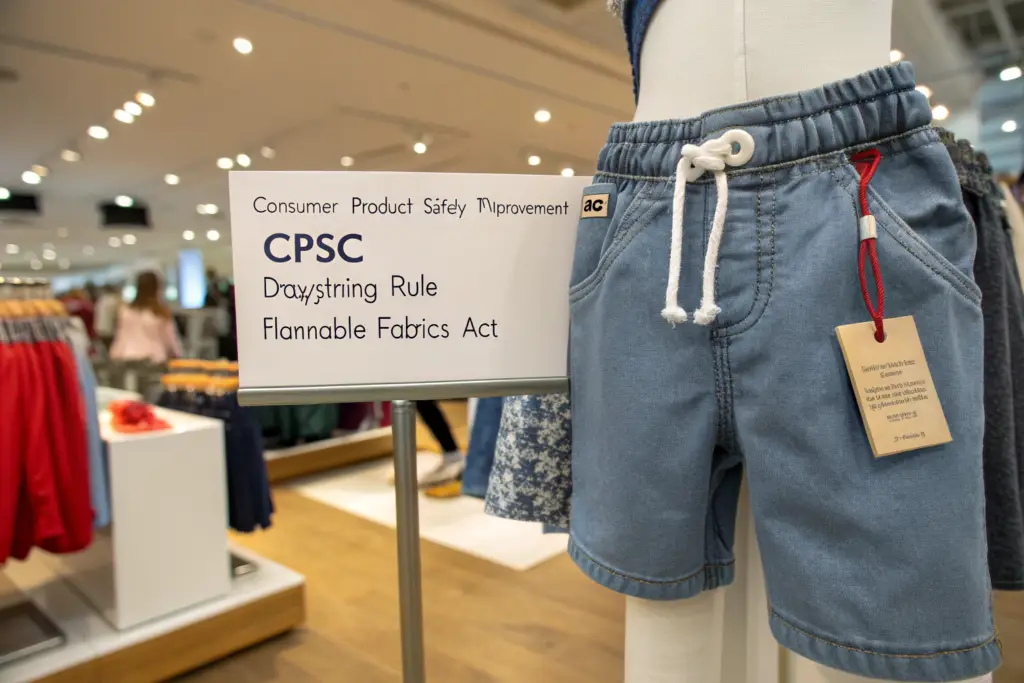
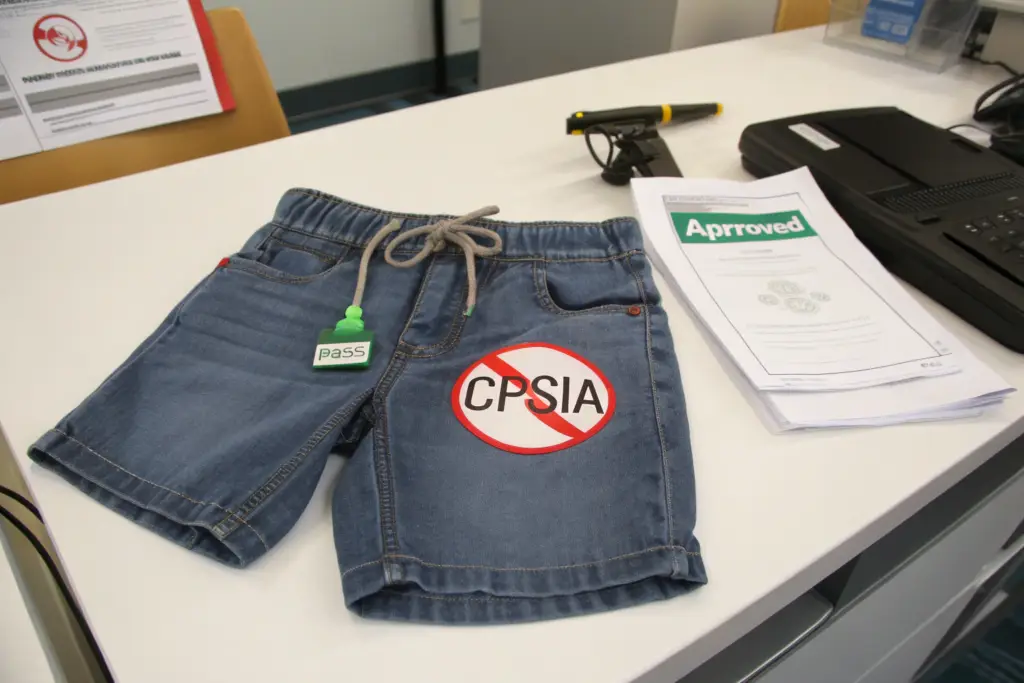
For children's denim shorts, three regulatory frameworks are most relevant. The Consumer Product Safety Improvement Act, which sets limits on lead in surface coatings and lead in substrate materials, and requires third-party testing for children's products. The CPSC drawstring rule, which bans drawstrings at the neck and limits them at the waist and bottom for children's clothing sizes 2T to 16. And the Flammable Fabrics Act, which requires that clothing textiles meet specific flammability standards. A brand that sells children's denim shorts in the U.S. must ensure their products comply with all three. The factory that manufactures the shorts must support the brand's compliance by providing tested materials and documented processes.
Let me explain the two most critical safety regulations for denim shorts and how we design our products to comply.
What Are the CPSIA Lead and Phthalate Limits for Kids' Denim Shorts?
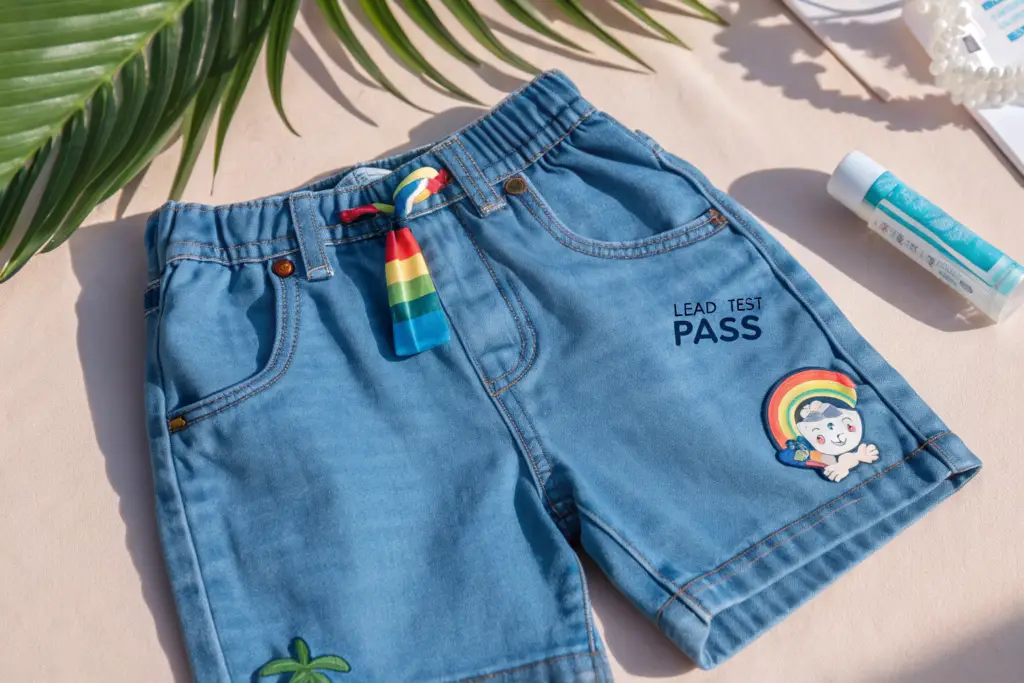
The Consumer Product Safety Improvement Act of 2008 set strict limits on lead and phthalates in children's products. For lead in surface coatings, such as paint on a metal button or a printed design on fabric, the limit is 90 parts per million. This is effectively a ban on the intentional use of lead in surface coatings. For lead in substrate materials, such as the metal of the button itself or the denim fabric, the limit is 100 parts per million. These limits apply to every accessible component of the short.
For phthalates, which are chemicals used to soften plastics, the CPSIA permanently bans the use of three phthalates, DEHP, DBP, and BBP, in any amount above 0.1% in children's toys and child care articles. It also interim bans three additional phthalates, DINP, DIDP, and DnOP, from products that can be placed in a child's mouth. While denim shorts are not primarily made of plastic, many components can contain phthalates. The synthetic leather patch on the back waistband. The plastic button or snap. The printed label. The elastic in the waistband. Any screen printing ink that uses a plastisol base.
We address CPSIA compliance at the material sourcing stage. We require all hardware suppliers to provide CPSIA-compliant material certificates showing lead content below 100 ppm. We test incoming hardware batches using an X-ray fluorescence analyzer in our lab. For phthalates, we specify phthalate-free materials in our purchase orders to trim suppliers. The CPSIA lead and phthalate limits are published on the CPSC website. A brand must issue a Children's Product Certificate certifying that the product has been tested by a CPSC-accepted third-party laboratory and found compliant. We provide the material data and the internal test results to support that certification.
Why Does the CPSC Drawstring Rule Matter for Denim Shorts?
Drawstrings on children's clothing have caused multiple deaths and serious injuries. A drawstring around the neck can catch on playground equipment, a crib, or a vehicle door, causing strangulation. A drawstring at the waist or bottom can catch on a car door or an escalator, causing dragging injuries. The CPSC issued guidelines in 1996, which were incorporated into a mandatory standard in 2011 under ASTM F1816.
The rule states that children's upper outerwear in sizes 2T to 12 must not have drawstrings at the hood or neck area. Children's upper outerwear in sizes 2T to 16 must not have drawstrings at the waist or bottom that do not meet specific requirements. For waist and bottom drawstrings, they must be sewn in place so they cannot be pulled out, and they must not extend more than 3 inches outside the garment when fully extended.
Denim shorts are not upper outerwear, so the specific ASTM F1816 rule may not technically apply to shorts. However, the CPSC has consistently applied the drawstring safety principle broadly. Any long, free-hanging drawstring on a child's garment is a potential entanglement hazard. We take a conservative approach. We do not use drawstrings on any children's denim shorts in sizes up to 14. If a design calls for a waist adjustment, we use a sewn-in elastic with a non-functional tie that is securely bar-tacked at the center back so it cannot be pulled out. Or we use a functional drawstring that is securely stitched at the center back to prevent removal and has no free ends. The CPSC drawstring safety guidelines explain the risks and the requirements. A brand that ignores these guidelines is risking a recall and, far worse, a child's safety.
What Child-Specific Design Features Do We Incorporate?
Safety is about what you remove. Drawstrings. Small, detachable buttons. Sharp edges. It is also about what you add. Secure closures that a child can operate. Reinforced seams that withstand the playground. Comfort features that prevent skin irritation. Designing for children requires a different mindset than designing for adults. The end user is small, active, and has sensitive skin. The parent who buys the shorts is acutely aware of safety and durability.
Our kids' denim shorts are not simply our adult shorts graded down to smaller sizes. They are designed from the ground up for a child's body and a child's life. The proportions are different. The waist-to-hip ratio is different. The rise is shorter. The leg is shorter. The functional requirements are different. A child squats, climbs, runs, and falls. Their shorts must move with them without restricting movement and without failing at the seams.
Let me explain the specific design features we incorporate for safety and comfort.
How Do We Replace Hazardous Components with Child-Safe Alternatives?
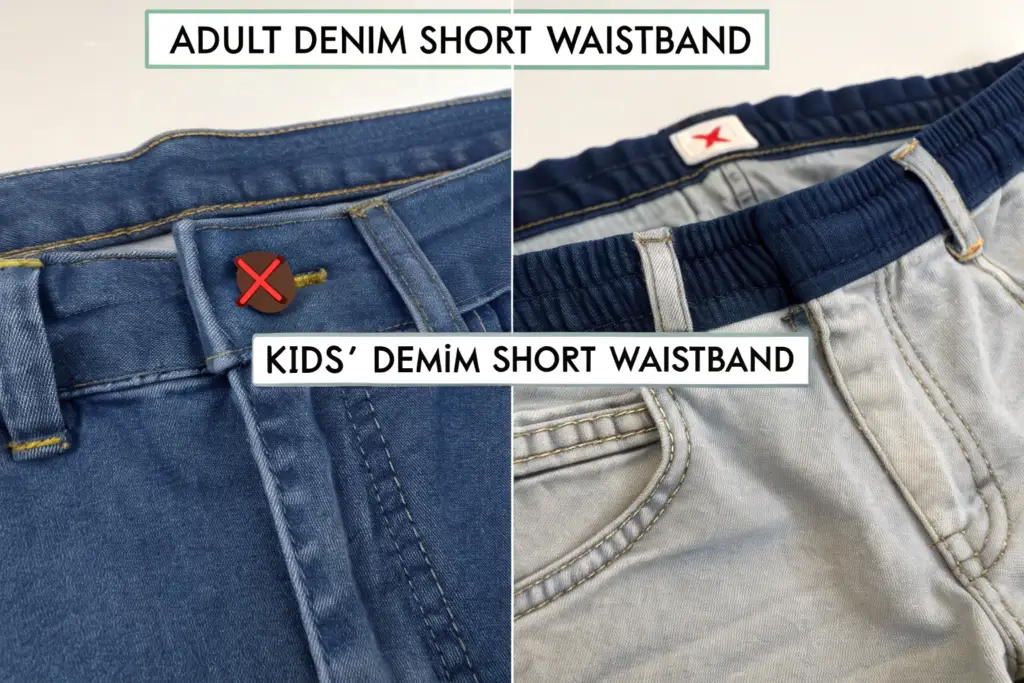
The traditional denim short uses a metal button fly and metal rivets. These are hazardous for young children. A metal button can detach and become a choking hazard. A metal rivet can have sharp edges. A metal zipper can pinch a child's skin. We replace these hazardous components on toddler and infant sizes.
For the fly closure on sizes up to 5T, we use a faux fly with an elastic waistband. There is no functional fly opening and no metal components at the front closure. The waistband is an encased elastic that provides a comfortable, adjustable fit without the need for a button or zipper. For sizes 4 to 7, we sometimes use a functional fly with a plastic snap closure instead of a metal button. The snap is made from phthalate-free plastic and is attached with a reinforced snap attachment that is tested to 20 pounds of pull force. The snap is large enough that it would not pose a choking hazard even if it did detach, though our testing ensures it will not detach under normal use.
For rivets on the pocket corners, we use bar-tack stitching instead of metal rivets on sizes up to 7. A bar tack is a dense zigzag stitch that reinforces the pocket corner without any metal. It is soft, secure, and zero choking hazard. For decorative elements, we use embroidered patches, fabric appliques, and printed designs instead of sewn-on buttons, beads, or sequins. The children's clothing safety design guidelines from the CPSC provide a comprehensive overview of hazardous components to avoid. We have internalized these guidelines into our design process.
What Fit and Comfort Features Prevent Skin Irritation and Restriction?
A child's skin is more sensitive than an adult's. Seams that rub. Labels that scratch. Fabric that does not breathe. These are not minor annoyances for a child. They can cause rashes, discomfort, and a refusal to wear the shorts. The parent then returns the shorts and leaves a negative review.
We use flat-felled seams on the inseam and outseam of our kids' denim shorts. A flat-felled seam encloses the raw fabric edge within the seam, creating a smooth interior surface with no exposed overlock stitching that can rub against the skin. On toddler sizes, we place the care label on the outside of the waistband, or we print the care information directly onto the fabric, eliminating the scratchy woven label that is standard on adult garments. We use a soft, brushed cotton twill for the pocket bags, not a stiff poly-cotton that can irritate small hands. The waistband elastic is a wide, soft elastic that distributes pressure evenly without digging into the waist. The leg opening is designed to be roomy enough for free movement but not so wide that it catches on objects. These design features are small individually, but together they create a short that a child can wear all day without complaint. The children's apparel fit and comfort standards are not as formalized as safety standards, but experienced children's wear manufacturers develop internal standards based on feedback from parents and children.
What Testing and Certification Do We Provide for Kids' Denim Shorts?
Testing for children's products is not optional. It is a legal requirement enforced by the CPSC. A manufacturer or importer of children's products must have their products tested by a CPSC-accepted third-party laboratory. They must issue a Children's Product Certificate based on the passing test results. The certificate must accompany the product through the supply chain. Retailers will ask for it. Customs may ask for it. If a product is found to be non-compliant, the CPC serves as evidence that the importer exercised due diligence.
We support our brand clients by providing materials and components that have been pre-tested for the relevant CPSIA requirements. We also coordinate with CPSC-accepted laboratories for final product testing. Our internal lab is not a CPSC-accepted lab, so we cannot issue the CPC ourselves. But our internal testing catches problems before the expensive third-party testing stage. When the third-party test occurs, we are confident the product will pass.
Let me explain the testing process and the certification documentation we provide.
What Specific Tests Do We Perform In-House Before Third-Party Certification?
Our in-house testing for kids' denim shorts covers the three main CPSIA hazard areas. Lead in surface coatings, lead in substrates, and small parts detachment.
For lead in surface coatings, we use an X-ray fluorescence analyzer. This handheld device shoots X-rays at the surface of the component, a painted button, a printed patch, a coated zipper, and measures the fluorescent energy that bounces back. The device quantifies the lead content in parts per million. We test every component that has a surface coating. If the reading exceeds 90 ppm for coatings or 100 ppm for substrates, the component is rejected. The XRF is a screening tool, not the definitive test method, but it is highly reliable for detecting lead above the limits.
For small parts detachment, we use a pull-force gauge. We test snaps, buttons, rivets, and any attached decorative element. The gauge pulls the component with 20 pounds of force for 10 seconds. If the component detaches or breaks, it fails. We also perform a torque test, where the component is twisted with a specified torque to see if it loosens or detaches. And we perform a drop test for components that could break on impact, though this is less relevant for soft denim shorts. These tests follow the CPSC small parts testing methods described in 16 CFR Part 1501.
For phthalates, our in-house testing capability is limited. We rely on material certifications from our suppliers and on third-party lab testing for phthalate verification. We do not use plastisol inks or PVC components in our kids' line specifically to avoid phthalate risk.
What Documentation Do We Provide to Support Your Children's Product Certificate?
When a brand places an order for kids' denim shorts, we provide a compliance documentation package. This package includes the OEKO-TEX Standard 100 Class I certificate for the fabric, which certifies the fabric is free from harmful substances including lead and phthalates at levels safe for babies. It includes material composition certificates from our hardware suppliers, stating the metal alloy composition, the absence of lead and nickel, and phthalate-free status for plastic components. It includes our internal test reports from the XRF screening and the pull-force testing, with the test dates, the component tested, and the pass-fail result. It includes the bill of materials, listing every component in the short with its material composition and supplier.
This package does not replace the third-party CPC testing. The brand must still commission testing from a CPSC-accepted lab. But the package provides the data the brand needs to understand what is in their product and to have confidence that the third-party test will pass. If the brand requests, we can coordinate the third-party testing. We send pre-production samples to the brand's chosen CPSC-accepted laboratory, such as SGS, Bureau Veritas, or Intertek. The lab tests for the required CPSIA parameters. The brand receives the test report and issues the CPC. The CPSC Children's Product Certificate requirements specify what the certificate must contain. We help the brand compile that information.
Conclusion
Kids' denim shorts are not a smaller, cheaper version of adult denim shorts. They are a regulated children's product with legal safety requirements and moral obligations attached. At Shanghai Fumao, we take those requirements seriously. We design out hazards from the start. No drawstrings that can strangle. No small metal buttons that can choke. No sharp rivets that can scratch. We replace hazardous components with child-safe alternatives. Elastic waistbands. Plastic snaps. Bar-tack reinforcements. Embroidered decorations. We test every component for lead, for phthalates, for detachment force, using in-house screening equipment and coordinating with CPSC-accepted third-party laboratories. We provide a documentation package that supports the brand's Children's Product Certificate.
These practices cost more. Child-safe components are more expensive than standard hardware. Testing adds cost and time. Designing a separate kids' pattern block requires investment. But the cost of a shortcut is unacceptable. A child injured by a product you sold. A recall that destroys your brand. A lawsuit that threatens your business. The economics of safety are clear. Spend the money upfront to prevent the catastrophe.
If your brand is developing a kids' denim short line, or if you are expanding your existing denim line into children's sizes, we have the expertise and the infrastructure to support you. Contact our Business Director, Elaine. She can provide our kids' safety design guide, a sample pair of our kids' denim shorts, and a sample compliance documentation package. She can also arrange a video call with our quality team to walk through our testing procedures. Her email is elaine@fumaoclothing.com. At Shanghai Fumao, we believe that a child's safety is not a competitive advantage. It is a shared responsibility of every brand and every factory in the children's wear industry. We take that responsibility seriously. So should you.