You spent six months developing a new denim short. The curved hem. The custom wash. The unique pocket shape. The embroidered logo on the back. You sourced the fabric. You approved three rounds of samples. You launched the product. It sold well. Three months later, you are scrolling through Alibaba and you see your short. Same curved hem. Same wash. Same pocket shape. A different brand logo is stitched on the back. A factory in Guangzhou is offering it for $4.80 FOB, ready to ship to anyone who asks. Your design was stolen. Your competitive advantage, the uniqueness that justified your premium price, just became a commodity available to every drop-shipper with an internet connection. You feel violated. You feel powerless. You are not sure what you could have done differently.
You protect your denim design from being copied by factories through a layered strategy that combines legal protection, operational security, and relationship management. The legal layer includes Non-Disclosure Agreements, Non-Use Agreements, and design registration where applicable. The operational layer includes splitting production across multiple factories, compartmentalizing key processes, and controlling the most copy-able elements like washes, labels, and custom hardware in-house. The relationship layer involves choosing factory partners with a track record of integrity, structuring contracts with clear consequences for unauthorized use, and conducting regular market surveillance to detect copies early.
I run Shanghai Fumao. I have been on both sides of this issue. I have had clients accuse my factory of copying their designs, accusations that turned out to be unfounded, but the fear was real. I have also had my own factory's capabilities copied by competitors who visited our showroom, took photos, and replicated our wash techniques. Design theft is a real problem in this industry. In this article, I will tell you what actually works to protect your designs, what does not work, and how to choose a factory partner who will treat your intellectual property with respect.
What Legal Protections Should You Put in Place Before Sharing Your Design?
The legal protections are the foundation. They do not prevent a determined thief from stealing your design, but they give you the right to take action if a theft occurs. Without legal protections, you have no standing. You cannot sue. You cannot send a cease-and-desist letter. You cannot file a complaint on Alibaba. You have nothing but frustration.
The most important legal tool in the apparel industry is not a patent. It is a contract. Patents protect inventions, not fashion designs. Copyright protects artistic works, but it is difficult to apply to functional garments. Trademarks protect logos and brand names, not garment designs. The contract, specifically the Non-Disclosure Agreement and the Non-Use and Non-Circumvention Agreement, is your primary legal shield. A well-drafted contract, signed by the factory before you share your design, creates a legal obligation. If the factory breaches that obligation, you have a basis for a claim.
Let me explain the specific agreements you need and how to make them enforceable in a Chinese context.
What Is an NNN Agreement and Why Is It Essential for Denim Sourcing?
NNN stands for Non-Disclosure, Non-Use, and Non-Circumvention. It is a stronger version of a standard NDA, which typically only covers non-disclosure of confidential information. The NNN agreement adds two critical protections for apparel sourcing.
Non-Use means the factory agrees not to use your design for any purpose other than fulfilling your order. They cannot manufacture the design for another client. They cannot sell samples of your design to other buyers. They cannot post photos of your design on their website or social media without your written permission. This is the clause that directly prohibits the factory from copying your design.
Non-Circumvention means the factory agrees not to contact your customers, your suppliers, or your distribution partners directly, attempting to cut you out of the supply chain. This is less about design protection and more about business relationship protection, but it is often bundled into the same agreement.
The NNN agreement should be signed before you share any design details, sketches, tech packs, or reference samples. It should be bilingual, in English and Chinese, so the factory cannot claim they did not understand the terms. It should specify the governing law, ideally the law of a jurisdiction where you have the resources to enforce it, such as Hong Kong or Singapore, rather than mainland China where enforcement by a foreign entity is more difficult. It should include a clause specifying that the losing party pays the prevailing party's legal fees in any dispute, which discourages frivolous defenses. The NNN agreement for China manufacturing is a standard tool used by sourcing agents and international law firms. A factory that refuses to sign an NNN agreement is a factory that plans to copy designs. Walk away.
Can You Register a Denim Design for Legal Protection in the U.S. and China?
Design registration is possible but limited in scope. In the United States, you can register a design patent for a new, original, and ornamental design for an article of manufacture. A design patent protects the visual appearance of the product, not its functional features. If your denim short has a unique visual element, a specific pocket shape, a particular seam layout, a distinctive hem curve, that is not purely functional, you may be able to secure a design patent. The process takes 12 to 18 months and costs $2,000 to $5,000 in legal fees. A design patent gives you the right to exclude others from making, using, or selling the design in the U.S. for 15 years.
In China, you can register a design patent through the China National Intellectual Property Administration. The process is faster, typically 6 to 9 months, and less expensive. A Chinese design patent gives you enforcement rights within China, which is where the copying is likely to occur. However, enforcement requires initiating legal action in Chinese courts, which is a significant undertaking for a foreign entity. The practical value of a Chinese design patent for a small or medium brand is limited unless you have a legal presence in China.
Trademark registration is more straightforward and more essential. Register your brand name and logo as trademarks in China and the U.S. If a factory copies your design and applies your logo, you have a trademark infringement claim, which is easier to enforce than a design patent claim. If they copy your design but use a different logo, the trademark does not help. The USPTO design patent guide explains the process. For most small and medium brands, contract protection is more practical and more immediately enforceable than design registration.
How Should You Physically Protect Samples and Production Information?
Legal protection is the backstop. Physical protection is the day-to-day defense. The most common way a design is copied is not through a sophisticated industrial espionage operation. It is through a sample left on a meeting room table. It is through a photo taken by a visitor on a factory tour. It is through excess production that the factory sells out the back door. The physical security of your products and information matters.
You control what the factory sees. You control what samples you leave behind. You control what production quantities are manufactured. These controls are within your power as the buyer. They do not require the factory's cooperation. They do not require a signed contract. They are simple, operational measures that reduce the opportunity for copying.
Let me explain the specific physical security measures you should implement during sampling and production.
Why Should You Restrict the Distribution of Physical Samples?
Every physical sample you give to a factory is a potential copy master. The sample can be deconstructed, measured, photographed, and replicated. If you are developing a new design, do not send your only sample to multiple factories simultaneously for competitive quoting. This is the most common way a design gets copied. A factory receives a sample, sees a design they like, and decides to add it to their catalog.
If you must send a sample for quoting, do two things. First, require an NNN agreement signed and returned before you ship the sample. Second, send the sample to one factory at a time, not to five factories at once. The more copies of your sample circulating in the manufacturing ecosystem, the higher the probability of unauthorized reproduction. If a factory wants to keep your sample after quoting, say no. The sample is your property. It should be returned to you or destroyed with photographic evidence of destruction.
During the development process, label every sample as "Confidential - Property of [Your Brand Name]." This is not a legal protection, but it is a reminder to whoever handles the sample. During production, limit the number of pre-production samples made. Some factories make extra samples for their showroom without telling the client. Specify in your contract that the factory may only produce the number of samples necessary for development and that all extra samples must be shipped to you or destroyed. The sample security in apparel manufacturing guidelines are part of standard brand protection protocols used by large retailers.
How Can You Split Production to Prevent Any Single Factory from Having the Full Design?
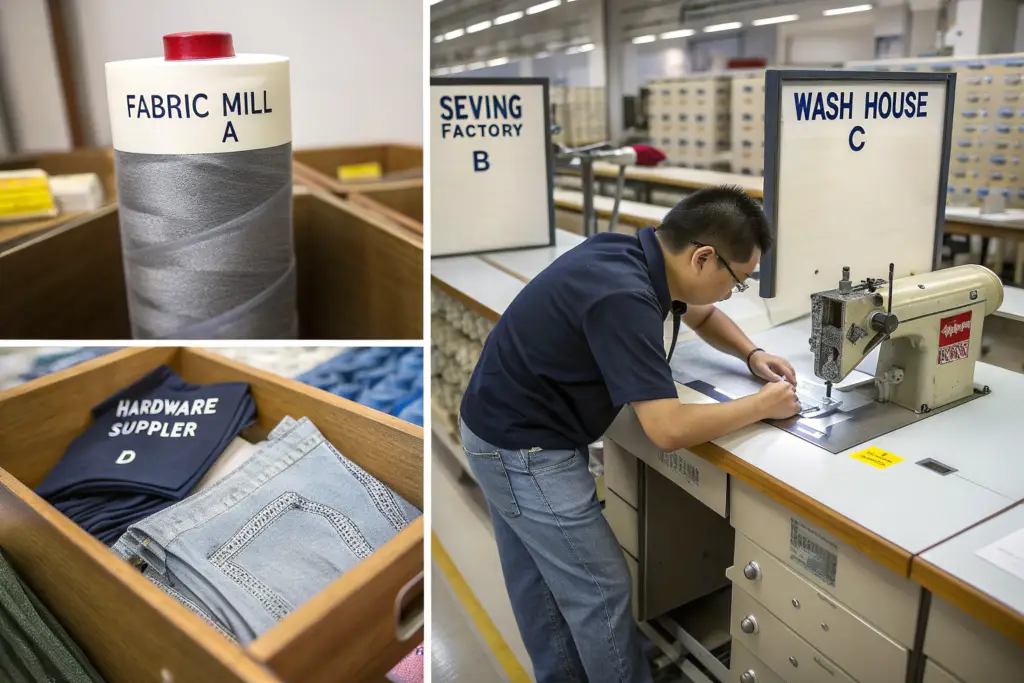
The full design of a denim short is composed of multiple elements. The pattern and fit. The fabric. The wash. The hardware. The labels and packaging. If one factory controls all of these elements, they can replicate the entire product. If you split these elements across multiple suppliers, no single supplier has the complete design.
This is the compartmentalization strategy. You source the fabric from one mill. You have the shorts cut and sewn by one factory. You have the wash done by a separate wash house that you contract directly. You source the custom hardware from a separate hardware supplier and consign it to the sewing factory. You print your own labels and hangtags and consign them. The sewing factory only sees the unwashed, unlabeled garment. They do not know the final wash recipe. They do not know your hardware supplier. They do not know your label design. Each supplier holds only a piece of the puzzle.
This strategy increases your management complexity. You are coordinating four or five suppliers instead of one. It requires a larger order volume to be economical because each supplier has minimums. But for a brand with a highly differentiated design that is the core of their competitive advantage, the added complexity is an insurance policy against copying. The supply chain compartmentalization strategy is used by brands that have experienced design theft and are determined not to experience it again.
How Should You Choose a Factory Partner That Respects Your IP?
The best legal and physical protections are useless if your factory partner is determined to copy your designs. An NNN agreement is a piece of paper. A factory that intends to steal will sign it without hesitation and copy your design anyway, betting that you will never find out or that you will not have the resources to enforce it in a Chinese court. The factory's integrity is your real protection.
Choosing a factory with a track record of respecting client intellectual property is the most important decision you will make. This is not about the factory's words. Every factory will tell you they respect IP. It is about the factory's business model, their client relationships, and their incentives. A factory that makes 80% of its revenue from long-term repeat clients has a strong incentive to protect those clients' designs. Losing a five-year client relationship is far more costly than the short-term profit from selling a copied design. A factory that operates on one-off transactions with anonymous Alibaba buyers has no such incentive.
Let me explain the specific signals that indicate a factory will protect your designs and the signals that indicate a risk.
What Business Model Signals That a Factory Will Not Steal Designs?
A factory that operates on a partnership model, with dedicated production lines for specific clients, long-term contracts, and a high repeat order rate, is structurally incentivized to protect client IP. Their business depends on client trust. A design theft that becomes public would destroy that trust and cost them their revenue base.
Look at the factory's existing client relationships. Ask for references. Ask those references how long they have worked with the factory. Ask if they have ever seen a copy of their design in the market. Ask if the factory has ever asked permission before using their product photos. A factory that asks permission before posting a photo of your product on their website has an internal culture of respecting client ownership.
Look at the factory's own marketing. Do they post detailed photos of client products with brand logos visible? If they do, and they have not obtained permission, they are probably doing the same with your designs. Do they offer "custom" products that look suspiciously like current market trends with minor modifications? A factory that offers to "customize" a design that is clearly another brand's current product is a factory that will offer your design to the next client.
Look at the factory's physical security. On a video tour, do they have a separate, locked sample room? Do they restrict visitor access to production areas where client orders are running? A factory that allows any visitor to walk through the production floor and photograph anything is a factory that does not take IP security seriously. The factory IP protection culture is a subset of the broader compliance culture. A factory that is transparent, audited, and committed to legal compliance in other areas is more likely to respect IP.
Why Do Long-Term Partnerships Reduce the Risk of Design Theft?
A transactional relationship is a one-night stand. There is no future to protect. A partnership is a marriage. There is a future, and both parties invest in protecting it. When a factory sees you as a long-term partner, your success becomes their success. Your design is not a one-off opportunity to make a quick profit. It is a shared asset that generates returns for both parties over years.
In a long-term partnership, the factory also has more to lose. They have invested time in understanding your fit block, your wash preferences, your quality standards. They have allocated production capacity to your program. They have built a dedicated team that knows your account. If they steal your design and you find out, all of that investment is lost. The switching cost for the factory is high. This creates a natural alignment of interests.
You build a long-term partnership by starting small and growing gradually. Place a small trial order. Evaluate the quality and the relationship. Place a larger order. Share more of your product roadmap as trust builds. Visit the factory in person if possible. A face-to-face relationship creates a personal bond that a purely digital relationship lacks. The factory owner who has shared a meal with you is less likely to betray you than an anonymous contact on Alibaba. The supplier relationship management principles apply here. Invest in the relationship. The return on that investment includes IP protection.
Conclusion
Protecting your denim design from being copied requires a layered defense. The legal layer gives you enforcement rights. Sign an NNN agreement with every factory before sharing any design information. Make it bilingual. Specify the governing law. The physical layer limits exposure. Restrict sample distribution. Label everything confidential. Consider splitting production across multiple suppliers so no single factory holds the complete design. The relationship layer aligns incentives. Choose a factory whose business model depends on long-term partnerships, not one-off transactions. Verify their track record through references. Build the relationship gradually, starting with small orders and growing trust over time.
No defense is perfect. A determined thief with no regard for legal consequences can still copy your design. But a layered defense makes copying harder, riskier, and less profitable. Most factories that copy designs do so because it is easy. They see a sample sitting on a table and take a photo. They receive a tech pack with no NNN agreement and add it to their catalog. They are opportunists, not master criminals. Making copying harder diverts them to easier targets.
I run a factory, and I protect my clients' designs because my business depends on their trust. I sign NNN agreements. I do not show Client A's samples to Client B. I do not post client designs on social media without permission. I do not sell excess production out the back door. These are not exceptional practices. They are the baseline of professional manufacturing. But in an industry where the baseline is not always met, they differentiate a factory you can trust from one you cannot.
If you are developing a new denim short design and want a factory partner who will treat your intellectual property as if it were their own, contact our Business Director, Elaine. She will send you our standard NNN agreement template for your review. She can also arrange a video tour of our factory so you can see our sample security and client confidentiality practices. Her email is elaine@fumaoclothing.com. Your design is your brand's most valuable asset. At Shanghai Fumao, we treat it that way.