I remember a conversation I had three years ago with a young entrepreneur from Austin, Texas. She had a brilliant concept for a sustainable denim brand. The designs were sharp. The marketing plan was solid. She had $15,000 in seed funding and a burning desire to launch. But every factory she contacted shut her down with the same five words: "Minimum order is 3,000 units." That one requirement would have eaten her entire budget on a single style, leaving nothing for marketing, photography, or inventory buffer. She called me as a last resort, voice shaking with frustration. I told her we could start with 300 units per style. She cried. Not an exaggeration. Actual tears. That moment crystallized why I run Shanghai Fumao the way I do. The traditional factory model is built to serve giant brands with massive warehouse capacity. It actively excludes the most creative, dynamic segment of the market: startups. I've designed our MOQ structure specifically to open the door for founders like her.
What Is a Startup-Friendly MOQ in Denim Manufacturing?
Let me define the term first, because "startup-friendly MOQ" gets thrown around loosely, and it means different things to different factories. In the traditional denim manufacturing world, a standard MOQ is 1,000 to 3,000 units per style, per color. That's the number the big mills and large factories need to justify the setup costs, the fabric minimums, and the production line configuration. For a brand that's just launching, that volume is not just high; it's dangerous. Ordering 3,000 units of an untested design is how startups end up with a garage full of unsold inventory and a maxed-out credit card.
A startup-friendly MOQ, in my definition, is an order quantity that allows a new brand to test the market without betting the entire company. It's a quantity that covers the factory's basic setup costs while leaving the founder with enough cash to actually run the business. At Shanghai Fumao, our standard MOQ for denim shorts is 300 units per style. For some more complex washes or specialized fabrics, it might be 500 units. That's not a random number. I arrived at it by analyzing the break-even point on our pattern making, marker planning, fabric sourcing, and line setup. I structured our internal processes to absorb some of the fixed costs that would normally be passed through to the client on a small order. I do this because I believe that today's 300-unit startup is tomorrow's 10,000-unit brand. I've seen it happen enough times to know the bet pays off.
A 300-unit MOQ changes the risk calculus for a founder. Instead of sinking $45,000 into a single style, they can invest $4,500. They can test two or three styles instead of betting everything on one. They can use the remaining capital on professional product photography, targeted social media ads, and influencer seeding. These are the activities that actually drive sales. A beautiful pair of shorts sitting in a warehouse with no marketing budget behind it is just expensive fabric. The startup-friendly MOQ is not just about the number on the purchase order. It's about preserving the founder's ability to build a brand around the product.
How Does a 300-Unit MOQ Reduce Financial Risk for New Brands?
The financial risk of a first production run is not just the cost of the goods. It's the cost of the goods plus the storage, the insurance, the opportunity cost of the tied-up capital, and the potential liquidation loss if the product doesn't sell. A high MOQ amplifies all of these downstream costs. A low MOQ contains them.
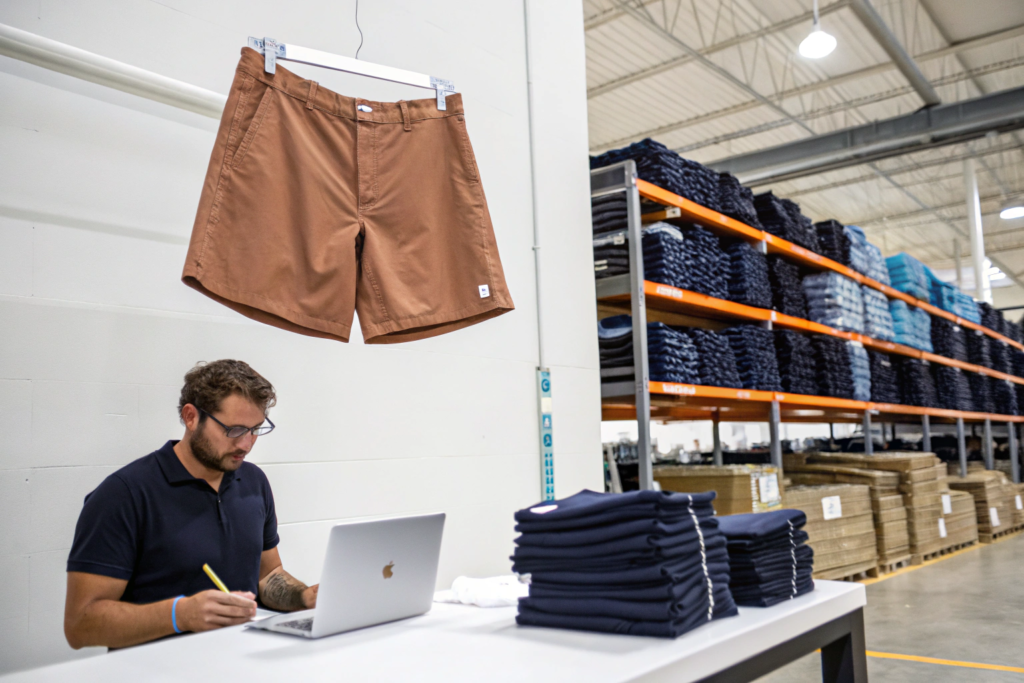
Let me put some real numbers on this. Suppose a startup orders 300 units of a denim short at an FOB price of $9.50 per unit. The total production cost is $2,850. Add $400 for freight on a shared container, $150 for customs brokerage, and the total landed cost is roughly $3,400. That's a manageable investment for a seed-funded startup. They can price the short at $68 retail, sell through their initial inventory in six weeks if the product resonates, and use the revenue to fund the reorder.
Now suppose that same startup is forced into a 2,000-unit MOQ by a traditional factory. The production cost jumps to $17,000 even with a volume discount that brings the unit price to $8.50. The freight for a partial container is $2,500. The total landed cost is around $20,000. That's not a seed investment; that's a bank loan or a personal savings wipeout. And if the product doesn't sell through immediately, the founder is sitting on 1,700 pairs of shorts that are slowly becoming last season's inventory. The carrying cost alone—storage, insurance, the mental weight of unsold stock—can crush a young company.
I've watched this play out in real time. A Chicago-based startup I worked with in 2024 placed a 300-unit order for a recycled denim short. They sold out in three weeks. They immediately placed a 500-unit reorder, which also sold out. By their third production run, they were ordering 1,500 units per style. They grew into the larger volumes organically, using market validation to de-risk each step. If they had been forced to start at 2,000 units, they would have spent their entire budget on inventory, had no marketing dollars left, and likely would have failed. The 300-unit MOQ wasn't just convenient for them; it was existential.
Why Do Most Factories Set High MOQs That Hurt Startups?
I need to explain the factory's perspective here, because it's not pure greed. There are real structural reasons why large factories set high MOQs. Understanding these reasons will help you appreciate why a factory that offers low MOQs has made deliberate operational choices, not just marketing promises.
The first structural reason is fabric minimums. A denim mill typically won't fire up its dyeing and weaving machinery for less than 1,000 to 3,000 yards of a specific quality and color. If a factory needs 1.2 yards of denim per pair of shorts, a 3,000-yard mill minimum translates to roughly 2,500 units. A factory that relies entirely on made-to-order fabric from the mill is trapped by this constraint. They physically cannot produce a smaller order unless they buy and warehouse the excess fabric, which ties up their working capital.
The second reason is production line efficiency. A standard sewing line is balanced for long, uninterrupted runs of a single style. The first few hours of a new style are slow, as operators learn the operations and the flow stabilizes. On a 5,000-unit run, the learning curve cost is spread across thousands of units. On a 300-unit run, the same learning curve is spread across a tiny base, and the per-unit labor cost spikes. Large factories, optimized for efficiency at scale, simply can't make money on small runs.
The third reason is the opportunity cost of the line slot. A factory with high demand and limited capacity will naturally prioritize large orders that fill the line for weeks. A small order that occupies the line for two days and then requires a changeover to a different style is a disruption. The factory would rather fill that slot with a large, stable order from a known brand.
So, when you encounter a factory demanding a 3,000-unit MOQ, it's not necessarily that they don't care about startups. It's that their entire operational model is built for volume. They've optimized for the big brands, and startups are structurally incompatible with that optimization. A low-MOQ factory like Shanghai Fumao has made different choices. We stock greige fabric inventory to bypass mill minimums. We maintain flexible sewing cells that can switch between styles quickly. And we deliberately reserve a portion of our production capacity for small-batch orders, accepting a lower margin on those runs in exchange for the long-term client relationships they build.
How Can Startups Access Premium Washes With Small Orders?
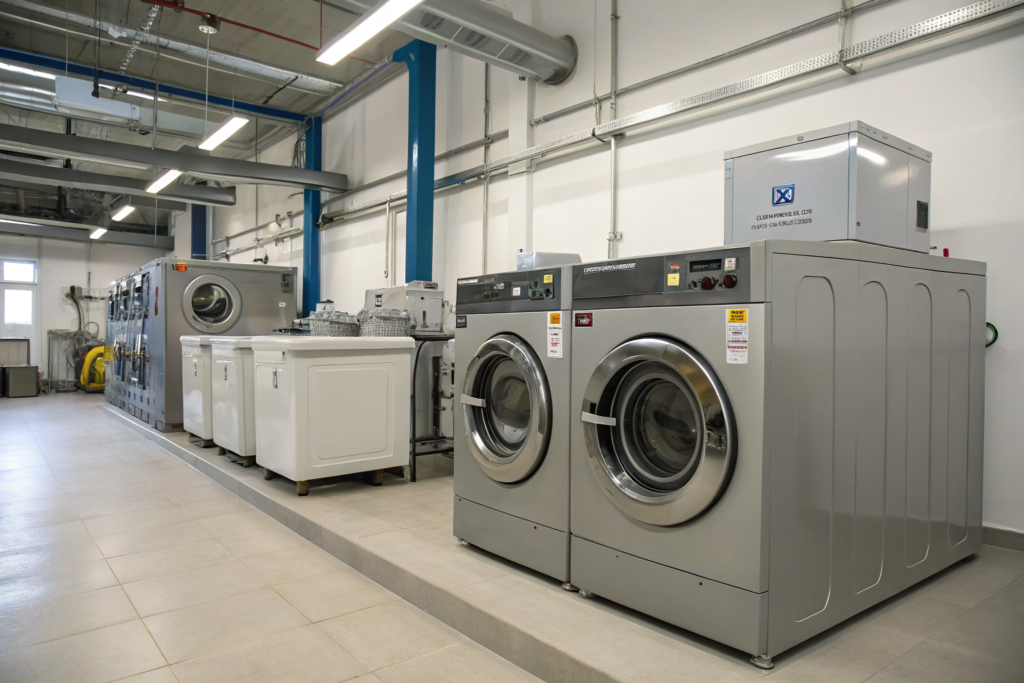
The wash house is where the magic happens in denim. It's also where the most brutal MOQ barriers exist. A traditional wash house is set up for large batches. Their washing machines hold 50 to 80 kilos of garments per load. A complex multi-step wash recipe requires calibrating the machines, mixing the chemicals, and running test loads. The setup cost for a wash program can be hundreds of dollars, regardless of whether you're washing 100 units or 10,000 units. Many wash houses simply refuse to run small batches because the setup cost per unit is unsustainably high.
When I built our in-house wash facility, I made a deliberate decision to include small-batch capability. We have a set of sample-sized washing machines and tumblers that can process as few as 20 units per load. These smaller machines cost more per kilo of capacity than industrial-scale drums, and they're less efficient to operate. But they allow us to offer premium wash treatments on orders as small as 300 units. This is a capability that almost none of our large-scale competitors offer, because it's not profitable in the short term. I treat it as a long-term investment in our startup clients.
A startup founder from Portland came to us last season with a vision for a "salt-wash" denim short, a treatment I described in a previous article. It's a three-stage process involving a coarse sea salt abrasive tumble, a light indigo over-dye, and a silicone softener finish. A large wash house would have quoted her a $2,000 setup fee and a 2,000-unit minimum. We ran her 350-unit order through our small-batch system. The per-unit wash cost was higher than it would have been on a 5,000-unit run, but the total investment was manageable. She launched the short at a premium $78 retail price, and the unique wash became her brand's signature. She couldn't have accessed that finish without a low-MOQ wash partner.
What Wash Techniques Are Available for Low-Volume Production?
Not every wash technique scales down well, and I'm honest with my startup clients about which ones work at low volume and which ones don't. Here's a breakdown of the wash categories we offer for small-batch denim production:
| Wash Category | Available at 300 Units? | Notes for Startups |
|---|---|---|
| Standard Enzyme Wash | Yes, fully available | Most cost-effective option for small batches |
| Stone Wash (Light/Medium) | Yes, fully available | Pumice stones work in small drums without issue |
| Bleach Wash (Basic) | Yes, with slight cost premium | Chemical handling requirements are the same regardless of volume |
| Acid/Micro-Acid Wash | Yes, with small-batch surcharge | Sealed gas chamber setup is the same; per-unit cost is higher |
| Vintage Tint (Single Layer) | Yes, fully available | Tint application in small drums is straightforward |
| Hand-Sprayed Fades | Yes, ideally suited | Actually better at low volume; artisan attention is higher |
| Multi-Layer Complex Washes | Yes, with development fee | Setup cost amortized over fewer units; we often waive part of the fee for first-time startup clients |
| Boil-and-Tumble Texture | Limited availability | Extreme temperature process requires minimum drum fill; may need 500-unit minimum |
The techniques that are actually better suited to low volume are the manual, artisan-driven processes. A hand-sprayed fade on 300 units gets more individual attention than the same process on 10,000 units. The spray technician can spend more time on each garment, creating a more nuanced, authentic-looking fade. This is an advantage that startups can leverage in their marketing. "Small-batch, artisan-finished denim" is a genuine value proposition, not just a tagline.
I encourage startups to lean into the washes that benefit from small-batch attention. A simple enzyme wash with a localized hand-sprayed whisker pattern can look more premium than a fully automated complex wash on a mass-market short. The consumer can feel the human touch, even if they can't articulate it. And the startup's cost structure remains manageable.
Can You Mix Multiple Washes Within One Small Order?
Yes, and this is one of the most powerful tools I offer to startup brands. A traditional factory will often require a separate MOQ for each wash variation. If you want a light stone wash and a dark vintage tint, that's two separate production runs, two separate minimums, and often two separate purchase orders. A startup that wants to offer three color options is suddenly facing a 900-unit total minimum, even if the factory's stated MOQ is 300 units.
We handle this differently. Within a single 300-unit order, we allow you to split across multiple washes. Want 100 units in light stone, 100 in vintage ecru tint, and 100 in a dark indigo rinse? We can do that. The sewing production is the same for all three washes; only the wash house processing diverges. We run the three wash batches separately in our small-capacity drums and then reunite them for finishing and packing.
This flexibility is critical for a startup's market testing strategy. A new brand doesn't know which wash their customers will prefer. If they have to commit 300 units to a single wash, they're guessing. If they can spread 300 units across three washes, they're running a controlled experiment. They can track which wash sells out first, gather customer feedback, and double down on the winning option for the reorder. This data-driven approach to inventory management is how smart startups avoid the dead stock problem that kills so many young fashion brands.
I worked with a startup from Miami who used this exact strategy. They launched with 300 units split across four washes: light stone, vintage yellow tint, dirty black, and a raw rigid. The raw rigid sold out in four days. The dirty black sold steadily. The two lighter washes moved slower. For their reorder, they adjusted the mix to 50% raw rigid, 30% dirty black, and 20% combined light washes. They didn't have to guess. They had real sales data from a low-risk initial run. That's the power of small-batch, multi-wash flexibility.
What Design Flexibility Do Small-Batch Orders Offer New Brands?
Design flexibility is not just about how many pocket styles you can choose from. It's about the ability to iterate, to respond to customer feedback, and to refine your product without being locked into a massive inventory commitment. Large production runs punish iteration. When you've ordered 5,000 units, you live with whatever design decisions you made six months ago. Small-batch production rewards iteration. When you order 300 units, you can sell through, learn, and improve on the next run.
I've structured our production process to support this iterative approach. We keep digital pattern files for every startup client on file, and we can modify them between runs. The setup time for a pattern adjustment on a repeat order is minimal because we're not starting from scratch. A client can sell through their first 300 units, gather feedback, and request a fit tweak or a pocket redesign on the reorder. The cost and time impact of that change on a 300-unit reorder is manageable. On a 5,000-unit order, it would be a logistical nightmare.
A Denver-based outdoor lifestyle brand I work with has refined their denim short design three times over the course of a year and four small production runs. The first version had a standard five-pocket layout. Customers requested a zippered side pocket for secure storage during hikes. We added it on the second run. The third run tweaked the pocket placement based on wear-test feedback. The fourth run introduced a reinforced crotch gusset for mobility. Each iteration was informed by real customer input, and each run was 300 to 500 units. They never had to clear out old inventory before introducing the improved version. The product evolved organically, and the brand built a reputation for actually listening to their customers. That kind of responsive design is only possible with small-batch production.

How Does Custom Hardware Become Affordable at Lower Volumes?
Custom hardware is the holy grail of brand differentiation. A custom-branded button or a unique rivet design elevates a pair of denim shorts from a generic commodity to a branded product. But traditional custom hardware manufacturing is brutally unfriendly to small brands. A custom metal button requires a die mold, which can cost $300 to $800 to produce. The button factory then has a minimum run of 5,000 to 10,000 pieces. For a startup ordering 300 units, that's a lifetime supply of buttons and a sunk cost that doesn't make financial sense.
We've worked around this barrier by building relationships with smaller trim suppliers who specialize in low-volume custom hardware. These are boutique metal workshops, mostly in the Guangdong province of China, that have invested in rapid die-making technology and are willing to run smaller batches at a slightly higher per-unit cost. A custom button die from one of these workshops might cost $150, with a minimum run of 1,000 buttons. For a 300-unit order, that's about 0.50 cents per unit for custom hardware, which is a manageable premium for brand differentiation.
I also guide startups toward semi-custom hardware options that achieve a branded look without the full custom die investment. A standard brass shank button can be laser-engraved with a simple logo or wordmark. The laser engraving setup is minimal, and there's no separate die cost. The result is a branded button at a fraction of the cost and with no MOQ penalty.
For rivets, which are smaller and less visible than buttons, I often recommend using a high-quality unbranded rivet in a distinctive finish—antique copper, matte black, brushed nickel—that complements the brand's aesthetic. The rivet finish contributes to the overall look without requiring a custom die. Then the budget is concentrated on the button, which is the most visible hardware element. This tiered approach to custom hardware lets a startup achieve a premium, branded feel without blowing their trim budget on parts the customer barely notices.
Can You Test Multiple Silhouettes in a Single Production Run?
Yes, and this is another advantage of our flexible production model. A startup that's finding its fit identity can test multiple silhouettes within a single purchase order. Want to try a baggy streetwear fit alongside a more tailored slim-straight fit? We can run both within a combined minimum, as long as the total unit count meets our order threshold and the fabric is the same across the silhouettes.
The production efficiency of this approach depends on how different the silhouettes are. If the two shorts share the same pocket design, the same fly construction, and the same waistband treatment, the sewing line can handle the variation with minimal disruption. Only the side seam and the leg shape differ. The operators can switch between the two patterns with a quick bundle change. If the silhouettes are dramatically different—say, one is a zip fly and the other is a button fly—the line changeover is more significant, and we might need to treat them as separate production batches with a small surcharge.
The strategic value of silhouette testing is enormous for a new brand. The denim short market in 2026, as I discussed in a previous article on trends, is fragmented across fits. The young streetwear customer wants an oversized, baggy fit. The classic menswear customer wants a tailored, above-the-knee fit. The outdoor lifestyle customer wants a relaxed fit with mobility. A startup that launches with a single silhouette is guessing which customer segment to target. A startup that tests two or three silhouettes in a small initial run is gathering market intelligence. They can analyze sell-through rates, customer reviews, and return reasons by silhouette. The data tells them where to focus their brand positioning.
I had a startup client from Nashville who tested three fits in their first 400-unit order: a relaxed taper, a straight leg, and a slim fit. The straight leg outsold the others 3-to-1. They had assumed the slim fit would be their hero product based on Instagram polls and competitor analysis. The actual sales data proved them wrong. They pivoted to a straight-leg-focused brand identity on their second run, and their sell-through rate improved dramatically. Without the small-batch, multi-silhouette testing capability, they would have invested heavily in the wrong fit and potentially failed.
Why Does Our Sampling Process Support Startup Iteration?
The sampling process is where startup dreams either take shape or fall apart. A large factory's sampling department is often a bottleneck. They prioritize their big clients. A startup requesting a fit sample or a wash development sample gets pushed to the back of the queue. Weeks turn into months. The season slips away. The founder loses momentum and confidence. I've heard this complaint so many times that I designed our sampling workflow specifically to prevent it.
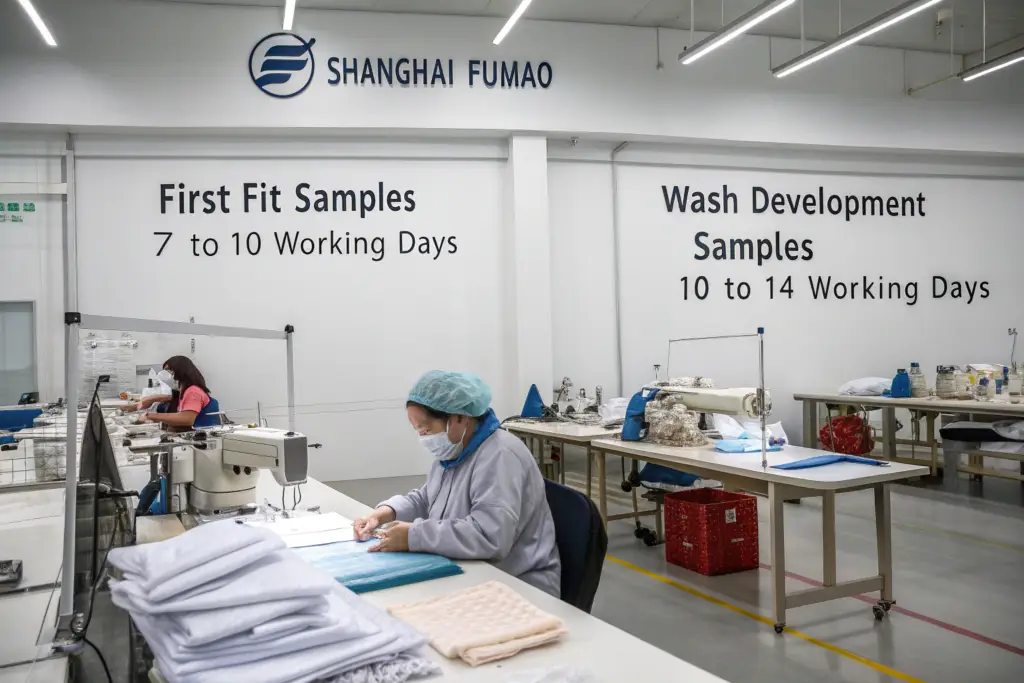
At Shanghai Fumao, we have a dedicated sampling room that operates separately from the bulk production lines. A team of experienced sample machinists works exclusively on development samples, not on bulk orders. This means a startup client doesn't have to wait for a gap in the production schedule to get their sample sewn. The sample room runs continuously, and we track turnaround times as a key performance indicator. Our standard turnaround for a first fit sample is 7 to 10 working days from receipt of the approved tech pack. For a wash development sample, it's 10 to 14 working days, depending on the complexity of the wash.
Speed matters in sampling, but so does iteration friendliness. A startup will typically need two or three rounds of samples to dial in the fit. The first sample reveals the big issues. The second refines the proportions. The third is usually the approval sample. A factory that charges full sampling fees for each round, or that treats each iteration as a new project, makes this process prohibitively expensive. We charge a nominal sampling fee that covers our material and labor cost, and we offer one free fit revision within the sampling process. If the first sample needs adjustments, the second sample is at no additional charge. We absorb that cost because we know that a well-fitted sample leads to a confident production order.
How Many Sample Rounds Are Typical Before Production Approval?
For a startup developing their first denim short, three rounds is the realistic expectation. I tell all my new clients this upfront so they can budget the time and the sampling fees accordingly. Promising a one-round approval is either naive or dishonest. Denim is a complex fabric. It behaves differently after washing than it does on the cutting table. The fit that looks perfect on a paper pattern often needs adjustment after the first wash.
Round One is the initial fit sample. This is sewn in a proxy fabric that matches the weight and stretch characteristics of the production denim, but may not be the exact production fabric. The focus is on the silhouette, the proportions, and the construction details. The founder tries the sample on a fit model, takes photos, and sends feedback. Common Round One findings include: the rise is too low, the leg opening is too wide, the pocket placement looks awkward, the waistband is gaping at the back.
Round Two incorporates the fit corrections. By this round, the production fabric is usually secured, so the sample is sewn in the actual denim. The founder sees the true drape and hand feel. The wash is applied to the second sample so the post-wash fit can be evaluated. Common Round Two findings are more subtle: the waistband sits correctly but could be 0.5 cm narrower, the inseam length is perfect but the hem fold width needs adjustment.
Round Three is the approval sample, also called the pre-production sample. This is sewn in the production fabric, with the approved wash, using the actual trims and labels. It should be identical to what will ship. The founder signs off on this sample as the production standard. We keep one approved sample in our QC department as the reference against which bulk production is inspected.
For startups that have a very clear, detailed tech pack and an experienced fit technician on their team, two rounds is sometimes achievable. For startups that are designing from scratch with a less technical background, four rounds is not uncommon. I encourage founders to budget for three rounds and be pleasantly surprised if they nail it in two.
What Digital Tools Do We Use to Speed Up Fit Approval?
Waiting for physical samples to ship back and forth across the Pacific is the slowest part of the development process. We use several digital tools to compress this timeline and give our startup clients faster feedback loops.
For fit comments, we use a digital annotation platform. The client receives high-resolution photos of the sample on a dress form, taken from front, back, and side angles. They can draw directly on the images, add comments pinned to specific points on the garment, and share the annotated file back to us instantly. Instead of an email saying "the waistband feels loose, maybe take it in a bit," we get a visual mark on the exact side seam location with a note: "Reduce waist circumference by 1.5 cm, tapered from side seam." This precision eliminates the back-and-forth clarification emails that eat up days.
For brands that have access to 3D design software, we can also provide a digital twin of the sample. The physical sample is scanned, and a 3D model is generated that shows the fit on a parametric avatar. The client can rotate the model, zoom in on construction details, and even simulate the drape of the fabric. This technology is not yet a full replacement for a physical sample—hand feel and wash appearance still require a physical garment—but it accelerates the early fit rounds significantly.
I had a startup client from Brooklyn who used our digital annotation platform for her fit feedback. She was traveling for her day job and couldn't receive physical samples reliably. We sent her the photo set and the 3D model. She annotated the images on her phone from a coffee shop in Portland. We received her comments the same day and had the revised sample in work the next morning. What would have been a ten-day round trip for a physical sample—ship out, receive, evaluate, ship comments back—was compressed into 48 hours. That speed allowed her to complete three sampling rounds in the time it would normally take to do two. She launched her collection on schedule, and the fit was dialed in perfectly.
Conclusion
The traditional factory MOQ model is broken for startups. It forces new brands to over-order, under-market, and take existential financial risks on unproven designs. I built Shanghai Fumao's MOQ structure to fix that. Our 300-unit minimum opens the door for founders who have the vision and the hustle but not the warehouse space or the six-figure production budget. It lets them test the market, iterate on design, and grow into volume organically.
The startup-friendly MOQ is not just a smaller number. It's a whole ecosystem of supporting capabilities. It's the small-batch wash house that lets a new brand access premium finishes without a 2,000-unit commitment. It's the flexible production scheduling that allows multiple washes and multiple silhouettes within a single order. It's the sampling department that treats a 300-unit startup with the same urgency as a 10,000-unit brand. It's the digital tools that compress the fit approval timeline so the founder can iterate fast and launch on schedule.
The young entrepreneur from Austin I mentioned at the beginning of this article? She launched her sustainable denim brand with a 300-unit order of a vintage-tint short. She sold out in two weeks. She reordered 500 units. Then 800. Then 1,500. Today, she's a multi-style brand with a loyal customer base and a profitable business. I didn't give her charity. I gave her a production model that matched her stage of growth. That's what I want to offer every startup that comes through our door.
If you're a founder sitting on a denim short design and you've been turned away by factories with impossible minimums, I want you to know that there's another way. Reach out to our Business Director, Elaine. She can talk you through our MOQ structure, our sampling timeline, and the wash options available for your first production run. You can contact her directly at elaine@fumaoclothing.com. You have the idea. We have the production model. Let's launch it.