I lost a $50,000 order once because of a misunderstood email. The client, a brand owner from Dallas, sent a message to his previous supplier's sales rep. He wrote: "Can we deepen the indigo by about 15%?" The sales rep replied: "Yes, confirmed." What the sales rep meant was "Yes, I received your message." What the client understood was "Yes, the change is implemented." The shorts shipped in the original shade. The client discovered the error when he opened the container. The sales rep insisted he had only confirmed receipt, not the change. The email thread was ambiguous. The relationship collapsed. The brand owner told me this story when he first contacted us, and the frustration in his voice was still raw, a year later. Communication gaps between overseas factories and Western brands are not minor annoyances. They are the primary cause of production errors, missed deadlines, and dissolved partnerships. I'm Richard, the owner of Shanghai Fumao, and I've spent years building a communication system specifically designed to eliminate these gaps. This article explains how.
Why Does the Traditional Sales Rep Model Fail Importers?
The traditional model is broken by design. It's not that individual sales reps are lazy or dishonest, though some are. The problem is structural. In a typical overseas garment factory, the sales rep sits in a separate department, often physically distant from the production floor. Their job is to sell. They are compensated on commission, measured on order volume and revenue closed. Once the order is signed, their incentive to engage deeply with the production details drops sharply. They move on to closing the next deal. The client's production order passes to a merchandiser, who passes it to a production planner, who passes it to a sewing supervisor. The client keeps emailing the sales rep, because that's the relationship they built. The sales rep, now distracted by new prospects, forwards messages with a quick note: "FYI, please handle." Context is lost. Urgency is diluted. The game of telephone begins.
This is the root cause of the communication gap. The person the buyer trusts and talks to has no operational authority. The people with operational authority never talk to the buyer directly. Information degrades at each handoff. A specific instruction about pocket placement becomes a vague verbal note. A question about wash chemistry goes unanswered because the sales rep doesn't know the answer and is too busy to walk to the wash house and ask. The buyer senses the distance growing. Their emails get shorter, more terse. The sales rep senses the tension and becomes defensive. Trust erodes.
I saw this dynamic destroy a promising brand during my early years in the industry. A Los Angeles streetwear label placed a 5,000-unit denim short order with a large factory. The sales rep was charismatic and responsive during the pitch. After the order was placed, the brand owner's emails took three to five days to get a reply. A critical question about the wash recipe sat unanswered for a week. The shorts shipped with an incorrect tint. The brand owner screamed at the sales rep. The sales rep blamed the merchandiser. The merchandiser blamed the wash house supervisor. The brand owner pulled his business. Everyone lost. I was a junior production manager at that factory then, watching from the sidelines, and I made a mental note: if I ever ran my own factory, the communication structure would be completely different.

How Does the "Silo Effect" Between Sales and Production Cause Errors?
In a traditional factory, the sales department and the production department are separate silos. They have different managers, different KPIs, different software systems, and often different physical locations within the building. The sales team uses a CRM. The production team uses an ERP or a whiteboard. These systems don't talk to each other.
When a buyer emails the sales rep with a spec change, the sales rep types it into an email and sends it to the merchandiser. The merchandiser reads it, interprets it, and either updates the ERP or writes it on a paper traveler. The production supervisor reads the traveler and tells the sewing line. At each step, the information passes through a human filter. Each filter introduces a risk of misinterpretation, omission, or delay.
I've analyzed the error chain in our industry extensively, and the data consistently points to communication breakdowns as the leading cause of production defects. It's not that factory workers don't know how to sew. It's that they sew what they're told to sew, and what they're told is often wrong.
Here is a comparison of the traditional sales rep model versus what I call the "integrated account management" model we use at Shanghai Fumao:
| Communication Aspect | Traditional Sales Rep Model | Fumao Integrated Model |
|---|---|---|
| Point of Contact | Changes after order is placed | Same person from inquiry through shipment |
| Relationship to Production | Distant, relies on forwarding messages | Sits in production office, attends daily meetings |
| Information Flow | Multiple human handoffs | Direct entry into shared production software |
| Response Time to Queries | 2-5 days during production | Same day, often within hours |
| Technical Knowledge | Sales-trained, limited production depth | Cross-trained in garment construction and wash chemistry |
| Incentive Structure | Commission on closed sales | Salary plus retention-based bonus |
The structural fix is simple to describe but hard to implement: merge the communication channel with the production channel. The person talking to the client must be the person who can walk onto the floor and verify the answer. This requires a different kind of employee—someone who is both technically knowledgeable and client-facing—and a different kind of compensation model that rewards long-term client retention, not just initial order capture.
Why Do Language Barriers Persist Even With English-Speaking Reps?
This is a subtle but critical point. A sales rep can speak perfectly fluent English and still create communication gaps. The problem isn't vocabulary. It's cultural framing and technical precision.
In many Asian business cultures, including Chinese manufacturing culture, there is a strong bias toward saying "yes" to maintain harmony and avoid confrontation. A buyer asks, "Can you finish this by Tuesday?" The rep knows it's unlikely but says, "We will try our best." The buyer hears, "Yes, Tuesday is confirmed." The rep meant, "I acknowledge your request and will attempt it." This is not dishonesty. It's a cultural communication pattern where direct refusal is considered rude. The gap between "we will try" and "we guarantee" is vast, and it's where many production timelines die.
Another layer is technical vocabulary. A buyer might say, "The crotch point is too low, can we drop the front rise by half an inch?" A sales rep without pattern-making knowledge might not understand that "dropping the front rise" means shortening the distance from the waistband to the crotch seam. They might picture "dropping" as "lowering" in the opposite direction. They relay the instruction incorrectly to the pattern room, and the sample comes back with a longer rise instead of a shorter one. The buyer is confused and frustrated. The rep is embarrassed. The sample round is wasted.
At our factory, we address this by requiring every account manager to have hands-on garment construction training. They spend time in the pattern room. They learn to read a tech pack. They learn the difference between a flat-felled seam and an overlock seam, between a bartack and a lockstitch. When a buyer says, "The armhole is too tight," on a woven shirt, the account manager knows to check the armhole curve measurement, not just the bicep circumference. This technical fluency eliminates the translation layer that causes so many errors.
Cultural training is equally important. Our account managers are trained to use explicit confirmation language. They don't say, "We will try." They say, "I have checked with the cutting room. The fabric will be spread on Thursday. The sewing will begin on Friday. The shipment will be ready on the 28th. This is confirmed unless I notify you otherwise." And if something is uncertain, they say, "I cannot confirm this yet. I will confirm by Wednesday 5pm Shanghai time." That clarity is what Western buyers expect, and we train it deliberately.
How Does Our Dedicated Account Manager Model Work?
When a new client signs with Shanghai Fumao, they are introduced to one person: their dedicated account manager. This is not a rotating pool of junior staff. It is one named professional who will be the client's single point of contact for every stage of the process—from the initial tech pack review, through sampling, through bulk production, through quality inspection, to final shipment. This person's name, direct email, direct phone number, and WeChat or WhatsApp contact are given to the client on day one. There is no call center. There is no "your call will be transferred to the next available representative." There is one person who owns the relationship.
This account manager sits physically in our production planning office. Their desk is twenty steps from the pattern room, thirty steps from the cutting room, and a one-minute walk from the sewing lines. They attend the 8:30 AM daily production meeting every single day. In that meeting, every active order is reviewed. The account manager hears the status of their client's order directly from the cutting supervisor, the sewing line leader, and the wash house manager. If there is a delay or a quality issue, they know about it within minutes of the meeting ending. They don't have to chase information. The information comes to them as part of the factory's operational rhythm.
The account manager is also the person who translates the client's design intent into internal production instructions. When a buyer sends a tech pack, the account manager reviews it for completeness and feasibility before it goes to the pattern room. They flag missing measurements, unclear wash descriptions, or construction details that conflict with the proposed fabric. They communicate these issues back to the client in a single, organized query, not a scattered series of confused emails over several days. This front-end clarity prevents the back-end errors that traditional sales rep models generate.
The relationship depth that this model enables is transformative. A dedicated account manager who has worked with a client for three production cycles knows their preferences intimately. They know that the client prefers delivery to a specific Los Angeles warehouse with particular carton labeling requirements. They know the client's customer base is sensitive to waistband comfort, so any fit adjustment needs extra attention to the waistband construction. They know the client responds to emails within an hour on weekday mornings Texas time, so they batch their communications accordingly. This institutional memory, held in a single person, eliminates the repetitive explaining that drains a client's energy when they deal with rotating sales reps.
Who Is Your Single Point of Contact Throughout Production?
Your single point of contact is a named individual with a face, a voice, and a direct line. When I assign an account manager to a new client, I send a welcome email that includes a photo of the account manager, their full contact details, and a brief biography: how long they've been with the company, what types of products they specialize in, and what brands they've worked with previously. This humanizes the relationship from the start.
You will speak to this person on a video call during the onboarding process. You will see their face. You will hear their English. You will get a sense of their technical depth and their communication style. If you don't feel a good chemistry fit, I'll assign a different account manager. Chemistry matters in a long-term partnership. You need to feel confident that this person understands your brand voice and your quality expectations.
During production, this account manager sends you weekly updates with photos and, if you're on our advanced tracking system, dashboard access. But the key is that you never have to wait for a scheduled update if you have an urgent question. You send a WhatsApp message. You get a reply, usually within hours, sometimes within minutes if it's during Shanghai business hours. The reply is not a placeholder. It's a substantive answer. "What's the status of the zipper delivery?" The account manager doesn't say, "Let me check and get back to you." They already know, because they checked the trim inventory that morning during the production meeting. They reply, "The YKK zippers arrived yesterday. They are in our trim store. The sewing line will begin attaching them on Thursday." That is the level of operational integration that a dedicated, production-embedded account manager provides.
People get sick. People take vacations. People have family emergencies. Continuity planning is essential, and a factory that can't handle a temporary absence of a single employee has a brittle system.
Each client account at our factory has a secondary account manager assigned as backup. This is not a random junior staff member. It's another experienced account manager who has been briefed on the client's active projects. The primary and secondary managers hold a brief weekly sync, usually on Friday afternoon, where the primary updates the secondary on any recent developments, upcoming milestones, or sensitive issues. This sync takes fifteen minutes. If the primary manager is unavailable on Monday morning, the secondary manager steps in seamlessly. They know the order status. They have access to the production dashboard. They can answer the client's query without a panicked catch-up session.
The client is informed of the backup arrangement at the start of the relationship. During the onboarding process, the primary account manager introduces the secondary manager on a brief introductory video call. The client knows who to contact if the primary is out. The backup manager's contact details are in the welcome packet. There is no moment of "My account manager isn't responding, who do I even email?"
Beyond individual backups, all client communication history is stored in our centralized production management platform. Every email, every WhatsApp message, every annotated spec sheet, every approved sample photo—it's all logged against the client's account, organized by production order. Any authorized account manager can pull up the full communication history within seconds. There is no "lost in a personal email inbox" problem. The system holds the institutional memory, so the backup manager doesn't need the primary manager to forward a chain of emails. They just open the platform and see everything.
This system was tested during a genuine crisis two years ago. A senior account manager, Lisa, had a family medical emergency and was out of the office for three weeks with almost no notice. She was managing six active client orders at the time. Her backup managers absorbed the workload within a day. Not a single client experienced a communication delay. Lisa's clients sent concerned messages when they learned of her absence, but their production schedules were unaffected. That's the standard we hold ourselves to.
What Real-Time Tools Do We Use to Track Your Order?
I believe in radical transparency. A client who can see their order moving through the production pipeline in real time is a client who sleeps well at night. They don't send anxious emails. They don't imagine worst-case scenarios. They look at the dashboard, see the progress bar advancing, and focus on their own business. This transparency also creates accountability on our side. We know the client is watching. We know that a delayed milestone will trigger a notification. The visibility motivates us to hit our commitments.
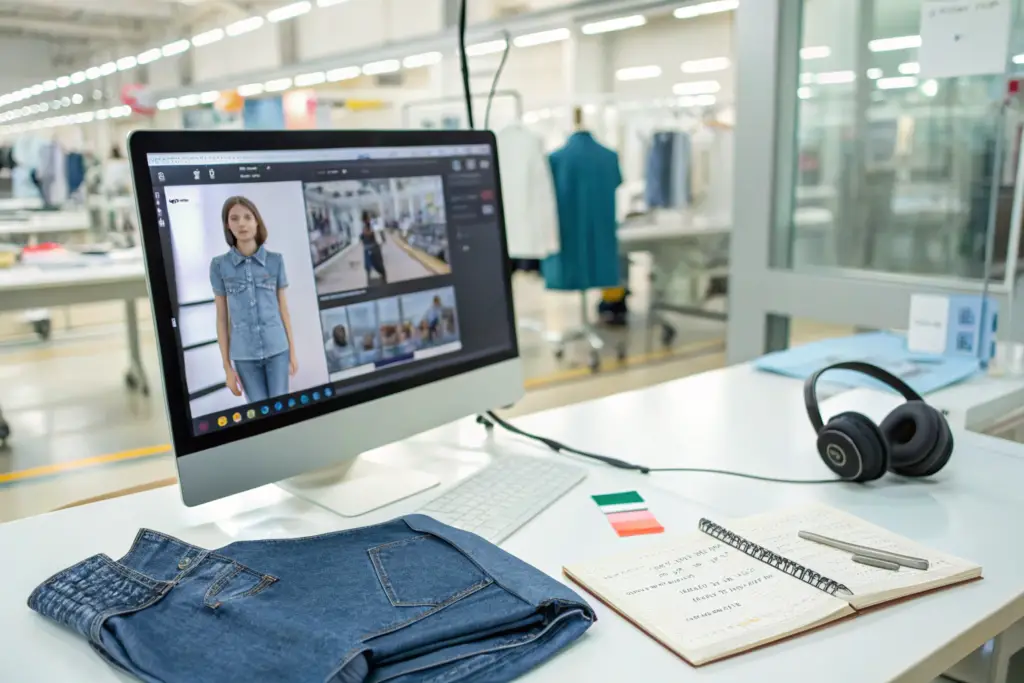
Our primary tool is a cloud-based production tracking platform that we developed in partnership with a software firm specializing in apparel manufacturing. Each client receives a secure login. Inside the platform, their active orders are displayed with a visual progress tracker. The tracker breaks the production process into discrete milestones: Fabric Received, Cutting Complete, Sewing In Progress, Wash Complete, Finishing In Progress, QC Inspection Passed, Packing Complete, Shipment Booked, Shipped. Each milestone has a target date and an actual completion date. When a milestone is completed, the client sees it update in real time.
Beyond the milestone tracker, the platform contains a document repository. The approved tech pack, the approved sample photos, the fabric test reports, the QC inspection report with AQL results, the packing list, and the bill of lading are all uploaded and accessible. The client never has to dig through old email threads to find a document. Everything is organized by order number.
The platform also has a messaging function that threads communications by order. Instead of sending a WhatsApp message that gets lost in a sea of other chats, the client can post a question directly on the order thread. The account manager receives a notification and replies on the same thread. The conversation stays attached to the order, creating a permanent, searchable record. This is immensely valuable when a question arises months later: "What did we decide about the pocket lining on that Spring order?" The answer is in the order thread, not buried in a WhatsApp export.
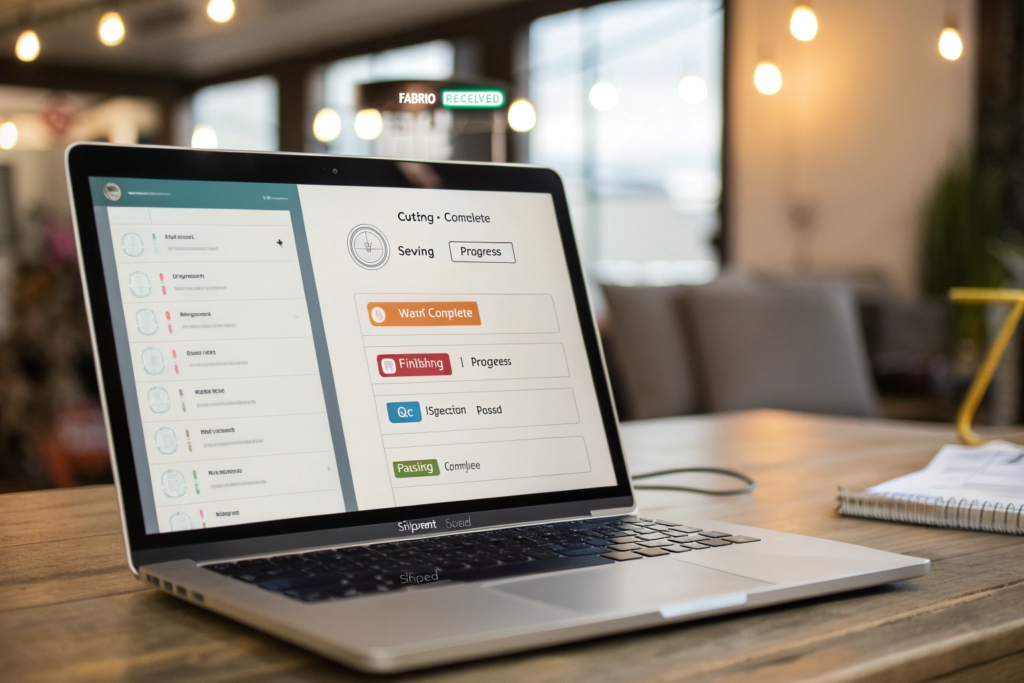
How Does a Production Dashboard Prevent Status-Update Emails?
The status-update email is the most common email in the apparel sourcing world. "Hi, just checking in on the order status. Where are we at?" The buyer sends it because they're anxious. The rep receives it, checks with production, and replies. The round trip takes a day or two. The buyer is only slightly reassured because the update is already stale by the time they read it. A few days later, the anxiety returns, and the cycle repeats. This pattern wastes enormous amounts of time on both sides and creates a low-grade stress that erodes the relationship.
The production dashboard eliminates this pattern entirely. The buyer doesn't need to send a status-update email because they can see the status anytime they want. They can check the dashboard at 2 AM from their phone in bed if they're worried. The information is always current, always accessible.
This shifts the nature of communication from status-checking to exception-handling. Instead of "Where are we?" the conversations become "I see that cutting completed a day behind schedule. Is this going to impact the shipment date?" That's a much more productive conversation. It addresses a specific, identified issue rather than a vague anxiety. And because the buyer saw the delay in real time, they can adjust their own downstream plans—warehouse staffing, marketing launch dates, retail delivery commitments—with maximum lead time.
Our internal data shows the impact of the dashboard. Before we introduced the platform, our account managers spent roughly 30% of their communication time responding to status-update requests. After the dashboard launched, that dropped to under 5%. The time saved is reinvested in proactive problem-solving and deeper client collaboration. The buyers report lower stress levels and higher trust. The dashboard turns the factory from a black box into a glass box. That's the transparency I want every client to experience.
Can You Get Real-Time Photos and Videos of Your Production?
Yes. This is an extension of the dashboard capability that we offer as a premium service for clients who want an even deeper level of visibility. On request, our account managers will capture photos and short video clips of the client's specific order at key production stages and upload them to the dashboard.
For a denim short order, the typical photo milestones are: the fabric rolls in the warehouse with the mill labels visible, the cutting machines spreading the denim, the sewing line with the shorts in progress, the wash house with the shorts entering the drums, the finishing line with the shorts being pressed and packed, and the final cartons stacked on pallets with shipping marks visible. These are not staged marketing photos. They are unpolished, real-time snapshots taken on a phone, date-stamped and uploaded within minutes.
The video clips are similarly unvarnished. A 30-second clip of the sewing line operating on the client's order, with the background noise of the factory. A pan across the finished cartons in the warehouse. A close-up of the QC inspector measuring a pair of shorts from the batch. These videos give the buyer a sensory connection to their production that a dashboard status bar cannot convey. They see the factory working on their goods. They hear the machines. They feel present.
I had a client from Seattle who was preparing for a crucial retail buyer meeting. The buyer wanted assurance that the production was on track and that the factory conditions were compliant. My client pulled up our dashboard during the meeting, showed the real-time production photos and the QC report, and played a 20-second video of the sewing line. The retail buyer was impressed by the transparency and approved the order. My client told me later that the video was the single most convincing piece of evidence he presented. The retail buyer had never seen a factory provide that level of live access before. It differentiated my client's brand as one with a genuinely managed, transparent supply chain.
What Onboarding Process Aligns Expectations From Day One?
Most communication gaps are seeded at the very beginning of the relationship, before a single pair of shorts is sewn. The buyer has a set of expectations about timelines, quality standards, communication frequency, and problem-resolution processes. The factory has its own assumptions. Neither side articulates these assumptions explicitly. Production begins, and when reality diverges from the unspoken expectations, frustration builds.
I've designed an onboarding process that forces these expectations into the open. When a new client signs a purchase order with Shanghai Fumao, they don't just get a confirmation email and a production slot. They go through a structured onboarding sequence that includes a detailed kickoff call, a documented project timeline, and an explicit quality standards alignment. This process takes about an hour of the client's time, and it saves dozens of hours of confusion later.
The kickoff call is attended by the client, their dedicated account manager, and, for complex projects, our head pattern maker or wash house supervisor. We review the tech pack page by page. We ask clarifying questions about every detail that is ambiguous. "You've specified a 12oz denim here, but the reference image you attached looks closer to 14oz—can we clarify?" "The wash description says 'vintage fade,' but your reference photo shows a contrast level that requires a specific spray application—are you expecting the crisp contrast of the photo, or a softer overall fade?" These questions can feel tedious in the moment, but they are the work of preventing a $10,000 mistake.
After the kickoff call, the account manager produces a detailed project timeline. This is a shared document that lives in the client's dashboard. It shows every milestone from the kickoff call through the estimated ship date: pattern making completion, first sample completion, sample shipping and client review window, second sample if needed, fabric procurement, bulk cutting start, sewing completion, wash completion, QC inspection, packing, and shipment booking. Each milestone has a date and a responsible party clearly identified. The timeline includes the client's review windows, making explicit that a delayed client approval will push the shipment date. This shared timeline eliminates the "I thought you were doing it" / "No, I was waiting for you" confusion that plagues cross-continental production.

How Do We Define and Document Your Quality Standards?
Quality is subjective. One brand's "premium" is another brand's "unwearable." One brand wants a clean, flawless finish. Another brand wants a rough, distressed look that would be rejected as defective by the first brand's standards. If we don't define what quality means for your specific brand, we will apply our default standards, which may not match your expectations.
During onboarding, we establish your quality baseline through a combination of reference samples, defect tolerance levels, and measurement tolerances. We ask you to provide a physical sample of a product that represents your quality standard. This could be a previous production sample, a competitor's product that you want to match or exceed, or a prototype you've developed. We analyze this reference sample in our QC lab and document its characteristics: the stitch density, the seam construction, the wash consistency, the fabric hand feel.
We then agree on an AQL, which stands for Acceptable Quality Level. This is the statistical sampling standard that defines how many defects are acceptable in a given batch. For most denim shorts programs, we recommend an AQL of 2.5 for major defects and 4.0 for minor defects. This means that in a sample of 125 pieces pulled randomly from the batch, no more than 7 major defects and no more than 10 minor defects are allowed. If the batch fails, it is 100% re-inspected and reworked at our cost. We document this AQL agreement in the production file.
We also document measurement tolerances. A waist measurement on a 32-inch short might have a tolerance of plus or minus half an inch. The inseam might have a tolerance of plus or minus a quarter inch. These tolerances are realistic for denim, which shifts slightly during washing. We agree on them upfront and write them into the tech pack. When QC inspection happens, the measurements are checked against the agreed tolerances, not against an arbitrary ideal. This prevents the "the waist is off by a tiny bit" arguments that happen when tolerances aren't defined.
What Happens During the Critical First Production Call?
The first production call, which I refer to internally as the "kickoff," is the single most important hour in the entire client relationship. I've seen this call done poorly at other factories—a rushed 15-minute chat where the sales rep nods along and says "no problem" to everything. That's not a kickoff. That's a setup for failure.
Our kickoff is structured and documented. The account manager prepares an agenda and shares it with the client 48 hours in advance. The agenda covers these items, in order:
First, we confirm the purchase order details: the style numbers, the quantities, the sizes, the delivery date, the shipping terms, and the payment terms. Any discrepancy between the quote and the purchase order is flagged and resolved here. We don't proceed until the commercial terms are crystal clear.
Second, we do the tech pack walkthrough. The account manager shares their screen and goes through the tech pack page by page. They verbalize their understanding of each specification. "I see the front pocket is a standard five-pocket style with a 10cm opening. The pocket lining is the 65/35 poly-cotton twill we discussed. The bartacks are at the stress points per your diagram." The client confirms or corrects each point. This verbal confirmation catches misunderstandings that a silent email review misses.
Third, we review the sample plan. How many samples? What size? When will the first sample ship? How will the client provide fit feedback? What's the timeline for the client's review window? We set explicit dates.
Fourth, we review the communication plan. How often will the account manager send updates? What channel will we use for urgent communications? Who is the backup contact? What time zone windows work for both sides?
Fifth, we do a brief risk assessment. The account manager identifies any aspects of the order that carry elevated risk—a new fabric, a tight timeline, a complex wash—and discusses the mitigation plan. "The vintage tint wash is a three-stage process, and we'll run a lab sample before production to confirm the shade. If the lab sample isn't approved by the 15th, we'll discuss a timeline adjustment." This proactive risk communication builds enormous trust. The client knows we're not just saying "no problem"; we're anticipating problems and planning for them.
The call is recorded, with the client's permission, and a written summary is posted to the dashboard within 24 hours. Both sides have a shared reference document of what was agreed. When a question arises six weeks later, we don't rely on memory. We pull up the kickoff summary.
Conclusion
The communication gap between overseas factories and Western brands is not a language problem. It's a structure problem. The traditional sales rep model severs the link between the person the buyer trusts and the people who actually make the product. Information degrades across silos. "Yes" means "I heard you," not "I will do it." Urgent questions disappear into email inboxes while production rolls on, uncorrected. This is the root cause of the missed specs, wrong washes, and late shipments that drive importers to despair.
The solution I've built at Shanghai Fumao is an integrated communication architecture. A single dedicated account manager, embedded in the production team, serves as the client's permanent bridge to the factory floor. This person attends the daily production meeting, speaks the technical language of garment construction, and is trained in the explicit confirmation style that Western business culture expects. They are backed by a secondary manager for seamless continuity, a cloud-based production dashboard that eliminates status-check emails, and an onboarding process that aligns expectations on quality, timelines, and communication frequency before a single stitch is sewn. Real-time photos and videos, accessible on demand, turn the factory from an opaque black box into a transparent partner.
The $50,000 order I mentioned at the start of this article—the one lost to an ambiguous email—was a tragedy that could have been prevented by any one of these systems. A dedicated account manager would have walked to the wash house to verify the indigo deepening before replying. A production dashboard would have shown the original wash spec, making the discrepancy obvious. A kickoff call would have established explicit confirmation protocols. The tools exist. The processes are proven. What's rare is the factory willing to invest in them.
If you've been burned by communication gaps with previous suppliers—if you've opened a container and found something you didn't approve, or spent weeks chasing an answer that should have taken hours—I invite you to experience a different model. Our Business Director, Elaine, can walk you through our communication systems, introduce you to an account manager, and set up a sample dashboard login so you can see the transparency for yourself. You can contact her directly at elaine@fumaoclothing.com. Let's close the communication gap for good.