I'm going to start with an uncomfortable truth. Most North American brand owners and distributors are leaving money on the table when they negotiate with overseas factories. Not because they're bad at business, but because they don't understand how a factory calculates its costs. They push on the wrong levers. They demand a 10% price cut on the finished garment, and the factory quietly swaps in a cheaper zipper or a thinner pocket lining to protect its margin. The brand owner thinks they won the negotiation. Six months later, they're dealing with product returns and damaged retail relationships. I've watched this cycle repeat for fifteen years. I'm Richard, the owner of Shanghai Fumao. I've sat on both sides of the negotiation table. I know the factory's hidden math, and I'm going to share it with you.
Where Does the Real Cost of a Bulk Denim Short Come From?
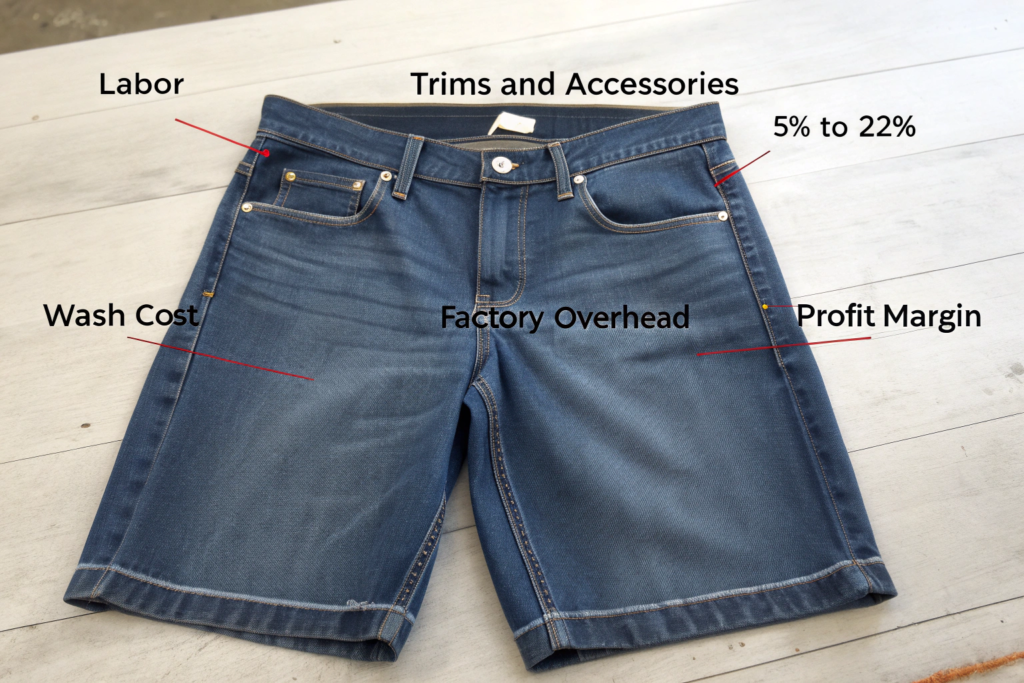
If you want to negotiate effectively, you need to know where the money actually goes. The retail price of a denim short is not the factory's problem. The FOB price is. FOB stands for Free on Board, and it's the price the factory charges to produce the short and deliver it to the port of export. This FOB price breaks down into a handful of cost buckets, and each bucket behaves differently when you apply pressure.
The biggest bucket is fabric. Denim fabric typically eats up 50% to 65% of the total FOB cost of a pair of shorts. Let that sink in. More than half of what you're paying isn't the sewing labor, the buttons, or the factory profit. It's the denim itself. This means that if you're only negotiating on the labor cost or the factory margin, you're fighting over the smallest slices of the pie. The real leverage sits in the fabric bucket.
The second bucket is labor, which covers the cutting, sewing, and finishing operations. On a standard five-pocket denim short, labor is usually 15% to 22% of the FOB. The third bucket is trims and accessories: the zipper, the button, the rivets, the labels, the hangtags. This runs about 8% to 12%. Then there's the wash cost, which varies wildly depending on the complexity—anywhere from 5% for a simple rinse to 15% or more for a multi-layer vintage treatment. Factory overhead, which covers electricity, machine depreciation, rent, and indirect staff, is typically 5% to 8%. The remaining slice, often just 5% to 10%, is the factory's profit margin. This is the number you think you're attacking when you demand a blanket discount. But it's too small to absorb significant cuts without triggering quality substitution.
I had a distributor from New Jersey visit me last year. He was fixated on getting a 12% price reduction on a 5,000-unit denim short order. I pulled out my cost sheet and showed him the numbers. The only way to hit that target was to drop the fabric weight from 13oz to 10oz, switch to a cheaper Pakistani denim, or eliminate the reinforced bartacks. He didn't want any of those changes. He wanted the same short, just cheaper. I told him honestly that it wasn't possible without cutting corners I wasn't willing to cut. We eventually found a 4% saving by optimizing the cutting marker to reduce fabric waste, and we held the quality exactly where it was. That's real negotiation. Not demanding a magic discount, but understanding the cost structure and finding genuine efficiencies.
How Does Denim Fabric Weight and Composition Drive Up the Price?
Denim fabric is priced by weight, by cotton quality, and by construction complexity. A lightweight 8oz denim is cheaper than a heavyweight 15oz denim simply because it uses less cotton per yard. But weight isn't the only variable. The type of cotton matters enormously. Long-staple cotton, like Supima or high-grade Xinjiang cotton, produces a smoother, stronger yarn. It costs significantly more than short-staple cotton, which is rougher and weaker. The yarn spinning method also affects price. Ring-spun yarn, which has a classic irregular texture and higher strength, costs more than open-end yarn, which is more uniform but less characterful.
If your brand is positioned in the premium segment and you're spec'ing a 14oz ring-spun selvedge denim, your fabric cost is going to be at the high end of the range. You can't negotiate that down to the price of a generic open-end denim without changing the fundamental character of your product. What you can do is ask the factory to present fabric options at different price points and explain the trade-offs clearly.
I keep a library of denim qualities at different cost tiers. When a client sits with me, I show them a high-tier Japanese-inspired selvedge, a mid-tier ring-spun denim from a reputable Chinese mill, and an entry-level open-end denim. I explain the hand feel, the fade potential, and the durability differences. Sometimes the client realizes they've been over-spec'ing. A mid-tier denim might achieve 90% of the look and feel of the premium option at 70% of the cost. That's not a negotiation concession; that's an informed material decision. Other times, the premium fabric is non-negotiable for their brand identity, and we need to find savings elsewhere. The key is to have this conversation openly. A factory that hides its fabric sourcing is a factory that will substitute materials without telling you. A factory that brings you into the sourcing conversation is a partner.
Which Trims and Accessories Are Silent Profit Eaters?
Trims seem small. A zipper is a tiny piece of metal and tape. A button is a disc of brass. A rivet is a speck of copper. How much can they possibly cost? The answer, surprisingly, is quite a lot if you're not paying attention. And because trims are small, they're easy for a factory to downgrade without the brand owner noticing until the complaints start rolling in.
The zipper is the most critical trim on a pair of shorts with a fly. A genuine YKK zipper costs several times more than a generic zipper from an unbranded supplier. The difference is not just the brand name. A YKK zipper has precise tooth alignment, a smooth slider action, and a tested lifespan of thousands of open-close cycles. A generic zipper will catch, snag, and eventually fail. When a customer returns a pair of shorts because the fly won't stay up, that return probably costs you more than the entire zipper budget for the production run.
Buttons and rivets have similar quality tiers. Solid brass or copper hardware ages beautifully and doesn't corrode. Alloy hardware plated with a thin brass coating looks the same out of the box but will chip and reveal a dull gray metal underneath after a few washes. The price difference is meaningful at the bulk scale. For a 10,000-unit order, switching from solid brass shanks to plated alloy shanks might save $800 to $1,200. That sounds like a lot of money on the cost sheet. But spread across 10,000 pairs, it's eight to twelve cents per unit. Is saving twelve cents per short worth the risk of a hardware failure that triggers a negative review? I've had this exact conversation with dozens of clients. The smart ones keep the premium hardware and find savings in larger buckets.
Another silent trim eater is the internal waistband lining and pocketing fabric. These are materials the end consumer sees and touches every time they put the shorts on. A cheap, rough pocketing fabric feels terrible against the hand. A low-quality fusible interlining in the waistband will bubble and separate after repeated washing. I source all my pocketing from a specific mill that produces a soft, durable cotton-poly twill designed for high-wash cycles. It costs about 15% more than the standard pocketing most factories use. I refuse to downgrade it because I know that a blown-out pocket is a one-star review that lives on your product page forever. When you're reviewing a cost sheet, pay attention to these hidden trims. Ask the factory to show you samples of the zipper, the button, and the pocketing fabric. Touch them. Test them. Then decide if the saving is worth the compromise.
How Can You Leverage Order Volume and Timing for Lower Pricing?
Volume and timing are the two most powerful negotiation tools you have that don't compromise quality. A factory's cost structure has fixed components that don't change much whether we're producing 500 units or 5,000 units. The machine setup, the pattern development, the wash recipe calibration—these are one-time costs. If we spread those fixed costs across a larger order, the unit price drops naturally. You don't have to squeeze my margin; you just have to give me more units to distribute the setup cost across.
Timing works similarly. A factory with an empty production line is a factory that's losing money every day. Machines sit idle. Workers have no piece-rate income. The rent and electricity bills keep coming. If you can place your order to fill a gap in the production schedule, you have significant negotiating power. The factory will accept a lower margin to keep the lines running and the workforce employed. This is the off-peak pricing dynamic, and it's the single biggest cost opportunity that most brand owners don't exploit.
I'll give you a real example. A men's streetwear brand from Los Angeles placed their Summer 2026 denim short order with us in late October 2025. That's early. Most brands are still finalizing designs in October. Because the order was early, I had visibility into my production schedule and could slot them into a quiet period in November. My lines were running at 60% capacity that month. I gave them a 6% discount on the FOB price, not because they negotiated hard, but because the timing was perfect for me. They filled a valley in my production calendar, and I rewarded that with a price break. No quality was sacrificed. No corners were cut. It was a pure scheduling win. If that same brand had placed the same order in February 2026, when every line in the factory is running at 100% capacity for peak summer production, I would not have offered that discount. I simply wouldn't need to. The opportunity cost of giving them a slot would be too high.
What Is the Minimum Order Quantity That Unlocks Real Discounts?
I get asked about MOQs constantly. Every brand owner wants to know the magic number that triggers a price break. The honest answer is that there isn't a single threshold; there's a tiered structure, and the breaks happen at the points where the fixed costs get meaningfully diluted.
For a standard denim short, the first significant price break usually comes around 500 to 800 units per style. Below that, the fixed costs of pattern making, marker planning, and machine setup are spread so thinly that the unit cost is high. Between 800 and 1,500 units, you start to see some efficiency gains, but nothing dramatic. The real savings kick in above 3,000 units per style. At this volume, the fabric mill starts offering bulk discounts on the denim, the cutting efficiency improves because the marker can be optimized across a longer run, and the sewing line gains speed as the operators repeat the same operations.
Above 10,000 units, the discounts start to plateau. There's only so much efficiency to be squeezed from a production line. The fabric cost doesn't drop much further because the mill's raw cotton cost is the floor. The labor cost per unit stabilizes once the operators have fully learned the style. At this point, additional volume might get you a small further discount of maybe 1% to 2%, but nothing transformational.
Here's a rough guide I use internally to estimate FOB price movement by volume tier for a mid-weight denim short with a standard wash:
| Order Volume (per style) | Approximate FOB Price Movement |
|---|---|
| 300 - 500 units | Baseline price, high unit cost |
| 500 - 1,500 units | -3% to -5% from baseline |
| 1,500 - 3,000 units | -5% to -8% from baseline |
| 3,000 - 8,000 units | -8% to -12% from baseline |
| 8,000 - 15,000+ units | -12% to -15% from baseline |
These percentages are approximate and vary based on the complexity of the style. A heavily washed, hand-sprayed short with premium trims will see less percentage movement because a larger share of its cost is in variable labor and chemicals, not fixed setup. A simple rinse-wash short will see more movement. The takeaway is this: if you can consolidate your orders across fewer styles and push the volume per style above 3,000 units, you unlock the most meaningful savings band. Don't spread 6,000 units across six styles. Put 3,000 on two styles each.
Why Does Placing Orders During the Off-Season Cut Costs?
The apparel industry runs on a brutal calendar. Every brand wants Spring/Summer goods delivered in January and February. Every brand wants Fall/Winter goods delivered in July and August. This means that all factories in the sourcing countries are slammed during the same windows, and we're all quiet during the same windows. This synchronized cycle creates a pricing opportunity for brands that can break from the herd.
The off-season for denim production in China is typically March through May and September through October. During these months, the peak summer crunch has passed and the winter rush hasn't started yet. The lines are running at reduced capacity. The wash house isn't running triple shifts. The factory is hungry for work.
If you can design your development calendar to land bulk production orders in these windows, you can negotiate significantly better pricing. The factory is essentially trading margin for cash flow continuity. I'd rather run a 5,000-unit order at a 6% margin in April than have my line sit idle and lose money. In February, when I'm booked solid and turning away work, that same order needs to carry a 10% margin to justify the opportunity cost of the line slot.
The challenge, of course, is that this requires forward planning. You need to finalize your designs, approve your samples, and release your bulk order months earlier than your competitors. That's hard. It requires discipline and a willingness to commit before trends are fully validated. But the brands that do this consistently capture a structural cost advantage that no amount of last-minute negotiation can match. One of my longest-standing distribution clients, a mid-sized operation out of Texas, has built their entire sourcing calendar around this principle. They finalize their Summer line in August, sample in September, and release bulk orders in October for a March production slot. They consistently pay 7% to 10% less than their competitors who are scrambling to place orders in January. They also get better quality because the factory isn't rushed. The off-season strategy is a competitive advantage hiding in plain sight.
Which Negotiation Tactics Build Trust Instead of Resentment?
I've been on the receiving end of every negotiation tactic you can imagine. The aggressive opener. The fake walkout. The "my other factory offered me a better price" bluff. I know them all, and I can tell you honestly that they don't work on me, and they don't work on any experienced factory owner who values long-term relationships over short-term gains. These tactics create resentment. They signal that you see the factory as an adversary to be defeated, not a partner to collaborate with. And when the relationship turns adversarial, the factory protects itself. We build margin buffers into the pricing. We deprioritize your production when schedules get tight. We stop sharing cost-saving ideas because we know you'll just pocket the savings and ask for more.
The negotiation tactics that actually work are the ones that treat the factory as a partner with shared interests. They're transparent, data-driven, and focused on finding mutual gains. They don't attack the factory's margin; they attack the inefficiencies that neither side benefits from.
The most effective opening move I've ever seen came from a brand owner from Vancouver. He sat down, laid out his target retail price, his required wholesale margin, and his maximum allowable FOB cost, and he said, "Richard, this is the number I need to hit to make this program work. Can we figure out how to get there together without compromising the quality that my customers expect?" He didn't demand a discount. He shared his constraint and invited me to solve the problem with him. That changed the dynamic entirely. We spent the next hour going through the cost sheet line by line, looking for genuine efficiencies. We found a fabric consolidation opportunity, simplified the wash recipe slightly without changing the visual effect, and adjusted the packaging spec. We hit his number, and the margin was still healthy for me. That conversation happened four years ago, and he's still one of my most valued clients. Trust-based negotiation works.

How Do You Ask for a Price Breakdown Without Offending the Supplier?
This is a delicate question. In some sourcing cultures, asking for a detailed cost breakdown is considered aggressive or disrespectful. It implies that you don't trust the quoted price. I understand why a supplier might bristle. But I also believe that a transparent factory has nothing to hide, and a professional buyer has a right to understand where their money is going.
The key is how you frame the request. Don't say, "Send me your cost breakdown so I can see where you're ripping me off." That will get you nowhere. Instead, say something like, "I'd like to understand the cost structure so I can make informed decisions about where to invest and where to save. If the fabric is the biggest cost driver, maybe we can explore alternative mills together. If the wash is the driver, maybe we can simplify the recipe." This frames the breakdown as a collaborative tool, not an interrogation.
When a client asks me for a breakdown respectfully, I provide it willingly. I show them the fabric cost per meter, the consumption per unit, the labor minutes per operation, the trim costs per piece, and the wash cost per unit. I show them the overhead allocation and the margin. Yes, the margin. I have nothing to hide. My margin is reasonable, and I'd rather have a client who knows that and trusts me than a client who suspects I'm gouging them and holds back.
The breakdown also helps the client make better decisions. I had a client who was shocked to see that the wash cost on his vintage-tint short was 14% of the FOB. He asked if we could achieve a similar look with a simpler wash. I developed three alternative wash recipes at different cost points, and he chose one that was visually 90% similar at 60% of the wash cost. That conversation couldn't have happened without the breakdown. He saved money, I maintained my margin, and the product still looked great. That's the power of open-book negotiation.
Why Is a "Cost-Saving Suggestion" More Powerful Than a Price Demand?
A price demand is a zero-sum move. You want to pay less, which means the factory earns less, or the factory cuts corners to maintain its margin. Either way, value is transferred, not created. A cost-saving suggestion is a positive-sum move. It reduces the total cost of producing the garment, and the savings can be shared between the brand and the factory. Both parties end up better off.
This is why I always tell my clients to bring their production expertise to the negotiation. If you know something about garment construction, about material utilization, about packaging efficiency, share it. You might see a cost saving that I've missed, or you might have an idea from a different product category that can be applied to denim.
I'll give you a specific example. A client from Seattle who produces workwear noticed that the denim shorts we were making for him used a traditional folded-and-stitched hem. He suggested switching to a raw, laser-finished hem, which he'd seen on a trend report and which his customer base would appreciate as a design feature. The raw hem eliminated the hemming operation entirely, saving about eight minutes of sewing labor per unit and reducing the thread consumption. The design change was a trend win for his brand and a cost win for the production. I passed the labor saving through to him in the pricing, and we both made more margin on the order. That suggestion came from him, not from me. It was his industry knowledge that created the value.
If you want to deploy this tactic effectively, come to the negotiation with a list of ideas. Look at the sample. Study the construction. Ask yourself: Are there operations that could be simplified without hurting the look? Is the packaging over-spec'd? Could the inner labels be printed instead of woven? Could the fabric utilization be improved by tweaking the pattern shape slightly? Then present these ideas as collaborative suggestions. "What if we tried this? Would it save us both money?" The factory owner who dismisses these suggestions is transactional. The one who engages with them is a partner.
What Common Negotiation Mistakes Drive Up Your Landed Cost?
The FOB price is what you pay the factory. But the landed cost is what you actually pay to have the goods in your warehouse, ready to sell. Landed cost includes the FOB, plus ocean freight, insurance, customs duties, and any logistics fees. I've seen brand owners celebrate a 5% FOB reduction, only to lose 8% on the back end because of mistakes made during the negotiation that increased their freight, duty, or quality-control costs. The total cost is what matters, not the line item.
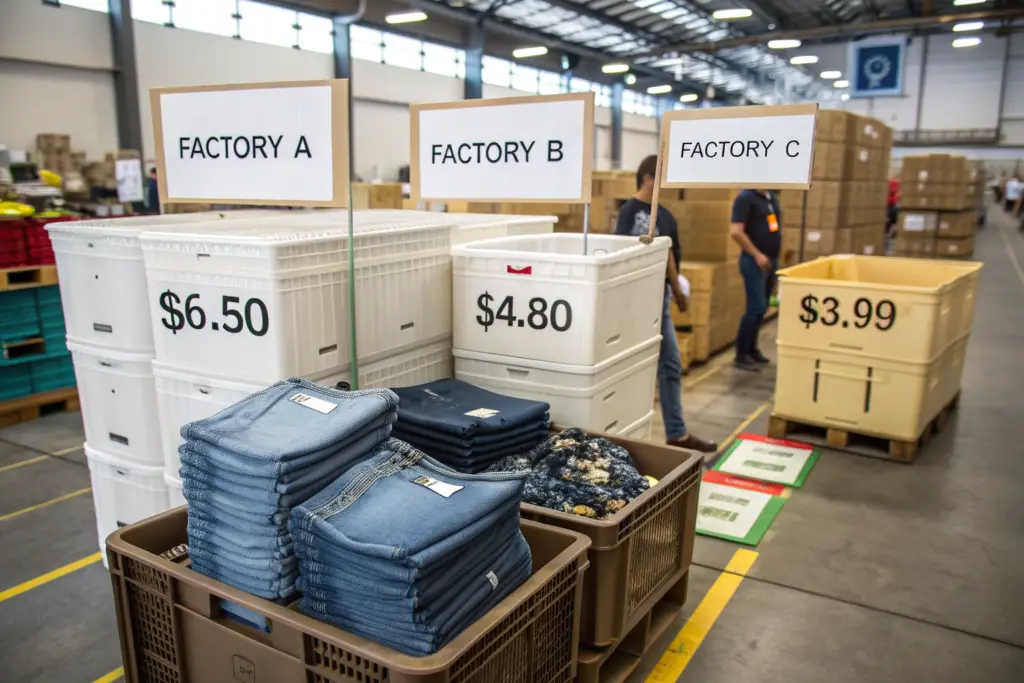
The most common mistake I see is sourcing from multiple factories to chase the lowest FOB on each product category. A distributor will buy denim shorts from Factory A at $6.50, woven shirts from Factory B at $4.80, and knit polos from Factory C at $3.90. Each of these factories has a minimum order quantity. The distributor now has three separate shipments, three sets of documentation, three customs clearance fees, and three freight bookings. The consolidated buying power at any single factory is lost. The logistical complexity and cost multiply.
The smarter approach, which I encourage my long-term clients to adopt, is category consolidation. Pick a factory that excels in your primary category—in our case, denim—and then explore whether that factory can also handle your woven or knit programs through in-house or closely partnered capacity. You might pay $0.20 more per unit on the knit polo compared to the lowest FOB bidder, but you save $0.80 per unit on freight and handling because everything ships together in a consolidated container. You also save the management time of coordinating three suppliers, three quality inspections, and three payment schedules. The total landed cost is lower, even though the line-item FOB is slightly higher on one category.
Why Does Splitting Orders Across Factories Inflate Total Costs?
Splitting orders seems like a smart hedge. You diversify supplier risk. You create competition between factories to keep pricing sharp. These are valid instincts. But the hidden costs of splitting often outweigh the benefits, especially for small to mid-sized brands that don't have huge in-house sourcing teams.
Every factory has a fixed documentation and communication overhead per order. At Shanghai Fumao, processing an order involves the account manager, the pattern team, the cutting planner, the production scheduler, the QC team, and the shipping department. This overhead is roughly similar whether the order is 500 units or 5,000 units. If you split a 4,000-unit denim short program across two factories, you pay that overhead twice. You also pay for two separate sets of pre-production samples, two separate lab tests, two separate compliance audits. These costs are either billed directly or absorbed into the FOB.
Freight is the biggest multiplier of splitting costs. A full 40-foot container from Shanghai to Los Angeles has a per-unit freight cost that is dramatically lower than a shared or partial container. If your 2,000 units from Factory A fill half a container and your 2,000 units from Factory B fill the other half, you're paying for two less-than-container-load shipments or one consolidated container with additional handling fees. Consolidating the full 4,000 units at a single factory gives you a full container and the lowest possible per-unit ocean freight rate.
There's also the quality consistency risk. Two different factories, using two different fabric mills, two different wash houses, and two different sewing teams, will produce two subtly different shorts. The shade of indigo might not match perfectly. The hand feel might differ. A retail buyer who places the two shorts side by side on a shelf will notice. If you're building a brand with a consistent product, this variability is a hidden cost that manifests in lost reorders.
How Does Changing Specs After Price Agreement Hurt Your Bottom Line?
This happens all the time. The price is negotiated, the order is confirmed, and then the brand owner sends an email: "One small change—can we switch the pocket lining to organic cotton? And add an extra bartack on the belt loop? And change the hangtag material?" Each of these changes sounds minor in isolation. Cumulatively, they blow up the cost structure that the original price was based on.
The factory has already booked the fabric, ordered the trims, and scheduled the production. A spec change after this point creates waste. The original pocketing fabric has to be returned or scrapped. The production planning has to be reworked. The sewing line has to be rebalanced for the new operation. Each change introduces a ripple of small costs that the factory has to absorb or pass through.
What's worse is that the brand owner often doesn't see these costs. They think, "It's just a different piece of fabric in the pocket. How much can that cost?" The answer might be a few cents per unit, but the production disruption and the waste of the already-purchased material can add up to hundreds of dollars in unrecoverable cost. Multiply this by multiple late-stage spec changes, and the factory's margin on the order has eroded to near zero.
I've learned to handle this by building a change-order process into my client relationships. If a spec change is requested after the purchase order is confirmed, I acknowledge it immediately, but I also cost it transparently. I tell the client, "We can make this change. Here's the additional cost and the impact on the delivery date. Do you want to proceed?" Some changes are worth it. Most, in my experience, are not. The ones that are worth it are usually caught much earlier in the sampling process. The antidote to late spec changes is thorough sampling and a disciplined approval timeline. Nail the sample. Sign off on every detail. Then freeze the spec and don't touch it. Your landed cost will thank you.
Conclusion
Negotiating the best price for bulk denim shorts is not about being the toughest person in the room. It's about being the most informed. You need to understand where the real cost drivers live—in the fabric weight and composition, in the trims you spec, in the wash complexity you choose. You need to understand how volume and timing interact with the factory's fixed cost structure, and you need to plan your sourcing calendar to capture the off-peak discounts that most brands leave on the table. You need to negotiate in a way that builds partnership rather than resentment, asking for transparent cost breakdowns and offering collaborative cost-saving ideas instead of making aggressive price demands. And you need to avoid the common mistakes—splitting orders unnecessarily, changing specs after the price is locked—that silently inflate your total landed cost even as you celebrate a lower FOB line item.
If you want to have a different kind of negotiation, one where the factory owner pulls out the cost sheet and works through the numbers with you as a partner, I invite you to reach out to our Business Director, Elaine. She can walk you through our pricing structure, discuss volume tier breaks, and explore how your production calendar might align with our off-peak windows. You can contact her directly at elaine@fumaoclothing.com. Let's find a price that works for both of us, without sacrificing the quality your brand depends on.