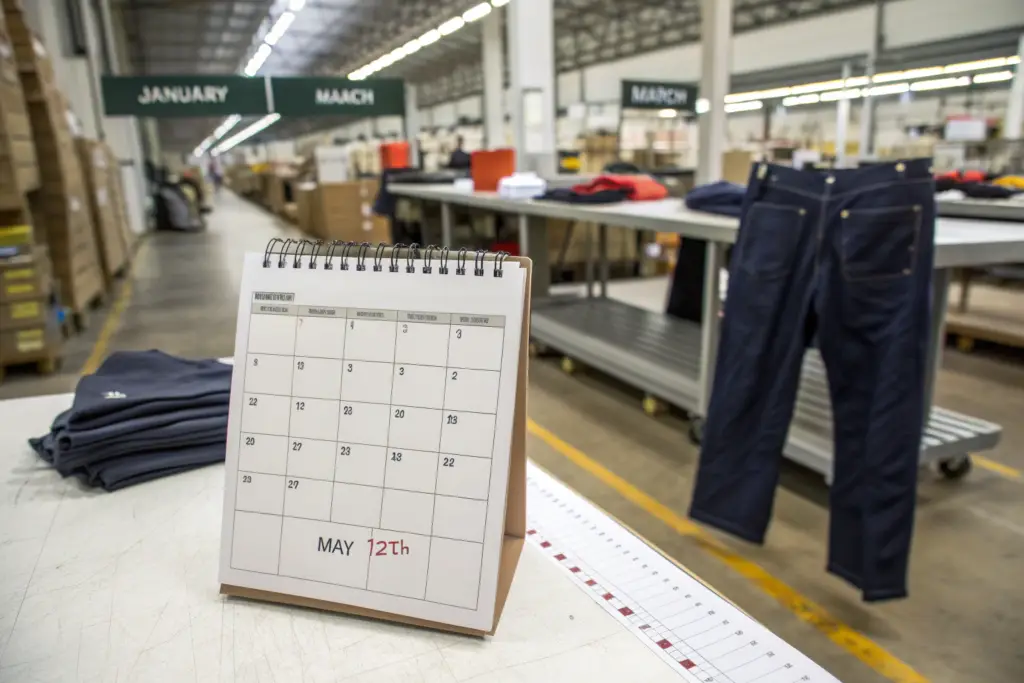
You place a production order in January. The supplier confirms a March 15th ex-factory date. You book your marketing campaign around a late April launch. You notify your wholesale accounts. March 1st arrives. You email for an update. "Small delay, one week." March 8th. "Fabric is arriving tomorrow." March 20th. "Finishing now, shipping next week." The pants finally leave the factory on April 5th. They spend ten days at the port waiting for a vessel. They arrive at your warehouse on May 12th. Your launch window closed two weeks ago. Your wholesale accounts have moved on. Your cash is trapped in inventory that is now competing with early markdowns. The supplier's promise of on-time delivery was never a plan. It was a hope wrapped in reassuring words. Hopes do not survive contact with a fragmented supply chain.
Ensuring on-time delivery requires replacing supplier promises with a verifiable, milestone-driven production calendar backed by contractual penalties, independent progress verification at each stage from fabric procurement to container loading, a pre-booked logistics chain that reserves vessel space before the goods are even finished, and a pre-negotiated escalation plan—including air freight at the supplier's cost—that activates automatically when defined delay thresholds are crossed. The goal is not to hope for the best. The goal is to build a system where late delivery is structurally difficult and financially painful for the supplier, and early intervention is automatic when a delay is detected.
My name is Elaine. At Shanghai Fumao, I have spent over a decade managing production timelines for North American and European brands. I have been on the supplier side of a missed deadline. I have made the difficult phone call. I have also rebuilt our entire production planning and client communication system to ensure that phone call is almost never necessary. In this article, I will walk you through the exact, actionable steps—the contract clauses, the milestone verification methods, the logistics pre-booking strategy, and the penalty structures—that transform on-time delivery from a wish into a controlled, predictable outcome.
What Contract Clauses Make On-Time Delivery a Legal Obligation, Not a Courtesy?
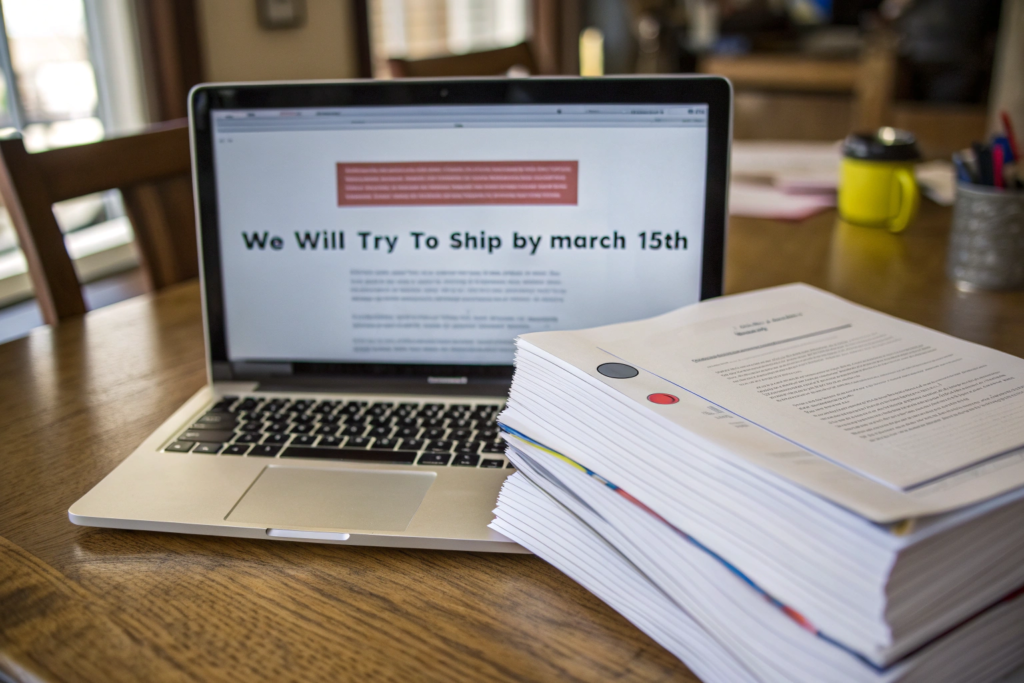
A verbal agreement on a delivery date is legally worthless. An email that says "we will try to ship by March 15th" is a statement of intention, not a commitment. A legally enforceable delivery obligation requires three specific elements in the written contract: an exact, calendar-date-defined delivery deadline, a defined consequence for missing that deadline, and a defined method for verifying whether the deadline was met. Without these three elements, the delivery date is a suggestion, and you have no recourse when it is ignored.
A contract that secures on-time delivery must include: a specific "Latest Ex-Factory Date" defined as a calendar date, not a range; a "Delay Penalty Clause" specifying a financial penalty—typically 2% to 5% of the order value per week of delay, capped at a negotiated maximum; a "Cancellation Right" that allows you to cancel the order with a full refund if the delay exceeds a specified threshold, typically four weeks; and a "Recovery Obligation" that requires the supplier to air-freight a percentage of the order at their cost if the delay threatens your agreed in-warehouse date. These clauses must be in the purchase order or manufacturing agreement, signed by both parties, before the deposit is paid.
How Do You Define "Late" in a Way That Leaves No Room for Argument?
The word "late" is subjective. A supplier who promises "March shipment" and ships on March 31st will claim they met the commitment. You, expecting goods in your warehouse by late March, will feel the shipment is two weeks late. The ambiguity is the problem. The contract must define "on time" with a specific, verifiable event on a specific calendar date.
Define the delivery obligation as the "Latest Ex-Factory Date." This is the date by which the goods must be packed, inspected, and loaded onto the truck at the factory's loading dock, verified by a dated and time-stamped photo of the loaded truck or container. Do not define delivery by the vessel sailing date. The factory does not control the vessel. Define it by the event the factory does control: the moment the goods leave their facility. Then define "delay" as any day after the Latest Ex-Factory Date on which the truck loading photo has not been provided. This definition is objective. The photo either exists with a date stamp on or before the deadline, or it does not. There is no gray area, no cultural ambiguity, no room for interpretation. I learned this lesson after a dispute in 2023 where a supplier claimed "ex-factory March 15th" meant the goods were packed in cartons on March 15th, while the truck arrived on March 20th. The goods missed the vessel cutoff. The supplier argued they had met the ex-factory date because the goods were "ready to ship." The contract now defines the ex-factory date specifically as "truck loaded and departed factory premises, verified by photo." The international manufacturing contract delivery clauses guide from the U.S. Department of Commerce explains how precise definitions eliminate disputes. A contract that says "on or about" is a contract that invites argument.
What Penalty Structure Is Effective Without Being So Punitive That Suppliers Refuse It?
A penalty clause that demands 20% of the order value for a one-week delay is commercially unreasonable. No reputable supplier will sign it. A penalty clause that demands nothing is commercially useless. The effective penalty structure is one that is painful enough to motivate action but reasonable enough to be accepted as a fair allocation of risk.
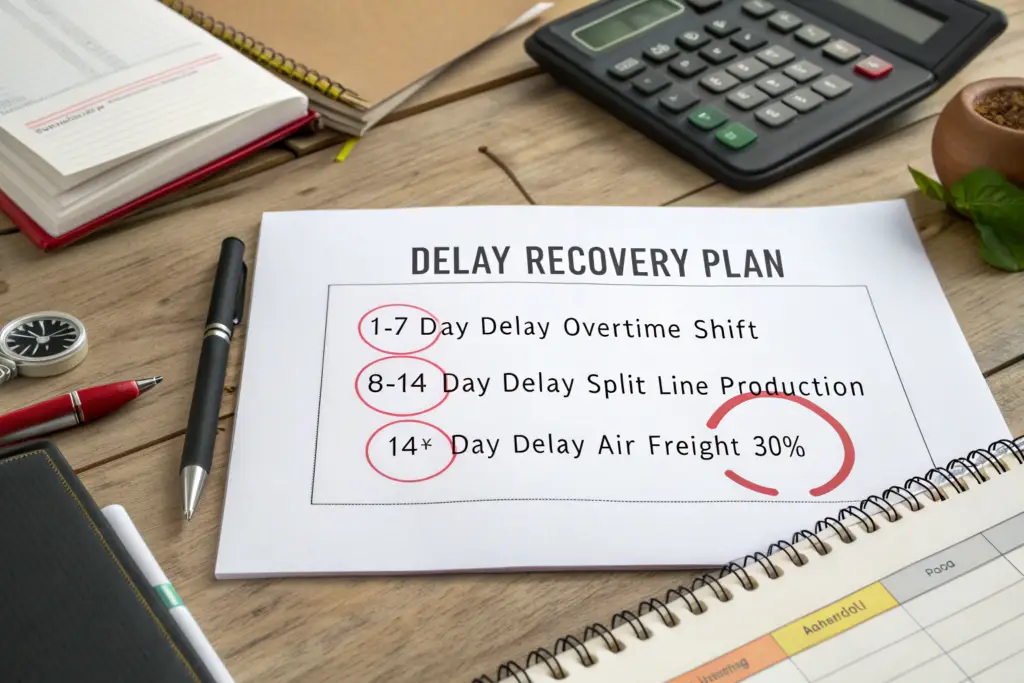
The industry-standard structure I recommend and use at Shanghai Fumao is a tiered delay penalty. For a delay of one to seven calendar days, a 2% discount on the total invoice value. For a delay of eight to fourteen calendar days, a cumulative 5% discount. For a delay of fifteen to twenty-one calendar days, a cumulative 8% discount. For a delay exceeding twenty-one calendar days, the buyer has the right to cancel the order with a full refund of all payments made, including the deposit, within seven business days. Additionally, for any delay exceeding fourteen calendar days attributable to the supplier, the supplier shall air-freight a minimum of 30% of the order quantity to the buyer's designated warehouse at the supplier's expense, with the remaining balance to follow via ocean freight within seven calendar days. This structure is specific, graduated, and commercially standard. It is not designed to bankrupt the supplier. It is designed to align the supplier's financial incentive with your delivery deadline. A supplier who misses the deadline by a week loses margin. A supplier who misses it by a month loses the order. The delay penalty clauses in manufacturing contracts resource provides legal language templates. Adapt these to your specific order and have a qualified attorney review them for enforceability in the relevant jurisdiction.
What Production Milestones Must You Independently Verify Before the Ship Date?
A contract defines the legal obligation. Milestone verification defines the operational reality. A supplier who reports "everything is on schedule" without evidence is managing your perception, not their production. You need independent, photographic verification at each stage where a delay can be concealed. The purpose of milestone verification is not to micromanage the factory. It is to collapse the information delay between when a problem occurs and when you discover it. A fabric delay hidden for three weeks becomes a season-killing crisis. A fabric delay reported on the day it occurs is a manageable problem with a recovery plan.
The five production milestones you must independently verify are: fabric arrival in the factory warehouse, verified by a photo of the fabric rolls with your order number visible on the tags; cutting start, verified by a photo of the spread fabric on the cutting table; in-line sewing progress, verified by a photo or short video of semi-finished garments on the production line; final QC inspection, verified by a third-party inspection report with a pass/fail result; and container loading, verified by a dated photo of the sealed container or loaded truck with the container number clearly visible. Each milestone should have a contractually defined "promised date," and any missed milestone should trigger a mandatory video call within 24 hours.

Why Is Fabric Arrival the Single Most Predictive Milestone?
Every delay I have seen in fifteen years, regardless of the reason the supplier eventually gives, traces back to one root cause in the majority of cases: the fabric was not in the factory when the production schedule said it would be. The supplier promised a production start date based on an assumed fabric delivery date. The fabric mill was late. The supplier, not wanting to deliver bad news, said nothing. The entire downstream schedule collapsed.
The fabric arrival milestone is the earliest and most predictive indicator of on-time delivery. If the fabric is in the factory, properly tagged with your order number, by the promised fabric arrival date, the probability of on-time delivery is high. If the fabric is not in the factory by that date, the probability of a delay approaches certainty. The math is simple. A one-week fabric delay cannot be recovered without either overtime, parallel processing on a second line, or logistics acceleration. A fabric delay longer than two weeks almost guarantees a missed delivery date unless the supplier takes aggressive and costly recovery measures. At Shanghai Fumao, we send a photo of the client's fabric rolls within 24 hours of their arrival in our warehouse. The photo includes a visible tag with the client's order number, the fabric lot number, and the date. The client knows, from that moment, that the physical foundation of their order exists and is in our control. If a supplier resists providing a fabric arrival photo, assume the fabric is not there. Ask for a video call immediately. Ask to see the fabric rolls live on camera. The supply chain milestone visibility best practices research confirms that early-stage visibility is the most effective intervention point for preventing downstream delays. Catching a delay at the fabric stage gives you weeks to respond. Catching it at the container loading stage gives you zero days.
How Does Third-Party QC Verification Protect Both the Timeline and the Quality?
A factory's internal QC report is a self-assessment. It may be honest. It may be sanitized. You have no way of knowing. A third-party inspection report from an independent agency like SGS, Intertek, or QIMA is an objective verification. The inspector works for you, not the factory. Their report is not influenced by the factory's desire to ship on time.
The timing of the third-party inspection is critical. Do not schedule the inspection for the day before the container loading. Schedule it for the day the factory claims the goods will be 100% finished and packed. If the inspection fails, the goods must be reworked before they can be loaded. This delay is the factory's responsibility. If the inspection passes, the goods can proceed to loading. The inspection report provides a definitive, dated proof point of the goods' existence and quality status. I have seen this save a client's season. A brand owner scheduled a third-party inspection for February 28th, the promised finishing date. The inspector arrived. The goods were only 60% packed. The remaining 40% were still on the sewing line with visible defects. The inspection failed. The brand owner was notified immediately and activated the contract's delay penalty and air freight clause. The factory, faced with the financial consequence, authorized overtime and an extra weekend shift. The goods shipped one week late, and the air-freighted portion arrived in time for the launch. Without the independent inspection, the factory would have reported "shipped on time" on February 28th, and the brand owner would have discovered the truth three weeks later when a substandard shipment arrived at their warehouse. The third-party garment inspection timing strategy guide explains the optimal inspection scheduling to maximize leverage and information. An inspection after the goods are loaded is a post-mortem. An inspection before loading is a decision point.
How Does Pre-Booking Logistics Prevent the Post-Production Bottleneck?
A garment factory can finish your pants on time, and you can still miss your delivery date. The post-production bottleneck—the gap between the finished goods sitting in cartons and the container actually departing on a vessel—is a separate supply chain phase with its own risks and its own lead times. Many importers treat logistics as an afterthought, arranging the freight booking after the goods are finished. This approach guarantees delays. During peak shipping season, vessel space is scarce. A factory that finishes goods on March 15th but books the freight on March 14th may find the next available vessel is March 28th. The goods sit for two weeks, and the delivery is late through no fault of the production schedule.
Pre-book your logistics at least four weeks before the ex-factory date. Your freight forwarder or your DDP supplier should reserve a vessel slot with a confirmed sailing date that aligns with your ex-factory date plus a buffer for port transit and container loading. The booking confirmation with a vessel name, voyage number, and estimated departure date should be shared with you. This transforms the logistics phase from a variable post-production scramble into a fixed, pre-planned step in the production calendar. The container is waiting for the goods, not the other way around.

What Is a "Vessel Booking Confirmation" and Why Must You Demand It?
A vessel booking confirmation is a document issued by the shipping line or the freight forwarder that reserves a specific container slot on a specific vessel with a specific estimated departure date. It has a booking number that can be tracked on the shipping line's website. It is not a promise. It is a reservation. The container space is allocated to your shipment.
Demand a copy of the booking confirmation at least two weeks before the ex-factory date. The booking confirmation proves that the logistics chain is activated and that a specific vessel is being targeted. If the supplier cannot provide a booking confirmation, they have not secured vessel space. The goods may finish on time and then sit in a warehouse waiting for the next available slot. This is a common cause of "production finished on time but delivery was late" scenarios. The booking confirmation should show your order reference, the container size, the port of loading, the port of discharge, the vessel name, the voyage number, and the estimated time of departure. Track the vessel on the shipping line's website as the departure date approaches. If the vessel is delayed, you know immediately and can adjust your downstream plans. The ocean freight booking process for importers from Maersk explains the documentation and the process. This document is your proof that the logistics chain is under control. A supplier who is vague about the vessel booking is a supplier whose logistics are not under control.
How Does DDP Simplify the Logistics Coordination Into a Single Accountability Point?
I have written extensively about DDP in a previous article, but its role in on-time delivery deserves emphasis here. Under FOB, you coordinate the freight forwarder, the customs broker, and the trucking company. Each entity operates independently. A delay caused by one entity is blamed on another. The freight forwarder missed the booking deadline. The broker filed the entry late. The trucker had a scheduling conflict. You are the only party with an incentive to resolve the problem, and you have the least control over any of the entities involved.
Under DDP, the supplier is responsible for the entire logistics chain. One company controls the production, the freight booking, the customs clearance, and the delivery. When a problem occurs anywhere in the chain, one company owns the problem and one company is financially motivated to solve it. This structural simplification eliminates the fragmentation that causes post-production delays. The supplier who produced the goods also booked the vessel, also filed the customs entry, also arranged the trucking. There is no gap between production and logistics. They are managed as a single, integrated process. At Shanghai Fumao, we issue a DDP tracking link when the order is confirmed. The link shows the planned production milestones, the vessel booking confirmation, the estimated departure, and the estimated delivery date. The client watches a single dashboard, not four separate email chains. The DDP versus FOB delivery reliability comparison shows that DDP shipments have statistically lower delivery variance than FOB shipments because the single-point accountability eliminates coordination failures. If on-time delivery is your priority, DDP is your strongest structural choice.
What Recovery Mechanisms Should Be Pre-Negotiated Before a Delay Occurs?
The best time to negotiate how a delay will be handled is before the delay occurs. During a crisis, emotions are high, leverage is shifting, and the window for rational problem-solving is narrow. A pre-negotiated recovery plan, signed as an appendix to the manufacturing agreement, removes the negotiation from the crisis. When the delay trigger is crossed, the recovery action activates automatically. There is no argument. There is no blame. There is only execution of a pre-agreed protocol.
A delay recovery plan must specify three things: the delay thresholds that trigger different recovery actions, typically one week, two weeks, and three weeks past the ex-factory date; the specific recovery action for each threshold, escalating from overtime shifts to split-line parallel processing to air freight; and the cost allocation for each action, specifying whether the supplier bears the cost, the buyer bears the cost, or the cost is shared. The plan must be signed before the deposit is paid. A supplier who refuses to pre-negotiate recovery mechanisms is a supplier who intends to improvise when things go wrong.
What Recovery Actions Are Realistic and Effective at Each Delay Threshold?
Recovery actions are not magic. They are specific operational adjustments that compress the remaining production or logistics timeline. Each action has a cost, a time-compression capability, and a practical limit. Understanding these limits prevents you from demanding the impossible and allows you to negotiate realistic, executable recovery plans.
For a delay of one to seven calendar days, the primary recovery mechanism is overtime. The factory authorizes additional working hours, typically evening shifts and weekend shifts, at a wage premium of 1.5x to 2x standard rates. This can compress a seven-day delay to a two-day delay, assuming spare capacity exists and the workforce is available. The cost is the overtime wage premium, which is typically 15% to 25% of the affected labor cost. For a delay of eight to fourteen calendar days, overtime alone is insufficient. The recovery requires parallel processing. The order is split across two sewing lines instead of one. This doubles the production speed on the affected portion but requires a second line supervisor, a second set of machines, and careful quality coordination. The cost is higher, but the time compression is significant. For a delay exceeding fourteen calendar days, production acceleration cannot close the gap. The recovery must shift to logistics acceleration. A percentage of the order, typically 30% covering the launch inventory, is air-freighted instead of ocean-freighted. Air freight takes five to seven days compared to twenty-five to thirty-five days for ocean freight. The cost is four to eight times higher than ocean freight. At Shanghai Fumao, we accept the cost of the air freight if the delay was caused by our internal process failure. If the delay was caused by a force majeure event or a buyer-initiated change order, the cost allocation follows the pre-agreed contract terms. The garment production delay recovery strategies guide explains the operational mechanics of each recovery action. A factory that cannot explain specifically how they will recover a delay is a factory that cannot recover a delay.
How Do You Enforce the Recovery Plan Without Destroying the Relationship?
Enforcing a penalty or a recovery action can feel adversarial. The supplier may become defensive, uncooperative, or even hostile. The relationship, which you have invested time in building, can be damaged. The key to enforcement without relationship destruction is to frame the recovery plan as a shared problem-solving tool, not a punishment.
When a delay occurs and a recovery action is triggered, communicate with the supplier as a partner facing a shared problem. Say, "We both want these pants in the customer's hands by May 1st. The delay is at fourteen days, so our pre-agreed recovery plan activates the air freight option. Let's work together to execute this so your product and our brand succeed. Here is the air freight booking I have initiated." The language is collaborative. The action is pre-agreed. The focus is on the shared goal of customer satisfaction. The supplier is not being punished. They are being held to a standard they agreed to, and the recovery action is the mechanism that protects both parties from the larger loss of a missed season and a damaged relationship. The supplier relationship management during disputes research emphasizes that clear, pre-agreed protocols actually preserve relationships by removing the need for adversarial negotiation during a crisis. The protocol makes the decision, not the people. Both parties can focus on execution rather than blame.
Conclusion
On-time delivery of linen wide-leg pants from Shanghai is not a function of luck, hope, or the supplier's good intentions. It is a function of a system that replaces promises with contracts, assumptions with independent verification, reactive logistics with pre-booked vessel space, and crisis negotiation with pre-agreed recovery protocols. The system has four components, and each component is essential.
First, a contract that defines the ex-factory date with a verifiable event—a truck loading photo—and attaches graduated financial penalties and a cancellation right to that definition. Second, independent milestone verification at five points—fabric arrival, cutting start, sewing in-line, final QC, and container loading—that catches delays when they are small and recoverable, not large and catastrophic. Third, a pre-booked logistics chain, ideally under DDP terms, that reserves vessel space weeks in advance and integrates production and shipping under a single accountability point. Fourth, a signed delay recovery plan that activates specific operational responses—overtime, parallel processing, air freight—at defined delay thresholds, with pre-agreed cost allocations.
At Shanghai Fumao, this system is not theoretical. It is how we operate every order. Our contracts include the graduated penalty and air freight clause. Our clients receive milestone photos at each stage, pushed to them without asking. Our logistics team pre-books vessel space four weeks before the ex-factory date. Our delay recovery plan is a standard appendix to our manufacturing agreement. We do this not because our clients demand it, but because we demand it of ourselves. We want our delivery performance to be provable, not arguable.
If you have been burned by late deliveries in the past, or if you are placing a time-sensitive order for a fixed launch date and cannot afford the cost of a delay, I invite you to experience how a system-driven factory operates. Contact me, Elaine, at elaine@fumaoclothing.com. Share your launch date, and I will map our production milestones to your calendar and show you exactly how we guarantee on-time delivery, in writing, before you pay a deposit. Your season should not be a gamble. It should be a plan.