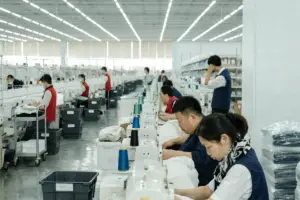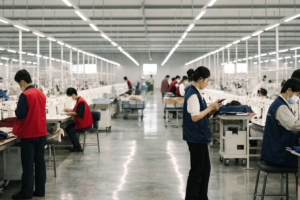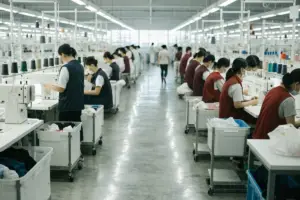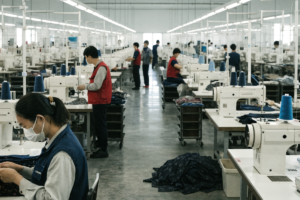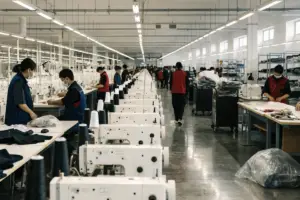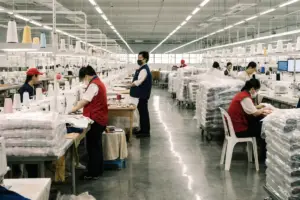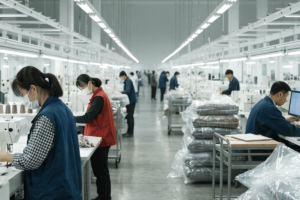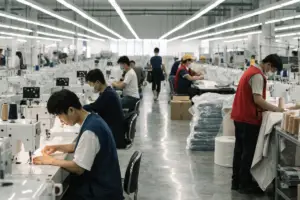
You find a supplier in Vietnam, China, or India offering beautiful linen wide-leg pants at a price that makes your margin spreadsheet sing. The photos look perfect. The sample they couriered feels soft and drapes beautifully. You are ready to place a $15,000 order. Then a quiet question enters your mind: "How do I actually know this fabric is linen? How do I know it was made without exploiting workers? How do I know it won’t be seized at the port?" The answer to all three questions is the same: certifications. But the market is flooded with fake certificates, expired documents, and meaningless logos. Relying on a PDF a supplier emailed you is like relying on a stranger’s smile. It feels good but guarantees nothing.
Certifications are critical because they are the only legally enforceable, third-party verified bridge between a developing country’s factory floor and your home country’s consumer safety laws, retail compliance requirements, and ethical sourcing commitments. A valid, traceable certification protects you from port seizures under REACH and CPSIA regulations, shields your brand from greenwashing accusations with GOTS or OCS transaction certificates, and provides a statistical quality benchmark through ISO and AQL standards. Without them, you are importing legal liability disguised as affordable linen.
I learned the hard edge of this lesson fifteen years ago, not as a factory owner, but as a young merchandiser watching a shipment get destroyed. A container of linen blazers we had produced for a French client was stopped at Le Havre port. The test report the client had accepted from a third-party fabric supplier was forged. The fabric contained restricted amines from azo dyes far above the legal limit. The entire container was crushed. The supplier who provided the fake certificate disappeared. The client lost their season. That image of a shipping container being emptied into an incinerator never left me. My name is Elaine. Since that day, and now as the co-owner of Shanghai Fumao, I have built our supply chain around the absolute integrity of our certifications. I want to walk you through the three layers of certification that protect your business: the safety certifications that keep you out of legal trouble, the ethical certifications that your end consumers demand, and the quality certifications that stop your returns from spiraling. I will tell you how to spot a fake, how to verify a real one, and why this piece of paper is actually a financial asset on your balance sheet.
What Safety Certifications Protect Your Linen Pants From Port Seizure?
The moment your linen pants enter a U.S. or European port, they cease to be a fashion product. They become a chemical sample. Customs authorities in the United States and the European Union operate with the legal assumption that textiles from developing countries are guilty until proven innocent. They use X-ray fluorescence scanners to detect heavy metals in dyes and finishes. They pull cartons at random. If your shipment lacks a valid, lab-verified certificate proving the absence of restricted substances, you have no defense. The goods are detained. You pay storage fees daily. The goods are tested. If they fail, the goods are destroyed at your expense.
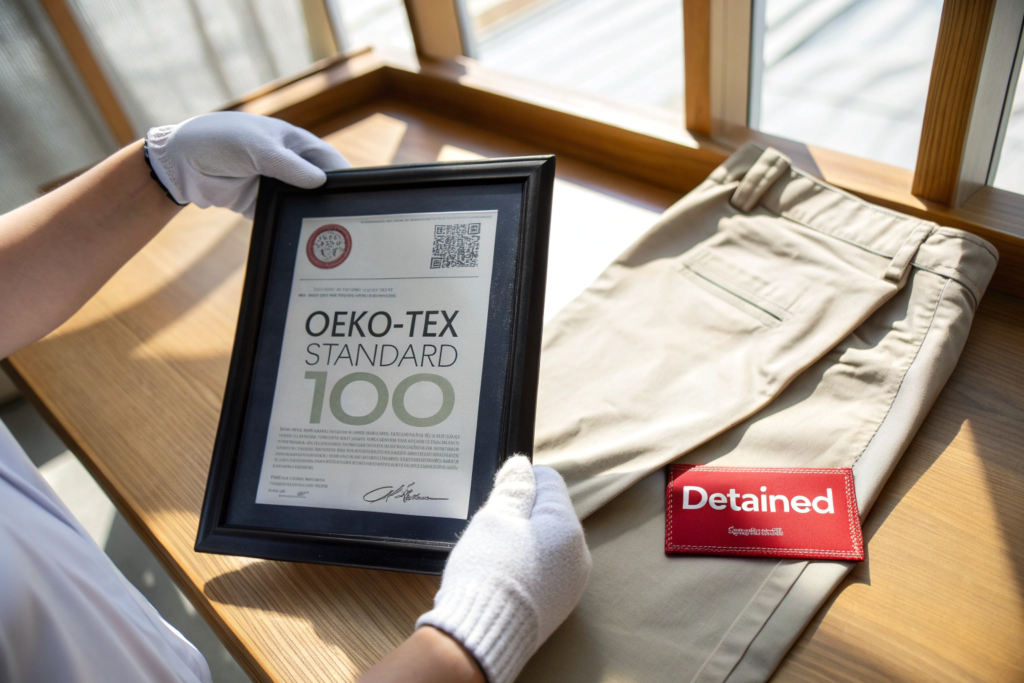
The non-negotiable safety certifications are OEKO-TEX Standard 100 for general harmful substance screening, and a REACH SVHC compliance report for the European market or a CPSIA compliance certificate for the U.S. market. These documents must be specific to the production lot, traceable to a recognized lab like SGS or Intertek, and verifiable through a public database or a direct phone call to the issuing lab. A generic, undated certificate is not a shield; it is a placebo.
How Does OEKO-TEX Standard 100 Actually Prevent a Customs Disaster?
A common misconception is that OEKO-TEX is an environmental certification. It is not. It is a product safety certification. It tests for over 100 harmful substances known to be dangerous to human health: formaldehyde, heavy metals, chlorinated phenols, and restricted azo dyes that can break down into carcinogenic amines. A linen pant dyed with cheap, uncertified dyes might look beautiful in oatmeal beige but contain benzidine, a banned amine linked to bladder cancer.
The certificate has a specific anatomy that you must check. It has a certificate number, a validity period, and a list of tested product classes. Linen pants worn next to the skin fall under Product Class II. If the certificate says Product Class IV (for home textiles like curtains), it does not cover your garment. I teach our clients a three-step verification. First, look at the certificate number. Second, go to the OEKO-TEX official label check website. Type in the number. The site will tell you if the certificate is currently valid, who the certificate holder is, and what product classes it covers. Third, call the testing lab listed on the certificate. I once discovered a supplier was using a real certificate number belonging to a completely different factory in a different province. A two-minute label check exposed the fraud. For U.S. importers, the parallel requirement is CPSIA compliance. If your linen pants are for children or include any component that could be considered a children’s product, CPSIA third-party testing is mandatory. The Consumer Product Safety Commission can impose fines of up to $100,000 per violation. The cost of a valid OEKO-TEX or CPSIA test report is roughly $300 to $500 per fabric lot. The cost of a port seizure is the value of the shipment plus storage plus destruction fees plus the lost season. The math is brutally clear.
Why Does REACH SVHC Compliance Matter Even for Non-EU Sellers?
You might think, "I only sell in the U.S., so REACH does not apply to me." This is a dangerous assumption. The global supply chain is interconnected. A U.S. brand that sells through a large online marketplace may find their products listed on European platforms without their direct involvement. Additionally, many large U.S. department stores and retailers have aligned their internal Restricted Substances Lists with REACH standards anyway. If you want to sell to a major U.S. retailer’s private label program, they will almost certainly require REACH-level chemical compliance.
REACH, specifically the Substances of Very High Concern list, regulates chemicals that are persistent in the environment or toxic to reproduction. Nonylphenol ethoxylates, once common in textile detergents, are on this list. I insist that our wet-processing mills provide a REACH SVHC compliance declaration for every batch. We don’t just ask for a blanket statement. We ask for the lab test report that shows "not detected" for the specific SVHC substances relevant to linen finishing. The designation "SVHC" is a living list. Chemicals are added to it regularly. A certificate from 2021 that does not reference the latest SVHC additions is obsolete. Your supplier must show that they monitor the list and update their testing protocols. At Shanghai Fumao, our compliance team reviews the ECHA candidate list update every January and July. We send a bulletin to our clients if a new substance is added that could affect linen dyes. This proactive approach is the difference between a supplier who protects you and a supplier who ships you a legal time bomb.
How Do Ethical Certifications Like GOTS Impact Your Brand’s Market Access?
Safety certifications protect you from legal trouble. Ethical certifications open the door to premium retail accounts and allow you to charge a higher wholesale price. The modern linen consumer, particularly in the 25-45 demographic that shops at boutiques and sustainable retailers, has been trained to look for logos. GOTS, OCS, Fair Trade. These are not just symbols. They are shortcut trust signals that allow a consumer to make a purchase decision in seconds. If your pant lacks them, and a competitor’s pant has them on a similar rack at a similar price, you lose the sale.
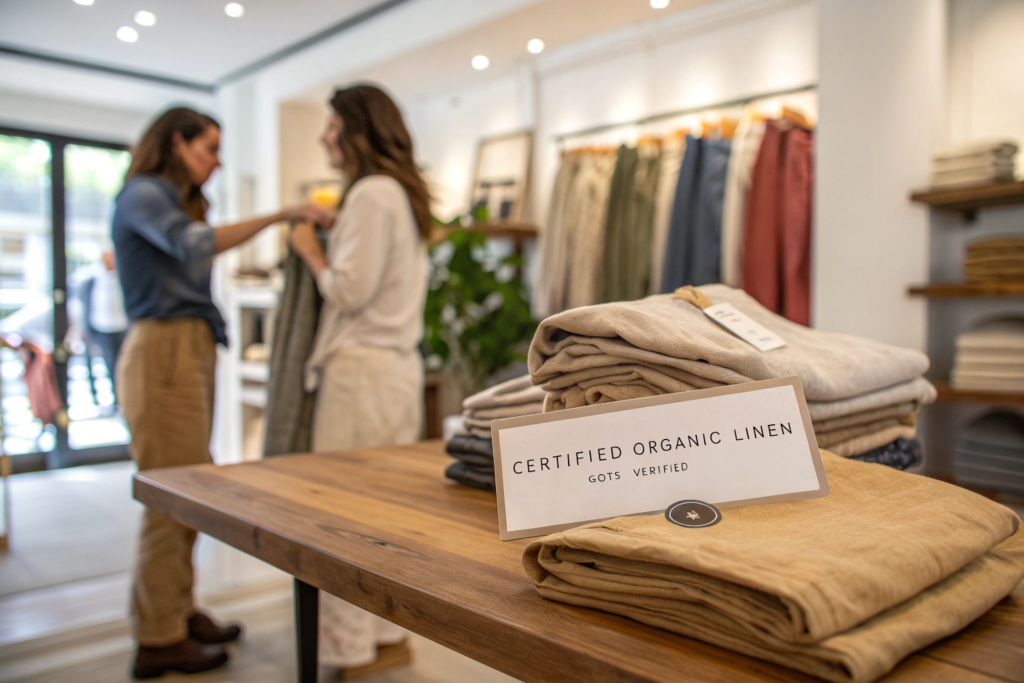
GOTS certification is the global gold standard for organic textiles, covering both the organic status of the flax fiber and the social conditions of the workers processing it. It allows you to place the GOTS logo on your hangtag, which immediately signals to retailers and consumers that the product has passed an annual audit cycle tracing the fiber from field to finished garment. Without it, you cannot legally use the word "organic" on your labeling in many jurisdictions.
What Is the Difference Between a GOTS Transaction Certificate and a Supplier’s "GOTS Material" Claim?
This is the most widespread fraud in the organic linen market. A supplier claims, "Our fabric is GOTS certified." They might even show you a GOTS certificate. But the certificate belongs to the spinning mill, not to the garment factory. The fabric was woven by an uncertified weaver, dyed in an uncertified dye house, and sewn in an uncertified factory. The organic integrity broke at the first step after the yarn left the spinner. This product is legally not GOTS. You cannot put the GOTS logo on the hangtag.
The authentic proof is a transaction certificate, or TC. A TC is issued for each stage of production and travels with the goods. The certified flax farm sells to a certified spinner, who issues a TC. The spinner sells to a certified weaver, who issues a TC. The weaver sells to a certified garment factory, like Shanghai Fumao, and we issue the final TC to you. This creates an unbroken chain of custody. You can verify a GOTS operator by searching their name or license number on the GOTS public database. A retailer who is serious about their organic claims will ask for this TC chain. If you cannot produce it, they cannot accept the goods. I recall a conversation with a San Francisco-based boutique chain buyer in 2023. They were evaluating two linen pant suppliers. Supplier A offered "GOTS material" at a lower price. Supplier B, us, offered a full GOTS transaction certificate. The buyer told me, "My customers read labels. If a customer challenges my organic claim and I don’t have the paperwork, my reputation is destroyed. I will pay the extra 8% for the legal safety." The transaction certificate is not paper. It is insurance for your marketing claims.
Why Are Social Compliance Audits Becoming a Retailer Requirement?
Beyond the fiber, retailers are increasingly demanding proof that the people who made the pants were treated fairly. The collapse of a garment factory building, the exposure of forced labor in a supply chain, these stories travel globally in hours. A retailer cannot afford to be associated with a supplier who violates basic human rights. Their ESG commitments, their public pledges, and increasingly, their legal obligations under laws like the German Supply Chain Due Diligence Act, require them to audit their supply chain.
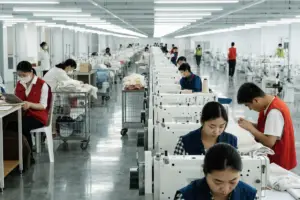
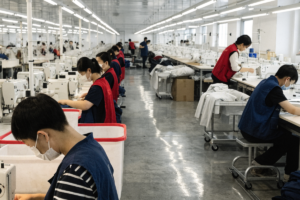
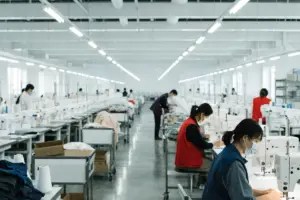
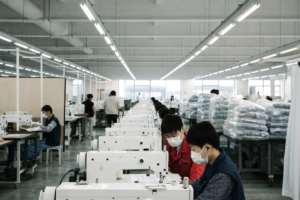
Social compliance audits like SMETA, BSCI, or SA8000 are becoming standard order qualifiers. An auditor visits the factory, inspects the fire exits, checks the payroll records for minimum wage compliance, interviews workers privately, and verifies that no child labor is used. At Shanghai Fumao, we hold an active BSCI audit report with a "B" rating. We share this report with any prospective client who signs a non-disclosure agreement. We do not hide our audit history. A BSCI audit overview explains the rigorous scope of the assessment. The audit is not a one-time event. It is an annual cycle of improvement. A factory that refuses an audit or only offers a self-assessment questionnaire is almost certainly hiding a violation. That violation, when discovered by a journalist or a customs enforcement agency, will attach to your brand, not just the factory’s. The cost of an ethical audit is embedded in the factory’s overhead, reflected in the per-unit price. A pant made in a factory with fire alarms, living wages, and overtime limits costs more to produce. The alternative is a pant made in a shadow factory where the true cost is paid by a worker you will never meet, and the reputational bill eventually arrives at your company’s headquarters.
How Do Quality Management Certifications Reduce Your Defect Rate?
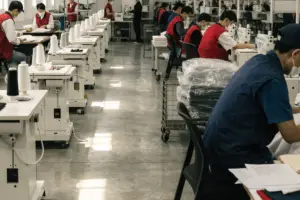
You can have the safest, most ethically made linen pants in the world. If the seams split when the customer sits down, or the left leg is two inches wider than the right leg, the pants are coming back. Quality is not a subjective opinion. It is a statistical measurement. Factories that operate without formal quality management systems rely on the owner’s eye. The owner walks through the sewing floor, picks up a garment, and says, "Good," or, "Fix this." This is inspection by mood. It is unpredictable. A factory that holds an ISO 9001 certification has been audited by an external body and has proven that it operates a documented quality management system with defined processes, corrective action procedures, and continuous improvement cycles.
ISO 9001 certification proves that a factory has a documented, audited quality management system, while adherence to AQL standards provides a statistical, mutually agreed-upon sampling method for accepting or rejecting a shipment. Together, they transform quality from a subjective argument into an objective, measurable outcome where a "pass" or "fail" is determined by pre-agreed numbers, not by a supplier’s assurance.
How Does an AQL Standard Prevent the "It Was Good Enough When It Left" Defense?
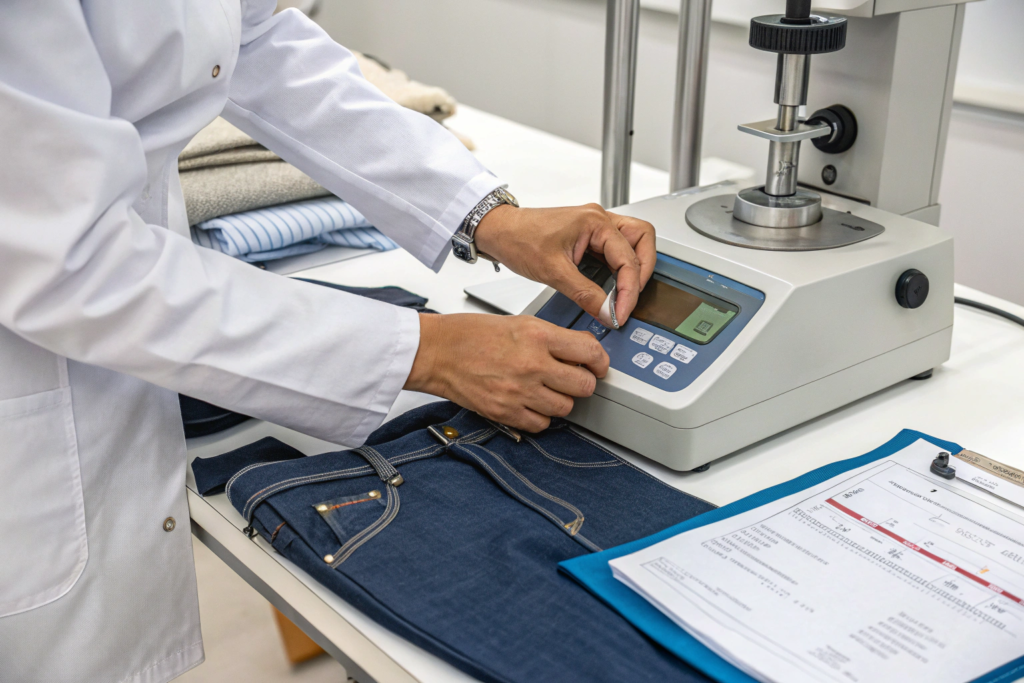
The most frustrating conversation a buyer can have with a supplier is: "The pants arrived with stains and loose threads!" followed by the supplier’s response: "Our QC checked everything and it was fine." This is a "he said, she said" argument that wastes time and kills trust. The AQL standard eliminates this ambiguity. AQL stands for Acceptable Quality Limit. It is a statistical sampling method defined in ISO 2859. You and the supplier agree on an AQL level before production starts. For apparel, the industry standard is AQL 2.5 for major defects and AQL 4.0 for minor defects.
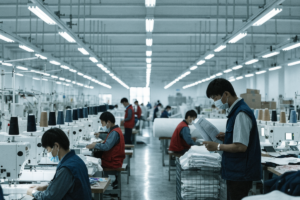
The inspector randomly selects a specific number of garments from the shipment based on the total lot size. They inspect each sampled garment against a defined defect list. If the number of defective garments exceeds the acceptance number for the agreed AQL, the entire lot fails the inspection. The supplier must then perform a 100% inspection, rework the defects, and re-submit for inspection. This process is objective. It removes the supplier’s personal opinion. I have seen this standard save a distributor client of ours from a disastrous shipment in 2024. The factory they had used previously argued, "The defects are small, you can still sell them." When they moved the order to us, we shipped under a signed AQL 2.5 agreement with a third-party inspection service. The inspector’s report is the final word. The AQL inspection standards guide explains how the sampling tables work. You must specify AQL in your purchase order. If the supplier resists signing an AQL agreement, they are reserving the right to ship you defective goods and argue about it later. A supplier who welcomes AQL is a supplier who is confident in their production.
Why Does ISO 9001 Signal a Factory That Invests in Long-Term Systems?
A factory that is just trying to survive this year does not invest in an ISO 9001 certification. The process is expensive. It requires hiring a dedicated quality manager, documenting every production procedure, conducting internal audits, and hosting external surveillance audits every year. A factory that commits to this standard is signaling financial stability and a long-term business horizon.
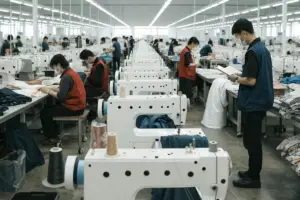
The practical benefit to you as a buyer is traceability. An ISO 9001 certified factory like Shanghai Fumao maintains detailed production records. If a defect pattern emerges—say, the hem stitching is failing on 3% of the pants—we can trace that defect back to a specific sewing machine, a specific operator, and a specific shift. We can then perform root cause analysis, retrain the operator, or service the machine. A non-certified factory cannot do this. They lack the records. The fix is a general, shouted instruction to "sew better," which does not solve the systemic problem. The ISO 9001 quality management principles include evidence-based decision making and continual improvement. When I decided to invest in this certification for our facility, it was a deliberate competitive choice. I wanted our U.S. brand clients to know that our quality control is not a person they have to trust. It is a system they can audit. You can request a copy of a factory’s ISO certificate and verify it on the issuing certification body’s website. A factory that has let its certificate expire, or that cannot produce a recent surveillance audit report, has abandoned the system. The system only works if it is maintained.
Conclusion
A certification is not a bureaucratic annoyance that adds cost to your linen pants. It is a three-layer armor that protects your business from three distinct threats. The first layer, safety certifications like OEKO-TEX and REACH compliance, shields you from legal penalties, port seizures, and the incineration of your inventory. The second layer, ethical certifications like GOTS transaction certificates and BSCI social audits, unlocks premium retail channels and allows you to make organic and ethical claims that your customers are actively searching for, without the risk of greenwashing accusations. The third layer, quality management certifications like ISO 9001 and AQL inspection agreements, transforms quality from a subjective debate into a statistical fact, slashing your return rate and protecting your distributor relationships.
At Shanghai Fumao, we do not treat certifications as sales brochures. We treat them as operational infrastructure. Our compliance team monitors the REACH candidate list. Our production records feed the ISO audit cycle. Our fabric sourcing is chained through GOTS transaction certificates. We do this because I have seen the incinerator at the port, and I decided that no client of mine would ever stand there watching their season turn to ash. If you are sourcing linen pants and you are currently looking at a supplier’s certificate list with uncertainty about what is real and what is a photocopy, I am happy to help you audit those documents. Send me the certificates your current supplier provided, and I will walk you through the verification steps. Or, if you are ready to work with a partner whose certifications are independently verifiable and annually renewed, reach out to me. My name is Elaine, my email is elaine@fumaoclothing.com. Let’s build a supply chain that is safe, ethical, and measurable, not just hopeful.