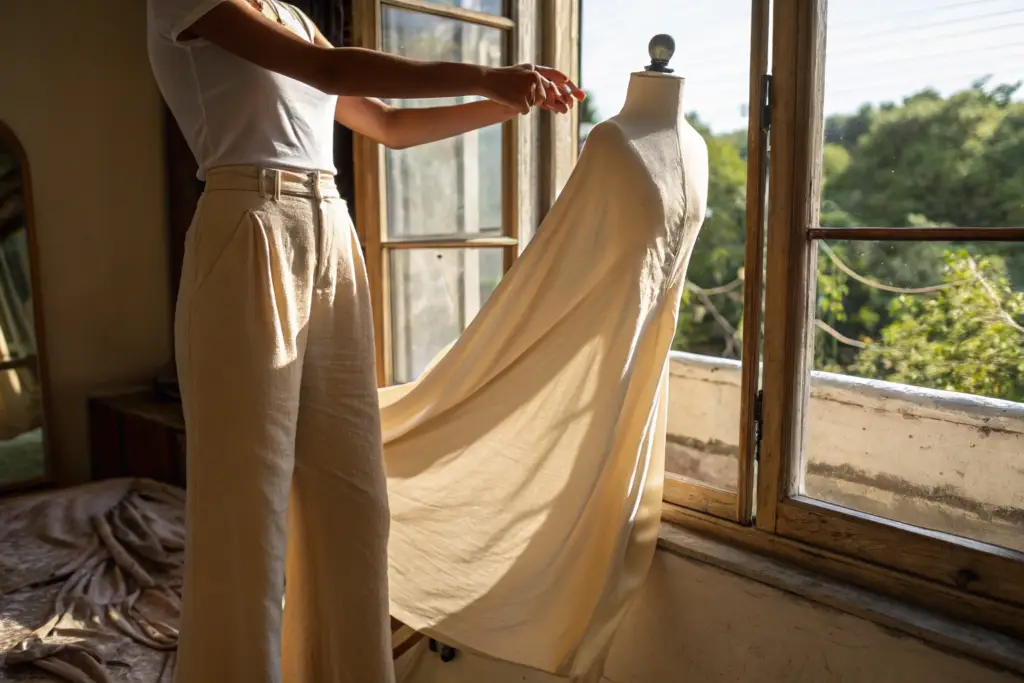
A brand owner from Miami showed me a return last July. It was a linen wide-leg pant she had sourced from a cheap supplier. The customer had worn it once. Washed it once. The fabric had shrunk three inches in length. The seams were puckered. The surface was covered in tiny pills, like a worn-out sweater. The pant looked five years old after one wash. She had sold it as "premium linen." The customer left a one-star review that said, "This is not linen. This is a scam." The brand owner lost the customer. She lost the trust of everyone who read that review. She learned the hard way that not all linen is equal. The word "linen" on a label means nothing if the fiber behind it is low-quality.
High-quality linen for summer wide-leg pants is defined by four factors: the origin and length of the flax fiber, the weave density measured in grams per square meter, the type of finishing wash applied, and the fabric's shrinkage and pilling resistance. Long-staple European flax woven at 180 to 210gsm, with an enzyme wash finish and a pre-shrunk treatment, produces a pant that drapes beautifully, breathes efficiently, and ages gracefully. Cheap, short-staple linen woven loosely at 130gsm will deform, tear, and disappoint after the first wash.
I have sourced linen fabric from mills across China and Europe for over 15 years. I know the difference between a $3 per meter linen and a $8 per meter linen. I know which one belongs in a $28 fast-fashion pant and which one belongs in a $128 boutique pant. Let me show you exactly what makes linen high-quality so you can specify it correctly and sell it confidently.
Why Does Flax Fiber Origin and Staple Length Matter Most?
Linen is made from the flax plant. The quality of the linen begins in the soil where the flax grows. The climate, the rainfall, the soil composition, and the harvesting method all imprint themselves on the final fabric. A pant made from French flax does not feel the same as a pant made from Chinese flax or Indian flax. The difference is not marketing. It is botany.
The highest quality linen comes from long-staple flax fibers grown in a cool, moist maritime climate. The coastal region stretching from Northern France through Belgium and the Netherlands is the global gold standard. The long, fine fibers produce a yarn that is strong, smooth, and resistant to pilling. Short-staple flax, often grown in drier, hotter regions, produces a weaker, rougher yarn that pills easily and feels scratchy against the skin. The staple length is the single biggest predictor of linen quality.
When I source linen for my clients, I ask the mill two questions first: "Where was the flax grown?" and "What is the average staple length?" The answers determine the price and the quality tier.
What Is the Difference Between European and Asian Flax?
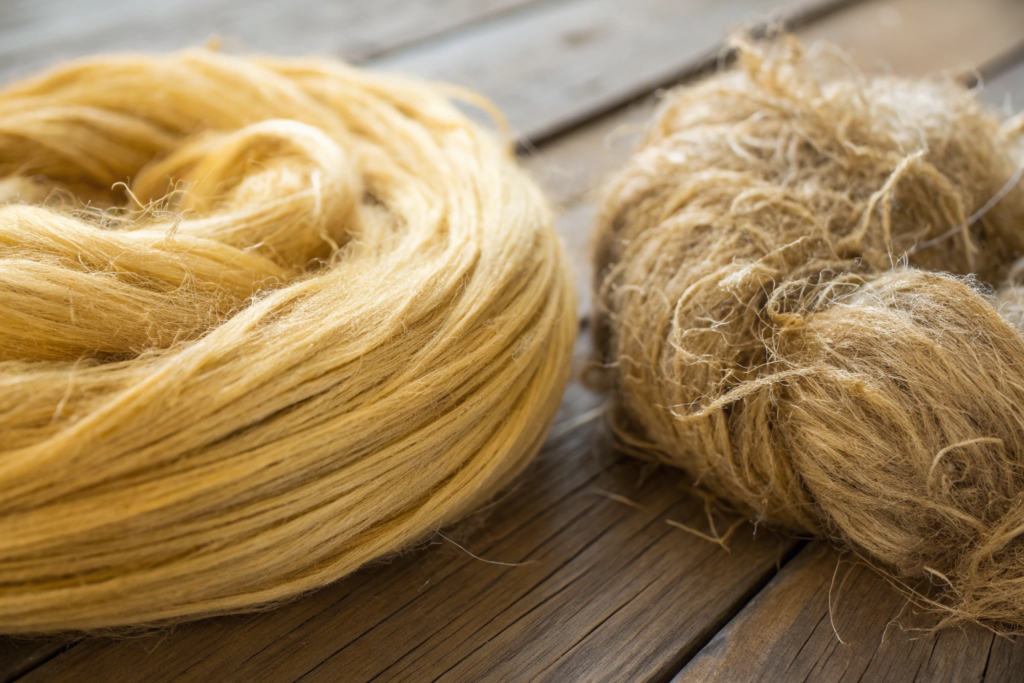
European flax, specifically from the Normandy region of France and the Flanders region of Belgium, benefits from a unique climate. The winters are mild and wet. The summers are cool. The soil is rich and well-drained. The flax plants grow tall and straight, reaching over a meter in height. The fibers inside the stalks are long, sometimes 80 to 100 centimeters. Long fibers spin into a fine, even yarn with high tensile strength. The fabric woven from this yarn is smooth, lustrous, and gets softer with every wash.
Asian flax, primarily grown in China in the Heilongjiang and Hunan provinces, is more variable. Some Chinese flax is excellent. Some is medium-grade. The climate is more extreme, with hot summers and cold winters. The fibers are shorter on average, typically 40 to 60 centimeters. Shorter fibers spin into a slightly rougher, less even yarn. The fabric has more slubs and a less consistent surface. This can be a desirable aesthetic for a rustic, textured look. But it is objectively a lower grade of fiber.
Indian flax is grown in the Himalayan foothills and Gujarat. It is typically short-staple and coarse. It has a very rustic, earthy character. Some boutique brands love this for its authenticity. But it is not a premium, soft-hand-feel linen.
At Shanghai Fumao, I offer my clients a choice. We can source European flax for a premium, soft, luxury pant. Or we can source high-grade Chinese flax for a more affordable, textured pant. I am transparent about the origin. The price reflects the fiber. A European flax linen pant has an FOB cost roughly 20% to 30% higher than a Chinese flax pant. The customer feels the difference in the drape and the softness.
How Does Staple Length Affect Pilling and Durability?
Pilling is the formation of small, fuzzy balls on the surface of the fabric. It happens when short fibers in the yarn break loose, tangle together, and form pills. Long-staple linen has very few short fibers. The yarn is composed of long, continuous filaments. There are almost no loose ends to break free. The fabric resists pilling for years. A long-staple linen pant looks new after ten washes. A short-staple linen pant starts to pill after three washes.
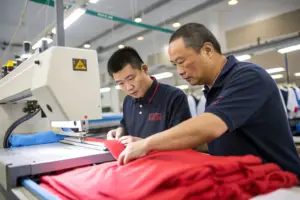
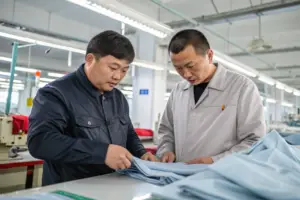
You can test the staple length yourself. Take a fabric swatch. Rub the surface vigorously with your thumb 20 times. Look at the surface. Does it look fuzzy? Do you see tiny balls forming? High-quality long-staple linen shows almost no change. Low-quality short-staple linen fuzzes immediately. I do this test on every new fabric lot that arrives at my factory. I call it the "thumb test." It takes five seconds. It predicts the customer's experience after a month of wear.
I had a client who sourced linen from a cheap Indian mill. The pants looked beautiful in the e-commerce photos. The returns started coming in after six weeks. "The fabric is pilling." "It looks worn out." The short-staple fiber was the invisible culprit. He switched to our long-staple European flax linen. The returns stopped. His repeat purchase rate went up. The fabric cost him $1.20 more per pant. It saved his brand's reputation.
What Is the Ideal Fabric Weight and Weave for Summer Wide-Leg Pants?
The weight of the linen determines how the pant hangs. Too light, and the pant becomes a sheer, flimsy curtain. Every pocket outline is visible. The wind blows the leg up. It looks cheap. Too heavy, and the pant loses the summer breathability. It becomes a stiff, hot, canvas-like shell. The wide-leg silhouette especially demands the right weight. The fabric must have enough body to hold the shape, but enough fluidity to move gracefully.
The ideal fabric weight for a summer linen wide-leg pant is between 170gsm and 210gsm. Below 160gsm, the fabric becomes too sheer and lacks the structural integrity for a tailored wide-leg shape. Above 230gsm, the fabric loses its summer lightness and can feel stiff and warm. The weave should be a plain weave or a subtle twill, not a loose, open weave that catches and snags easily.
At Shanghai Fumao, 190gsm is the most popular weight for boutique clients. It is the Goldilocks weight. Not too heavy. Not too light. It drapes in soft folds without collapsing.
How Does GSM Translate to Real-World Wearability?
GSM stands for grams per square meter. It is the physical weight of the fabric. A 130gsm linen is like a lightweight shirt. Hold it up to the light. You can see your hand through it. Make a wide-leg pant from this fabric, and you can see the pocket bags, the thigh, and the underwear line. The pant is a beach cover-up, not a trouser.
A 190gsm linen is like a mid-weight shirting. Hold it up to the light. It is opaque. The fabric has presence. When you drape it, it holds a soft shape. It skims the body without clinging. The pockets are invisible from the outside. The pant can be worn to a restaurant, not just the beach.
A 250gsm linen is like a lightweight jacket fabric. It is heavy. It holds a very structured shape. The wide-leg silhouette becomes architectural. But in 90-degree summer heat, it feels substantial. The airflow is reduced because the fabric is dense.
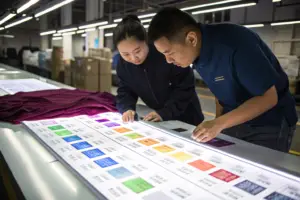
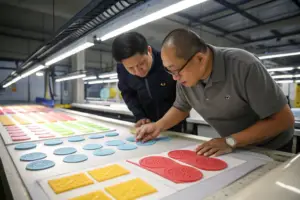
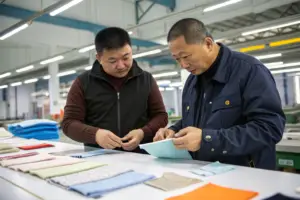
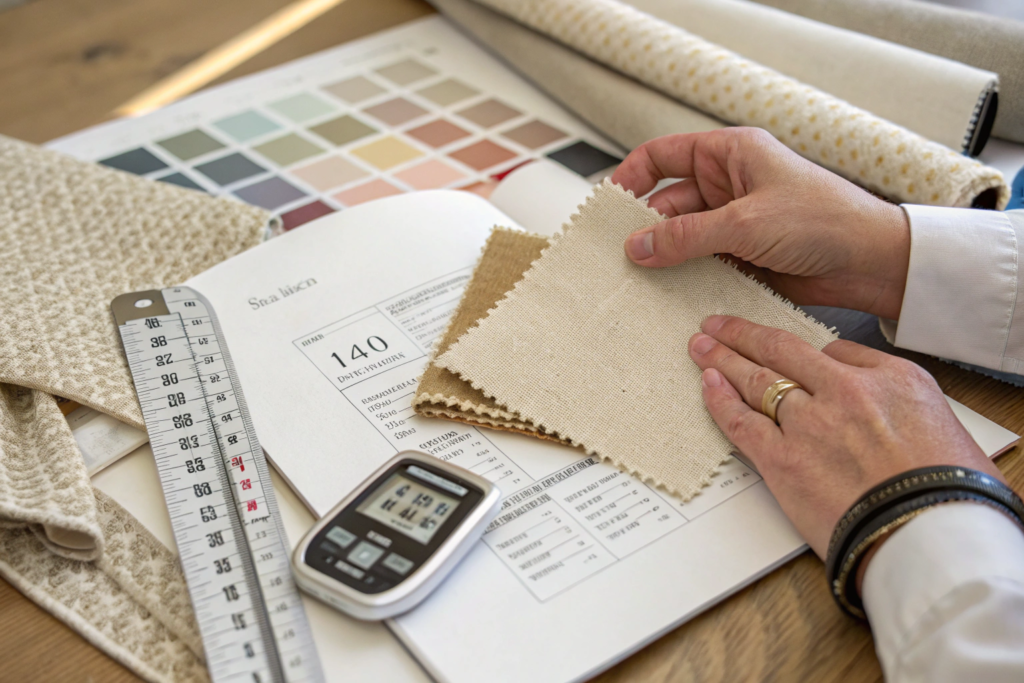
I show my clients a weight sample card. Four swatches of the same natural linen in 150gsm, 180gsm, 210gsm, and 250gsm. I drape each one over my hand. The visual difference is immediate. Most clients choose 180 or 210. The 150 looks cheap. The 250 looks like a winter pant.
Why Does the Weave Type Matter for Drape and Snagging?
Linen is traditionally a plain weave. The warp and weft yarns cross over and under each other in a simple grid. This creates a stable, durable fabric that breathes well. The plain weave is the classic linen texture. It has a crisp hand feel that softens with washing.
A loose, open weave is sometimes used for very lightweight linen. The yarns are spaced further apart. This creates a gauzy, sheer fabric. It breathes extremely well. It also catches on everything. A fingernail. A door handle. A piece of jewelry. A loose-weave linen pant will snag and pull threads constantly. It looks destroyed after a few wears.
A twill weave has a diagonal pattern. It is more dense and drapable. Linen twill is less common but works very well for wide-leg pants. The diagonal structure gives the fabric a fluid, liquid drape. It resists wrinkles slightly better than plain weave.
For a boutique brand selling a premium summer pant, I recommend a plain weave European flax linen at 190gsm. It is the standard for a reason. It behaves predictably. It photographs beautifully. It wears durably. It is the fabric that built the modern linen pant category.
How Do Finishing Processes Transform Linen's Feel and Performance?
Raw linen straight off the loom is not ready for a garment. It is stiff. It is scratchy. It has a rough, boardy hand feel. It shrinks unpredictably. It has a yellowish-grey natural color. The finishing processes transform this raw material into the soft, supple, stable fabric that a customer wants to wear against their skin. The finishing is what you pay for. It separates a premium linen pant from a budget one.
The most important finishing processes for high-quality linen are enzyme washing, pre-shrinking, and softening. Enzyme washing uses natural enzymes to eat away the surface fuzz and soften the fibers without chemicals. Pre-shrinking stabilizes the fabric dimensions so the pant does not shrink three inches after the first wash. Softening treatments, either mechanical or silicone-based, give the linen a buttery hand feel that upgrades the perceived value instantly.
A linen pant that is not enzyme-washed feels like a tablecloth. A linen pant that is enzyme-washed feels like a cloud.
What Is Enzyme Washing and Why Does It Matter?
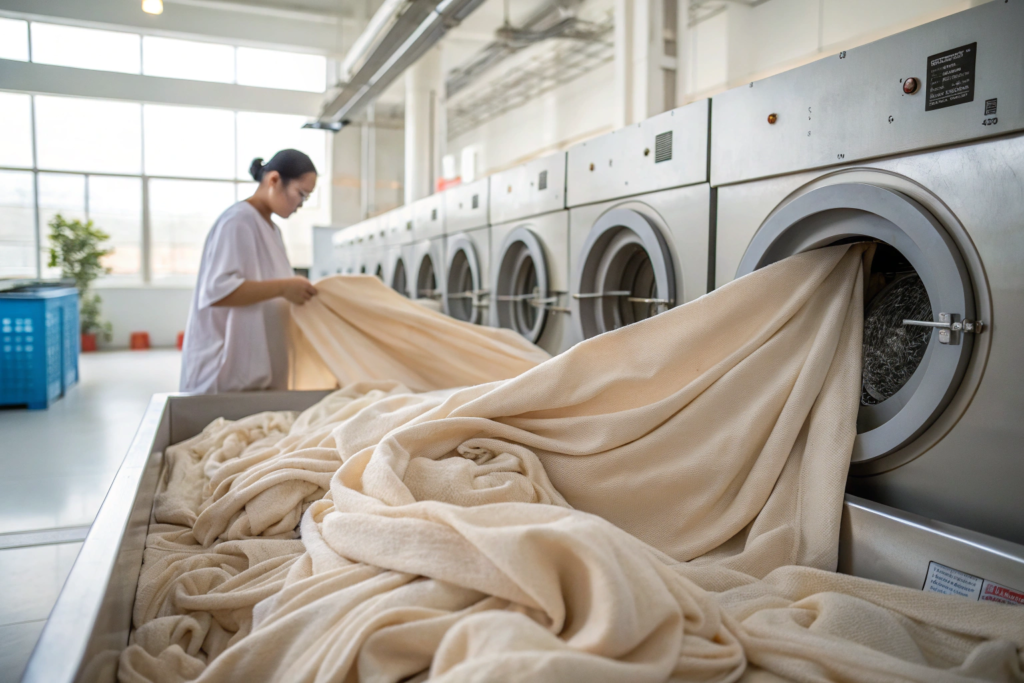
Enzyme washing is a natural, biodegradable process. Enzymes are proteins that act as biological catalysts. A specific enzyme called cellulase is applied to the linen fabric in a warm water bath. The cellulase eats the tiny, microscopic fuzz on the surface of the fibers. It smoothes the yarns. It softens the fabric. It also gives the fabric a subtle, "lived-in" appearance. The color becomes slightly muted and dimensional, like a favorite pair of pants that has been washed a hundred times.
The result is a fabric that is incredibly soft against the skin. It feels broken-in on day one. It does not feel like it needs to be "worn in." The enzyme wash also reduces pilling because the loose surface fibers are removed before they can tangle into pills.
Cheap linen skips the enzyme wash. It relies on a simple water wash or a light chemical softener. The softness is temporary. It washes out after two laundry cycles. The fabric returns to its stiff, scratchy state. The customer feels the difference immediately. "Why are my new linen pants so rough?" The answer is a lack of enzyme finishing.
At Shanghai Fumao, all of our linen wide-leg pants for boutique brands are enzyme-washed. It adds about $0.40 to the fabric cost per meter. It is the best $0.40 you can spend.
How Is Pre-Shrinking Done Correctly?
Linen shrinks. It is a natural fiber. It absorbs water and swells, which causes the yarns to shorten. A linen pant that is not pre-shrunk will lose 5% to 7% of its length after the first wash. A 40-inch inseam becomes a 37.5-inch inseam. The pant is ruined.
Pre-shrinking is done in one of two ways. The best method is mechanical shrinkage, also called compressive shrinkage or Sanforizing. The fabric is fed through a machine that compresses it lengthwise while it is damp. This mechanically forces the shrinkage to happen before cutting. The fabric is stabilized. The residual shrinkage is less than 2%.
The second method is a simple wash-and-dry. The fabric is washed in hot water and tumble-dried on high heat. This is effective but less precise than mechanical shrinkage. The shrinkage is fully released, but the fabric surface can become too rumpled and require additional pressing.
I specify mechanical pre-shrinking for all my linen fabric. The mill certificate must show a residual shrinkage of less than 3% in both warp and weft directions. I test every lot myself with the cut-square wash test I described in another article. If the shrinkage exceeds 3%, the fabric is rejected. The pattern is adjusted for the exact shrinkage percentage of the approved lot. The finished pant fits the size chart after the customer washes it at home. This is basic quality control. It is shocking how many factories skip it.
How to Test and Verify Linen Quality Before Production?
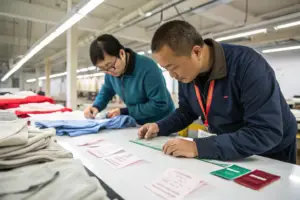
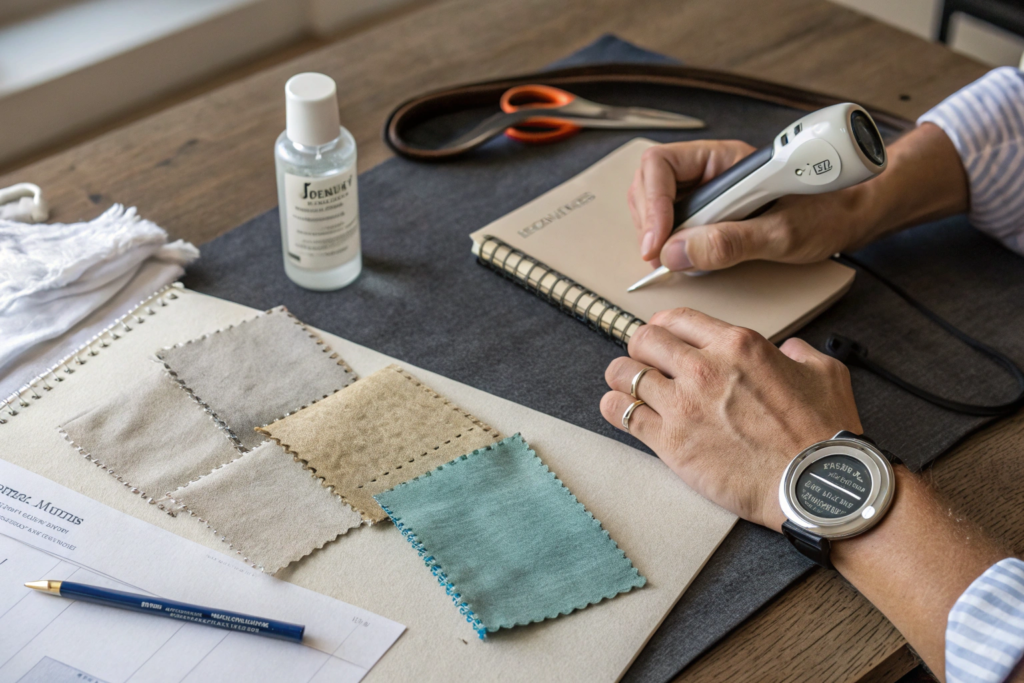
You have the swatch. You have the mill certificate. Now you must verify the quality yourself before you commit to 3,000 units. The mill certificate is a promise. The swatch is evidence. Your own tests are the confirmation. You don't need a laboratory. You need a sink, a towel, and your eyes.
The three home tests that verify linen quality are the rub test for pilling, the wash test for shrinkage, and the drape test for hand feel. Rub the fabric vigorously 20 times. Wash it in warm water and measure it before and after. Drape it over your hand and watch how it falls. High-quality linen shows minimal surface change, shrinks less than 3%, and drapes in soft, fluid folds without stiffness.
These tests take 20 minutes. They will tell you more than any certificate.
How Do You Perform a Simple Wash and Shrinkage Test?
Take your swatch. Measure it carefully. Write down the length and width in inches or centimeters. Put it in your washing machine with a small load of laundry. Use warm water. Use your regular detergent. Dry it on medium heat in your dryer. This mimics the customer's home laundry cycle. Real-world conditions, not lab conditions.
Measure the swatch again. Calculate the percentage shrinkage. If the swatch shrank more than 3%, the fabric is not properly pre-shrunk. The production pants will shrink. Your customers will return them. Also, look at the surface after washing. Is it pilling? Are the seams puckering? Is the color fading unevenly? The washed swatch is the truth. The unwashed swatch is a promise.
I do this test on every new fabric lot. I tell my clients to do it on the pre-production sample pant. Put the whole sample through the wash and dry cycle. Wear it for a day. Does it stretch out at the knees? Does the waistband elastic recover? A sample that looks good on a hanger is not validated. A sample that looks good after a day of wear and a wash cycle is validated.
What Does the Drape Test Reveal About Linen Quality?
Take the swatch. Hold it in the air by one corner. Let it fall. Watch how it moves. High-quality linen has a fluid, liquid drape. It falls in soft, undulating folds. It does not stick out stiffly. It does not collapse into a crumpled heap.
Now drape the swatch over your fist. Pull it gently. Does it glide smoothly? Does it resist and then suddenly slip? The way the fabric moves over a curved surface predicts how the wide-leg pant will move around the body when walking. A good summer pant has a fabric that skims, not clings. The drape test tells you this in seconds.
A client in Amsterdam sent me a video of her drape test on two swatches. One was my 190gsm European linen. The other was a cheap 160gsm linen from a competitor. The cheap linen fell like a tissue. It had no weight, no movement. My linen fell like water. Soft, heavy, fluid. She chose my fabric. Her collection was called "Liquid Linen." It sold out. The fabric did the marketing for her. The drape was visible in every photo and video. The customer could see the quality before they clicked "add to cart."
Conclusion
High-quality linen for summer wide-leg pants is a chain of intentional choices. It starts in a flax field in Normandy, where the climate produces long, fine fibers. It continues at a mill that weaves these fibers at a 190gsm plain weave, dense enough for opacity and drape, light enough for summer airflow. It transforms in the finishing plant, where enzyme washing softens the fabric without chemicals and mechanical pre-shrinking stabilizes the dimensions. It is verified by a simple wash test and drape test on a physical swatch. Every link in the chain is visible in the final pant.
A cheap linen pant looks good on a website and disappoints after one wash. A high-quality linen pant looks good on day one and looks even better on day one hundred. The customer becomes a repeat buyer. The brand builds a reputation for quality. The fabric is the foundation of that reputation.
If you want to feel the difference yourself, I can send you a quality sample kit. It includes swatches of our 190gsm enzyme-washed European linen, our standard Chinese linen, and a budget linen for comparison. You can do the rub test, the wash test, and the drape test at your desk. Our Business Director, Elaine, will arrange the kit. Email her at elaine@fumaoclothing.com. Ask for the Linen Quality Sample Kit. Feel the difference. Then let's design a summer wide-leg pant that your customers will wear for years, not weeks.