A brand owner in Texas sent me a certificate last year. It was an OEKO-TEX Standard 100 document from a factory in another Asian country. The price was great. The certificate looked real. The logo was there. The stamp was there. But one number was wrong. The certificate number was 8 digits. Real OEKO-TEX certificates have 9 digits with a specific check digit algorithm. I told him to call the issuing body. The certificate was fake. The factory had copied a real certificate and changed the company name. He almost wired $25,000 to a factory that had no organic certification, no safety testing, and no accountability. That certificate was not a document. It was a trap.
Spotting a fake certificate requires three verifications: checking the certificate number directly on the issuing body’s official online database, examining the document for internal consistency in dates, logos, and formatting, and cross-referencing the factory name and address on the certificate with the actual business license and bank account. A certificate is only real if an independent third party confirms it is real.
I have been dealing with apparel certifications for 15 years. I know what a real document looks like. I know the tricks fake factories use. I want to give you the tools to verify every certificate yourself, without relying on the supplier’s word.
What Are the Most Commonly Faked Certificates in Linen Sourcing?
Not every certificate is worth faking. Fraudsters target the certificates that buyers ask for most often. They know that a small brand owner has heard of "OEKO-TEX" and "GOTS" from a trade show or a podcast. They know the buyer will ask, "Do you have the certificate?" and then accept a PDF without further checking. The fake certificate is a shortcut to closing the deal. It is a piece of paper that says, "You can trust me."
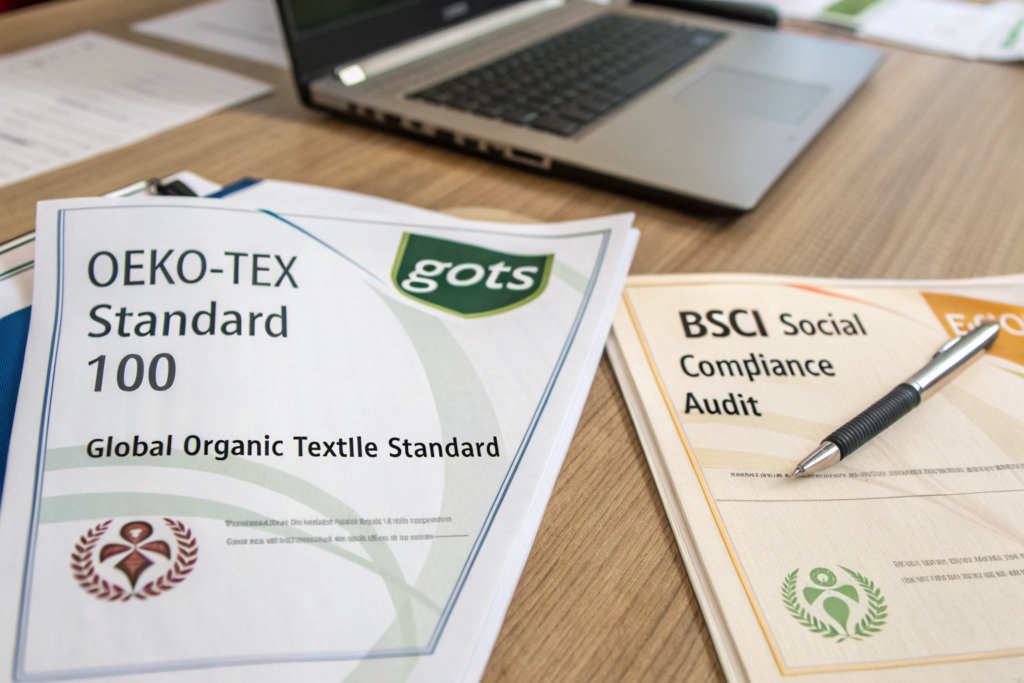
The most commonly faked certificates are OEKO-TEX Standard 100, GOTS (Global Organic Textile Standard), and BSCI social compliance audit reports. These are faked because they carry high marketing value, they are requested by Western buyers, and the faker assumes the buyer will not verify the document with the issuing body. Fake ISO 9001 certificates also appear, but they are less common because ISO is easier to verify through public registries.
The faker’s strategy is psychological. They present the certificate early in the conversation. It lowers your defenses. You think, "They have the certificate, so they must be legitimate." This is the exact wrong conclusion. The certificate itself must be verified. The presence of a document is not proof. The validation of the document is proof.
Why Is OEKO-TEX Standard 100 a Prime Target for Fraud?
OEKO-TEX is the most recognized textile safety standard in the world. It tests for harmful substances. A brand puts the OEKO-TEX logo on their hangtag. The customer sees it and feels safe. This is why a fake OEKO-TEX is so damaging. It sells a safety that does not exist.
A real OEKO-TEX certificate has a specific format. It lists the product class, the test institute that issued it, and a unique certificate number. The number is always in the format "XX 000 000000" or similar, depending on the issuing institute. The certificate is valid for one year. After one year, it must be renewed. A fake certificate often has an old date, or a date that extends far into the future, or a number with the wrong format. I saw a fake certificate last year from a supplier claiming to have OEKO-TEX. The certificate number was "12345678." A real OEKO-TEX number from most institutes contains a country code prefix and a specific digit count. The number itself was nonsense. The buyer had not checked. He had just seen the logo and felt reassured. The lesson is simple: the logo means nothing. The number means everything. And the number must be verified on the official OEKO-TEX website.
How Do Fake GOTS Certificates Mislead Eco-Conscious Brands?
GOTS is the gold standard for organic textiles. It certifies the entire supply chain, from the flax field to the finished garment. A fake GOTS certificate is a direct attack on an eco-conscious brand’s integrity. The brand markets their pants as "GOTS-certified organic linen." A customer or a journalist checks. The certificate is fake. The brand is accused of greenwashing. The reputational damage is worse than the financial loss.
The fraud works because GOTS has a complex supply chain. A factory might have a real GOTS certificate for one production line but not for another. Or they might show a GOTS certificate from their fabric supplier, not from their own factory. The certificate is real, but it does not cover the specific pants they are selling you. This is a "certificate misrepresentation," not a forgery. It is equally deceptive.
A real GOTS certificate has a license number. It is issued by an approved certification body like Ecocert, Control Union, or Soil Association. You can check the license number on the GOTS public database at global-standard.org. The database shows the company name, the address, the product categories, and the validity date. If the supplier’s name does not match exactly, the certificate is not valid for that supplier. A client in Vancouver showed me a GOTS certificate from an Indian supplier. The name on the certificate was "ABC Textiles Ltd." The name on the supplier’s invoice was "ABC Garments Pvt Ltd." They sounded the same. They were not. The certificate belonged to a different company in the same group. The supplier was misrepresenting the coverage. We caught it. The client sourced with us instead. The due diligence saved his brand from a false organic claim.
How Can You Verify a Certificate Directly with the Issuing Body?
The single most powerful verification step is also the least used. Go to the source. Every legitimate certification body has a public online database. You type in the certificate number. You see the company name, the scope, and the validity date. If the number does not return a result, the certificate is fake. If the name or address does not match, the certificate is being misused. This check takes 5 minutes. It can save $50,000.
Verify a certificate by opening a browser, navigating to the official website of the issuing body, and entering the certificate number in their public validation tool. Do not click a link in the supplier’s email. Do not scan a QR code on the PDF. A sophisticated faker can create a fake verification website. You must type the URL yourself. The official OEKO-TEX and GOTS websites are the only sources of truth.
This is the digital equivalent of kicking the tires. I do it for every new trim supplier and fabric mill I onboard. You should do it for every factory you consider.
How Do You Use the OEKO-TEX Label Check Tool?
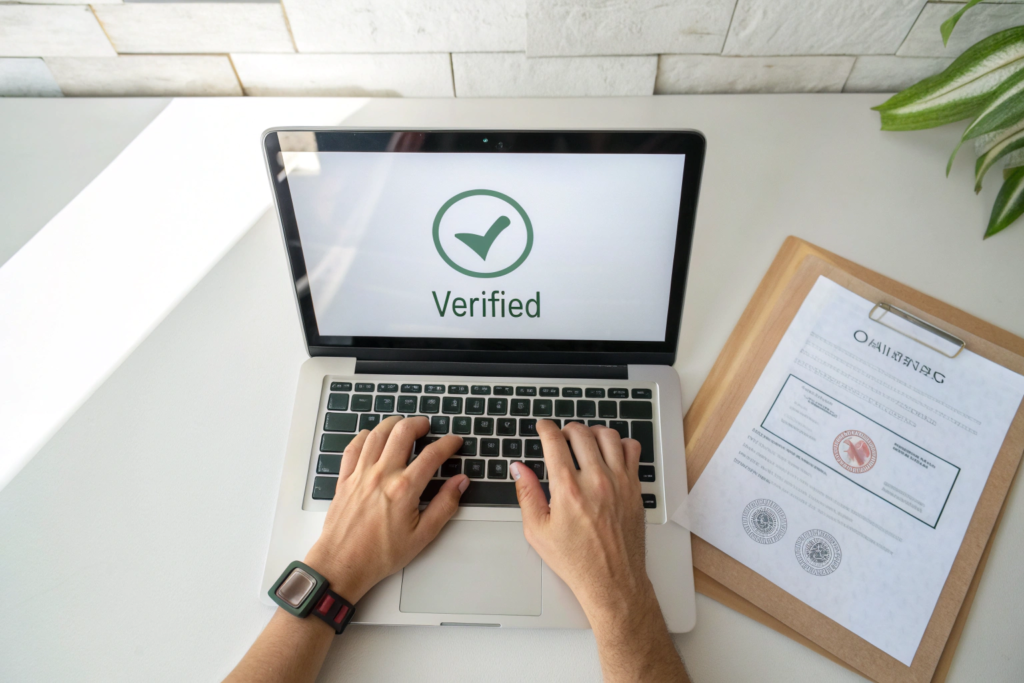
The OEKO-TEX website has a "Label Check" page. The URL is simple. You type in the certificate number exactly as it appears on the document. The system returns the company name, the product class, and the expiry date. If the certificate is valid, it says "Valid." If it is not, it says "Invalid." There is no gray area.
I recommend you check while you are on a video call with the supplier. Ask them, "Can you share your screen and show me the certificate on your computer?" Then, on your own screen, you type the number into the Label Check. You can see in real-time if the names match. A legitimate supplier will not hesitate. A nervous supplier will make excuses. "The website is down." "Our certificate is being renewed." "We can send it later." These are red flags. A certificate that is being renewed has a grace period, but it is documented. The issuing body can confirm it. Never accept a verbal explanation for a failed digital check. The database is the authority. The salesperson is not.
I did this check for a potential fabric supplier last year. The certificate number came back as "Valid," but the company name was a different entity. The supplier said it was their "sister company." I asked the certification body directly. The sister company was not covered. The certificate was being used fraudulently. I rejected the supplier. The digital check took 2 minutes. The consequence of trusting the PDF would have been a shipment of linen with no verifiable safety testing.
How Does the GOTS Public Database Work?
The GOTS database is similar but more detailed. It shows the scope of certification. This is critical for a linen pant. The scope tells you what exactly is certified. It might say "Spinning, Weaving, Finishing of Organic Linen Fabric." Or it might say "Cutting, Sewing, and Packing of Organic Apparel." Or both.
You need to check that the scope covers the actual work the supplier is doing for you. If the scope says "Fabric trading" but the supplier says they are a manufacturer, the certificate is not for manufacturing. They are a trader showing a mill’s certificate. This is a common trick. The certificate is real, but it is not theirs.
The GOTS database also shows the certification body that issued the certificate. You can contact that body directly. Send them an email. Attach the certificate. Ask, "Is this certificate currently valid for this company and for this scope?" The certification bodies are helpful. They want to stop fraud. A 5-minute email provides a definitive answer. I always tell my clients at Shanghai Fumao to call or email our certification bodies to verify our documents. I provide the contact information. A transparent supplier welcomes verification. A fraudulent supplier fears it.
What Visual Red Flags Exist on a Fake Certificate Document?
Before you even go to the database, you can often spot a fake just by looking at the document. The forgers are not graphic designers. They are impatient. They copy and paste logos. They use low-resolution images. They make spelling mistakes. The certificate is a visual product, and a fake one has visual defects.
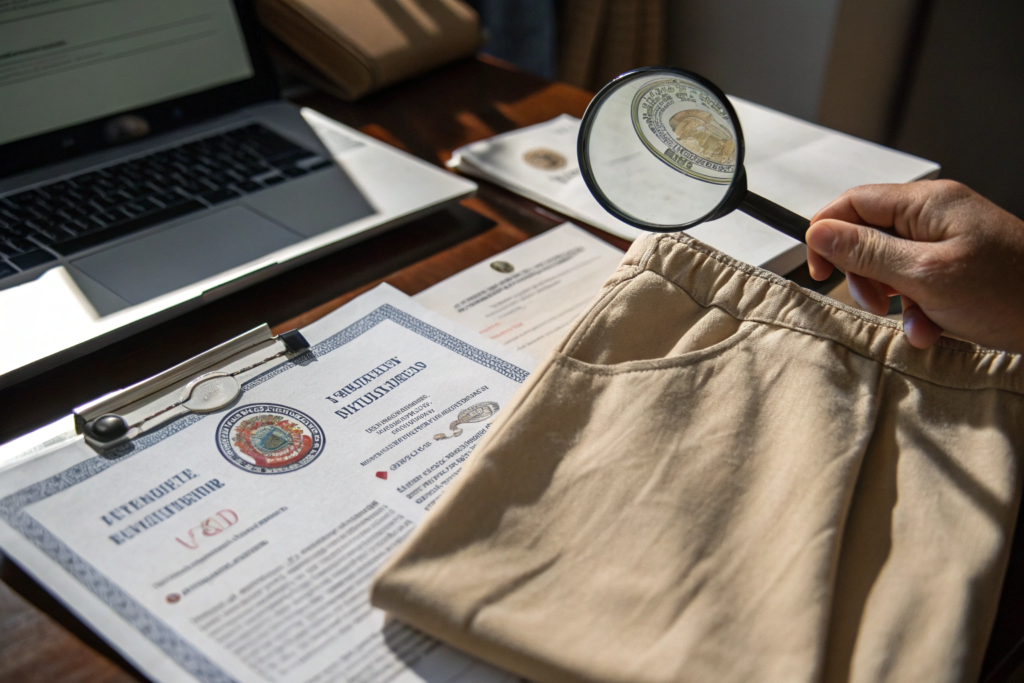
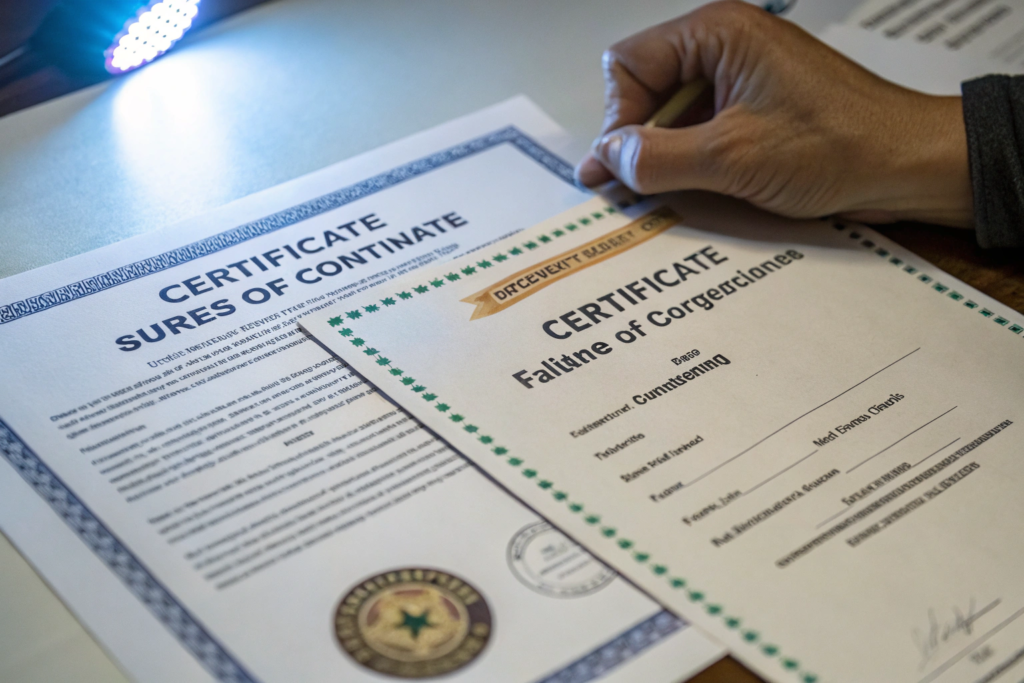
Visual red flags on a fake certificate include a low-resolution or stretched certification body logo, inconsistent fonts compared to a genuine sample from the body’s website, dates that don’t align with the certification body’s known issuance format, and signatures that appear to be printed rather than hand-applied. A genuine certificate has a professional, consistent typography and a hologram or embossed seal that is difficult to replicate.
Your eye is a detection tool. Train it on real certificates first.
How to Compare Logos and Fonts Against a Known Real Certificate?
Go to the official OEKO-TEX or GOTS website. Download a sample certificate or look at the visual guide. Pay attention to the logo. Look at the color. OEKO-TEX uses a specific shade of green. Fakers often use a generic green that is slightly off. Look at the font. The word "STANDARD 100" is in a specific typeface. A fake might use Arial or a close-but-not-exact font.
Look at the layout. Where is the certificate number placed? Where is the barcode? A real OEKO-TEX certificate has a barcode that scans to the certificate number. A fake certificate might have a blurry barcode that does not scan, or no barcode at all. Scan it with your phone. It should resolve to the correct number. If it scans to a different number or a dead link, it is fake.
Look at the issuing institute’s logo. OEKO-TEX certificates are issued by member institutes like Hohenstein, Testex, or Centexbel. Their logos are specific. A fake certificate might use a generic logo that says "OEKO-TEX Institute" without naming the specific member. Or the member institute logo is pixelated. A genuine certificate is a high-resolution PDF, not a scanned photocopy. Request the original digital file. If the supplier sends a grainy scan from a 10-year-old printer, be suspicious. A real factory invests in real compliance. They have the original documents.
Why Do Date Inconsistencies Signal a Fake?
Certification bodies have rules about certificate validity. OEKO-TEX certificates are valid for one year. GOTS certificates are also valid for one year, with an annual audit. BSCI reports are valid for two years. Look at the issue date and the expiry date.
I saw a fake GOTS certificate with an issue date of January 2023 and an expiry date of January 2027. GOTS does not issue a 4-year certificate. The validity period was impossible. The faker had just typed a date far into the future to make the certificate seem current. A genuine certificate has a realistic validity window. Also, look at the audit date on a BSCI report. If the report is dated December 25th, be suspicious. Factories do not undergo social compliance audits on Christmas Day. A date that falls on a major holiday or a weekend is a red flag. These small details are the fingerprints of a sloppy forger. A legitimate certificate is dated on a normal working day. The details matter because the faker is focused on the big elements—the logo, the name—and they overlook the small, logical inconsistencies. Your job is to find those inconsistencies.
How to Cross-Check Factory Details Beyond the Certificate?
A certificate is one piece of the puzzle. A clever faker can create a convincing fake certificate. But they cannot fake an entire physical factory. They cannot fake a bank account history. They cannot fake a video call walkthrough. Cross-referencing the certificate with other independent data points is the final verification layer. This is where the fraud collapses.
Cross-check the factory name and address on the certificate against three independent sources: the factory’s business license, the factory’s bank account registration, and a live video call showing the physical premises. The name must be identical across all four documents. A mismatch, even a small one, is a major red flag that requires a direct explanation from the certification body, not from the supplier.
This is the "full body scan" of supplier verification. It takes time, but it makes fraud almost impossible.

How to Match the Business License with the Certificate Details?
Every legitimate factory in China has a business license issued by the local Administration for Market Regulation. It has a unified social credit code, a legal representative name, a registered address, and a business scope. Ask for a copy of the business license.
Compare the company name on the business license with the company name on the certificate. They must be identical. Not similar. Identical. "Shanghai Fumao Garment Co., Ltd." on the license must match "Shanghai Fumao Garment Co., Ltd." on the certificate. If the license says "Shanghai Fumao Trading Co." and the certificate says "Shanghai Fumao Manufacturing Co.," the certificate is for a different legal entity. The factory is showing a certificate that does not belong to them.
Compare the addresses. The registered address on the license is the legal address of the company. The address on the certificate is the audited production site. They should match or be reasonably close. If the license address is a virtual office in a city center and the certificate address is a factory in an industrial zone, ask why. Maybe the factory is a branch. But the certificate should list the actual production site. A mismatch in addresses without a clear legal relationship is a sign that a trading company is showing a factory’s certificate. This is the most common certificate fraud in Asia. A trader buys products from an uncertified factory and shows you a certificate from a different, certified factory. You think you are buying from the certified factory. You are not.
Why Is the Bank Account Name a Critical Verification Point?
The final money trail. When you wire a deposit, the bank account name must match the business license name and the certificate name. A fraudulent supplier will often ask you to wire money to a personal account, or to a company in Hong Kong with a completely different name.
A legitimate factory receives payments into its corporate bank account. The account name is the company name. If the certificate says "XYZ Garment Co." but the bank account is "ABC Trading Ltd." in Hong Kong, you are not paying the certified factory. You are paying a middleman. The certificate is meaningless for your transaction. I have seen this trap many times. The price is low. The communication is smooth. The certificate looks real. But the bank account betrays the truth. The money goes to a shell company. The goods arrive with no verifiable compliance. The certificates are not valid for the actual producer. Always, always verify the bank account name against the certificate and the business license. This is the final, financial verification. A real Shanghai Fumao client knows that our invoice, our certificate, our license, and our bank account all carry the exact same legal name. Consistency is the proof of integrity. Inconsistency is the proof of deception.
Conclusion
A fake certificate is a weaponized piece of paper. It is designed to bypass your rational brain and trigger your trust reflex. The way to defeat it is to replace trust with verification. Check the certificate number on the official issuing body’s database. Look at the document with a forensic eye for logo quality, font consistency, and date logic. Cross-reference the company name, address, and bank account across four independent sources. A fraudster can fake one document. They cannot fake all of them.
This verification process is not about being paranoid. It is about being professional. A legitimate factory welcomes these checks. I encourage every new client to verify my certificates. I provide the direct links. I offer a live video call where we walk through the database together. A factory that is offended by verification is a factory that has something to hide.
If you are sourcing linen wide-leg pants and you want to start with a factory that passes every verification test, I invite you to check ours. Our Business Director, Elaine, can send you our current OEKO-TEX, GOTS, and BSCI certificates with instructions on how to verify each one yourself. Email her at elaine@fumaoclothing.com. Verify the numbers. Check the databases. Compare the names. Then, once you are satisfied that we are real, let’s talk about your collection. Your due diligence is your brand’s armor. Wear it proudly. We will be here, verified and ready, when you are.