You placed an order for 500 linen wide-leg pants in February. The factory promised delivery by April 15th. That was your spring launch window. April 15th comes. No tracking number. You email. No response for three days. Finally, a vague reply: "Fabric delay. New ship date is May 5th." May 5th passes. It is now May 20th. Your boutique accounts are furious. Your online store has "Sold Out" badges on the banner images. You are losing revenue every single day, and the factory seems to feel no urgency at all. This is the most common nightmare in overseas manufacturing. It is not a quality problem. It is a timeline problem. And it kills brands.
You avoid delayed shipments when ordering linen wide-leg pants from China by selecting a factory with dedicated linen production capacity, building mandatory buffer time for linen-specific processes like enzyme washing and compaction, using a milestone-based production tracking system that flags deviations in real time, and contracting on DDP terms that incentivize the factory to ship on schedule.
Delays are not acts of God. They are predictable failures of planning. At Shanghai Fumao, we have spent years analyzing exactly where linen orders break down in the timeline. The causes are known. The countermeasures are specific and enforceable. Here is exactly how to take control of your delivery date and never miss a seasonal launch again.
What Are the Hidden Causes of Linen Production Delays That Most Buyers Miss?
When you ask a factory why your order is late, they give you a surface-level excuse. “The fabric was delayed.” “The washing machine broke.” “The holiday slowed everything down.” These are symptoms, not root causes. The real causes are deeper. They are structural gaps in the factory’s planning that the buyer never sees because the buyer only sees the final ship date. You need to understand the hidden choke points in linen production so you can ask the right questions before placing the order.
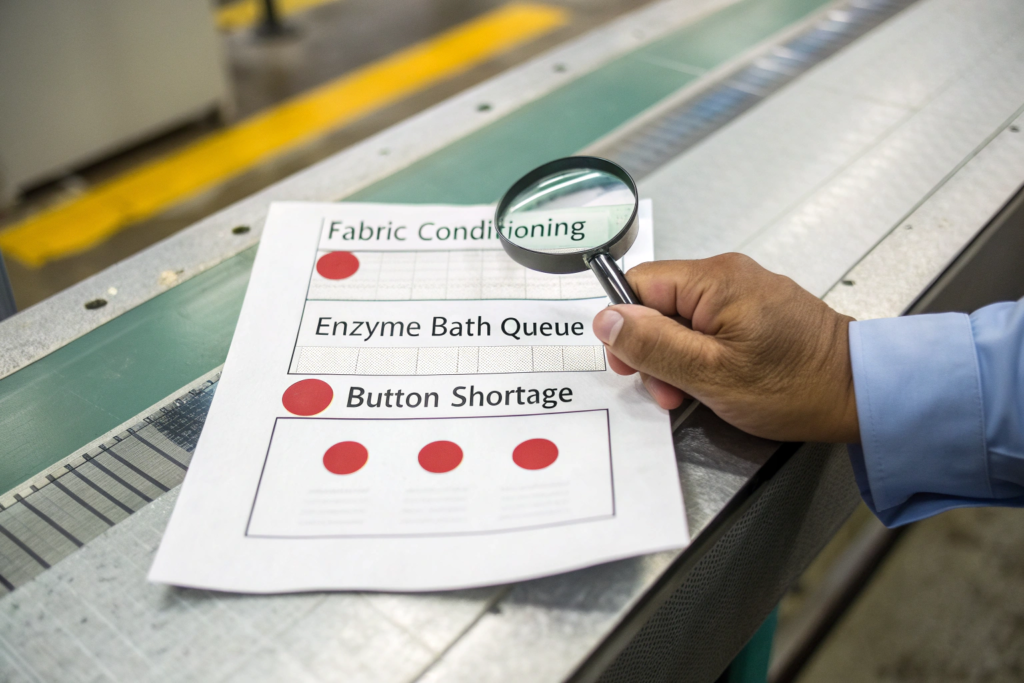
The hidden causes of linen production delays include unaccounted fabric relaxation and compaction time, enzyme wash queue bottlenecks at the wash house, custom trim lead times that are not ordered until the last minute, and factory overbooking that pushes your order out when a bigger client calls.
You cannot fix what you cannot see. Here is what happens behind the closed doors of a factory that is about to miss your deadline.
Why does “unbooked fabric relaxation time” destroy the production schedule?
Linen fabric arrives at the factory in a stressed state. It has been stretched on the weaving loom and wound tightly onto rolls. If you cut it immediately, the panels will shrink unpredictably after sewing. The correct process is to let the fabric relax. It needs to be unrolled, rested, and often pre-washed in a compaction dryer to remove all latent shrinkage. This relaxation process takes 24 to 48 hours.
A factory that is rushing to meet a tight deadline will skip this step. Or they will lie and say they did it. The result is not a delivery delay, but something worse: an on-time delivery of pants that shrink two sizes after the customer’s first wash. That is a return rate disaster.
But even in honest factories, the relaxation time is often invisible on the shared production calendar. The buyer sees “Cutting Start Date: March 10th.” The factory internally knows the fabric must be relaxed on March 8th and 9th. But if the fabric arrives late on March 9th, the cutting cannot start on the 10th. The calendar was based on an unrealistic assumption that the fabric would be ready the instant it arrived.
I tracked a specific failure for a client who ordered linen pants from a new supplier. The fabric arrived at the factory on the scheduled date. The buyer celebrated. But the factory had not booked the compaction dryer. The dryer was occupied with denim for another client for three days. The linen waited. The cutting start date slipped by three days. That three-day slip cascaded into a two-week delay because the sewing line had already been booked for another order. The factory never told the buyer about the dryer bottleneck. They just said, “Fabric problem.” The real problem was capacity planning for the relaxation step.
How do enzyme wash queues become the single biggest bottleneck for linen orders?
Enzyme washing is not instant. A linen pant must sit in a stainless steel enzyme bath at a precise temperature for 45 to 60 minutes. Then it needs to be rinsed, deactivated with a high-temperature wash, and tumble-dried. A single wash machine can process maybe 300 pants per cycle. If your order is 1,500 pants, that is five cycles, or roughly one full working day of continuous machine operation.
But the wash house is not a dedicated resource for your order. It is a shared resource for all the factory’s orders. If another client’s 3,000 cotton units are already in the queue, your linen pants wait. The wash house queue is the most common bottleneck that is never communicated to the buyer.
A brand we work with experienced this with their previous factory. The factory quoted a standard 4-week production timeline. But they did not disclose that the enzyme wash house had a 5-day backlog before their order could even enter a machine. The pants were sewn on time and then sat in a carton for a week waiting for the wash. The factory did not count the “wash queue” time in the production schedule. They only counted the actual wash cycle time. The buyer lost 7 days without knowing why.
To solve this, we book the wash machine time at the same moment we book the cutting table time. Our production schedule includes a “Wash Slot Reserved” milestone that is confirmed with the wash house before we even order the fabric. This removes the hidden queue from the timeline.
What Production Slot and Planning Systems Prevent Linen Shipment Delays?
The word “booked” does not mean the same thing in every factory. Some factories “book” you by writing your brand name on a whiteboard. That whiteboard gets erased when a bigger client calls. Other factories “book” you by accepting your deposit, but then they overbook their lines by 40%, assuming that some orders will cancel. You are not their primary client. You are the filler for gaps between their major accounts. This is why your order gets pushed back.
Effective delay prevention requires a factory that operates a hard-capacity production slot reservation system, a raw material pre-stocking program for repeat orders, and a buffer-week protocol specifically for the unpredictable drying time of washed linen.
The system must treat your order as a fixed, non-movable asset on the calendar, not a flexible suggestion.
How does a “hard slot reservation” differ from a soft promise, and how can you verify it?
A soft promise sounds like this: “Yes, we can start your order around mid-April. Don’t worry, we will manage.” This is not a reservation. This is a statement of intention with zero enforcement.
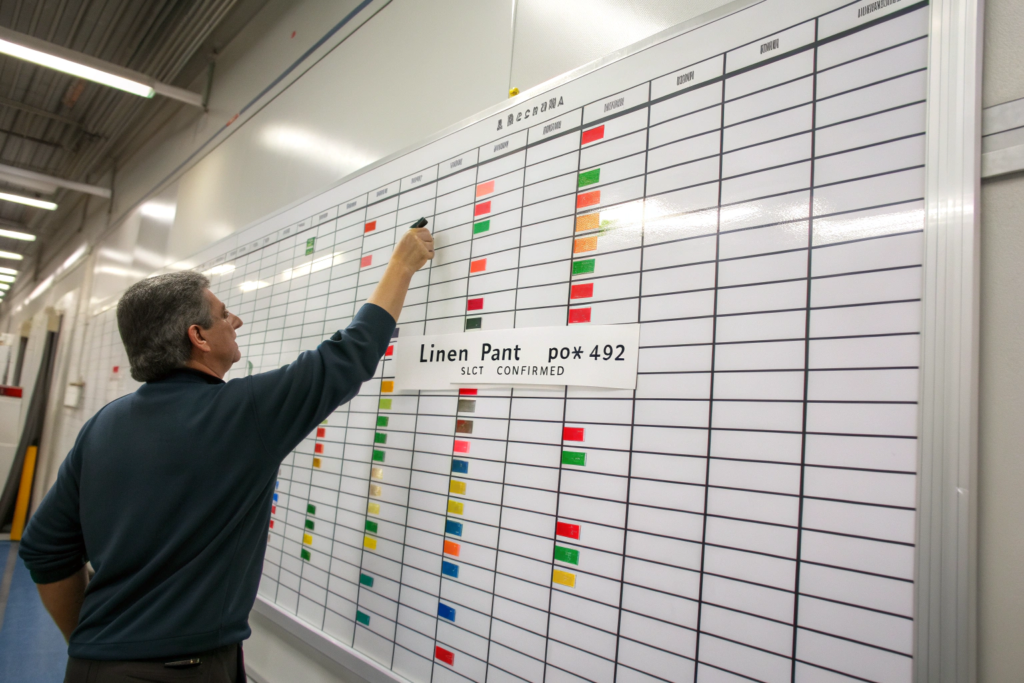
A hard slot reservation is a specific, documented allocation of production line hours. It states: “Your order is reserved on Line 3, starting Monday, April 14th, with a planned completion date of Monday, April 28th. These dates are blocked in our capacity planning software and will not be moved without your written consent.”
We operate a hard slot system. When you place an order, you receive a “Production Slot Confirmation” document. It shows your slot’s start and end dates. It shows the buffer time allocated after your slot for wash and QC. It shows the shipping container booking window.
I tell clients to do a simple verification test. Two weeks before your slot is supposed to start, ask the factory to send a photo of the production planning board with your order code visible, or a screenshot of the planning software. If they hesitate, if they make excuses, if the photo shows your slot has been shifted, you have an early warning. You can escalate before the delay hits.
A client tested this with us. Two weeks before her slot, she asked for the planning board photo. We sent it within the hour. It showed her order code locked on Line 4. She told us later that she had never received that kind of transparency from a factory. It gave her the confidence to book her PR launch event, which she had been holding off on. The hard slot system allowed her to coordinate her entire marketing calendar around a real, verifiable production date.
What is a “pre-stocked raw material program” and how does it cut lead time in half for repeat orders?
The longest part of a first-time linen order is the raw material procurement. Buying the yarn, weaving the fabric, dyeing the color, and compacting the roll. This takes 3 to 5 weeks. This full timeline must be absorbed into your first order.
But if you are reordering the same linen pant in the same color, there is no reason to wait 5 weeks for fabric again. We offer a “Pre-Stocked Raw Material Program” for clients with predictable, repeating orders. After your first order’s bulk production is finished, we analyze your sell-through data with you. If you are reordering every quarter, we pre-purchase and pre-dye the linen fabric for your next order before you even issue the PO. We hold the greige or dyed fabric in our warehouse, reserved for your brand.
This cuts the reorder lead time from 6-8 weeks to 2-3 weeks. The fabric is already relaxed, compacted, and ready to cut the day you confirm the order.
A resort wear brand that sells through boutique accounts in coastal towns has a predictable pattern. Every February, they reorder the same “Natural” and “Ocean Blue” linen pants. We pre-stock 500 meters of each color in January, based on their forecast. When their February PO arrives, we cut the fabric that same week. They receive their shipment in early March, while competitors who start fabric ordering in February receive theirs in April. This pre-stocking program is the single biggest competitive advantage in repeat wholesale linen orders. It removes the raw material lead time entirely from the critical path.
How Do Logistics and DDP Shipping Choices Impact On-Time Delivery?
You focus all your energy on the factory production schedule. You celebrate when the pants are sewn and packed. Then the goods sit on the loading dock for four days waiting for a truck. Then the container misses the vessel cutoff. Then the next available vessel is a week later. Then customs at the destination port flags the shipment for a random inspection. The factory met their production deadline, but your pants still arrive late. The post-production logistics chain is just as vulnerable to delays as the sewing line, and most buyers do not manage it closely enough.
Smart logistics choices that prevent post-production delays include booking the shipping vessel before production is finished, using a freight forwarder with a proven on-time record for the specific China-to-destination route, and selecting DDP terms that keep the factory financially responsible for the shipment until it reaches your door.
Your delivery date is not the date the factory finishes sewing. It is the date the cartons enter your warehouse. You must manage the entire chain.
Why should you demand that the vessel be booked at the start of production, not after?
A common sequence is: production finishes, the factory emails the freight forwarder, the forwarder looks for space on the next vessel, and the vessel is already full. The goods wait a week, sometimes two, for the next available ship. This waiting period is completely preventable.
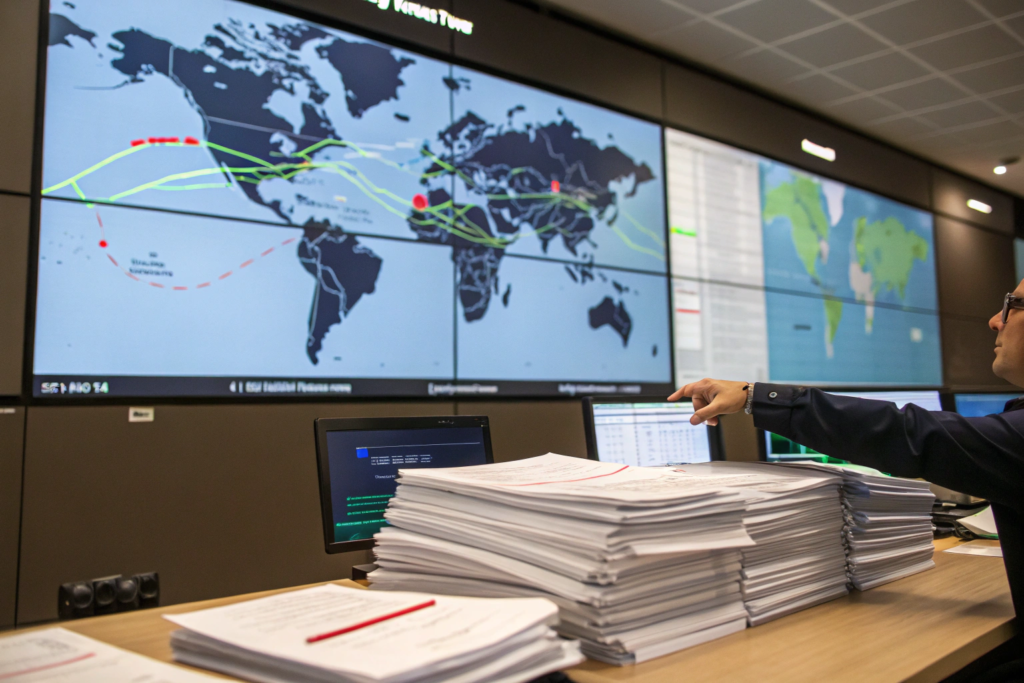
The vessel should be booked at the start of production, not at the end. We book the shipping container when your cutting date is confirmed. We reserve a slot on a specific vessel with a specific departure date that aligns with the scheduled completion of your order.
This is called “forward booking.” It is standard practice for large brands, but many smaller B2B buyers do not know to demand it. We do it as our standard operating procedure. When your production slot is confirmed, we simultaneously confirm a shipping slot with our freight forwarder. The vessel cutoff date is baked into the production schedule. The line supervisor knows that if the pants are not packed and palletized by Wednesday at 3:00 PM, the container will sail without them. This creates a hard, non-negotiable deadline on the factory floor.
A buyer from Toronto told me his previous factory “always needed an extra week for shipping arrangements.” That extra week was the factory waiting until the last minute to book the truck and the vessel. When we took over his linen pant order, we sent him the vessel name, voyage number, and estimated departure date two weeks before the pants were even sewn. He tracked the vessel on MarineTraffic and watched it depart on schedule. His goods arrived 10 days earlier than he had budgeted for. Forward booking is free. It just requires a factory that integrates logistics planning into production planning.
How does a DDP contract incentivize the factory to ship on time?
Under FOB terms, the factory’s responsibility ends when the goods cross the ship’s rail at the port in China. If the container is delayed at the port, the buyer pays the storage fees. If customs in the destination country requires additional documentation, the buyer scrambles to provide it. If the final-mile delivery is slow, the buyer chases the trucking company. The factory has zero financial incentive to solve any of these problems. They already got paid.
Under DDP terms, the factory is responsible for the goods until they reach the buyer’s specified delivery address. Every day of delay costs the factory money. Port storage fees? Factory pays. Customs inspection delay? Factory manages it. Missed delivery appointment? Factory reschedules and pays the penalty.
This financial alignment is the strongest incentive for on-time delivery. We ship on DDP terms to our US and European clients. We have a direct financial motivation to clear customs fast, to book reliable last-mile carriers, and to monitor the shipment every step of the way. A delay is not an abstract problem for us. It is a line item on our logistics invoice.
We once had a container of linen pants bound for Los Angeles that was selected for a random USDA inspection at the port. Under FOB, this would be the buyer’s problem. Under our DDP contract, our logistics team immediately contacted the inspection broker, provided all required fumigation certificates for the wooden pallets, and expedited the release. The inspection added 48 hours. We absorbed the inspection fee and the storage cost. The buyer received an updated delivery estimate and a note explaining the delay, but they paid zero extra dollars. DDP does not make inspections disappear, but it ensures the factory fights the delay as if it were their own money, because it is.
What Milestone Tracking System Should You Demand from Your Linen Manufacturer?
Silence is the most accurate predictor of a missed deadline. When a factory stops sending updates, something is wrong. They are trying to fix a problem before you notice. But by the time they tell you, the delay is already unrecoverable. You need a milestone tracking system that gives you bad news immediately, so there is still time to react. A weekly “all good” email is not a tracking system. It is a pacifier.
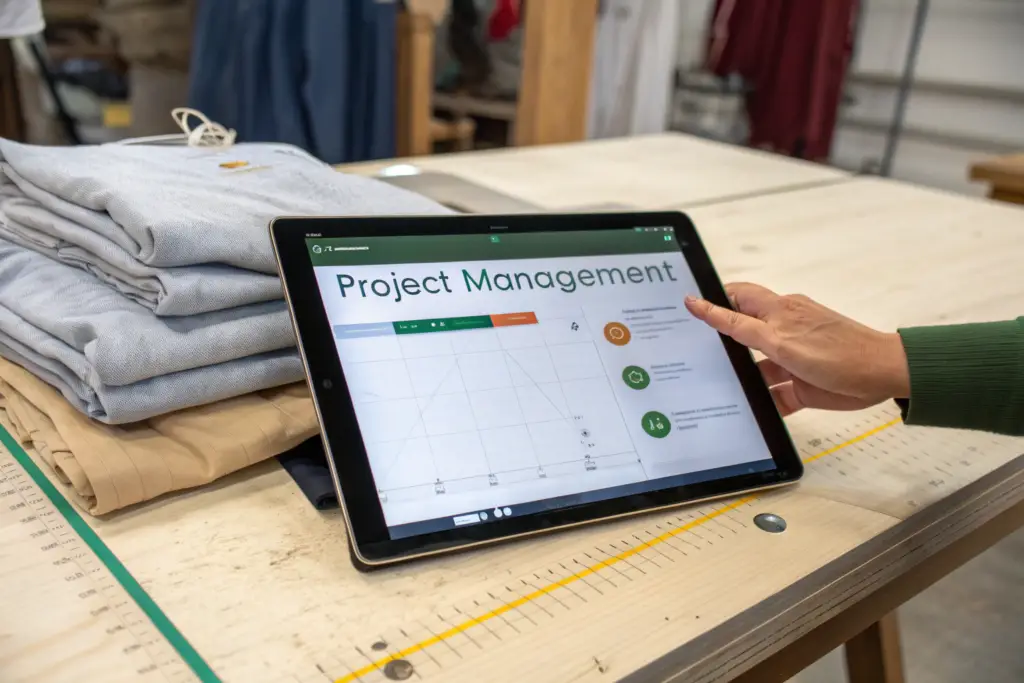
You should demand a shared, real-time milestone tracker that breaks your linen order into 10-15 specific stages, each with a planned date, an actual completion date, and a status flag that is updated by the factory’s production coordinator at the moment each stage is completed.
This is not micromanagement. It is shared visibility. If the factory resists sharing this level of detail, they are hiding their capacity problems from you.
What are the critical milestones that must be tracked for a linen pant order?
A generic tracker with three stages (Cut, Sew, Ship) gives you no early warning. By the time “Sew” is delayed, the ship date is already blown. You need granular milestones that detect problems at their source.
Here is the milestone template we share with every Shanghai Fumao client. It contains 12 critical stages:
| Milestone | What It Flags If Delayed |
|---|---|
| 1. Lab Dip Approved | Color development issues; restarts the dyeing clock |
| 2. Greige Fabric Received | Raw fabric supply chain problem |
| 3. Fabric Compaction Complete | Relaxation/dryer capacity bottleneck |
| 4. Bulk Fabric Cut | Cutting table availability; pattern issues |
| 5. Logo/Branding Applied | Embroidery or print placement problems |
| 6. Sewing Line Start | Operator allocation; no delay is acceptable here |
| 7. Inline QC Check (50% point) | Quality drift detected mid-production |
| 8. Sewing Complete | Production handoff to wash house |
| 9. Enzyme Wash & Dry | Wash house queue; re-wash if standard not met |
| 10. Final QC & Pressing | Defect sorting; ironing capacity |
| 11. Packed & Palletized | Packaging material availability; carton labeling |
| 12. Container Gated In at Port | Trucking delay; vessel cutoff missed |
If milestone 3 (Compaction) is delayed by two days, you immediately know that milestone 4 (Cutting) will also be delayed. You can adjust your marketing calendar by two days now, rather than discovering a two-week delay at the shipping stage. The granularity is the early warning system.
How should you respond when a milestone tracker shows an “amber” flag?
An amber flag means the milestone was completed, but late. It was supposed to finish on Tuesday. It finished on Thursday. The tracker shows the two-day delay immediately. Most buyers ignore the amber flag because “it was completed, so it is fine.” This is a mistake. Amber flags that are not investigated compound into red flags later.
Our protocol is that every amber flag triggers a root cause analysis from our production coordinator. The coordinator adds a comment to the tracker explaining why the delay occurred and how the time will be recovered. If the delay cannot be recovered, the final delivery date is recalculated and updated immediately. No hiding. No hoping.
A client’s order hit an amber flag at the enzyme wash stage. The wash house had a pH calibration issue and had to re-run a batch. The delay was one day. Our coordinator updated the tracker immediately: “Amber. Wash re-run required due to pH drift. One day lost. Recovery plan: Saturday overtime on final QC to regain one day. Delivery date unchanged.” The client saw the amber flag, read the recovery plan, and did not need to send a single worried email. The transparency of the amber process gave her confidence that we were in control, even when a small problem occurred.
This is the difference between a supplier who hides problems and a partner who solves them. The milestone tracker with amber protocols is the infrastructure of trust. If a factory refuses to provide this, you are ordering blind.
Conclusion
Avoiding delayed shipments when ordering linen wide-leg pants from China is not about hoping your factory is honest. It is about demanding systems that make delays impossible to hide. You must understand the hidden delay points: the unbooked fabric relaxation time, the enzyme wash queue, the last-minute vessel booking. You must verify that your factory operates a hard slot reservation system, not a soft promise. You must insist on DDP shipping terms that make the factory financially responsible for delays until your inventory is in your warehouse. And you must have a granular milestone tracker that flags amber delays the moment they happen, with a recovery plan attached.
At Shanghai Fumao, we built our entire production planning and logistics system around the principle that a delayed shipment is a broken promise. We do not overbook our lines. We do not hide our wash house schedule. We give you the vessel name before the pants are sewn. If you are ready to place a linen wide-leg pant order with a factory that treats your delivery date as a contractual commitment backed by transparent tracking, contact our Business Director, Elaine, at elaine@fumaoclothing.com. Let’s build a production timeline that you can set your marketing calendar to.