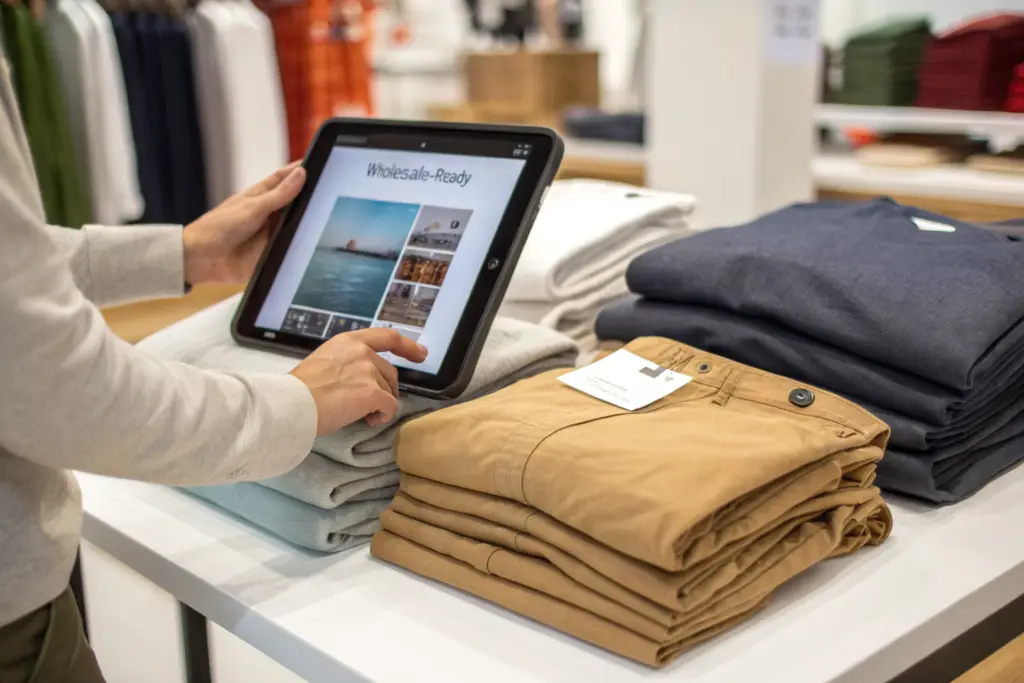
A wholesale buyer walks into a showroom and touches the fabric. That single moment determines the order. If the linen feels scratchy, the buyer walks away. If the seams look bulky, the buyer halves the quantity. If the color is inconsistent between the pant and the hangtag, the buyer loses trust in the brand’s quality control. Wholesale is the harshest sales channel in apparel. You are not selling to an emotional consumer; you are selling to a professional buyer who has seen a thousand pants and can spot a manufacturing shortcut from ten feet away.
Fumaoclothing’s linen wide-leg pants are perfect for wholesale orders because we have engineered every aspect of the garment—from the enzyme-washed hand feel and French seam finishing to the sealed color consistency and wholesale-ready packaging—to meet the specific audit criteria that professional buyers use to make split-second purchasing decisions.
We designed our wholesale linen program by reverse-engineering the buyer’s checklist. We asked retailers what makes them reject a linen pant at first touch. Then we fixed every single objection at the production level. Here is the exact breakdown of why our wide-leg linen pants win wholesale accounts.
What Specific Fabric Features Make Our Linen Pants Irresistible at First Touch?
The wholesale buyer’s decision is made in the first three seconds of physical contact. They do not read the spec sheet first. They touch the fabric. They crumple it in their hand and watch how it recovers. They hold it up to the light and check the opacity. If you fail the touch test, the conversation is over. No amount of discounting can revive a deal after a bad tactile experience.
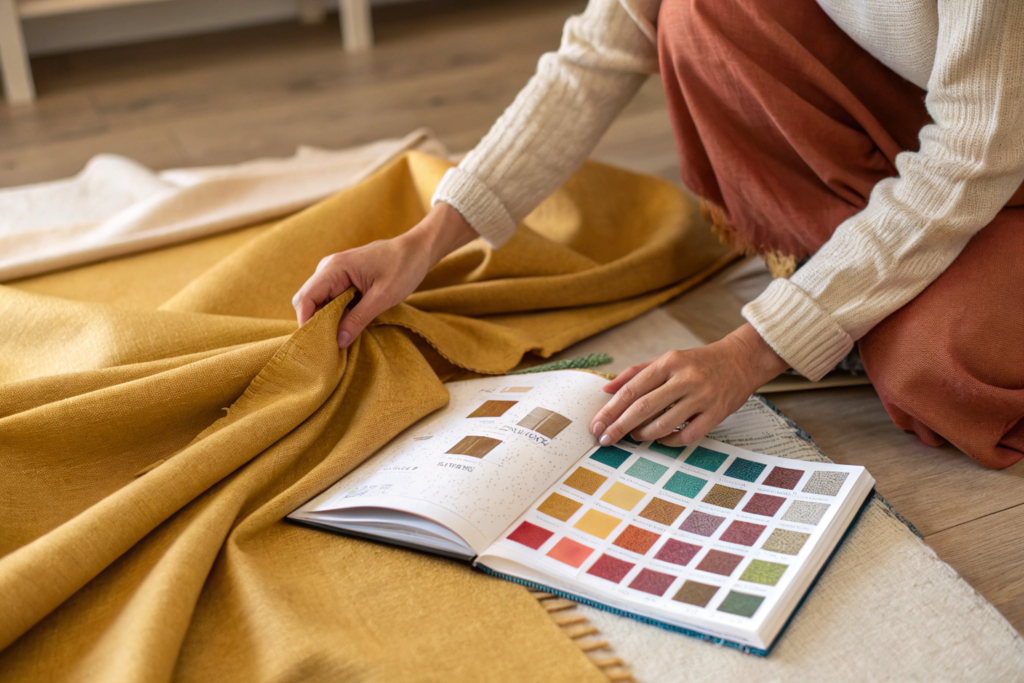
Our linen pants pass the wholesale touch test because we use long-staple wet-spun flax that has been bio-polished with enzymes, creating a smooth, peachy surface that drapes fluidly and recovers from wrinkling in a way that signals luxury rather than neglect.
We engineered the hand feel of our linen to trigger the buyer’s quality instinct. It is soft but not flimsy. It is crisp but not stiff. This is the Goldilocks zone of linen that commands a premium wholesale price.
How does our "wrinkle recovery" performance compare to standard market linen?
The biggest objection to linen is wrinkling. A buyer expects linen to wrinkle, but they need those wrinkles to look intentional and luxurious, not like a crumpled paper bag. Cheap, dry-spun linen wrinkles into sharp, chaotic creases that catch the light and look messy. Premium wet-spun linen wrinkles into soft, rounded folds that look relaxed and elegant.
The difference is in the fiber elasticity and the wash finish. Our enzyme wash relaxes the flax fibers, giving them a natural memory. When you crush our linen in your hand and release it, the fabric springs back with a soft texture. A standard linen stays crushed.
I demonstrated this to a department store buyer during a showroom visit. I took our pant and a competitor’s pant and crushed both in my fists for ten seconds. I released them on the table. The competitor’s pant looked like a topographic map of sharp ridges. Our pant had soft, wavy undulations. She placed an order for 200 units on the spot. She told me, "The wrinkle test is the first thing I do. Your pants look like they have been worn for an hour in a good way. The other looks like it was slept in."
This performance is repeatable because we control the wash chemistry. We do not just run a generic "soft wash." We specify a neutral cellulase enzyme cycle that relaxes the fiber at a molecular level. This is a measurable textile property called the "crease recovery angle." Our treated linen consistently scores 20-25% higher on the AATCC crease recovery test than standard non-enzyme washed linen.
Why does our "backlit opacity standard" give wholesale buyers confidence in lighter colors?
A common wholesale rejection happens with the natural and white colorways. The buyer holds the pant up to the showroom window light, and they can see the silhouette of their hand right through the fabric. It looks cheap. It looks like a cover-up, not a structured pant. The order is canceled, and the brand loses the shelf space.
We solved this with a mandatory "Backlit Opacity Check" for every light-colored linen batch. Before the fabric is approved for cutting, our QC team holds a single layer of the linen against a calibrated lightbox. A black card with a white "X" is placed behind the fabric. If the "X" is distinctly visible, the fabric fails. It is too sheer for a standard pant.
For a resort wear client who ordered 500 units in "Natural Flax," the mill’s initial batch failed our opacity test. The fabric was a beautiful 180gsm weight, but the weave was too open. We returned the batch and worked with the mill to increase the picks per inch. We tightened the weave structure without increasing the weight. The second batch passed. The buyer never knew there was a problem. They just saw a pant that was breathable but not see-through.
This standard is critical for wholesale because the retail customer cannot try on the pant before buying online. If the product photo shows a sheer garment, the return rate spikes. Our opacity standard protects the brand’s return rate and the buyer’s confidence.
What Wholesale-Ready Packaging and Labeling Services Do We Offer?
A beautiful pant in a crushed plastic bag is a lost sale. Wholesale buyers are not just buying a garment; they are buying a ready-to-shelve product. If the buyer has to re-fold, re-tag, or re-package every unit before it hits the retail floor, you are costing them labor. That labor cost gets subtracted from the price they are willing to pay. Your manufacturing job is to make the product shelf-ready the moment the carton is opened.
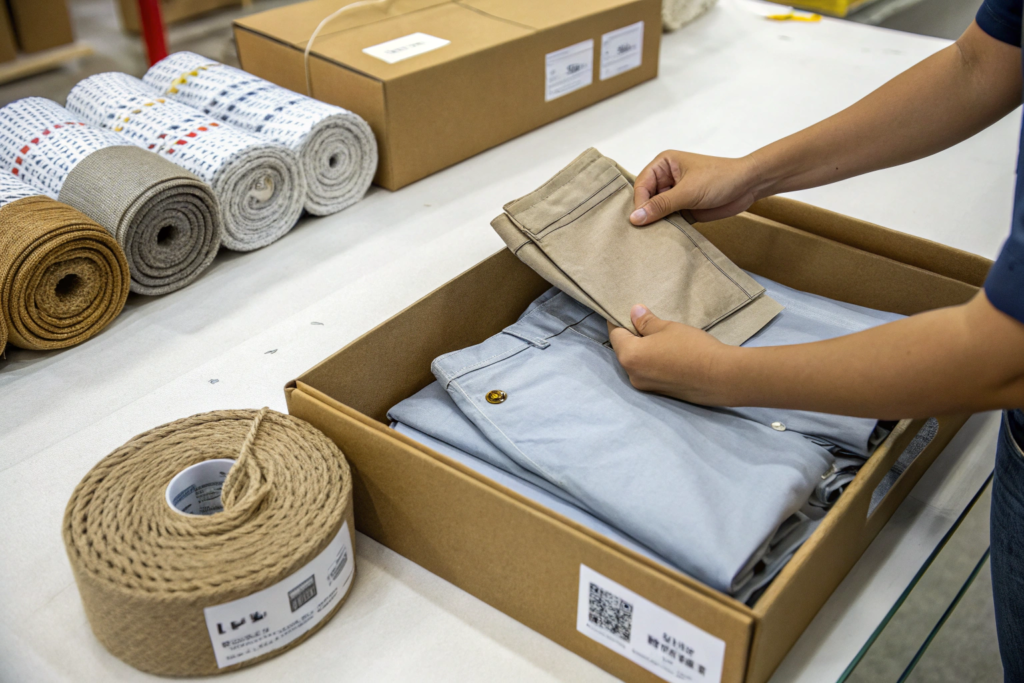
Our wholesale-ready packaging and labeling services include custom hangtags, barcode stickers, branded tissue paper, and poly-bagging or box packaging that meets the specific requirements of boutiques, department stores, and e-commerce fulfillment centers.
We transform the factory floor into the final packaging station so the wholesale buyer can move goods directly from the shipping container to the display shelf.
How do our "shelf-ready" hangtag and barcode systems reduce retail labor costs?
A boutique owner receives a box of 50 pants. Each pant needs a price tag, a brand story hangtag, and a care label that is visible without unpacking the folded garment. If the factory attaches the tags in the wrong position, or the barcode does not scan, the store associate has to spend 5 minutes per garment fixing the problem. That is 250 minutes of wasted labor for a single box.
We designed our hangtag attachment system to be retail-labor-free. We place the hangtag string through the main label loop, not through the fabric, to avoid needle holes. We position the barcode sticker on the outside of the poly bag so the retail worker can scan it without opening the packaging. We use barcode symbologies that have been tested with standard retail POS systems.
A multi-brand boutique chain we supply uses a standardized "unpack-and-display" metric. They track how many minutes it takes to process a new shipment. Before switching to our wholesale packaging, they averaged 12 minutes per unit from box to rack. After we implemented their custom shelf-ready packaging, the time dropped to 2 minutes per unit. This labor saving made our pant more profitable for them, even at a slightly higher wholesale cost. The buyer reordered within the month.
Why do we offer customized "branded packaging" without requiring a high MOQ?
Most factories demand a 5,000-unit minimum for custom branded boxes or tissue paper. This locks out small-to-mid-size wholesale brands who want a premium unboxing experience but cannot commit to huge volumes.
We built a relationship with a local packaging supplier that allows us to produce small-batch custom packaging. We can do runs as low as 200 units for branded tissue paper stickers, and 500 units for custom-printed kraft boxes.
A Melbourne-based brand with three retail stores wanted a specific "coastal blue" tissue paper and a thank-you card inside every linen pant. Their previous Chinese supplier demanded a 10,000-unit MOQ for the tissue paper alone. They were ordering only 800 pants per season. We connected our packaging partner and delivered the exact branded tissue at an affordable per-unit cost for 800 pieces. The brand now has a signature unboxing that matches their store aesthetic.
This flexibility makes us a wholesale partner for brands in the growth phase. You do not need to be a massive department store to get a premium, branded presentation. We scale our packaging services to your actual order volume.
How Do We Guarantee On-Time Delivery and Consistent Fit Across Large Wholesale Runs?
A wholesale order has a hard deadline. If the goods arrive on November 15th, they are inventory. If they arrive on December 1st, they are a liability. The buyer has already paid for the shelf space, the marketing emails are scheduled, and the seasonal window does not move for anyone. Late delivery kills wholesale relationships faster than a minor quality issue. Similarly, inconsistent sizing kills reorders. If the size Medium from this batch fits differently from the previous batch, the retail customer notices, and the returns begin.
We guarantee on-time delivery and consistent fit through a production scheduling system that builds in buffer time for wash relaxation, and a "Golden Pattern" matching protocol that ensures every cutting batch reproduces the approved fit sample exactly.
Wholesale reliability is not a promise. It is a system of documented protocols, buffer inventories, and pattern verification checks that remove the "hope" from the supply chain.
What is our "Production Slot Reservation" system, and how does it prevent seasonal delays?
Most factories operate on a "first-come, first-served" model with vague delivery estimates. When the holiday rush hits, all orders pile up simultaneously. The factory works overtime, quality drops, and everything ships late. The wholesale buyer is left explaining to their customers that "the factory had delays."
We do not overbook our lines. We operate a "Production Slot Reservation" system. When you place a wholesale order with us, you are not just buying pants; you are reserving a specific production window on one of our five lines. We give you a confirmed start date and a confirmed completion date.
Your slot includes the wash relaxation time. If the linen needs 48 hours of compaction and drying, those 48 hours are blocked on the schedule. We do not pretend the wash time does not exist and then scramble later.
A wholesale client in Chicago places a standing order for 400 linen pants every February for their spring collection. Their slot is permanently reserved on our calendar. They know that on February 5th, their fabric is being cut, and on February 20th, the cartons are sealed. They have never missed a launch date in three years of partnership. This is not because we are lucky. It is because we do not sell capacity we do not have.
How does the "Golden Pattern" protocol ensure size consistency between orders?
A brand sends us a sample they love. We create a pattern. The bulk order ships, and the fit is perfect. Six months later, they reorder the same style, but the new batch fits slightly tighter in the hip. What happened? The factory recut the pattern from the digital file, but the fabric shrinkage rate from the new lot was different, or the pattern paper expanded in humidity, or the grader used a slightly different tolerance.
We solved this by creating a "Golden Pattern." This is a physical, sealed pattern set made from durable plastic card stock. It is the master reference for every specific style. When you reorder, we do not print a new pattern from the computer. We pull the physical Golden Pattern from our library, check it against the digitized version for any drift, and use it to cut the new batch.
We also retain a "Golden Garment" from the approved bulk run. This is a sealed, finished pant that represents the perfect fit, wash, and construction standard. Before a reorder leaves the factory, our QC inspector pulls a random sample from the new batch and places it on a flat table next to the Golden Garment. Every measurement point is verified. The hip curve, the inseam length, the waistband width. If the new sample deviates by more than 0.5cm at any point, the entire batch is re-inspected and corrected.
This protocol ensures that a size Medium bought today fits identically to a size Medium bought two years ago. This is the consistency that makes wholesale buyers confident enough to place repeat orders without requesting new fit samples every season.
Conclusion
Fumaoclothing’s linen wide-leg pants are perfect for wholesale orders because we have built every detail around the buyer’s professional checklist. The enzyme-washed, wet-spun fabric passes the three-second touch test and the wrinkle recovery test that kills sales at the showroom table. The shelf-ready packaging with customized hangtags and scan-ready barcodes saves your retail partners hours of labor and gets your product on the floor faster. And the Production Slot Reservation system with the Golden Pattern protocol ensures that your 400-unit order arrives on time and fits exactly like the approved sample, season after season.
Wholesale is a trust business. Every order you place with us comes with the certainty that your shelf space will be filled on schedule, your customers will feel the same luxurious linen they fell in love with, and your retail partners will have zero extra work to do before selling the pant. If you are ready to experience a wholesale linen program that is designed to make your buying decisions easy and your reorder rate high, reach out to our Business Director, Elaine, at elaine@fumaoclothing.com. Let’s stock your shelves with linen pants that sell themselves.