A brand owner from Amsterdam once sat in my showroom and said something that has stayed with me ever since. She told me, "In Europe, ‘sustainable’ is not a marketing trend. It is a legal standard and a consumer expectation. My customer reads the care label. She checks the certification number on her phone before she buys. If I claim a fabric is organic or recycled, and I cannot prove it with a verifiable certificate, she will not just return the garment. She will post about it on social media. My brand will be publicly shamed. I need a partner who understands that sustainability is a chain of verifiable evidence, not a mood board with pictures of leaves."
Yes, Shanghai Fumao can produce sustainable fabrics for the European market. We offer a comprehensive range of certified, verifiable sustainable textiles, including GOTS-certified organic cotton, GRS-certified recycled polyester and recycled cashmere, FSC-certified TENCEL™ Lyocell and Modal, and innovative blends that combine sustainable natural and recycled synthetic fibers. Critically, every sustainable fabric we offer is backed by a complete chain of custody documentation: the relevant transaction certificates, scope certificates, and independent lab test reports, all verifiable on the issuing bodies’ public databases. We do not sell “eco-friendly” stories. We sell certified, auditable, and legally defensible sustainable materials.
The European market has the most stringent and legally enforced sustainability standards in the global apparel industry. The EU Strategy for Sustainable and Circular Textiles is raising the bar further, mandating digital product passports, extended producer responsibility, and stricter greenwashing prohibitions. For a European brand, a sustainable fabric claim is not a casual adjective. It is a regulated, auditable statement of fact. Our sustainable fabric offering is built to meet this specific, high-stakes requirement. I want to walk you through the certified sustainable fabrics we offer, the verification process that makes them legally defensible in the EU market, and the performance characteristics that ensure a sustainable fabric is also a beautiful, durable, and commercially viable fabric.
What Certified Sustainable Fabrics Do We Offer for the European Market?
The Amsterdam brand owner’s fear of greenwashing is well-founded. The market is flooded with vague “eco” claims. A fabric labeled “sustainable” without a specific, verifiable certification is, in the European legal and consumer context, essentially meaningless. It may even be legally actionable under new EU greenwashing regulations.
Our sustainable fabric offering is built around specific, internationally recognized, and independently audited certification standards. We do not offer generic “green” fabrics. We offer GOTS-certified organic, GRS-certified recycled, and FSC-certified cellulosic fabrics. Each comes with a specific certification number that you can verify independently.
What Is the Difference Between GOTS Organic, GRS Recycled, and FSC TENCEL™?
These three certifications represent the three major pillars of sustainable textile sourcing, and they certify different aspects of the fabric’s environmental and social impact.
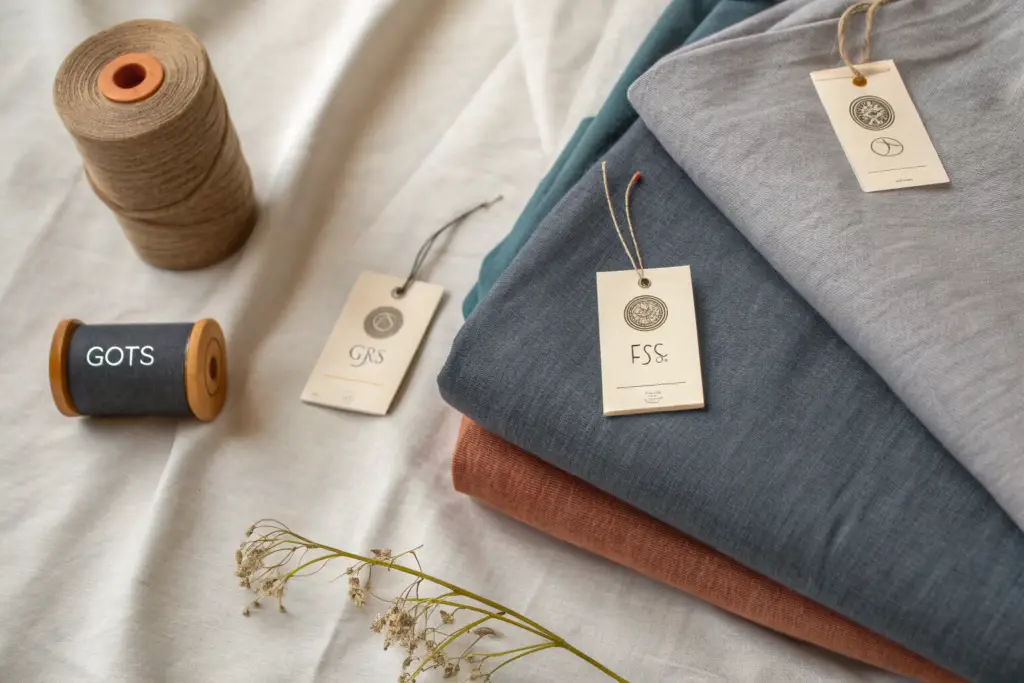
GOTS, the Global Organic Textile Standard, certifies that the natural fibers, primarily cotton, were grown without synthetic pesticides or herbicides, and that every stage of processing, from ginning to spinning to dyeing to garment manufacturing, meets strict environmental and social criteria. It is a comprehensive, whole-supply-chain certification. GRS, the Global Recycled Standard, certifies the recycled content of a fabric, such as recycled polyester from post-consumer PET bottles or recycled cashmere from post-industrial waste. It verifies the chain of custody from the waste source to the finished fabric and also includes environmental and social processing criteria. FSC, Forest Stewardship Council, certification applies to cellulosic fibers like TENCEL™ Lyocell and Modal produced by Lenzing AG. It certifies that the wood pulp used to make the fiber comes from responsibly managed forests. The TENCEL™ brand itself guarantees a closed-loop production process that recovers and reuses over 99% of the solvent. Each certification provides a specific, verifiable guarantee. A GOTS organic cotton fabric guarantees organic farming and ethical processing. A GRS recycled polyester fabric guarantees post-consumer recycled content. An FSC TENCEL™ fabric guarantees responsible forestry and closed-loop production. The GOTS certification standard, GRS certification standard, and FSC certification standard are the foundations of our sustainable fabric program.
Can You Blend Sustainable Fibers to Achieve Specific Performance Goals?
Yes, and this is where our fabric development expertise adds significant value. A 100% organic cotton French terry is soft and breathable, but it lacks the shape retention and durability required for a performance legging. A 100% recycled polyester mesh wicks moisture aggressively, but it may not feel luxurious against the skin.
We develop sustainable fiber blends that combine the best properties of different certified materials. For a sustainable activewear brand, we developed a fabric blend of 70% GOTS-certified organic cotton and 30% GRS-certified recycled polyester. The organic cotton provided softness, breathability, and a natural hand-feel against the skin. The recycled polyester provided wicking, shape retention, and durability. The fabric was tested to OEKO-TEX Class I standards, confirming it was free from harmful substances. The blend met the performance requirements of activewear while carrying both GOTS and GRS certifications for the brand’s sustainability story. For a premium womenswear brand, we developed a blend of 60% TENCEL™ Lyocell and 40% GOTS organic linen. The TENCEL™ provided fluid drape and a cool, smooth hand-feel. The organic linen provided a subtle, natural slub texture and breathability. The fabric was used for a summer dress collection and carried both FSC and GOTS messaging. The sustainable fiber blend development is a core part of our service.
How Do We Provide Verifiable Proof of Sustainability for EU Compliance?
The Amsterdam brand owner’s comment about her customer checking the certification number on her phone is not an exaggeration. European consumers are increasingly educated and skeptical. NGOs and consumer protection agencies actively investigate greenwashing claims. The EU’s proposed Green Claims Directive will require companies to substantiate environmental claims with independently verified evidence.
For a European brand, the sustainability certificate is not a marketing accessory. It is a legal compliance document. The chain of custody must be complete and verifiable, from the raw material to the finished garment. We provide this complete, verifiable paper trail for every sustainable fabric order.
What Is a Transaction Certificate (TC) and Why Is It Essential for GOTS and GRS?
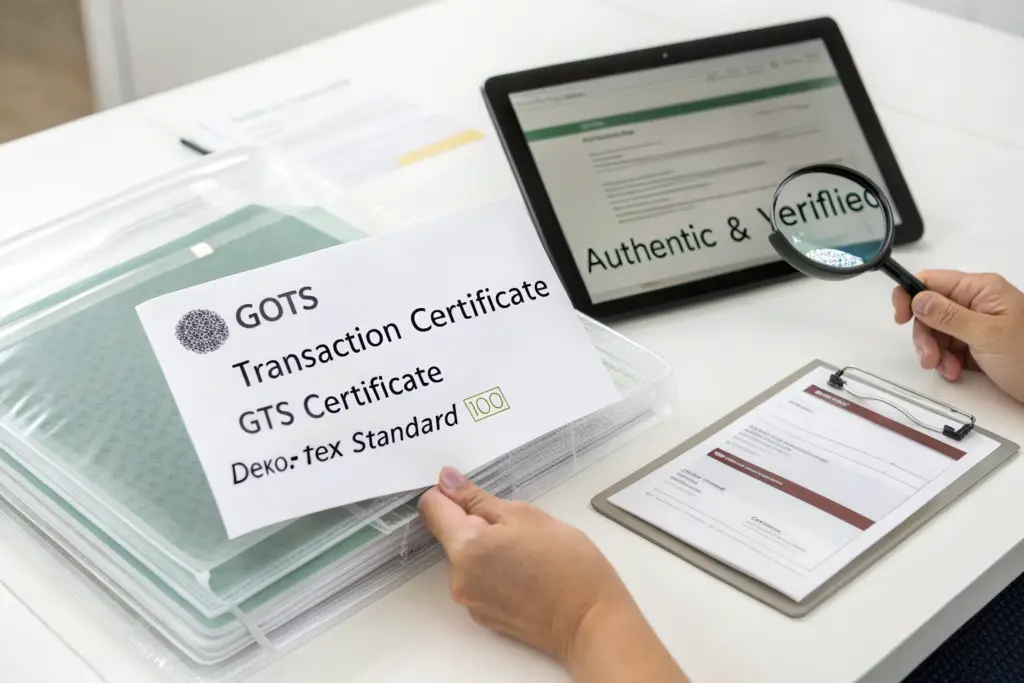
A Transaction Certificate (TC) is the specific, batch-level document that proves a particular shipment of fabric or garments is genuinely organic or recycled. It is issued by an independent, accredited certification body.
A Scope Certificate proves a factory is certified to handle GOTS or GRS goods. A TC proves that a specific batch of goods is actually certified. The scope certificate is a driver’s license. The TC is the receipt for a specific journey. For a GOTS-certified organic cotton t-shirt, the supply chain generates a sequence of TCs. The farm sells certified organic cotton to the ginner, generating a TC. The ginner sells to the spinner, generating a TC. The spinner sells to the knitter, generating a TC. The knitter sells to our garment factory, generating a TC. Finally, we issue a TC to you, the brand, for the finished garments. This unbroken chain of TCs, each verified by the certification body, is the legal proof of the organic claim. If any link is missing, the organic claim is not valid, and you cannot legally sell the product as GOTS-certified in the EU. We provide the complete TC documentation for every GOTS and GRS order, with the certification body’s details and the unique TC number. You can verify each TC on the certification body’s database. The GOTS Transaction Certificate and GRS Transaction Certificate are the legally required documents for making organic or recycled claims in the European market.
How Do We Prove Our Fabrics Are Free from Harmful Chemicals?
Sustainability is not only about fiber origin. It is also about chemical safety throughout the production process. A fabric made from organic cotton that is subsequently dyed with toxic AZO dyes is not a safe or sustainable product.
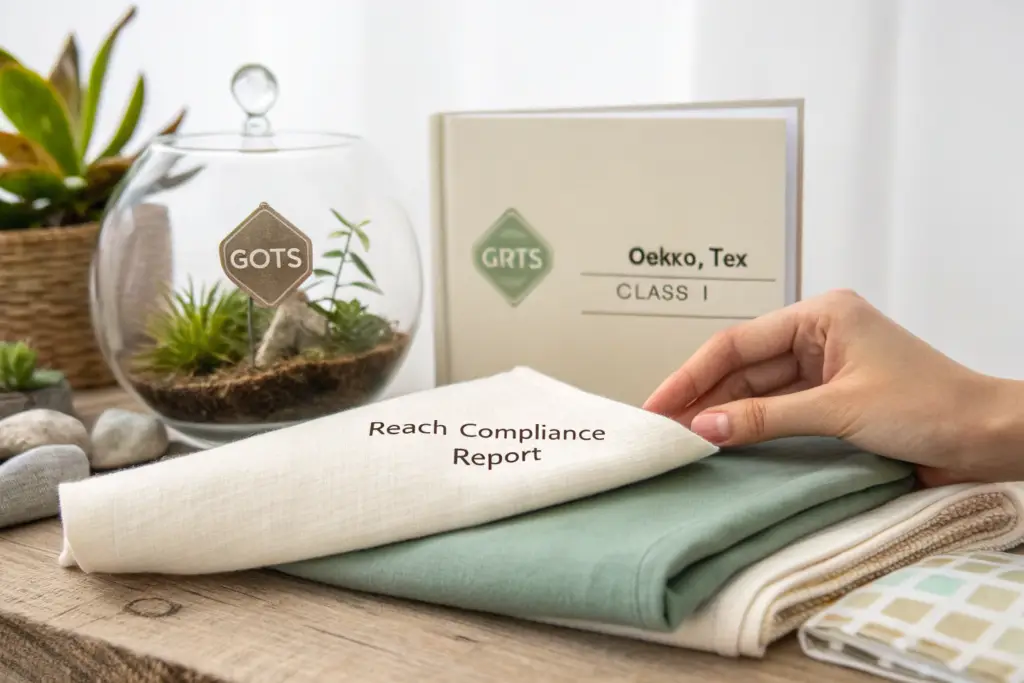
We provide OEKO-TEX Standard 100 certification for our sustainable fabrics. This certifies that every component of the fabric, the yarn, the dyes, the finishes, has been tested for over 100 harmful substances and is safe for human use. For the European market, we typically certify to Class I, the strictest standard for baby products, or Class II for direct skin contact. We provide the active OEKO-TEX certificate number, which you can verify on the official OEKO-TEX label check website. For brands requiring an additional layer of chemical compliance verification, we can provide a full REACH Annex XVII restricted substances screen from an independent accredited laboratory like SGS or Intertek. This tests for the specific chemical substances restricted under EU REACH regulations. This dual certification, OEKO-TEX and REACH, provides comprehensive, legally defensible evidence of chemical safety. The OEKO-TEX Standard 100 certification and EU REACH compliance are the chemical safety standards we work to.
Can Sustainable Fabrics Still Be Luxurious and Durable?
A luxury brand CEO from Milan once said to me, “I would love to use sustainable fabrics. But every time I have touched a ‘sustainable’ fabric, it has felt rough, looked dull, or fallen apart after a season. My customer will not accept a compromise on quality or luxury hand-feel for the sake of a green label. The product must be beautiful first. The sustainability is the story, not the selling point.”
His experience reflects a historical reality. Early generations of sustainable fabrics often did involve a performance or aesthetic compromise. That is no longer the case. Advanced spinning technologies, innovative fiber blends, and sophisticated finishing techniques now allow sustainable fabrics to match or exceed the performance and luxury of conventional materials.
How Do We Ensure Recycled Fibers Feel Soft and Premium?
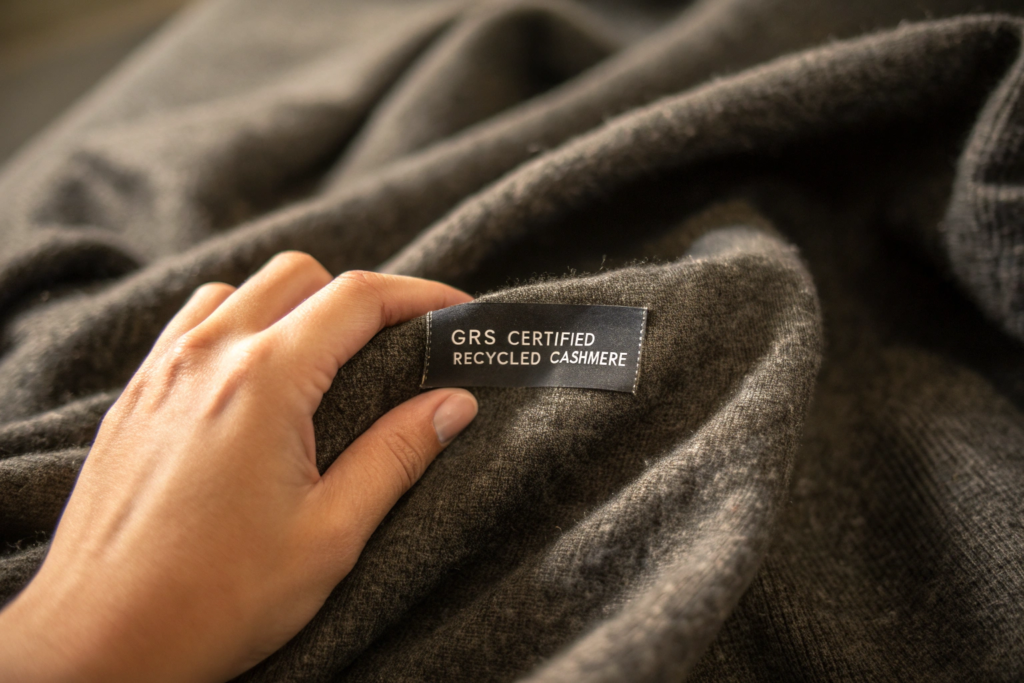
The rough, cheap hand-feel historically associated with recycled polyester is a function of the fiber quality and the spinning technology. We source only high-quality, GRS-certified recycled polyester yarns that are engineered specifically for apparel.
Modern recycled polyester yarns can be produced with very fine filament deniers and specialized cross-sections that mimic the softness, drape, and matte appearance of natural fibers. We work with mills that use advanced spinning and texturizing technologies to create recycled polyester with a genuinely premium hand-feel. For recycled natural fibers like cashmere or wool, the key is the quality of the sorting and re-spinning process. We source from specialist mills in Italy that mechanically sort post-industrial cashmere waste by color and fiber length, then re-spin it into a yarn with the same softness, warmth, and luxurious hand-feel as virgin cashmere. The resulting fabric feels indistinguishable from virgin luxury material to the consumer’s touch. The recycled fiber quality and hand-feel is validated by our in-house lab testing and, ultimately, by the client’s own sensory evaluation of the physical swatch.
Do Sustainable Finishes Compromise Fabric Performance?
No. We use advanced, sustainable finishing technologies that maintain or enhance fabric performance without using harmful chemicals. For example, we use enzymatic bio-polishing instead of chemical softeners to create a smooth, pilling-resistant surface on organic cotton. We use C0 DWR finishes, which are PFC-free, for water-repellent performance on outerwear. We use natural mineral-based treatments for odor control on activewear. These sustainable finishes perform comparably to conventional chemical finishes, and they are OEKO-TEX and REACH compliant. The sustainable textile finishing technologies are an integral part of our sustainable fabric offering.
Conclusion
Producing sustainable fabrics for Europe is not about offering a “green” option in the catalog. It is about providing a complete, certified, verifiable, and performant material solution that meets the legal, ethical, and aesthetic demands of the European market. At Shanghai Fumao, we offer GOTS organic, GRS recycled, and FSC TENCEL™ fabrics, all backed by complete chain of custody documentation and verifiable on the issuing bodies’ independent databases. We develop sustainable fiber blends that combine ecological responsibility with the specific performance and hand-feel requirements of your product. And we use advanced manufacturing and finishing technologies to ensure that a sustainable fabric is also a beautiful, durable, and commercially competitive fabric.
If your European brand is building a collection around a specific sustainable material story, I invite you to start a conversation with our sourcing team. Contact our Business Director, Elaine, at elaine@fumaoclothing.com. Describe your sustainability goals and your product category. Ask her for a sustainable fabric swatch pack, including the relevant GOTS, GRS, or FSC certifications. Touch the fabrics. Verify the certificates. Let the physical and documentary evidence demonstrate that sustainable fabric can be a luxury experience.