Last year, I got a panicked call from a client in Texas. He had just wired a 50% deposit to a new supplier in another country. Two weeks later, the supplier’s phone was disconnected. The website vanished. He lost $28,000. He called me not just to vent, but to ask a simple question that keeps every brand owner up at night: “How do I pay you safely so I don’t get burned again?” This is not a rare story. I have heard it too many times. The wrong payment method does not just delay a shipment. It can destroy your entire season. At Shanghai Fumao, we have spent years fixing this problem by focusing on what actually matters: visibility, security, and trust.
The best payment method for B2B apparel orders with Shanghai Fumao combines a secure initial deposit via T/T wire transfer with a balanced final payment triggered only after a rigorous third-party quality inspection report. This approach protects your cash flow while guaranteeing you only pay for goods that meet your exact specifications.
You are not just buying a box of T-shirts. You are investing in inventory that has to arrive on time, look perfect, and sell through fast. The old days of sending a risky 30% upfront and waiting in the dark are over. We have built our payment structure to mirror a logistics checkpoint system. Money only moves when the goods pass the test. I want to show you exactly how this works, why it is safe, and what alternatives you should avoid at all costs.
How to Securely Pay a Chinese Clothing Manufacturer Without Risk
I remember a startup owner from Miami who almost quit the industry in 2023. He placed a $45,000 order for organic cotton joggers. He paid the full amount upfront via a payment link because the salesman promised a “VIP speed production.” The delivery was delayed by three months. The quality was inconsistent. He could not do a chargeback. He was stuck with dead stock. The issue was not the factory’s technical skill. It was the imbalance of power created by the payment terms. Money left, leverage disappeared.
To pay without risk, you must split the transaction into three distinct gates. You should never allow a single payment to clear before an independent third party verifies the physical goods.

Why Is T/T with Inspection the Safest Choice for Your Order?
We recommend a simple structure: a 30% deposit to start production, and the 70% balance paid against the copy of the original Bill of Lading and a passing Quality Control inspection report. We use this method for 90% of our new partners at Shanghai Fumao.
Here is why it works. The deposit covers the raw materials. We do not ask you to fund our entire operation. We share the risk. In 2022, we sourced a rare modal-cashmere blend for a client in New York. The fabric was expensive. Our team bought it with the 30% deposit. We sent the client a photo of the fabric roll with the mill certificate before cutting. That is the first safety net. You see your money turned into raw materials.
The second safety net is the balance payment trigger. We never ship until you see the inspection video or report. A third-party agency checks the stitching density, colorfastness, and measurement chart. Only after you get the green light do you send the 70%. This puts the risk on us to perform. If the goods fail, we fix them before we get paid. This process eliminates the "ghosting" behavior that plagues bad suppliers. You hold the cards right up until the container seals.
What Are the Dangers of Using Full Upfront Payments?
I have to be blunt here. A full upfront T/T payment is the most dangerous option unless you are working with a top-tier verified partner. Even then, I advise against it for first orders.
Here is a breakdown of risk levels I have observed in my 15 years:
| Payment Method | Risk Level | Buyer Protection | Cash Flow Impact |
|---|---|---|---|
| Full Upfront T/T | Extreme | None | Very High |
| 30/70 T/T (Balance against B/L) | Low | High | Medium |
| Letter of Credit at Sight | Low | Highest | Low (Bank line used) |
| Open Account (Net 30/60) | High for New Buyer | None | Low |
A client of ours from Chicago tried full upfront payment with a bag factory in 2021. The price was 20% lower than ours. The factory sent him pictures of the correct samples. Three months later, he received bags with fake leather that peeled in two weeks. He had no recourse. He could not file a dispute because the bank transfer was a “willing payment for goods received.” The goods were trash, but the bank does not check quality. By splitting payments, you maintain the ability to walk away if something goes wrong, losing only the deposit rather than the entire order value.
How to Avoid Cash Flow Problems When Importing Apparel
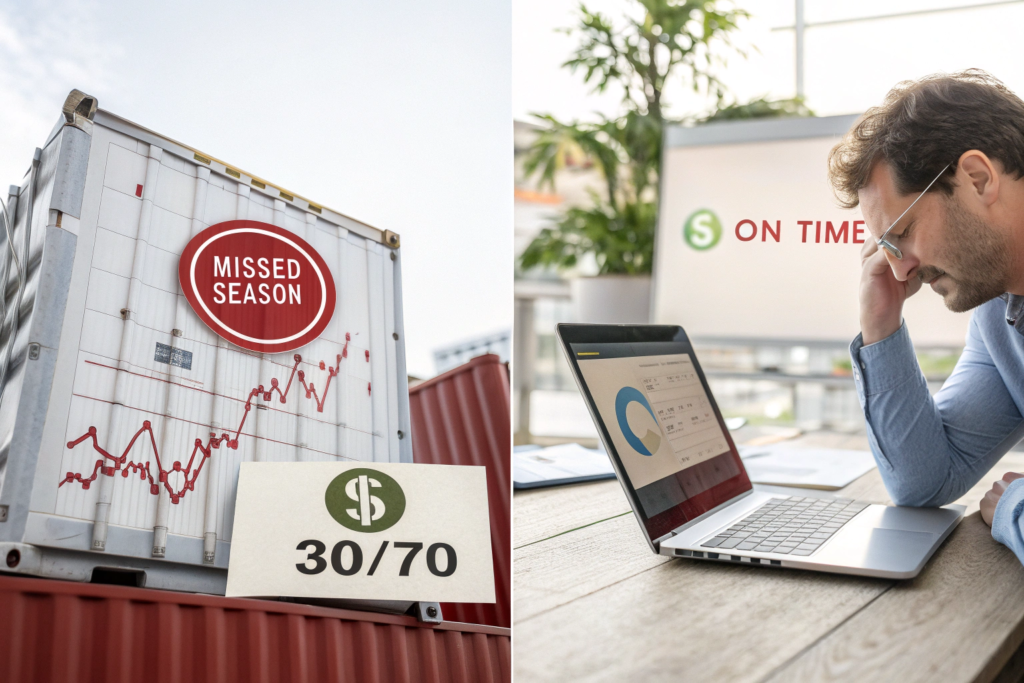
Cash flow kills more brands than bad design. I learned this early on. A mid-sized brand in Los Angeles came to us in a panic last summer. They had a hit women's linen blazer selling out online. They needed a restock of 2,000 units in 8 weeks. Their money was tied up in other inventory, and paying a massive deposit upfront would have crippled their marketing budget during peak season. We solved it not by changing the price, but by restructuring the financial timeline to sync with their sales velocity.
Managing cash flow is about matching the outflow of your money to the moment you are about to generate revenue. You do not want a huge gap between paying the supplier and receiving the goods on your warehouse floor.
How Do Production Deposits Affect Your Total Budget?
The deposit structure directly impacts your ability to scale. If you pay 50% upfront, you have locked capital for 60 to 90 days. That capital could have been used for Facebook ads or influencer seeding to build hype for the incoming shipment.
We worked with an activewear brand in Austin in 2023. They wanted to order 5,000 sets of leggings and sports bras. Using the standard open account model some US importers dream of was impossible for a first deal. But paying 50% upfront was also too heavy. We settled on a 20% deposit because the fabric was standard nylon-spandex, which we could resell easily if they cancelled. This freed up $15,000 in their pocket immediately. They used that money to book a photo shoot with a fitness influencer before the goods even shipped. By the time the container arrived, they had pre-sold 40% of the inventory via social commerce. The deposit size directly correlates with your ability to generate pre-launch momentum. If you are using standard fabrics, ask your supplier for a lower deposit. It never hurts to ask.
Can Delayed Payment Terms Help Your Business Grow?
Delayed terms are a goal, not a starting point. After three successful orders with Shanghai Fumao, we usually move partners to a more relaxed schedule. But there are immediate ways to fake "delayed terms" even on the first transaction without exposing us to risk.
One trick is the "shipping split" payment. For a Denver outerwear brand, we made 600 jackets. They paid the 30% deposit. When production finished, they needed the coats for a specific winter festival. We agreed to ship 200 units first via air freight against a 50% payment, and the remaining 400 by sea two weeks later against the final balance. This meant they got cash in from the first 200 sales to pay for the rest of the order. It is a self-liquidating strategy. It requires a supplier with reliable logistics and a flexible warehouse team. Not every factory will do this because it complicates their shipping schedule. But a true partner who cares about your sell-through rate will work with you to optimize the cash conversion cycle, not just the ex-factory date.
What Certifications Prove a Garment Factory is Trustworthy?
Two years ago, a distributor asked me for our "certifications." I sent him a folder of PDFs. He replied, "Sorry, I found a supplier with cheaper quotes and ISO in their email signature." Four months later, he came back, red-faced. The cheap supplier had photoshopped the logo of a well-known auditing firm onto a fake report. The 3,000 men’s shirts he ordered tested positive for restricted AZO dyes and were seized by US customs. He lost the goods, the shipping costs, and his Amazon selling privileges. This nightmare taught him a lesson: a certificate is not a piece of paper. It is a traceable, verifiable legal shield.
Trustworthy certifications are not just "nice to have." They are your primary defense against liability lawsuits and port detainment. You need to know which ones are mandatory and how to spot a fake.
Which Factory Audits Matter for US Import Regulations?
There are two layers here: social compliance and safety. For the US market, if you do not have these, your goods can be flagged.
First, you need a valid WRAP (Worldwide Responsible Accredited Production) certificate. This is the gold standard for apparel factories in the USA. It proves no forced labor, decent wages, and safe buildings. Our Shanghai Fumao facility maintains a Platinum-level WRAP certificate. This is not an easy badge to get. Auditors interview our workers privately without management present. They check fire exits and overtime records. A factory with a current WRAP certificate has gone through a rigorous external review.
Second, look for a structural safety and fire safety audit. Do not settle for a basic "ISO" without looking at the scope. We recently had a brand audit us for SMETA (Sedex Members Ethical Trade Audit). We passed the 4-Pillar audit, which covers environment and business ethics on top of labor and safety. If you are importing children’s products, CPSIA compliance is non-negotiable. We require specific third-party testing for lead and phthalates. I always tell my clients: ask for the audit number and the firm’s name, then go to the audit firm’s website and verify it yourself. A PDF screenshot is too easy to fake. A real certification allows you to type the number into a public database.
How Do We Guarantee Fabric Quality Before You Pay?
Certificates prove the factory is a safe place to work. But they do not prove the jacket you ordered will survive a washing machine. You need physical fabric inspections and performance reports.
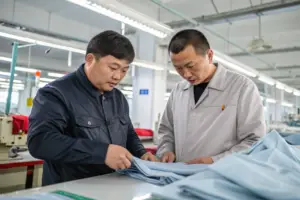
Before we cut your order, we do a full inspection on the bulk fabric. I remember a new client designing premium wool blend coats. The lab report we sent back showed the fabric’s pilling resistance was a 3.5 on a specific test, just below his spec of 4.0. Instead of hiding it, we paused production. We sent him a video sample of the anti-pilling finish we could add. He approved the extra treatment. We spent $0.35 per yard. The coats launched with zero returns for pilling. The alternative—shipping without this check—would have destroyed his brand’s "luxury for life" marketing claim.
We test for color fastness against AATCC standards, shrinkage, and seam slippage. You get the lab report before we ask for the balance payment. This flips the script. You are not paying for a promise. You are paying for verified, tested physical goods standing in our warehouse. This is the difference between a "vendor" and a "supply chain partner."
How to Stop Shipment Delays Ruining Your Selling Season
There is a term in retail called the "markdown grave." That is where products go when they arrive late. A client in New York designed a beautiful summer linen dress collection. The shipment was supposed to land in April. It landed in July. By then, Nordstrom had already marked down their competitor’s lines. She had to sell at a 60% discount just to free up warehouse space. The problem was not the sewing. It was the supplier lying about the real-time status of the raw fabric. They told her "fabric is finished" when the yarn had not even been dyed. At Shanghai Fumao, we have implemented a system to break this cycle of lies. We call it transparent tracking, not just "production updates."
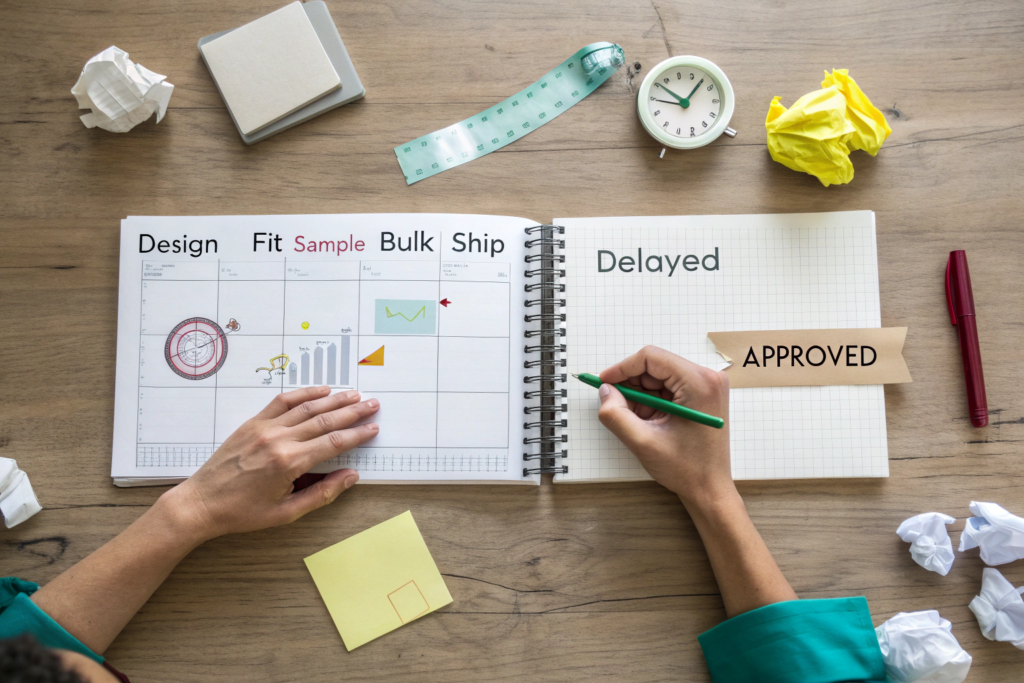
Stopping delays is about removing the supplier's ability to hide behind fake progress reports. You need visual proof embedded in the timeline.
What Is DDP Shipping and How Does It Protect You?
DDP (Delivered Duty Paid) is a game-changer for US brands tired of surprise costs. It means we, the seller, are responsible for the entire journey until the truck backs into your warehouse. We pay the freight, the insurance, and most importantly, the US import duties.
Last year, we shipped 2,000 bomber jackets DDP to a startup in New Jersey. They had never imported before. They did not have a customs bond. They did not know how to classify a nylon jacket. If we had sent it Free on Board (FOB), the container would have arrived in Newark, racked up $800 in demurrage fees, and the client would have no idea how to clear it. With DDP, our freight forwarder handled the customs clearance. The client’s only job was to open his door and sign for the pallets. For a new brand owner, DDP removes the fear of the unknown regarding logistics. It also forces us, the manufacturer, to be obsessed with on-time delivery because any port delay costs us money, not you.
Why Should You Use a Real-Time Production Tracking Link?
We once managed a 10,000-unit order for a large fitness chain. They were skeptical about delivery dates. So we gave them the password to our production tracking board.
This is not a high-tech AI robot. It is a shared document with our internal milestones. When our cutting master starts the cutting table, the box turns yellow. When the sewing line finishes the bundling, it turns blue. The client could see that on Day 10, the neck binding attachment was late and we were 1 day behind. Because he saw it in real-time, he did not panic. He saw us shift resources to catch up. In contrast, a "normal" factory would just tell him "all on schedule" via a lying email until the week of the deadline. The key to avoiding markdowns is catching a 3-day delay in week one, not a 3-week delay in week six. You need a supplier who lets you see the ugly middle of the process, not just a polished photoshoot of the final sample.
Conclusion
Choosing the right payment method and partner is not just a financial decision. It is the difference between building a sustainable brand and losing your shirt. We have walked through the security of T/T with inspection reports, the dangers of full upfront payments, and the need for verified certifications like WRAP and SMETA. We also looked at how cash flow, driven by smart deposit percentages, can make or break your pre-launch marketing. Finally, we tackled the logistics shield—using DDP shipping and real-time production links to stop delays from killing your season.
All of this comes down to one thing: the factory’s willingness to be transparent. A supplier who hides behind a slow email loop and asks for 100% upfront is not your partner. A partner shares the risk. A partner proves the goods are ready before they demand payment. A partner gives you visibility into the cutting room floor.
At Shanghai Fumao, we treat your money like it is our own inventory. We have spent over a decade refining this balanced payment and inspection system, not to make a quick profit, but to grow alongside you. We win when your reorder lands, not when your first container ships. If you are tired of the anxiety that comes with wiring money overseas, and you want a manufacturing extension that guards your cash flow and your calendar, I invite you to start a conversation with us. Reach out to our Business Director, Elaine, at elaine@fumaoclothing.com to get a detailed quote and a tailored payment proposal that protects your specific order. Let’s build a supply chain you can sleep well with.