Three years ago, I watched a first-time brand owner lose her entire $18,000 launch budget in six weeks. She had a beautiful logo. She had a strong Instagram following. She had 800 units of custom private label leggings sitting in her garage. What she did not have was a compliant care label. The FTC required fiber content and country of origin. Her label had neither. Her first wholesale shipment to a boutique was rejected. She had to pay a local contractor $1,200 to sew new labels into every unit. The delay caused her to miss her launch event. The stress nearly made her quit. She had spent months worrying about her logo and zero hours worrying about her legal labeling requirements. The logo was beautiful. The label was illegal. The label won.
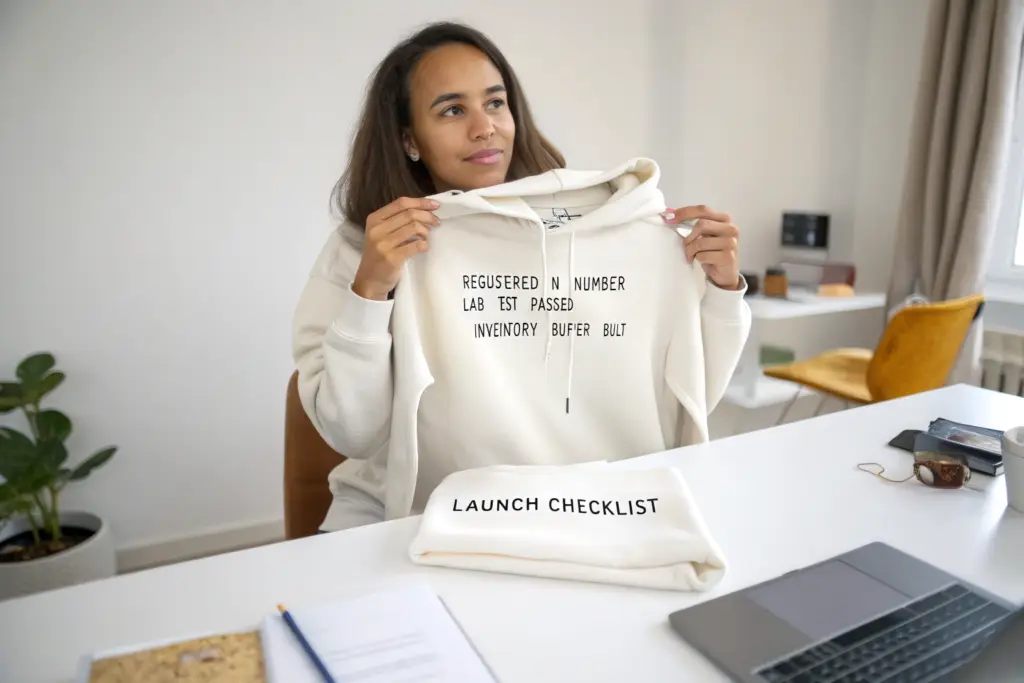
You completely avoid the biggest pitfalls when starting a new private label clothing brand by treating compliance, cash flow, and supply chain visibility as your three non-negotiable pillars, not afterthoughts to be handled after the designs are done. Pitfall one is legal labeling: you must have a registered RN number, compliant fiber content disclosure, and proper country of origin marking on every garment before you sell a single unit. Pitfall two is the "deposit trap": sending a large upfront payment to an unvetted factory is the number one way new brands lose their entire capital. You protect yourself by using a Letter of Credit, a small test order, or a factory that openly shares its financial health. Pitfall three is the "perfect sample, failed bulk" nightmare: the sample the factory sends you is flawless, but the bulk production is a different, cheaper quality. You prevent this by conducting a third-party inspection of the bulk goods before the balance payment is released. These three pitfalls account for the vast majority of private label launch failures.**
Starting a private label brand is the most accessible path into the apparel industry. The barriers to entry have never been lower. But the pitfalls are still the same traps that have sunk brands for decades. The difference between the brands that survive their first season and the brands that disappear is not creativity. It is preparation on the unglamorous, technical, legal, and financial details. I want to share exactly what we have learned at Shanghai Fumao from helping hundreds of private label brands launch, and what you must do to avoid becoming another cautionary tale.
Why Is Legal Labeling Compliance the Number One Trap That Gets New Brands Banned from Wholesale Platforms?
A brand owner I know launched her organic baby clothing line on a major wholesale platform. She had beautiful products, competitive pricing, and strong photography. Within three weeks, her store was suspended. The platform’s automated compliance review had flagged her products for missing country of origin labels. She had assumed the "Made in China" sticker on the polybag was sufficient. It was not. U.S. law requires a permanent label sewn into the garment stating the country of origin. She had to recall 200 units from her customers, re-label them, and re-ship. The cost was $3,500. The platform suspension cost her thousands more in lost sales. She had built her entire business on a platform that could shut her down with an automated email. One missing label nearly destroyed her.
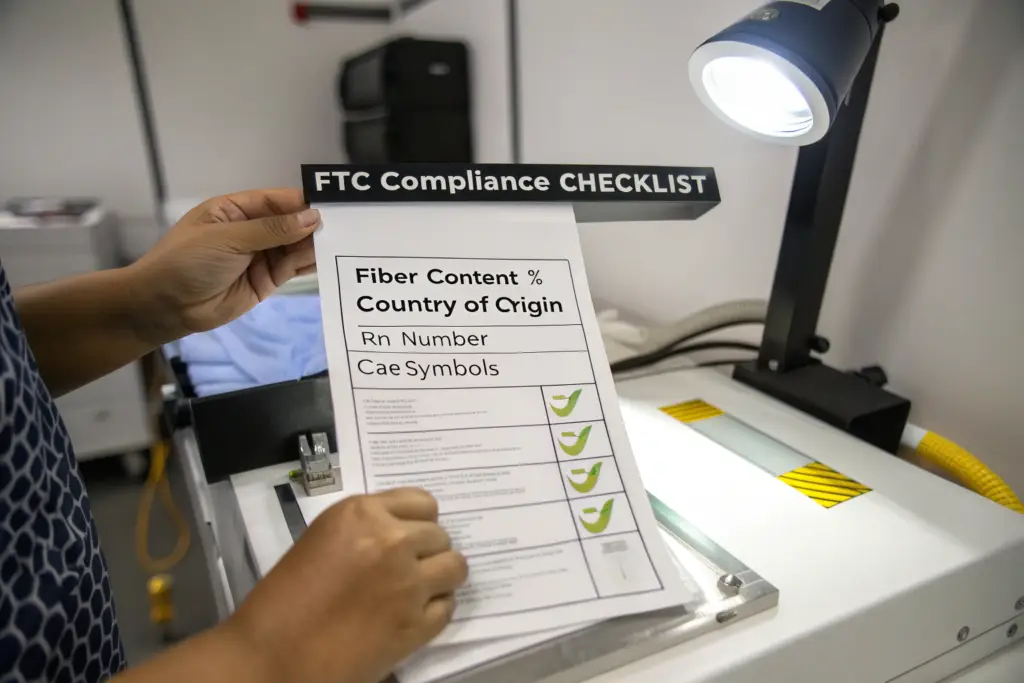
Legal labeling compliance is the number one trap for new private label brands because it is invisible until it is catastrophic. You can design, manufacture, and ship a beautiful product, and none of that matters if the label is non-compliant. The mandatory requirements in the United States include a permanent care label with the fiber content in descending percentages, the country of origin in English, and the manufacturer’s or distributor’s registered identification number, either an RN number from the FTC or the company name. The care instructions must follow the FTC Care Labeling Rule with proper washing, bleaching, drying, and ironing symbols. If you sell in the European Union, you need additional requirements including the flag of the country of origin and the manufacturer’s address. These are not suggestions. They are federal regulations. A non-compliant label can result in shipment rejection, platform suspension, retailer chargebacks, and in extreme cases, product recall and fines.
The tragedy of labeling compliance failures is that they are entirely preventable. The information is publicly available. The cost of a compliant label is pennies. The cost of a non-compliant label is existential.
What Are the Exact FTC Mandatory Requirements for a Garment Care Label in the United States?
The Federal Trade Commission requires under the Textile Fiber Products Identification Act that every garment sold in the United States must have a permanently attached label that clearly discloses the generic fiber names, such as cotton, polyester, spandex, in descending order by weight. The label must also state the country of origin, for example, "Made in China" or "Made in Vietnam." The label must identify the manufacturer or distributor, either by the company name or by the Registered Identification Number issued by the FTC. The care label, which can be the same physical label or a separate one, must provide complete care instructions including washing temperature, bleaching instructions, drying method, ironing temperature, and dry cleaning instructions. The care symbols must follow the ASTM D5489 standard. The FTC Threading Your Way Through the Labeling Requirements guide is the definitive resource. Every private label brand owner should read it before ordering a single label.
How Do You Obtain an RN Number and Why Does It Protect Your Brand’s Supply Chain Privacy?
An RN number is a Registered Identification Number issued by the Federal Trade Commission. It is free to apply for and takes approximately two to three weeks to receive. The RN number allows a brand to identify itself on the garment label without disclosing its company name and address to the public. This protects the brand owner’s privacy and creates a professional appearance. The application is a simple online form on the FTC website. You do not need to be a U.S. citizen or have a U.S. business entity, but you must have a U.S. mailing address. The FTC RN Number application portal is straightforward. A brand that uses an RN number signals to retailers and platforms that it is a legitimate, registered business.
How Does the “Deposit Trap” Destroy New Brands and How Do You Financially Protect Yourself?
A first-time brand owner I met at a trade show told me a story that made my blood run cold. He had found a factory on a B2B platform. The salesperson was responsive and the samples looked great. He wired a 50% deposit, $14,000, to start production. The salesperson went silent for a week. Then two weeks. Then the email bounced. The factory had disappeared. The brand owner had no legal recourse because he had wired money to an offshore account with no contract, no bank guarantee, and no factory address he could verify. His entire launch budget vanished. He never started the brand.
You protect yourself from the deposit trap by using a multi-layered financial defense. First, you never pay more than a 30% deposit to a new factory. The deposit should cover the raw material costs, not the factory’s operating expenses. Second, you use a Letter of Credit at Sight for orders over $10,000. The bank guarantees payment only when the factory presents compliant shipping documents, protecting you from non-delivery. Third, you conduct a small test order of 50 to 100 units before committing to a full production run. The test order proves the factory can deliver quality product on time. Fourth, you verify the factory’s physical address through a video call where they walk you through the production floor, showing you the street address outside the building. A factory that refuses any of these protections is a factory that is either financially unstable or actively fraudulent. The deposit trap is the most common and most devastating pitfall for new brands. It is also the most avoidable.
The deposit trap works because new brand owners are excited and trusting. They want to believe they have found a great partner. Fraudulent operators exploit this trust. The financial defenses are not a sign of distrust. They are standard business practices in international trade. A legitimate factory will respect them.
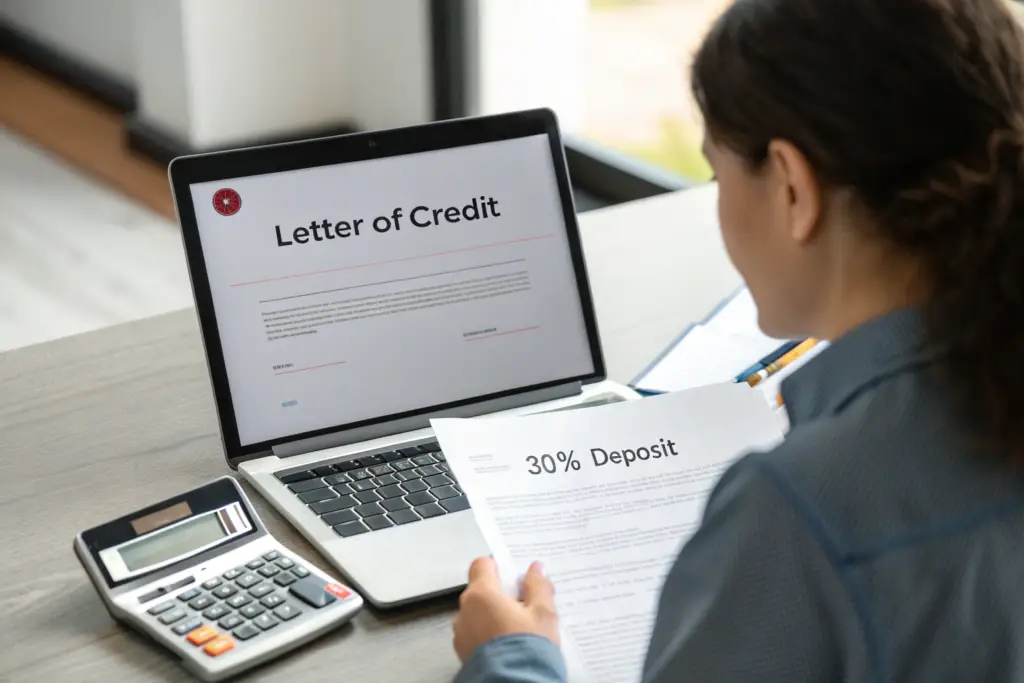
What Is a Letter of Credit and How Does It Guarantee You Never Lose Your Deposit to a Fraudulent Factory?
A Letter of Credit is a bank instrument. The buyer’s bank issues a letter to the factory’s bank promising to pay the agreed amount once the factory presents documents proving they have shipped the goods exactly as specified. The factory cannot receive payment until they prove they have fulfilled the contract. The buyer cannot access the goods until the bank releases the shipping documents, which happens after payment. Both parties are protected by the banking system. The cost is typically 0.5% to 1% of the order value. For a $20,000 order, the L/C costs $100 to $200. It is the cheapest insurance policy in international trade. The Letter of Credit for importers guide explains the process.
Why Should Your First Production Run Never Exceed 200 Units Regardless of How Confident You Feel?
A new brand has no sales data. No matter how much your friends love your samples, no matter how many likes your Instagram post gets, you do not know how many units will actually sell. A first production run of 200 units or less limits your financial exposure. If the product is a hit, you will sell out quickly, and the scarcity will build demand for your restock. If the product is a miss, you are stuck with 200 units, not 2,000. The loss is manageable. A brand that orders 2,000 units on their first run is betting their entire business on an unproven product. The minimum viable production quantity for new brands is a risk management tool, not a limitation.
What Specific QC Inspection Protocols Prevent the “Perfect Sample, Failed Bulk” Catastrophe?
A brand owner once sent me photos of two garments. The sample the factory had sent her was a beautiful, heavyweight 280 GSM French terry hoodie. The bulk production she received was a thin, 220 GSM jersey hoodie that looked like a cheap knockoff. The color was slightly off. The stitching was looser. The factory had produced a beautiful sample to win the order and then switched to cheaper materials for bulk production. The brand owner had paid the 70% balance upon receiving the sample approval. She had no leverage. The factory ignored her complaints. She was stuck with 500 units of a product she could not sell at her premium price point.
You prevent the "perfect sample, failed bulk" catastrophe by hiring an independent third-party inspection company to audit the bulk production before the balance payment is released. The inspection must be conducted after 100% of the goods are produced and at least 80% are packed. The inspector randomly selects a statistically significant sample based on the AQL standard, typically 2.5 for major defects and 4.0 for minor defects. The inspector checks every unit in the sample against your approved reference sample and your tech pack specifications, including measurements, fabric weight, color accuracy, stitch quality, and labeling compliance. You receive an inspection report with photos and a pass or fail recommendation. You only release the balance payment after the inspection passes. This independent verification step is the single most important quality control investment you will make. It costs $300 to $500 per inspection and saves you from receiving a container full of unsellable merchandise.
The third-party inspection is not an insult to the factory. It is a standard business practice in international trade. A factory that objects to third-party inspection is a factory that expects to fail it.
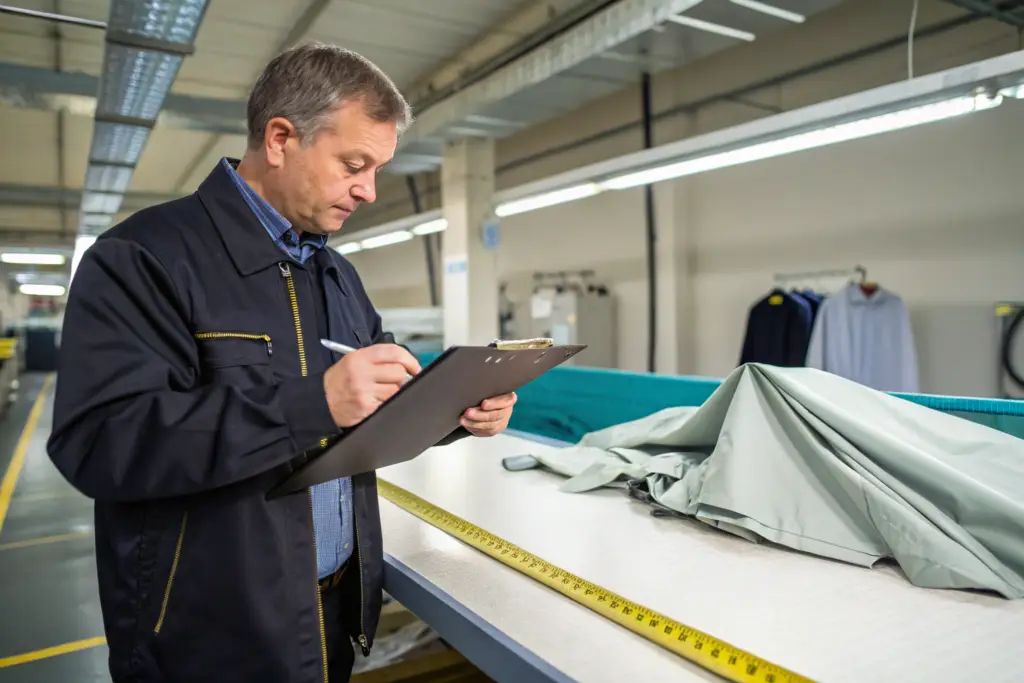
What Is an AQL 2.5 Inspection and How Do You Read the Pass or Fail Report Correctly?
AQL stands for Acceptable Quality Level. An AQL 2.5 inspection means that in a sample of the bulk goods, the inspector will count the number of major defects. If the number of defective units exceeds the acceptable threshold for the sample size, the lot fails. For a lot of 1,200 units, the sample size is 80 units. The lot passes if there are 5 or fewer major defects. It fails if there are 6 or more. The AQL inspection standards are the global standard for consumer goods. The report will clearly state the sample size, the number of defects found, and the pass or fail result. You should read the report carefully, not just the result. Look at the specific defects found. A lot that passes AQL 2.5 but has a consistent minor issue, like loose threads on every unit, is still a quality problem you need to address with the factory.
How Do You Ensure the Bulk Fabric Matches the Approved Sample’s Weight and Hand Feel?
The inspection report must include a fabric weight verification. The inspector cuts a sample of the bulk fabric, weighs it on a calibrated scale, and reports the GSM. Compare this to the approved sample’s GSM. A deviation of more than 5% indicates a fabric substitution. The inspector should also include a subjective hand feel comparison against the approved sample, rated on a scale of 1 to 5. If the hand feel is rated 2 out of 5, the fabric has been changed. You can also request a lab test for fiber content verification if you suspect the fiber blend has been altered. The fabric weight and hand feel inspection protocols provide objective data to support a rejection decision.
Conclusion
The three biggest pitfalls that destroy new private label clothing brands are entirely preventable. Legal labeling compliance is solved by reading the FTC requirements, obtaining an RN number, and having a compliance specialist review your labels before production. The deposit trap is solved by using a Letter of Credit, limiting your deposit to 30%, and verifying the factory’s physical address. The perfect sample, failed bulk catastrophe is solved by hiring a third-party inspection company to audit the bulk goods before you release the balance payment. None of these solutions are expensive. All of them are cheaper than the alternative: a suspended platform account, a lost deposit, or a warehouse full of unsellable inventory.
The brands that survive their first year are not the ones with the most creative designs or the largest social media following. They are the ones that treated the unglamorous, technical, and legal details as seriously as they treated their logo. The time to learn about labeling compliance is not when your shipment is held at customs. The time to negotiate payment terms is not after you have wired the money. The time to book an inspection is not when the goods are already on the water.
At Shanghai Fumao, we guide our private label brand partners through every one of these pitfalls. We provide compliant labeling templates with FTC and EU requirements built in. We accept Letters of Credit for new partnerships and offer a 30% deposit structure with the balance due after a passed third-party inspection. We welcome independent inspectors and maintain a transparent production process that makes the "perfect sample, failed bulk" scenario nearly impossible.
If you are starting a private label brand, or if you are in the planning stages and want to avoid these traps from day one, we can help. At Shanghai Fumao, we will provide you with a New Brand Launch Checklist, our compliant label templates, and a sample Letter of Credit guide. Contact our Business Director, Elaine, at elaine@fumaoclothing.com. She can walk you through our onboarding process and connect you with our compliance specialist. Start your brand with the confidence that the legal, financial, and quality details are handled by professionals who have seen the pitfalls and know how to avoid them.