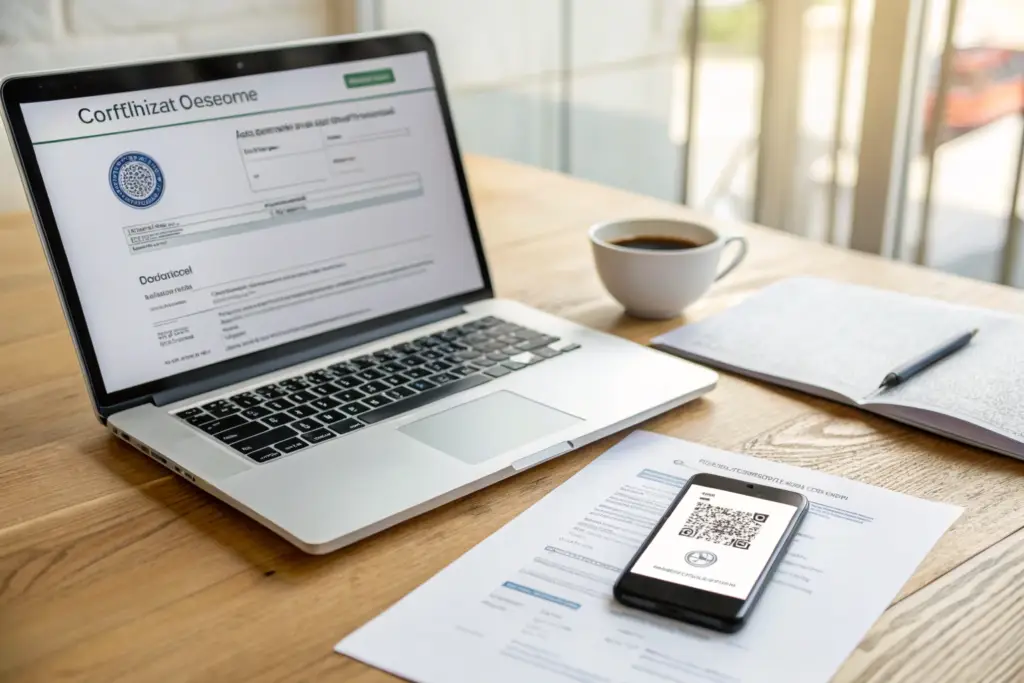
A factory sends you a PDF. It has a fancy gold seal. It says "ISO Certified" or "BSCI Audited." You feel a brief moment of relief. Then the doubt creeps in. Did they photoshop this? Are they a legitimate manufacturer or a trading company passing off someone else's certificate? I have been on the receiving end of this anxiety. A brand owner in California once told me he discovered his previous supplier's "audit report" actually belonged to a completely different factory located 200 miles away. The supplier had simply changed the company name in a PDF editor. That discovery came not from a routine check, but from a customer return that triggered a retailer audit. The brand lost its biggest wholesale account. It almost folded the business.
Verifying Shanghai Fumao's credentials takes less than sixty seconds and requires zero technical expertise. Here is the simple process: I provide you with a live audit ID number, not a static PDF. You take that ID, open the issuing body's public database—such as the amfori sustainability platform for BSCI or the SGS certificate lookup portal for ISO 9001—type in the number, and instantly see our factory name, address, scope, and validity date directly on the auditor's official server. There is no middleman. There is no chance of document tampering. The verification happens on a third-party domain that neither of us controls. In less than a minute, you know whether we are who we say we are. You can do this right now, during our first Zoom call, while I wait silently on the line. I insist on it.
This process is not complicated. But most suppliers never explain it because they hope you won't ask. They count on your trust, your politeness, or your lack of technical know-how. I count on your vigilance. A skeptical buyer is a smart buyer, and a smart buyer becomes a long-term partner. Let me walk you through the exact clicks you need to make, the specific databases that matter, and the red flags that signal a fabricated social compliance story.
Which Certifications Should a Reliable Chinese Apparel Factory Hold?
Not all certifications carry equal weight. Some are pay-to-play paper mills where the factory pays a fee and receives a digital badge within 48 hours, no site visit required. Others require an unannounced physical audit by an accredited third-party inspector who checks everything from fire extinguisher expiration dates to overtime payment records. Knowing which is which protects your brand from a PR disaster.
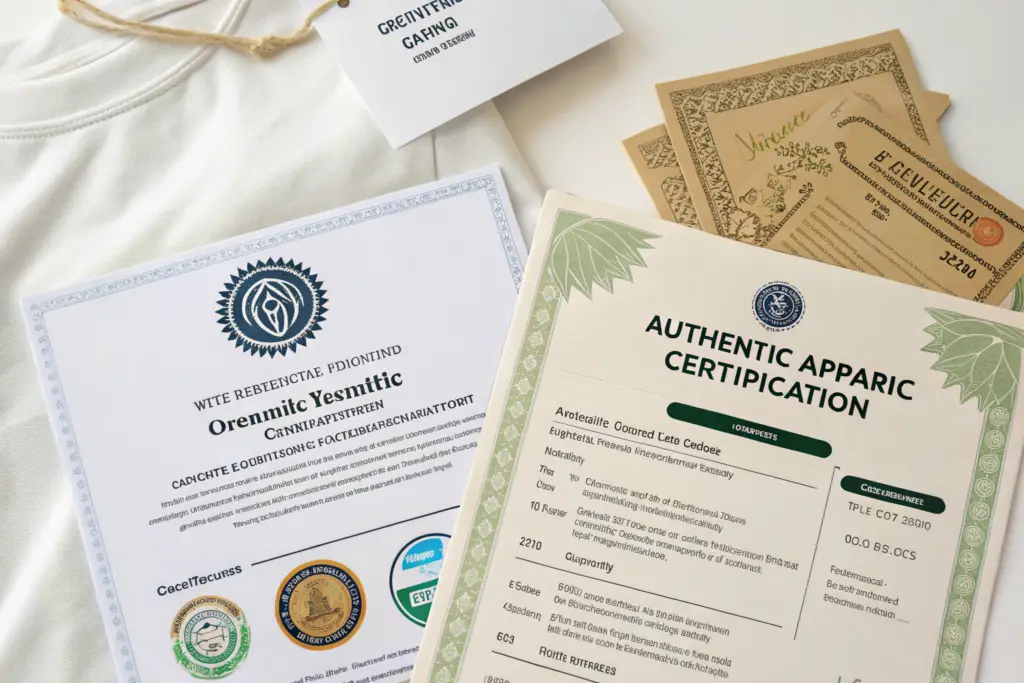
For an American apparel brand, I recommend focusing on three core certification pillars: quality management, social compliance, and product safety. For quality, the ISO 9001:2015 certification demonstrates that our manufacturing processes are documented, measured, and continuously improved through a formal corrective action system. For social compliance, the BSCI (Business Social Compliance Initiative) audit or an equivalent SMETA 4-Pillar audit proves that we pay legal wages, maintain safe working conditions, and do not use forced or child labor. For product safety, the OEKO-TEX Standard 100 Class I or II certification guarantees that every component of your garment—from the sewing thread to the zipper tape to the main fabric—has been lab-tested and found free of harmful substances like azo dyes, formaldehyde, and heavy metals. These three pillars form a compliance tripod. If a factory claims to be "certified" but cannot produce a live verification link for at least two of these three categories, treat that as a serious sourcing risk.
Let me break down exactly why each of these specific standards matters for your U.S. retail compliance and how to check them in real time.
Why Does a BSCI Audit Matter for U.S. Retail Buyers?
Your customers are watching. Not just the end consumers, but your retail partners. Major U.S. department stores and online marketplaces like Amazon have implemented strict Vendor Codes of Conduct that require documented social compliance from every tier-one factory in the supply chain. If a journalist or activist group discovers that your $60 yoga pants were made in a factory with locked fire exits, you lose the order, and worse, you lose your public reputation.
BSCI is the most widely recognized social audit framework for factories in developing countries. An amfori BSCI audit covers thirteen performance areas including fair remuneration, decent working hours, occupational health and safety, and no precarious employment. The audit is conducted by independent auditing companies like SGS, TÜV Rheinland, Bureau Veritas, or Intertek. They arrive unannounced, interview workers privately, check payroll records, inspect dormitories if they exist, and test emergency alarm systems. The resulting report is uploaded to the amfori sustainability platform, where you, the buyer, can access it using the audit ID. A valid BSCI audit with a "B" or "C" rating signals that the factory takes worker welfare seriously. We hold a current, valid BSCI report. I share the audit ID proactively, not reactively. This is not a checkbox for me; it is a business continuity requirement for you. The due diligence obligations under emerging legislation like the UFLPA make this verification non-negotiable for goods entering the U.S. market.
What Does OEKO-TEX Standard 100 Certification Guarantee?
Social compliance covers the treatment of people. Product safety covers the treatment of skin. A factory can be socially ethical but still use banned azo dyes that release carcinogenic amines when they contact human sweat. This is an invisible risk. You cannot see a restricted chemical on a finished garment, which makes it more dangerous than a visible stitching defect. A recall due to chemical safety can bankrupt a mid-sized brand through refunds, liability lawsuits, and irreversible retailer delisting.
OEKO-TEX Standard 100 is the global benchmark for textile chemical safety. When you see this label, it means every component—fabric, thread, button, interlining, printed label—has been tested by an OEKO-TEX member institute against a comprehensive substance list that is updated annually. Class I certification means the product is safe for babies and toddlers, the strictest standard. For our OEKO-TEX certified products, we provide a certificate number that you can verify instantly on the official OEKO-TEX label check portal. Type in the number, and the system returns our company name, the product categories covered, and the certificate's expiration date. This is critical for brands selling kids' wear, underwear, or any garment designed to sit directly against skin for extended periods. If a factory hesitates to provide the OEKO-TEX certificate number, or if the number does not match their legal entity name on the database, they are either lying or they are reselling another factory's goods without re-certification. Both are disqualifying red flags in a responsible supply chain compliance framework.
How Do I Spot a Fake Audit Certificate in Under a Minute?
Fraudulent certificates are more common than the industry likes to admit. The motivation is simple. A genuine audit costs money, time, and requires the factory to meet real standards. A fake certificate costs thirty minutes of graphic design time. For a busy brand owner who is juggling product development, marketing, and cash flow, a quick glance at a PDF might feel sufficient. This is exactly what the fraudsters count on.
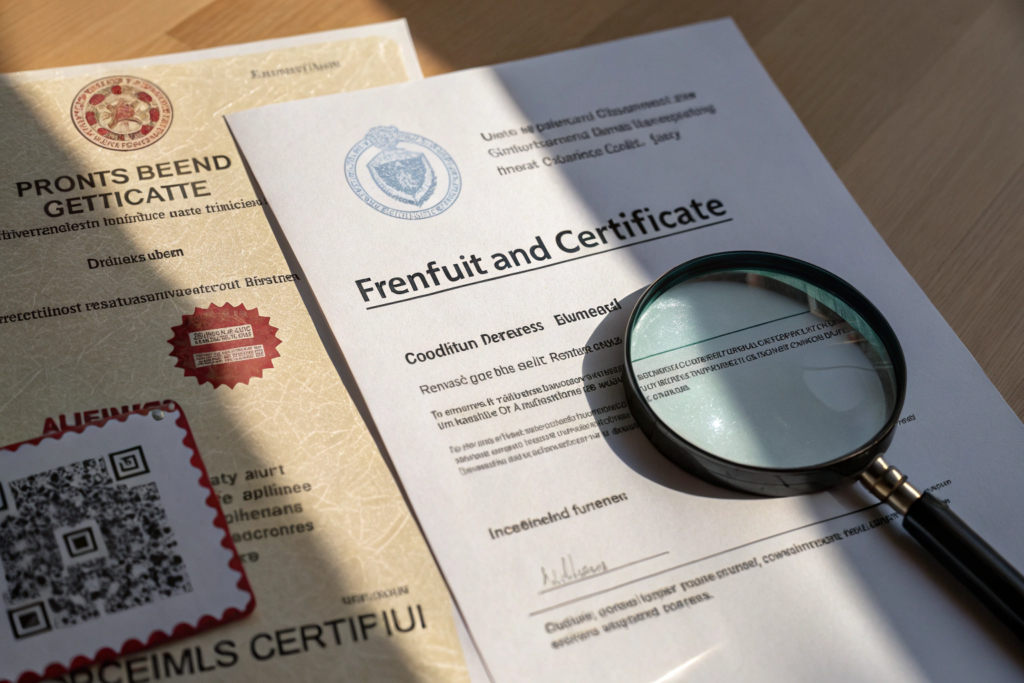
You can destroy a fake certificate's credibility in sixty seconds by following what I call the "Three-Point Lockdown Check." Point One: Verify on the issuing body's official database, never trust the PDF. A genuine BSCI, OEKO-TEX, or GRS certificate always has a unique public-facing ID that resolves on the certifier's domain. Point Two: Match the legal entity name on the certificate to the factory name on your contract. A trading company might show you a certificate from a factory they claim to work with, but you have no contractual relationship with that factory. Point Three: Check the scope and expiration date. An ISO 9001 certificate for "textile trading" is not the same as "textile manufacturing." An expired certificate is worse than no certificate because it signals negligence. If a factory fails any of these three points in the first minute of your due diligence call, end the conversation. No legitimate supplier pressures you to accept a PDF as proof without offering live verification.
These steps create a tamper-proof loop. They remove the human bias of "they seemed nice on the call" and replace it with hard data on an independent server. Let me drill into the specific mechanics of the database lookup and the scope mismatch trap.
How Do I Use the amfori Platform to Validate a Factory?
The amfori platform is the official repository for BSCI audits. I prefer it over a simple PDF because it shows the entire audit history, not just the one good snapshot a factory wants you to see. Perhaps the factory got an "A" rating two years ago but a "C" rating last year, with specific non-compliance findings on overtime hours. That trajectory matters more than a single data point.
Here is the sixty-second drill. Ask the factory for their amfori ID number. Then go to the amfori website's public-facing platform. Enter the ID. The screen will immediately populate the factory's legal name, its physical address, the audit date, the audit company name (for example, Bureau Veritas or SGS), and the overall rating. Scroll down and you will see the detailed findings per performance area. I encourage you to look at the "Working Hours" and "Occupational Health and Safety" sections specifically. A transparent supplier like Shanghai Fumao does not fear these questions, because we keep our documentation updated to reflect real-time improvements. If the factory name on the screen doesn't match the name on the email signature, close the tab. If the factory claims they "lost" their audit number, that is like a driver claiming they lost their license plate number. It does not happen. The SEDEX database is an alternative if the factory uses SMETA audits. The process is the same: check the name and address match, check the audit is current, check for adverse findings.
Why Does the Certificate Scope Need to Match My Product?
Imagine you are sourcing organic cotton baby onesies. A factory sends you a GOTS certificate. The certificate looks real, the authenticity checks out, but when you read the "scope" line carefully, it says "Manufacturing and export of woven polyester curtains." That factory has a GOTS certificate for a completely different product category. This mismatch is a common trap in the textile sourcing world.
A certificate is only valid for the specific processes and product categories listed in its scope. If we are manufacturing your kids' wear line, our OEKO-TEX certificate must explicitly state "garments for children" under its appendix. If the scope only covers raw greige fabric, then the finished garment assembly is not covered. For our GRS certification, the scope covers "manufacturing of knitted and woven garments from recycled materials." This means the document you hold actually applies to the stitching, cutting, and finishing of your recycled polyester hoodie. I always forward the Appendix pages of our certificates. Those pages list the specific product categories. When verifying a GOTS certificate, always check the scope line on the actual certificate text. A misleading scope is a deliberate attempt to exploit your trust. For our U.S. clients, I also align the scope with the requirements of the CPSC, ensuring that our children's product certifications directly support the Children's Product Certificate you issue as the importer of record.
Can I Conduct a Virtual Factory Tour Before Placing an Order?
A static certificate tells you about a point in time. A live video walkthrough tells you about right now. I have met too many brand owners who verified a perfect audit report, placed a 10,000-piece order, and then discovered that the factory's "production line" was actually a dimly lit shed with fifteen broken machines. The audit had been passed on a different day with a different setup. This is called a "show factory" scam.
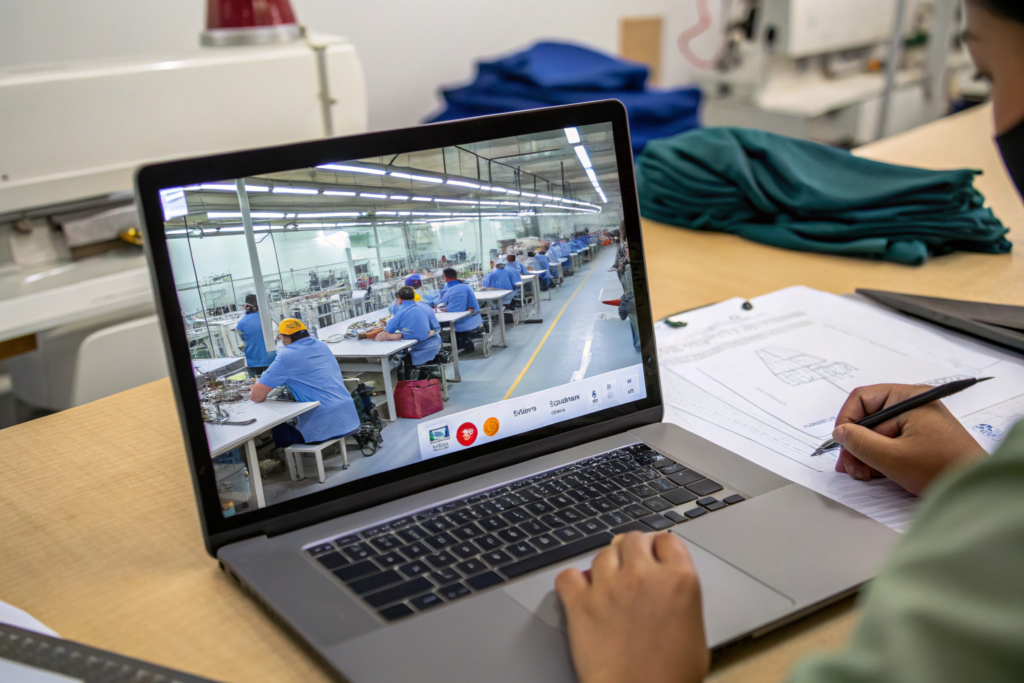
Within 48 hours of your request, I will conduct a live, unscripted video walkthrough of our production floor while you watch from anywhere in the world. This is not a pre-recorded corporate video. This is a FaceTime, WhatsApp, or Zoom call where you control the direction. You want to see the cutting tables? I walk there. You want to see the sewing line where your specific bulk order will be sewn? I show you the line card with your PO number written on a whiteboard next to the operators. You want me to zoom in on a random worker's glove or the expiry date on a fire extinguisher? I do it without hesitation. This real-time transparency is the ultimate confidence builder. A factory that refuses a live video tour, or insists that "the floor is too noisy" or "confidential," is a factory that has something to hide. Our doors are open digitally because our reality matches our certificates.
This live interaction replaces the expensive and time-consuming process of flying to China for an on-site visit. It is immediate, it is verifiable, and it gives you visual evidence that you can screenshot and timestamp for your own compliance files. Here is how to structure that call and what specific visual markers to demand.
How Do I Schedule a Live Video Inspection and What Should I Ask to See?
Do not schedule the call three weeks in advance. A factory with something to hide needs time to stage an environment. Give a short window. I typically tell my clients to surprise me. Send a message Monday morning and say, "Elaine, can you walk me through the floor now?" If I am available, I pick up immediately. If I am in a meeting, I give you a specific time slot within the same business day.
During the call, do not just admire the machines. Ask specific, verifiable questions. First, ask to see the Production Tracking Board. This is a whiteboard or digital screen that shows the daily output per line. A live factory updates this hourly. Second, ask to zoom in on the Quality Control checkpoint. An inspector should be present at the designated station with measuring tools in hand. Third, request to see the raw material warehouse. Look for neat stacking, humidity control, and fabric rolls tagged with lot numbers. For a recent client auditing our facility last fall, I showed them the specific tagged batch of GRS-certified recycled polyester waiting in the warehouse for their PO number. This verified that the fabric was physically present before they wired the deposit. A virtual tour checklist should always include verifying the raw materials physically exist. Many fraudulent operations secure the order first, then scramble to buy the fabric, causing both quality and delivery disasters.
Does a Virtual Tour Replace a Third-Party Physical Inspection?
A virtual tour builds trust. It proves the factory is the factory. It provides visual evidence of capacity and organization. But it does not replace a technical third-party inspection. A smartphone camera cannot measure stitching tension, fabric weight, or needle detection machine sensitivity. These require specialized equipment and a trained, neutral inspector on the ground.
I recommend using both tools in sequence. First, conduct the live video tour with me. Confirm our identity, our scale, and our organizational cleanliness. Second, for your first bulk production order, hire an independent third-party inspection company to visit during the actual manufacturing process. A company like QIMA, Bureau Veritas, or Intertek will send an inspector to our floor. The inspector checks the garments against your approved sample and AQL standards. I support this fully. I provide the inspector with a private room, access to all workstations, and the packing list. A factory that obstructs a third-party inspection is a factory you cannot trust to ship accurately. The combination of a virtual tour for speed and a physical inspection for technical data is the most robust quality assurance framework available for offshore production. This layered approach is documented in the Inspection 4.0 guidelines being adopted by forward-thinking supply chain managers.
What Banking and Trade Security Backs Fumao's Exports?
Certifications prove integrity. Virtual tours prove physical reality. But financial security proves that your money is protected if something still goes wrong. I am a factory owner, so I live in the world of production risk. You are a brand owner, so you live in the world of cash flow risk. When you wire a 50% deposit to a stranger in another country, you are making the largest leap of faith in the entire business relationship.
Shanghai Fumao mitigates your financial exposure through structured trade instruments and institutional-grade compliance. For first-time bulk orders, we accept payment via Irrevocable Documentary Letter of Credit (L/C) at Sight. This means your bank guarantees payment only when we present a complete, compliant set of shipping documents that proves the goods are on the vessel and match the purchase order specifications. You are not paying for a promise. You are paying for a stack of verifiable evidence, including the Bill of Lading, Commercial Invoice, Packing List, Certificate of Origin, and the passed inspection report from an independent third party. This process is governed by the International Chamber of Commerce's UCP 600 rules, a standardized framework understood by banks in New York, London, and Shanghai. It turns a trust-based transaction into a rules-based transaction. Your money sits in your bank until the container is sealed and documented.
This is not the cheapest payment method in terms of bank fees, but for a first order, it provides the highest level of security. I want you sleeping peacefully while your order is in production, not lying awake worried about your wire transfer. Let me detail how the L/C mechanism works in the apparel context and compare it to the more widely used TT method.

How Does a Letter of Credit Protect My Deposit on Bulk Orders?
The risk with a standard Telegraphic Transfer (TT) deposit is simple. You send the money. The factory owns it. If the factory goes bankrupt, catches fire, or simply decides to delay your order by four months, your cash is locked in their bank account. Legal recovery across international borders is slow, expensive, and often impossible.
An Irrevocable L/C at Sight breaks this dependency. The contract typically structures a 30% deposit by TT to secure raw material purchasing, with the remaining 70% covered by the L/C. Here is the flow: You open the L/C at your bank. We ship the goods. We present the set of compliant documents to our bank, which forwards them to your bank. Your bank has five banking days to check the documents. If every comma and description matches the L/C terms exactly, your bank releases the payment. If a document contains a discrepancy—for example, the Bill of Lading shows "48 cartons" but the Packing List shows "48 cartons"—we must correct it and re-present before payment is released. This documentary compliance requirement ensures that the physical shipment matches the contract. The International Chamber of Commerce UCP 600 rules that govern this process are recognized globally. This mechanism protects you from fraud, non-shipment, or gross misrepresentation. I use the term "Irrevocable" deliberately. Once opened, the L/C cannot be cancelled or changed without all parties' agreement, preventing last-minute renegotiation demands.
What Is the Safest Way to Handle a Sample Order Payment?
For a smaller sample development or a trial order of 200-500 pieces, an L/C can be overkill. The bank fees on a $3,000 transaction might eat up the margins on both sides. For these situations, I still advocate for a verifiable, third-party-escrowed transaction.
We typically process sample orders through our verified Alibaba Trade Assurance account, which has a trackable transaction history spanning years. Trade Assurance ties the payment release to a shipping deadline and a quality satisfaction checkpoint. If we fail to ship the samples by the agreed date, you file a refund request with a single click. The Alibaba platform holds the funds and adjudicates. This provides a safety net without the complexity of an L/C. Alternatively, we can process a simple 50/50 TT split. 50% upfront to cover the fabric procurement and specialized logo setup, and 50% paid against a video of the finished, packed, and labeled cartons with the tracking number visible. I send that video before you pay the balance. You see your samples exist before the second transfer. For our established repeat clients, we often move to open account terms after a successful track record of three completed orders, but we never ask a new client to take that leap. The baseline security of a Trade Assurance order is the minimum viable standard for a new B2B relationship. It creates a formal record of the transaction that serves as evidence in any future dispute resolution through cross-border trade platforms.
Conclusion
Trust in the apparel supply chain should never rest on a prayer. It should rest on a sixty-second database query, a live video walkthrough, and a banking instrument that your CFO understands and approves. We have dissected exactly how to verify the claims made by any overseas factory. You now know that a real BSCI audit is not a PDF but a live link on the amfori platform. You know that a genuine OEKO-TEX certificate has a validity date and a product scope you can cross-check instantly. You know that a factory refusing a live, unscheduled video tour is a factory communicating its risk level through its own defensiveness. And you know that an Irrevocable L/C at Sight transforms a 10,000-piece order from an act of faith into a standardized, rules-based commercial transaction protected by global banking convention UCP 600.
The sixty-second verification I described at the beginning is not a marketing slogan. It is an operational promise. I welcome it. Try me. During our first serious sourcing conversation, ask me for the BSCI audit ID. Watch me share my screen and navigate to the amfori site so you can read the name, address, and rating with your own eyes. This is the experience of working with a factory that views your due diligence not as an inconvenience, but as a mutual filter that separates serious, scalable buyers from temporary price-shoppers.
If you are currently building your compliant vendor list or need to validate a partner before committing to a Spring/Summer bulk run, I want you to connect directly with our Business Director. Elaine handles every certification request personally. She will send you the live links, schedule the virtual floor walk, and discuss the payment structure that makes you comfortable. Reach her at elaine@fumaoclothing.com. Sixty seconds is all it takes to verify Shanghai Fumao. Let us earn your trust the hard way, through transparent evidence, not smooth words.