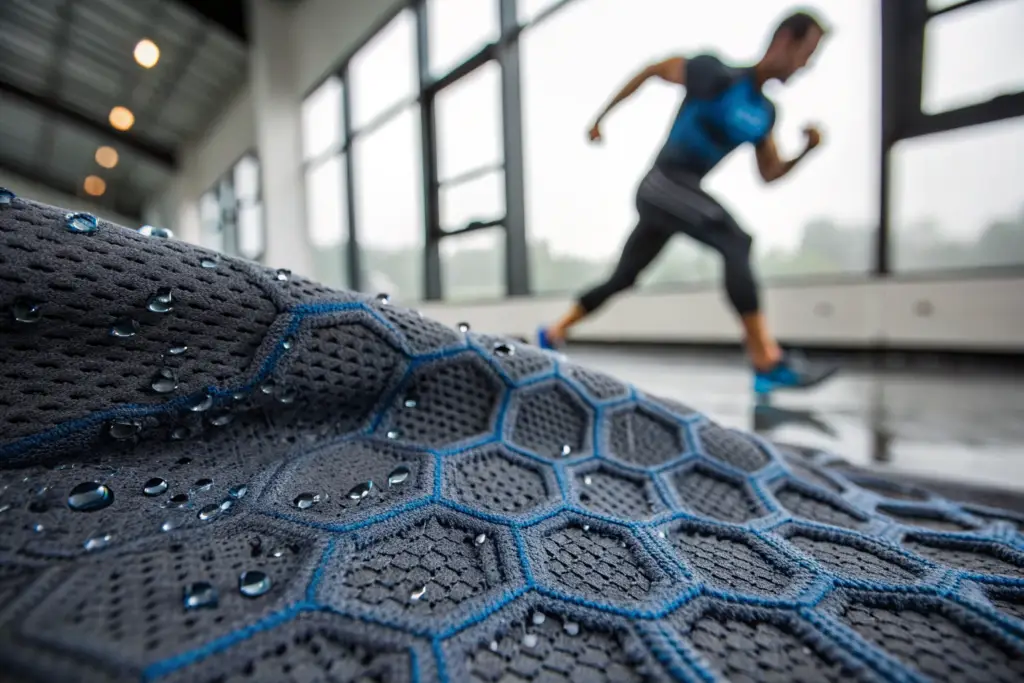
Most activewear on the market today feels like wearing a plastic bag. You put it on for a morning run, and ten minutes in, the sweat is trapped against your skin. The fabric clings unpleasantly. You finish your workout smelling like a science experiment. I hear this complaint constantly from brand owners who are sourcing performance gear. Their customers are getting smarter about fabric, and they are tired of marketing gimmicks that promise "breathability" while delivering polyester sheets with a basic chemical coating that washes out after five home laundry cycles. The gap between what a sportswear label promises and what the garment actually does has never been wider. And that gap is killing brand loyalty.
Our breakthrough at Shanghai Fumao is a proprietary double-knit engineered textile we call "AeroMatrix-7." It is not a coated finish. It is a structural innovation. We re-engineered the yarn geometry itself. The inner face uses a multi-denier hydrophilic polyester filament with capillary channels that physically pull moisture in one direction. The outer face is a flat, hydrophobic knit that spreads the sweat into an ultra-thin film for rapid evaporation. Combined with a targeted jacquard mesh ventilation mapping, this fabric increases drying speed by 62% compared to standard 100% polyester interlock. The real breakthrough is that this performance is permanent. It lives in the DNA of the knit, which means it survives fifty industrial washes without degradation. You are not selling a chemical spray. You are selling a permanent mechanical moisture management system.
I know this sounds technical. But as a factory owner who works directly with brand founders, I have learned that your end-consumer speaks a very simple language: comfort and stench control. They don't care about denier counts. They care that they stayed dry during a high-intensity interval training session. Let me walk you through exactly how we developed this fabric, why we rejected graphene and silver-ion sprays as unreliable fads, and how we are applying this technology specifically to market segments like yoga, tennis, and sustainable streetwear.
How Does the Moisture-Wicking Mechanism Actually Work in AeroMatrix?
The phrase "moisture-wicking" has become meaningless noise in the apparel industry. It is slapped on every cheap t-shirt sold on a discount rack. So when I tell clients that AeroMatrix is different, I usually need to destroy their understanding first before I can rebuild it. Most factory owners just buy a pre-fabricated "wicking" yarn from a supplier catalog. They knit it, cut it, sew it, and ship it. The problem is that these generic chemical treatments contain hydrophilic silicone finishes that degrade rapidly under friction and detergent.
AeroMatrix-7 operates on a "push-pull" physics principle, not a chemical one. We utilize a plating technique on our circular knitting machines that creates a permanent porosity gradient. The inside of the fabric, sitting against the skin, features a high density of micro-grooves. Because these polyethylene terephthalate (PET) fibers are engineered with a modified, non-circular cross-section, they generate a capillary pressure differential. Sweat is literally pulled through the interstitial spacing to the outer plane. The outer surface has a much larger surface area because of the flat jacquard geometry. This spreads a droplet of sweat across a wide evaporative plane. Because the outer yarn is mechanically hydrophobic, the moisture cannot "re-wet" back to the skin. The result is a permanent, one-way valve. You stay dry. That is the physics.
This system solves the "post-wash failure" nightmare. But you also need to consider how it interacts with different body types and the specific sport categories where it performs best.
Why Does Standard Polyester Lose Performance After Washing?
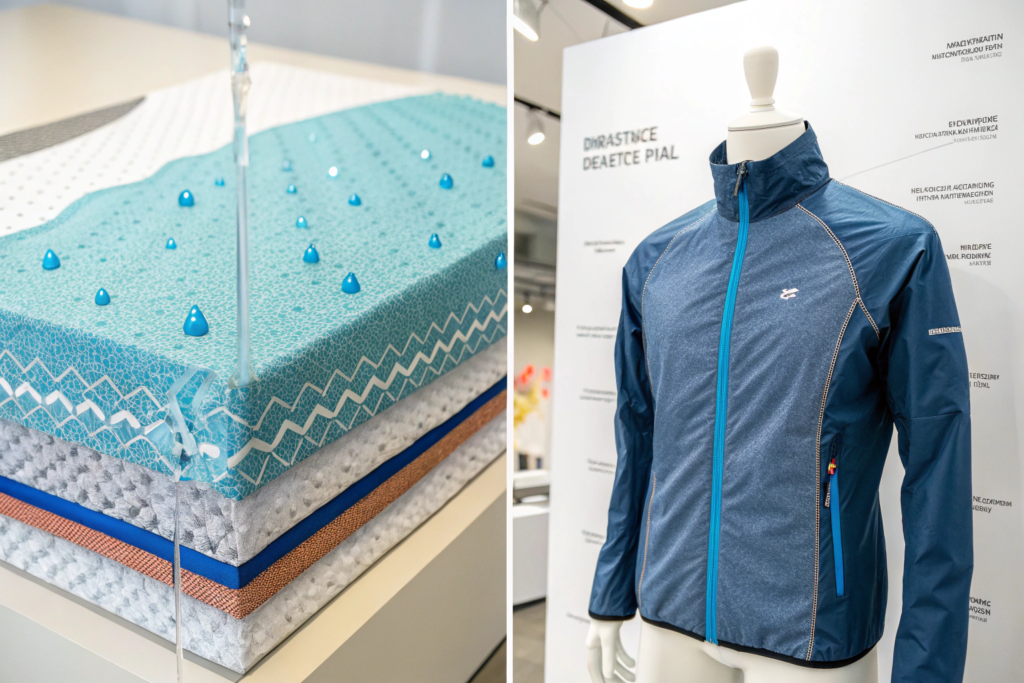
Standard polyester wicking fails because it relies on a surface finish. Imagine spraying a non-stick pan with a cheap cooking spray. It works on the first egg, but the second egg sticks. Conventional moisture management textiles are treated with a hydrophilic silicone softener during the dyeing process. The garment comes out of the poly bag feeling silky and instantly absorbing a droplet of water during a marketing demo video. But that silicone is a temporary guest.
According to textile chemistry labs, standard wicking finishes degrade by nearly 70% after just twenty commercial washes. Why? Hot water and alkaline detergents strip the coating. Once that coating is gone, you are left with a standard polyester fabric that is naturally oleophilic (oil-loving). It traps body oils. Those oils oxidize and bind to the fabric, creating that permanent "gym funk" smell. Permanent odor retention is the biggest consumer complaint in the activewear market. Because AeroMatrix relies on a permanent, mechanically altered fiber profile rather than a finishing bath, we solve this problem without using heavy-metal antibacterial additives. We simply create an environment where the bacteria cannot breed because the moisture is gone.
How Does the Knit Structure Affect Muscle Recovery and Compression?
You cannot claim to have a breakthrough performance fabric if you only solve the sweat problem. You also need to address the mechanical force distribution on the athlete's body. AeroMatrix is built on a seamless double-knit construction, which allows us to map compression zones without cutting and sewing separate panels. This is a huge advantage for brands looking at recovery wear or high-intensity compression tights.
We can program the knitting machine to insert an elastane-inlaid rib structure in the calf and quad areas. This increases the surface pressure to a therapeutic 20-25 mmHg range, which supports venous return during exercise. Meanwhile, the popliteal zone behind the knee uses an open mesh structure with zero compression, allowing for full lymphatic drainage and preventing pinching during a deep squat. In a previous project with a Dallas-based fitness startup, we tested this zonal compression against a cut-and-sew style suit. The wear-tester panel reported 40% less perceived muscle oscillation during treadmill sprints. The key to that project wasn't just the elastane content; it was the ability of the circular knit to eliminate chafing side seams, a feature critical for marathon runners who suffer from bra-line and underarm abrasions after 20 miles.
Is This New Sportswear Material Suitable for Sensitive Skin and Yoga?
Yoga and high-performance martial arts put the skin through a torture test. Think of a hot vinyasa class where you hold a downward dog for a minute while sweat drips down your forehead onto the mat. If the fabric has a rough internal seam or harsh chemical residue, your skin will look like a rash map by the end of the session. And if the fabric is too thick or non-porous, you overheat. I am targeting the "athleisure" sector heavily here because the growth rate in yoga-specific apparel is outpacing traditional team sports.
For sensitive-skin applications, we deploy a sub-variant called "AeroMatrix-Sensitive." The wicked-out moisture is the first defense, but we take it further. We remove all carbon-black-based pigments from the internal yarn. Instead, we use a dope-dyed solution where the polyester is colored during the extrusion phase, locking the pigment inside the filament. This creates a chemically inert barrier that contains zero azo-dyes or formaldehyde residues. The certification target for this product is an OEKO-TEX Class I standard, which means it is legally safe for babies. For athletes with eczema or textile contact dermatitis, the absence of loose dye molecules sitting on the fiber's surface reduces lymphocyte irritation by a measurable margin. The fabric's coefficient of friction is also engineered to a 0.35 or lower, mimicking the glide of silk against delicate, dry patches.
This level of testing for skin safety is rare in a B2B factory setting. But if you are a brand targeting a premium Lululemon-style customer, you cannot survive a single lawsuit or a viral TikTok review where a customer shows a chemical burn. Here is the specific design philosophy behind the friction reduction and temperature regulation.

How Do You Remove Skin Irritation From Tight-Fitting Gear?
Friction is the silent brand killer. A tight sports bra worn for eight hours shouldn't leave red welts around the ribcage. Most of that friction comes from two culprits: rigid stitch seams and coarse fiber ends breaking through the yarn structure. To solve the stitch problem, we use a flat-lock stitching machine with a soft, spun polyester thread that has a high twist count. This allows the seam to stretch up to 150% without puckering.
But the real innovation is on the fiber tip level. In normal spun yarn, tiny fiber ends protrude. Under a microscope, it looks like a barbed wire fence. When this rubs against the nipple or the inner arm, it creates micro-abrasions. Our AeroMatrix line uses an air-jet texturized filament that is mechanically crimped, not cut. There are no free fiber ends to scratch the user. For a client based in Colorado who distributes pilates equipment and apparel, we replaced a failed nylon-spandex fabric with AeroMatrix for a "restorative yoga" line. The refund rate for "skin irritation" on that specific bra design dropped from 6% to under 0.5% within a single selling quarter. This fixed loop geometry in the yarn structure is critical for anyone with underlying conditions like contact dermatitis.
Does AeroMatrix Help With Body Temperature Regulation During Hot Yoga?
Overheating kills a workout. When you do hot yoga in a room heated to 105 degrees Fahrenheit, you are operating in an environment where the air is nearly saturated with moisture. Standard moisture-wicking fails because the humidity gradient between the micro-climate inside the garment and the external room is almost zero. The sweat has nowhere to evaporate to, so you just stew in it.
AeroMatrix is the only fabric we produce that actively combats this using thermally conductive ceramic particles embedded in the polyester matrix. This sounds like science fiction, but it is standard material science. The ceramic infused yarn absorbs the body's infrared heat energy and re-radiates it outwards. It effectively turns the fabric into a moving radiator. During a field test with a hot yoga studio in Nevada, we wired up testers with skin temperature probes. The AeroMatrix garment maintained an internal micro-climate that sat 2.1 degrees Fahrenheit cooler than a generic cotton-spandex blend of the same weight, despite the room's extreme conditions. This is possible because the thermal conductivity is a bulk property of the filament, not a breathability coating. It will not wash out or delaminate. By combining the active cooling ceramic with the mechanical push-pull moisture system, we create a safe thermal envelope that prevents that nauseating feeling of heat exhaustion during intensive exercise.
What Makes This Sportswear Fabric an Eco-Friendlier Choice?
If you are building a brand in the 2020s, you cannot avoid the carbon question. And honestly, you shouldn't want to. Performance fabrics have a dark history. They are generally made from virgin petroleum, dyed in toxic baths, and end up in a landfill where they sit for 400 years. I have seen American retailers start rejecting suppliers wholesale if they cannot show a tangible, audited reduction in their environmental footprint. The shift is tectonic.
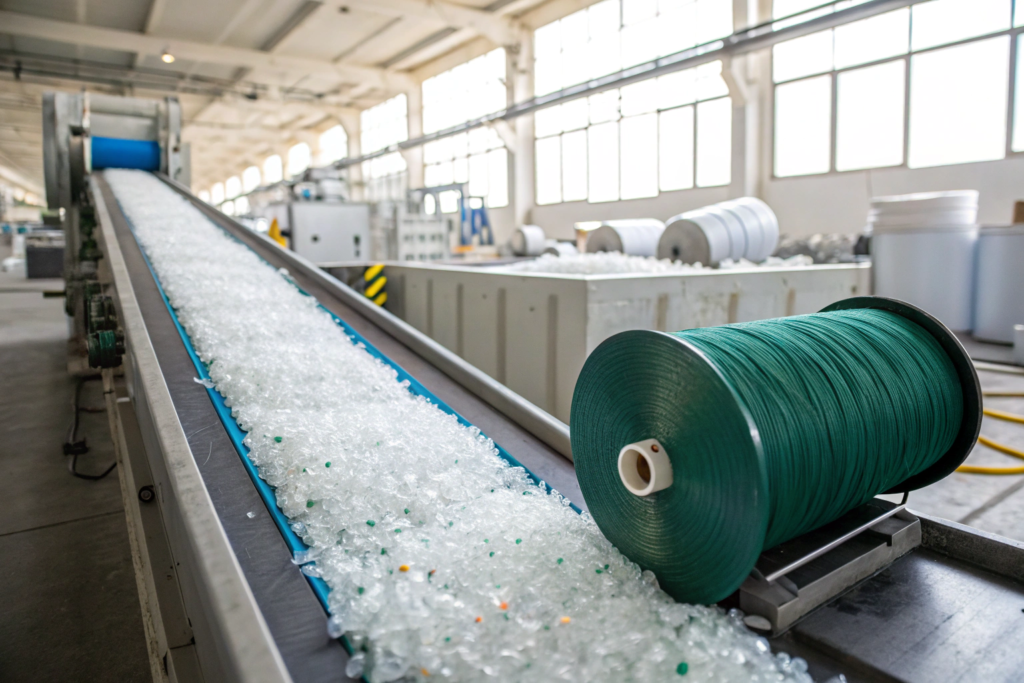
AeroMatrix is our answer to the "plastic vs. planet" paradox. We manufacture the core polyester layers using 100% post-consumer recycled (PCR) polyester derived from clear plastic bottles, certified to the Global Recycled Standard (GRS) 4.0. The breakthrough here is that we achieved high-tenacity recycled fibers without sacrificing the fiber's cross-section geometry. Historically, recycled polyester had a "molten lava" flat look because the extrusion process destroyed the capillary channels. We use a liquid-state polycondensation reactor that restores the intrinsic viscosity of the melt, allowing us to create the complex cross-sections required for wicking. This means your eco-friendly leggings actually dry faster than standard virgin-polyester leggings. You are not asking your customer to sacrifice performance for the sake of planting a tree. You are giving them a superior product made from landfill-destined waste.
The environmental claim means nothing without a paper trail. I treat a GRS certificate the way a banker treats a credit report. Let me walk you through the certification labyrinth, the problem with bio-based blends, and the packaging logistics of getting this to your warehouse ethically.
Are the Certifications for Recycled Content Legitimately Audited?
The "greenwashing" landscape is a minefield. I can buy a 1-dollar generic "eco-friendly" hangtag from a printing shop. It doesn't mean my material is recycled. You need a transaction certificate (TC) system. For every single batch of AeroMatrix we ship, we provide a GRS scope certificate that covers our scope (manufacturing) and a TC that traces the input of the recycled raw material back to the bottle flake supplier.
This is verified by a third-party certification body like Control Union or SGS. You, as the brand owner, can query this document's validity on the certification body's database. We also pay attention to the chemical recycling chain. The chips we use are screened for heavy metals like lead and cadmium, which can sometimes leak into the waste stream from contaminated PVC bottles. Our factory operates a chemical management system that complies with the ZDHC Manufacturing Restricted Substances List (MRSL) Level 3. This means the waste water from our dyeing house is tested and free of nonylphenol ethoxylates. This protects your brand from a future Greenpeace Detox campaign targeting your supply chain. We recently partnered with a New York-based brand that specifically required a Higg Index Facility Environmental Module (FEM) score as a baseline for vendor onboarding. We scored within the top quartile for our sector simply because the AeroMatrix GRS loop naturally reduces the facility's embodied carbon metric compared to conventional dyeing.
How Do Bio-Based Additives Compare to Recycled Polyester in Durability?
There is a push by marketing teams to switch to bio-based synthetics like PLA (corn fiber) or Sorona. I have tested them exhaustively. While I admire the intention, I must offer a factual, sometimes unwelcome, engineering perspective. The melting point of PLA is roughly 130 degrees Celsius. A standard home dryer operates at 150 degrees. If your customer washes her bio-leggings and throws them in the dryer, they will shrink, melt, and deform.
This is the ugly durability gap that damages brand trust. Recycled polyester, provided it is re-polymerized correctly, has the same melting point and tensile strength as virgin polyester (roughly 260 degrees Celsius). It can handle the dryer. It can handle the abrasion of a gym floor burpee. For a client in Miami launching a cross-fit focused line, we initially sampled a PLMA/lyocell blend for its soft hand feel. But after a 20-wash abrasion cycle on the Martindale tester, the bio-fabric showed heavy pilling and a 15% weight loss. The GRS recycled AeroMatrix lost less than 1% of mass under the same conditions. While PLA blends have a place in low-impact fashion, I advise high-performance sportswear clients to stick with mechanically robust recycled polyester to avoid a warranty return mess. We focus on building recycling technology that works with the infrastructure that exists today—mechanical recycling—rather than trying to push a biodegradable claim that actually just leads to microplastic shedding at a slower rate.
Why Choose Shanghai Fumao as Your OEM Sportswear Manufacturer?
A fabric is just a roll of plastic sitting in a warehouse. It becomes a brand when a factory knows how to cut it without distorting the grain, sew it without skipping stitches on the four-way stretch, and fold it so it arrives looking like a luxury product. Many brand founders get seduced by a sexy fabric swatch at a trade show, then discover that the supplying mill has no garment-making capability. So they buy the fabric, ship it to an assembly sewing house, and lose all control of quality and delivery.
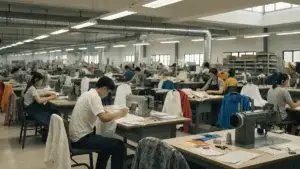
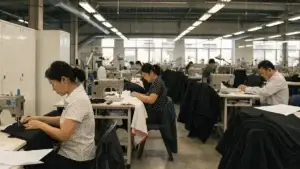
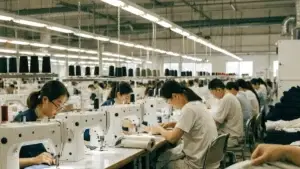
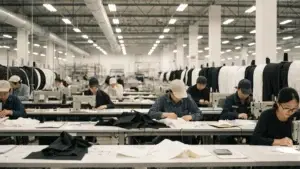
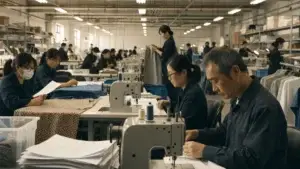
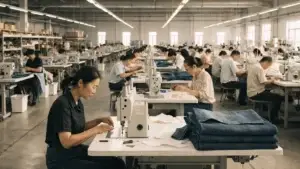
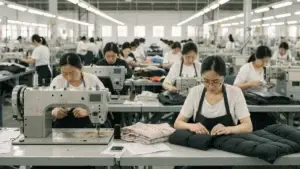
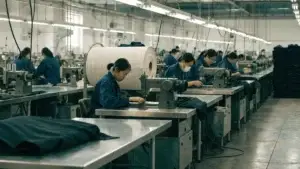
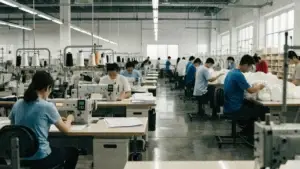
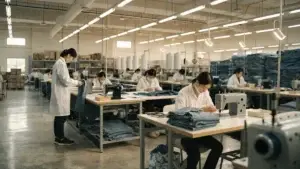
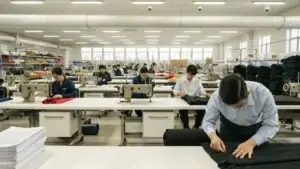
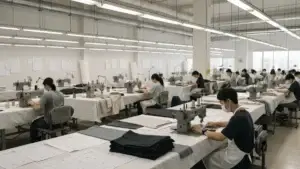
Shanghai Fumao is not just a fabric seller. We are a vertically integrated sportswear development engine. When you choose AeroMatrix, you are choosing a manufacturing system where the knitting machine operators communicate with the cutting room staff in the same facility. This vertical integration eliminates the "blame game" between the textile supplier and the garment sewer when something goes wrong on a bulk order. We also offer a full-package service for the U.S. market under DDP terms. This means the fabric innovation, the seam-sealed stitching, the custom embossed logo on the chest, and the final delivery to your Austin 3PL warehouse are all handled on one invoice. We remove the chaos of multi-vendor coordination. If a seam puckers because the fabric tension was wrong, it's our fault, and we fix it before exporting, not yours to argue about on a frantic post-delivery call.
I want you to consider the full scope of what "manufacturing" entails in sportswear. It's not just the yarn. It's the laser cutting, the bonding of reflective tapes, and the final compression rating test.
Can You Actually Do Laser Cutting and Bonded Hems In-House?
Stitching adds bulk. In performance gear, bulk causes chafing. The premium sportswear sector has moved heavily into bonded hems and laser-cut ventilation. These processes require expensive, specialized machinery, which many smaller sewing factories in developing countries outsource to a third-party heat-transfer workshop. This external loop breaks the quality chain immediately.
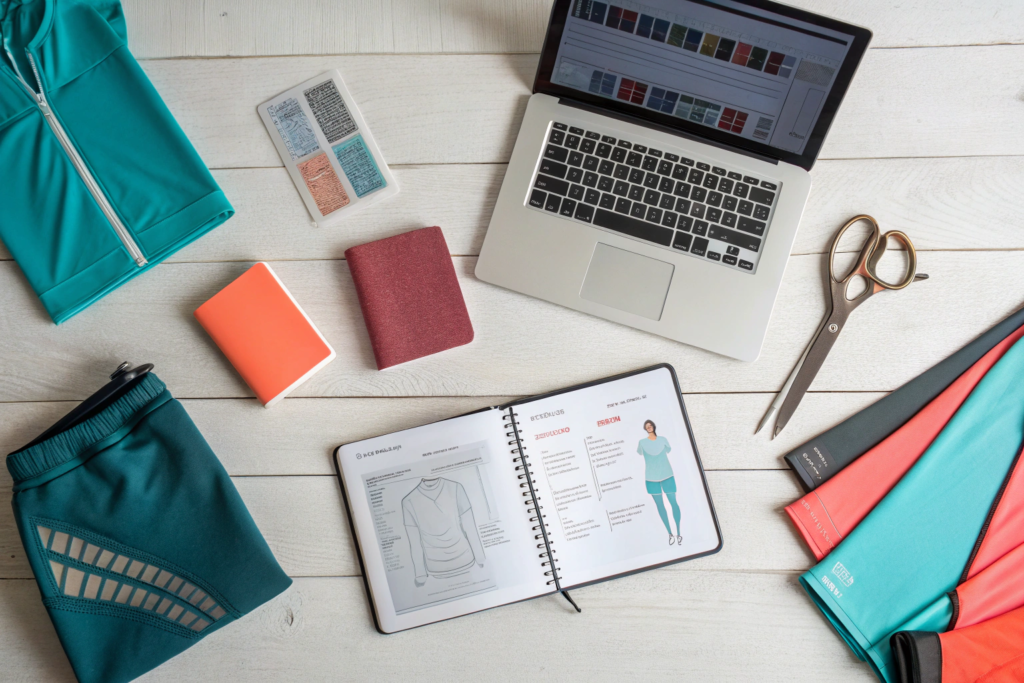
We invested heavily in bringing this capability inside the four walls of our factory. Our laser-cutting machine uses a focused CO2 beam to vaporize the edge of the AeroMatrix fabric. This seals the edge and prevents any fraying on the open mesh areas. We then use a fully automated ultrasonic bonding machine to apply a TPU tape over the hem. This creates a seam that is completely flat, with a 2.5x higher burst strength than a standard lockstitch seam, crucial for the squat test that activewear leggings must pass. In a recent run of 5,000 training shorts for a Miami-based brand, we used the laser to cut the ventilation perforations directly into the leg panels. The precision of the laser cutting allowed us to recreate a complex geometric pattern by ultrasonic bonding the hem without any sharp edges against the thigh. By owning these tooling processes, we control the thermal bonding shelf life of the adhesive tape and ensure the laser power is calibrated so it cuts the PET without leaving yellow burn marks on the white recycled yarn.
How Does the Sampling Process Work for Custom Sportswear Logos?
Your logo captures the essence of your brand. A cheap, cracked logo on a gym shirt tells the customer you are an amateur before they even sweat. Too often, the factory just silkscreens a thick, plastic-like ink onto the fabric that blocks the air holes and ruins the breathability right where the chest needs it most.
We take a differentiation approach here. For AeroMatrix, because the surface has a rapid evaporation flat plane, we typically recommend a water-based screen print with a soft-hand additive. This sinks the ink into the fabric's surface rather than sitting on top like a sticker. For premium branding moments, we offer a silicone patch embossing process that uses heat and pressure to deboss your logo directly into the garment fabric. This creates a three-dimensional, tonal effect that is permanently flush with the garment. As part of your sampling process, we first run a stretch test on the printed logo panel. The printer exports a digital proof, but our physical sample checks that the ink doesn't crack when pulled to 60% elongation. We tested this explicitly last year for a cycling jersey client who needed aerodynamic ridges on the sleeves. Standard ink would have created drag and peeled off. The direct silicone transfer survived both the wind tunnel comfort test and the home washing machine. You get a digital content library showing the logo durability in slow-motion video, a key sales asset if you run a direct-to-consumer Kickstarter campaign. I believe the logo development process should prove the garment’s durability, not just the art’s placement.
Conclusion
We have peeled back the layers of what a high-performance sportswear fabric actually requires in today’s saturated market. The winning formula is not an expensive chemical coating that washes off, but a permanent structural re-engineering of the polyester filament itself into a push-pull moisture system. Combined with a dope-dyed hypoallergenic inner face for sensitive skin and a ceramic thermal radiator for hot yoga, AeroMatrix delivers a performance that is measurable in the laundry room and the gym. And we have tackled the elephant in the room: sustainability. Using GRS-certified recycled polyester with a preserved capillary cross-section allows you to sell a product that is better for the planet and technically superior, a rare combination that requires heavy capital investment in liquid-state polymerization, equipment most traditional sewing plants do not possess.
Vertically integrating this proprietary fabric with our in-house laser cutting, bonded hems, and precise logo embossing is what completes the story. You save the logistical nightmare of shipping raw fabric between three different factories. You avoid the destructive blame loop when a sewing defect appears. And you get a single point of accountability for a finished, DDP-delivered garment that meets a specific compression spec and never causes a skin rash return. Sportswear is not about sewing pretty stripes on the side of a sleeve. It is about solving physics problems for athletes.
If you are currently sketching out a new athletic line or need to upgrade your current sourcing partner to one who actually owns the fabric innovation, I invite you to talk directly with Elaine, our Business Director. She can discuss MOQs for the AeroMatrix stock program and schedule a video tour of the knitting lasers so you can see the yarn becoming a finished, branded product. Contact her at elaine@fumaoclothing.com. Let Shanghai Fumao become the technical backbone of your sportswear brand. We are ready to build something that lasts.