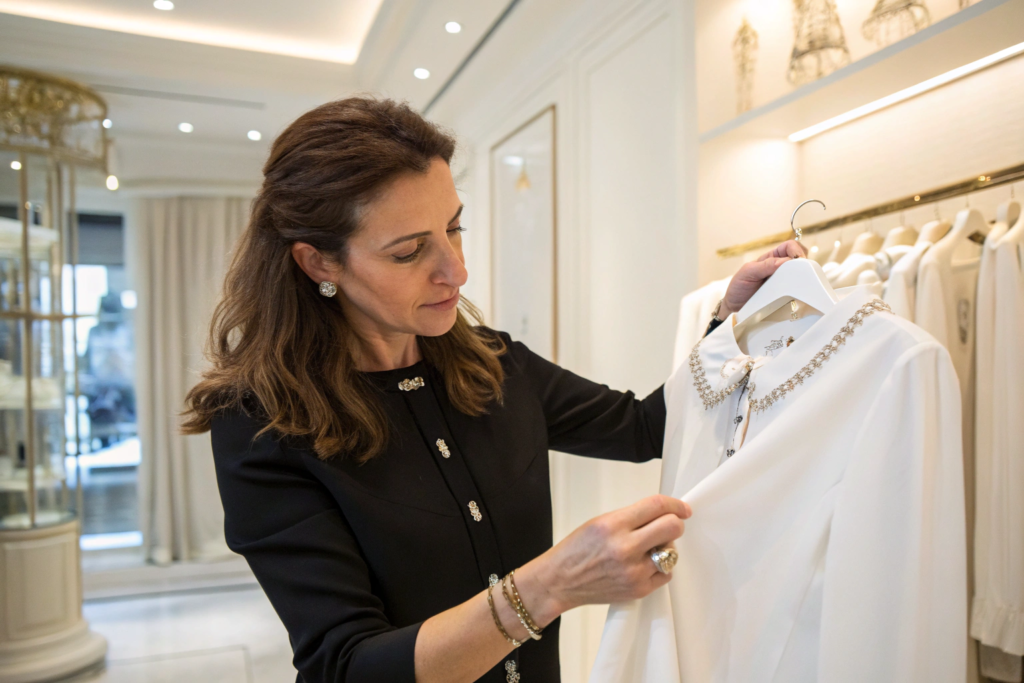
I have been in this industry for a long time, and I have seen too many buyers get burned by poor quality. They see a beautiful sample in a trade show booth, place a large order, and then receive boxes of garments that look nothing like what they approved. The fabric feels wrong. The stitching is crooked. The colors are off. It is a nightmare. A buyer from Boston called me last year, almost in tears, because a shipment of summer dresses arrived with seams that unraveled after one wear. Her brand's reputation was on the line.
Guaranteeing top quality in wholesale women's wear comes down to one thing: rigorous process control before, during, and after production. You cannot just rely on a sample and hope for the best. You need a partner who provides clear raw material specifications, conducts in-line inspections, and offers a clear policy for final quality checks. The sample is a promise. The process is the proof.
This is not complicated, but it requires discipline. You have to be willing to ask the hard questions and verify the answers. As the owner of Shanghai Fumao, a factory with five production lines dedicated to producing high-quality apparel for the U.S. market, I have built my entire business around this discipline. Let me walk you through the exact steps you need to take to protect your brand and ensure every piece you sell meets your standards.
What fabric tests should you demand before production starts?
Fabric is the foundation of your garment. You can have the best design and the best sewing, but if the fabric is poor, the whole product fails. I have dealt with many clients who approved a sample made from one batch of fabric, only to have the bulk order made from a cheaper, inferior substitute. This is a common trick in our industry. It is called "bait and switch," and it destroys brands.
Before any cutting starts, you must demand and approve fabric test reports from a recognized third-party lab. Do not rely on the factory's own word. For women's wear, critical tests include colorfastness to washing and light, fabric shrinkage, pilling resistance, and tensile strength. These tests give you objective data. They prove the fabric will perform as expected after your customer buys it and washes it at home.
Let me give you a real example. About two years ago, we had a client from Atlanta who wanted to produce a line of high-end knit tops. The sample we made for her used a premium Pima cotton jersey. She loved the hand feel. Before placing the bulk order, she sent the sample fabric to a lab in the U.S. for testing. The report came back perfect. For the bulk production, we sourced the exact same Pima cotton from the same mill. When the fabric arrived at our factory, we did our own internal shrinkage test, as we always do. It matched the lab report. Because we had this data from the start, there were no surprises. The bulk production went smoothly, and the client received exactly what she expected. This is the level of diligence you need. If a supplier hesitates to provide fabric sourcing details or resists third-party testing, that is a major red flag. At Shanghai Fumao, we encourage this. We want you to be confident. You can see our commitment to material quality on our website at Shanghai Fumao.
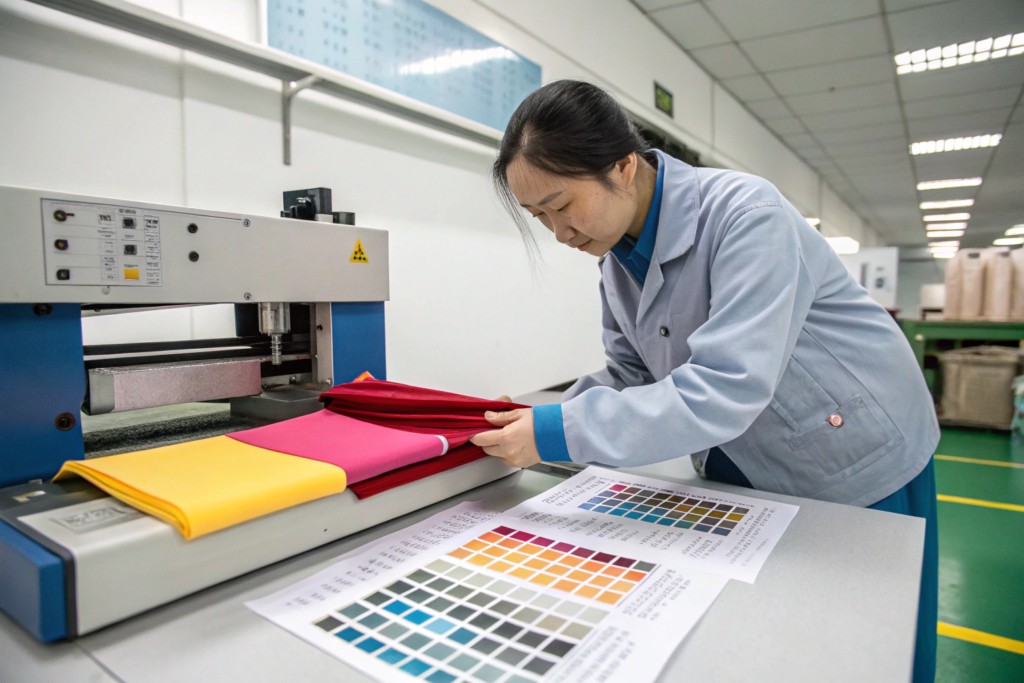
Why is a "shrinkage test" critical for women's knitwear?
Women's knitwear, like dresses and tops, is often fitted. If the garment shrinks after the first wash, it no longer fits. It becomes unwearable. A shrinkage test tells you exactly how much the fabric will contract. This data allows us to build the correct allowance into the pattern. For example, if the fabric shrinks 3% in length, we cut the garment 3% longer. After you wash it, it shrinks to the perfect size. Without this test, you are guessing, and your customers will be disappointed.
How do you verify a supplier's fabric claims?
You ask for a "fabric mill certificate" or a "mill sourcing declaration." A reliable supplier should be able to tell you the name of the mill that produced the fabric. You can then research that mill or even ask for a copy of their certifications, like OEKO-TEX. The best approach is to request that the fabric used for the bulk production is sent to a third-party lab like SGS or Bureau Veritas for pre-production testing. The lab report will confirm the fiber content, weight, and performance characteristics. You pay for the test, but it is cheap insurance.
How can a "pre-production sample" save your entire order?
The first sample you see is often a "development sample" or a "salesman sample." It is made with care, often by the best pattern maker in the shop, to impress you. It looks perfect. But when the bulk order goes into production, it is made by different people, on a faster timeline. This is where quality can fall apart. The gap between the perfect sample and the bulk product is where most problems hide.
The most critical step to guaranteeing quality is to demand and approve a "pre-production sample" made from the actual bulk fabric and with the actual bulk trims. This is not the sample you saw at the trade show. This is a sample pulled from the first production run, before the full cutting starts. It is your final chance to say "yes" or "no" to the actual product before hundreds or thousands of pieces are made.
I remember a situation with a client in Seattle who was ordering a line of women's jackets. We sent her a development sample. She loved it and approved it. Then, we sourced the bulk fabric, which was a different dye lot from the sample fabric. Before cutting, we made a pre-production sample using this bulk fabric. When we sent it to her, she immediately noticed the color was slightly different. The bulk fabric had a warmer tone. She was concerned it would not match her color story. Because we caught this before cutting, we were able to work with the mill to adjust the dye formula for the next batch. It delayed production by one week, but it saved the entire order. If we had cut 2,000 jackets in the wrong color, she would have been stuck with inventory she could not sell. This one simple step—the pre-production sample—is non-negotiable. If a factory tries to skip it or says it is not necessary, you should walk away. At Shanghai Fumao, we insist on it for every single order. It protects you, and it protects us from making a costly mistake.
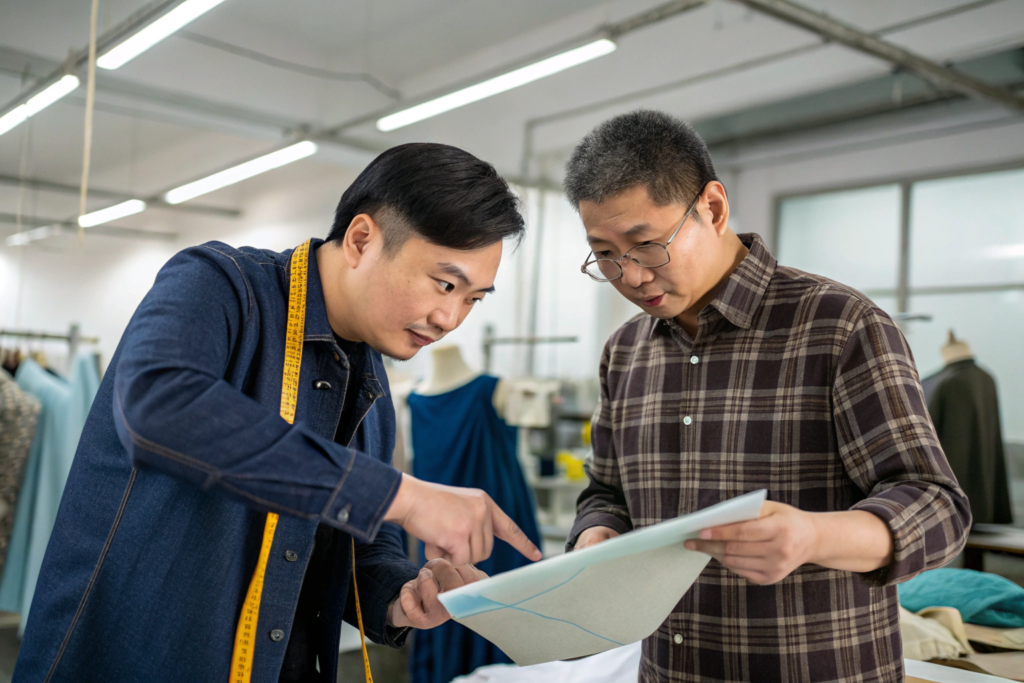
What is the difference between a fit sample and a PP sample?
A fit sample is made early in the process to check the garment's proportions and silhouette. It can be made in a generic fabric. Its purpose is to perfect the design and the way it hangs on the body. A pre-production (PP) sample is made right before bulk production. It is made in the exact fabric and with the exact trims that will be used for the bulk order. Its purpose is to verify the entire construction and appearance before mass production begins. You need both, but the PP sample is your final safeguard.
How many rounds of sampling are reasonable for a new style?
For a completely new, complex style, it is reasonable to have two or three rounds. The first is the development sample to get the design right. The second might be a revised sample based on your feedback. The final, most important one, is the pre-production sample. For a simple style based on an existing pattern, one development sample and then the PP sample is usually sufficient. The key is that you should never approve bulk production based only on the first sample you saw.
What in-line inspection points prevent defects at the source?
Waiting until the end of production to check quality is a huge mistake. If you find a problem then, the entire batch might be defective. It is too late to fix it without a major rework, which is expensive and time-consuming. The best way to guarantee quality is to catch problems as they happen, not after they have already happened to a thousand pieces.
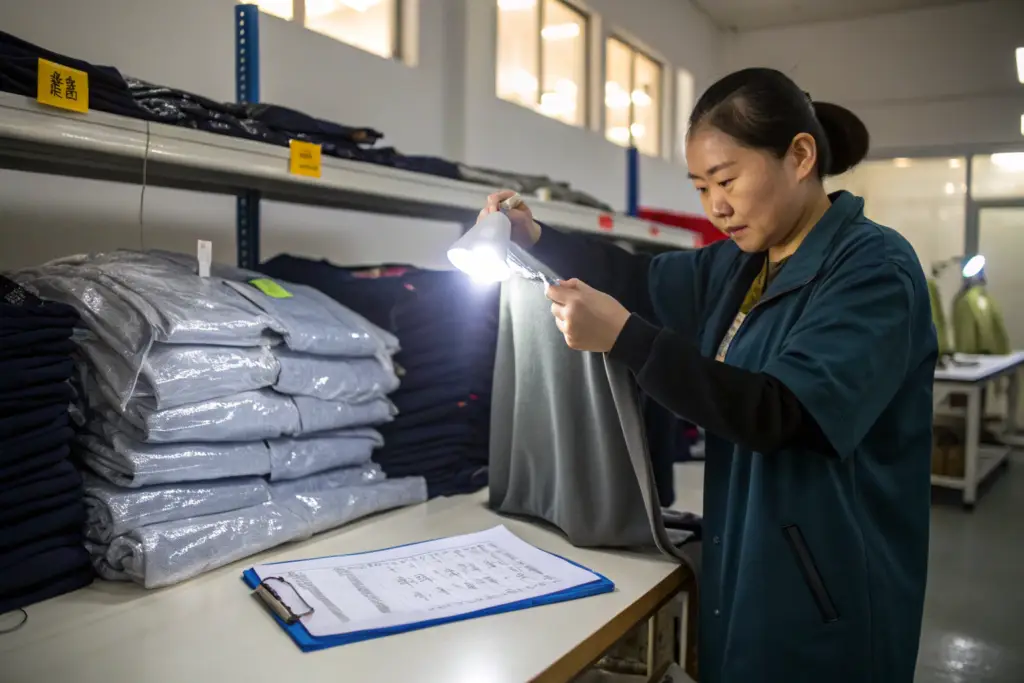
A professional factory will have a system of in-line inspections at critical stages of production. This means checking the fabric quality as it is cut, checking the stitching accuracy after the first few pieces are sewn, and checking the final assembly before the garment is finished. These checkpoints allow us to correct errors immediately. If one sewing machine is making a crooked stitch, we stop it and fix it, instead of letting it ruin 500 pieces.
Let me share how we do this at our own factory. We have a rule: every sewing line has a dedicated quality inspector. This person is not a sewer. Their only job is to check pieces coming off the line. They work from a checklist that is specific to that garment style. For example, for a women's blouse, they might check that the collar points are symmetrical, the placket is straight, and the sleeve gathers are even. They check a sample every 15 minutes. If they see a problem, they flag it immediately. The line supervisor stops the line, retrains the operator, and all pieces made since the last good check are inspected. This system has saved us countless times. A few months ago, an inspector noticed that a new operator was sewing the side seams with too much tension. We caught it after only 20 pieces. We fixed the tension, resewed those 20, and moved on. If we had waited until the end of the day, we might have had 200 pieces to redo. This is the level of detail that separates a reliable partner from a risky one.
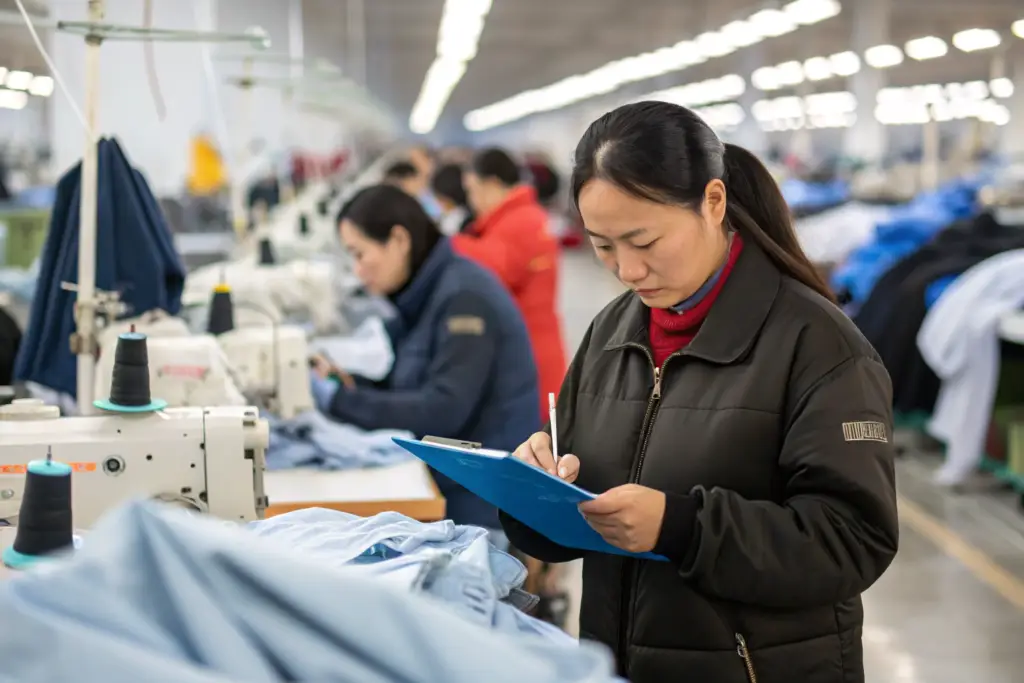
What are the critical control points in garment production?
The main control points are: 1) Fabric inspection (checking for flaws before cutting). 2) Cutting quality (ensuring pieces are cut accurately). 3) In-line sewing checks (verifying stitch quality and measurements during assembly). 4) Final assembly check (inspecting the complete garment before buttons and trims are added). 5) Finishing and packaging check (ensuring pressing, folding, and labeling are correct).
How can you, as a buyer, participate in in-line inspections?
You have a few options. You can hire a third-party inspection company like QIMA or AsiaInspection to visit the factory unannounced during production. They will send you a report with photos. You can also ask your supplier for daily production photos or videos. We often send our clients a WhatsApp video of the line running, so they can see the work in progress. For very large orders, you might choose to visit the factory yourself during the middle of production. This direct oversight gives you maximum confidence.
Why is a clear "quality acceptable quality limit" (AQL) so important?
I have seen many disagreements between buyers and suppliers come down to one thing: they had different definitions of "acceptable quality." The buyer thought "acceptable" meant no defects. The supplier thought "acceptable" meant a few minor defects were fine. Without a clear, written standard, you are headed for a dispute. And when you are 7,000 miles away, disputes are expensive and hard to win.
Before production starts, you and your supplier must agree on a clear quality standard, usually defined by an Acceptable Quality Limit, or AQL. This is an industry-standard statistical sampling method. For example, a common standard for high-end women's wear is AQL 1.0 for major defects and 2.5 for minor defects. This means that in a random sample from your order, we will accept a very small number of minor issues, but almost no major ones. Putting this in writing protects both of us.
Let me tell you a story. About four years ago, we had a client from Los Angeles who ordered a large quantity of women's trousers. We produced them, and before shipping, we did our own internal AQL inspection. We found that the defect rate was within the agreed-upon standard. We prepared to ship. However, the client also hired a third-party inspector to do their own check. That inspector used a stricter, un-agreed-upon standard and flagged a higher number of defects. We had a disagreement. Because we had a signed document specifying the AQL level (we used AQL 2.5), we were able to show the client that our inspection met the agreed terms. We then re-inspected together with the third party, using the AQL sampling method, and confirmed the order was good. It was shipped, and the client was happy. Without that written standard, it would have been my word against theirs, and the order might have been delayed or cancelled. This is why I insist on a clear AQL agreement with every client. It removes emotion from the decision and replaces it with data. You can learn more about our standard operating procedures by visiting Shanghai Fumao.
What is a typical AQL standard for women's fashion?
For mid-to-high end women's wear, the most common standard is AQL 2.5. This applies to minor defects, like a slightly crooked button or a loose thread. For major defects, like a hole in the fabric or a broken zipper, a stricter standard like AQL 1.0 or even AQL 0.65 is used. Major defects make a garment unsellable, so the tolerance for them must be near zero. You should discuss these numbers with your supplier and include them in your contract.
Can you explain AQL sampling in simple terms?
AQL sampling means we do not inspect every single garment. That would take too long. Instead, we use a standard table to decide how many garments to randomly pick and inspect. For example, if your order is for 1,000 pieces, the standard might say we need to inspect 80 pieces. We pick 80 at random. We check each one against a list of possible defects. If we find 3 or fewer major defects in that sample, the whole batch is considered acceptable. If we find 4 or more, the whole batch is rejected and must be sorted or reworked. It is a fair, mathematical way to judge quality.
Conclusion
Guaranteeing top quality in wholesale women's wear is not about luck. It is about building a system of checks and balances with your manufacturing partner. It starts with testing the fabric before a single piece is cut. It continues with a pre-production sample that confirms the design works in the real bulk materials. It relies on in-line inspections that catch errors at the moment they happen, not after. And it is finalized by a clear, written quality standard like AQL that defines what "good" means for both of you.
At Shanghai Fumao, we have built our entire reputation on this systematic approach to quality. Our five production lines are managed by experienced supervisors who understand the standards of the U.S. market. We welcome third-party inspections. We provide full transparency on our fabric sourcing. We insist on pre-production samples. We do this because we know that your success is our success. We are not just a factory; we are your quality assurance partner.
If you are ready to work with a manufacturer who takes quality as seriously as you do, let us start the conversation. We are here to answer your questions and show you how we work. Please contact our Business Director, Elaine, at strong>elaine@fumaoclothing.com to discuss your next women's wear collection.