You've found the perfect manufacturing partner. The samples are approved, and the bulk price is agreed. Now comes a critical conversation that will impact your cash flow and risk: negotiating payment terms. This isn't just about haggling over percentages; it's about structuring a financial partnership that protects both parties and enables growth. Poorly negotiated terms can strain your working capital or signal distrust to your supplier. So, how do you approach this delicate negotiation to arrive at a fair, sustainable agreement?
Successful negotiation of payment terms with a garment supplier requires preparation, understanding of industry standards, clear communication of your value as a partner, and a collaborative approach focused on shared success rather than unilateral advantage. The goal is to secure terms that support your cash flow while giving the supplier enough security to confidently invest in your order's production. It's a balance of risk, trust, and mutual benefit.
At Shanghai Fumao, a promising startup approached us with an ambitious order but requested 100% payment 60 days after delivery. This was a non-starter, as it asked us to fully finance their inventory with zero security. Instead of rejecting them outright, we explained the standard 30/70 model and our concerns. We then proposed a compromise: 30% deposit, 40% upon production completion (backed by inspection photos), and 30% against copy of Bill of Lading. This split the risk more evenly and demonstrated our willingness to work with them. They agreed, the order was a success, and they've since graduated to our standard 30/70 terms with a track record of prompt payment. This story highlights that negotiation is about finding creative, fair solutions. Let's build your negotiation strategy.
What Should You Understand Before Starting The Negotiation?
Walking into a payment term negotiation without knowledge is like shopping without knowing the market price. Your leverage comes from understanding standard practices, your own business's position, and the supplier's perspective. Preparation is 80% of the battle.
Arm yourself with facts, not just desires.
Know The Industry Standard Baseline
For the vast majority of custom apparel manufacturing, especially with new relationships, the baseline is:
- 30% Deposit upon order confirmation.
- 70% Balance before shipment.
This is not arbitrary. The 30% typically covers the factory's cost of purchasing your specific raw materials (fabric, trims). The 70% balance gives you leverage to ensure quality (via inspection) before releasing final payment. Any negotiation starts from this point.
Assess Your Own Position and Leverage
Honestly answer these questions:
- What is my order volume and value? A $200,000 order commands more flexibility than a $5,000 order.
- What is my company's financial health and payment history? Are you a well-funded startup, an established brand, or a first-time entrepreneur? Be prepared to share (selectively) your business stability.
- What is my growth potential? Can you project future, larger orders? A supplier is more likely to extend favorable terms for a client with clear growth potential.
- What is my alternative? Do you have other comparable quotes? Knowing your BATNA (Best Alternative To a Negotiated Agreement) strengthens your position.
Understand The Supplier's Perspective and Costs
A factory's primary concerns are:
- Covering Material Costs: They cannot front the entire cost of your custom fabrics.
- Mitigating Risk of Non-Payment: You are an unknown entity.
- Managing Their Cash Flow: They have payroll, rent, and other orders to finance.
Empathizing with these concerns will make you a more credible and respected negotiator. You're not just asking for a favor; you're proposing a viable commercial structure.
What Are Effective Opening Strategies and Conversational Frameworks?
How you open the discussion sets the tone. Avoid leading with a hard demand like "We only pay 10% deposit." This immediately puts the supplier on the defensive. Instead, frame the conversation as a collaborative problem-solving session.
Your goal is to be a partner, not an adversary.

The Collaborative Opening
Begin by acknowledging the standard and expressing your desire to build a long-term partnership. For example:
- "We understand the standard practice is a 30% deposit with 70% before shipment. We're very excited to partner with you and are confident this will be the first of many orders. As we plan for long-term growth, we'd like to discuss how we might structure payments to support our cash flow while making sure you feel completely secure."
This approach shows respect, signals future value, and opens the door for discussion rather than confrontation.
The Value Proposition Pitch
If you have strong leverage (large order, strong brand), you can lead with your value:
- "This initial order is for 5,000 units, and our forecast for next season is 15,000. To facilitate this scale, we typically work with partners on terms of 30% deposit, with the 70% balance paid against the copy of the Bill of Lading. This structure has worked well with our other manufacturing partners and helps us synchronize our financial cycles."
This demonstrates you are an experienced, valuable client who knows what you're doing.
Questions to Ask to Understand Their Flexibility
- "What is your standard policy for new clients, and are there circumstances where you've been able to adjust it?"
- "How do you typically handle payments with clients who become long-term partners?"
- "Is the deposit primarily to cover material costs? If we provided letters of credit from our fabric mill, would that affect the structure?"
These questions gather information and may reveal alternative solutions you hadn't considered.
What Concessions and Trade-Offs Can You Offer?
Negotiation is about trading value. If you want better terms, you must offer something in return that reduces the supplier's risk or improves their profitability. Simply asking for a lower deposit without offering anything is a weak position.
Think in terms of "If we do X, would you consider Y?"

Valuable Concessions You Can Propose:
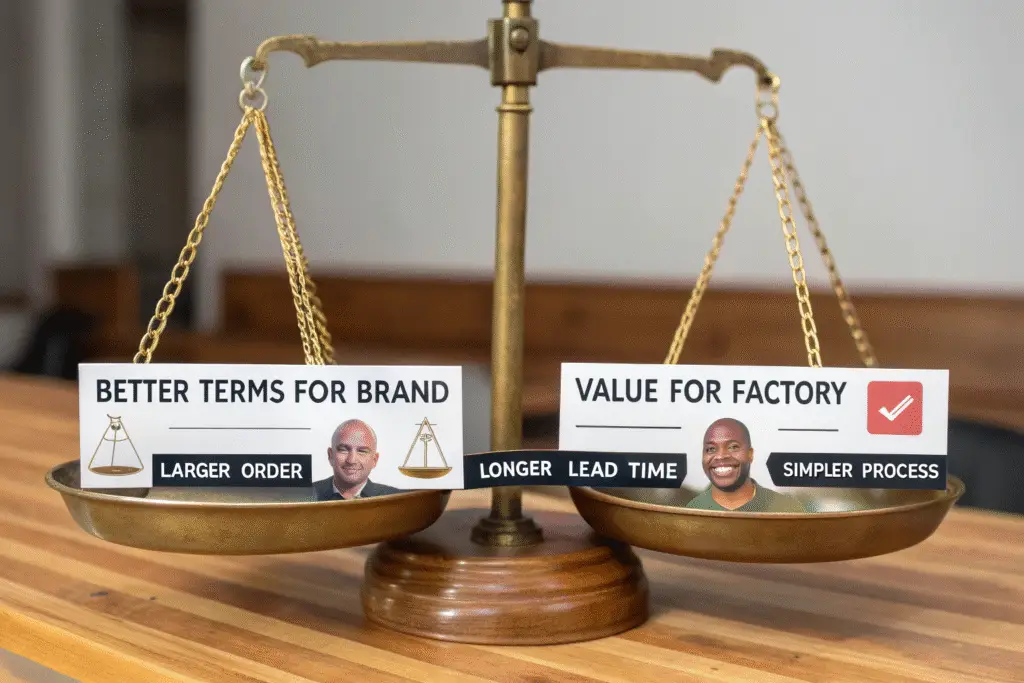
- Larger or More Frequent Orders: This is the most powerful lever. "If we increase this order by 30% and commit to a second order in 3 months, could we move to a 25/75 split?"
- Longer Lead Times: Rushing production costs the factory money (overtime, air freight for materials). Offering a more relaxed, predictable production schedule can be valuable. "We can give you an extra 3 weeks on the delivery timeline if we can pay 70% against BL instead of before shipment."
- Simpler Logistics: Opt for their standard DDP shipping consolidation instead of demanding specific, complicated freight methods. This reduces their administrative burden.
- Providing Materials (Carefully): If you have access to specialty fabrics, you could offer to supply them, reducing the factory's upfront material cost. Caution: This adds complexity and risk for you.
- Faster Approval Cycles: Commit to turning around sample and inspection approvals within 48 hours. This makes their planning more efficient.
- Personal or Company Guarantees: For very small businesses, a personal guarantee from the owner can sometimes provide additional assurance.
The "Phased Improvement" Agreement
If the supplier is unwilling to move from standard terms immediately, propose a phased approach based on performance:
- "For this first order, we'll agree to the standard 30/70. If we make all payments on time and the quality is perfect, could we agree in writing that for Order #2, we'll move to 30% deposit, 70% against BL?"
This reduces their risk on the first order while giving you a clear path to better terms. It's a common and fair way to build trust incrementally.
At Shanghai Fumao, we are often open to such proposals because they demonstrate the client's seriousness and commitment to a professional relationship.
What Are Realistic Target Terms Based on Your Situation?
Your target terms should be ambitious but realistic, grounded in your business reality. What's achievable for a funded DTC brand is different from a bootstrapped designer.
Set goals that protect your business without asking the factory to assume unreasonable risk.
Target Terms for Different Scenarios:
| Your Brand Profile | Realistic Opening Target | Fallback Position (Still Good) | Notes |
|---|---|---|---|
| Startup / First Order (<$20K) | 30/70 before shipment. | 50/50 before shipment. | Your goal is to build trust. Standard terms are a win. Don't over-negotiate. |
| Growing DTC Brand ($50K-$150K order) | 30% deposit, 70% against copy of BL. | 30/70 before shipment, but tied to approved PSI report. | Use your growth trajectory and professionalism as leverage. |
| Established Brand / Large Volume (>$200K) | 20% deposit, 80% against BL (or Net 30 after BL). | 25/75 against BL. | Your volume and reliability are key. You can negotiate like a partner. |
| Brand with Strong Credit/Corporate Backing | Net 30-60 days after shipment. (Rare, requires deep trust or LC) | Significant deposit reduction against BL. | You may need to provide financial statements or use a Standby LC. |
The Critical Importance of the Inspection Clause
No matter what terms you negotiate, always tie the final payment to an approved Pre-Shipment Inspection (PSI) report. Your contract should state: "Final balance payment is due upon Buyer's approval of the PSI report from [Named Inspection Company]." This is non-negotiable. It is your quality control checkpoint and prevents you from paying for defective goods.
Even if you achieve "payment against BL," the process should be: 1) Approve PSI report, 2) Factory ships and provides BL copy, 3) You pay balance. This ensures you only pay for goods that have passed inspection.
What Are The Red Flags and Deal Breakers?
Some positions in a negotiation are signs of an unprofessional partner or an unsustainable request. Knowing these red flags protects you from bad deals and problematic relationships.
A good negotiation should leave both parties feeling respected and secure.
Red Flags from the Supplier:
- Demanding 100% Payment Upfront: Extremely rare and high-risk. Walk away.
- Refusing to Provide a Detailed Proforma Invoice (PI): The PI is the basis of payment. No PI, no deal.
- Pressure to Use Unsecured Methods: Insisting on Western Union or MoneyGram for large amounts is a major scam indicator.
- Unwillingness to Tie Payment to Inspection: A factory confident in its quality should have no issue with a PSI-linked payment.
- Last-Minute Changes to Bank Details: Always verify via a secondary channel (phone call).
Unrealistic Requests from You (The Brand):
- Demanding 100% Payment After Delivery and Sale: This is a fantasy. No factory can be your bank and assume 100% of the risk.
- Refusing to Pay a Deposit at All: This shows you don't understand the supplier's need to secure materials for your custom order.
- Being Overly Aggressive on First Order: If you squeeze too hard on terms for a small first order, you signal that you will be a difficult, low-margin client. The factory may accept but deprioritize your order.
The "Walk Away" Point
Know your limit. If a factory insists on terms that would cripple your cash flow (e.g., 50% deposit on a very large order) or refuses basic quality safeguards, be prepared to end the negotiation. There are other suppliers. A partnership that starts with imbalanced terms is likely to be fraught with problems later.
Conclusion
Negotiating payment terms with a garment supplier is a critical skill that blends financial acumen, relationship building, and strategic communication. By entering the discussion prepared, empathetic, and focused on creating mutual value, you can secure terms that support your business's cash flow while giving your supplier the confidence to invest fully in your order's success.
Remember, the best terms are not necessarily the most one-sided; they are the ones that foster a stable, trustworthy, and long-lasting partnership. The goal is to establish a financial framework that allows both your brand and your manufacturer to thrive together.
If you are looking for a manufacturing partner who approaches payment term discussions with transparency, fairness, and a genuine interest in building a collaborative financial relationship, we are that partner. At Shanghai Fumao, we believe clear, mutually beneficial terms are the foundation of every successful order. Contact our Business Director Elaine to discuss your project and how we can structure a payment plan that works for both of us: elaine@fumaoclothing.com.