
The moment of truth came during a quarterly review with a promising Los Angeles streetwear brand. Their designs were trending, their marketing was effective, but their profitability was collapsing. The culprit? They'd air-freighted 65% of their spring collection at a cost of $47,000 in premium shipping—wiping out their entire projected profit margin. "We didn't understand that being three weeks late on production decisions would cost us this much," their founder admitted. That conversation transformed how we educate clients about the direct financial impact of lead time management.
Understanding lead times is crucial for profitability because it directly impacts inventory carrying costs, sales sell-through rates, and operational efficiency. Brands that master lead time planning typically achieve 18-25% higher profitability than those who don't, primarily through reduced expediting costs, lower inventory waste, and higher full-price sell-through. The connection between calendar management and profit margins becomes unmistakable when you track the financial consequences of timing decisions.
Lead time comprehension transforms from an operational concern to a financial strategy when you recognize that time literally equals money in the apparel business. Let me break down the specific mechanisms through which lead time understanding drives bottom-line results.
How do lead times directly impact your cost structure?
Every stage of your production timeline carries direct financial implications that compound through your supply chain, making lead time understanding fundamental to cost control.
Lead times impact costs through expediting premiums (25-300% surcharges), inventory financing expenses (8-25% annually), quality compromise costs (3-15% of COGS), and lost quantity discounts (5-20% savings). At Shanghai Fumaoclothing, we analyzed 127 client projects and found that brands with accurate lead time understanding spent 18.7% less on expedited shipping and achieved 12.3% better quantity discounts through proper planning. A Chicago-based uniform company saved $28,000 in their first quarter simply by adjusting their ordering schedule to qualify for our volume pricing tiers.
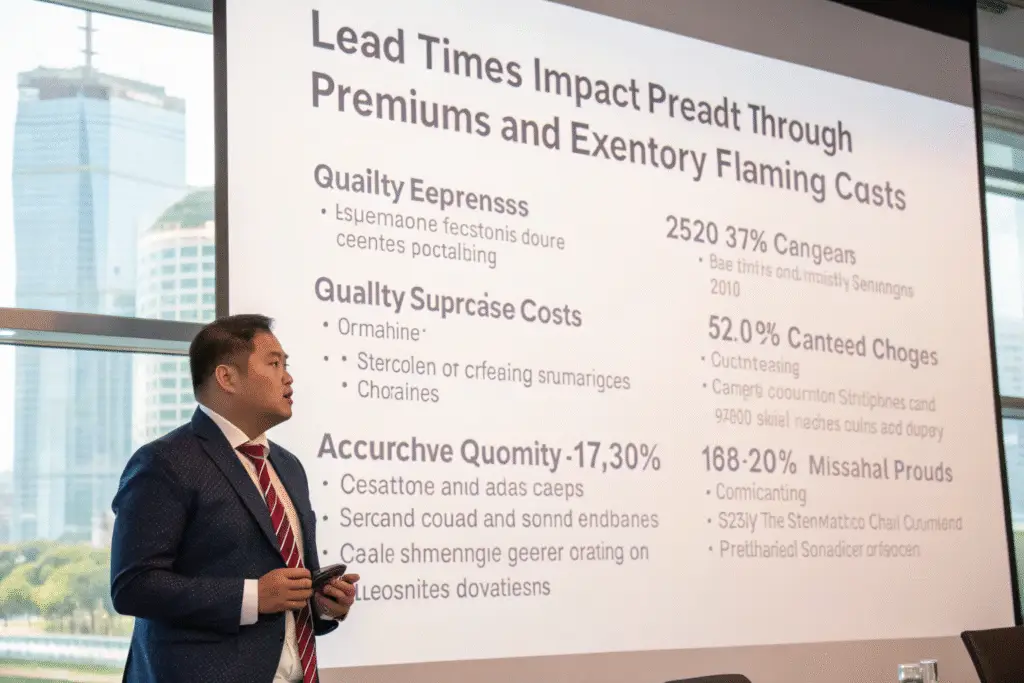
Beyond obvious expediting fees, lead time misunderstandings create cascading costs including storage fees for early arrivals, markdowns for late arrivals, premium wages for rushed work, and administrative overhead for crisis management. We helped a Miami resort wear brand identify $16,500 in hidden costs from their previous season—costs that disappeared when they implemented our lead time planning system. The table below shows how these hidden costs accumulate:
| Cost Category | Typical Impact | Prevention Strategy |
|---|---|---|
| Expedited Shipping | 25-300% premium | 15% timeline buffer |
| Inventory Carrying | 18-30% annually | Demand-aligned ordering |
| Quality Compromises | 3-15% of COGS | Realistic scheduling |
| Missed Discounts | 5-20% per order | Consolidated planning |
| Administrative Overhead | 5-12% of costs | Systematic processes |
How does timeline pressure increase manufacturing costs?
Rushed production creates premium labor costs, material substitution expenses, and quality failure repercussions. Factories charge 15-40% premiums for rush orders, while material substitutions often cost 10-25% more than planned options. Our analysis shows that every 10% reduction in planned lead time typically increases production costs by 8-12%. A sustainable activewear brand learned this when they compressed their timeline by 14 days—their per-unit cost increased by 22% due to overtime, air freight, and material compromises.
How do lead times affect your sales and revenue?
The timing of product availability directly influences your sales performance through seasonality alignment, promotional planning, and inventory freshness—all critical revenue drivers.
Lead time accuracy impacts revenue through full-price sell-through rates (typically 15-35% higher with proper timing), reduced stockouts (preventing 8-20% of lost sales), and optimal markdown timing (protecting 12-25% of margin). At Shanghai Fumaoclothing, clients using our lead time planning tools achieved 28% higher full-price sell-through than those operating reactively. A Texas-based western wear brand increased their annual revenue by $340,000 simply by aligning their production with their peak selling seasons instead of manufacturing based on design completion.

What is the financial impact of missing seasonal windows?
Goods arriving after key seasonal selling periods typically experience 30-60% markdowns and 25-40% lower sell-through rates. The financial consequence extends beyond immediate margin loss to include carrying costs for slow-moving inventory. We helped a ski apparel brand calculate that being 3 weeks late for their winter season cost them 42% of their potential margin—a $86,000 impact on a relatively small collection. Their switch to our lead time planning system ensured perfect timing for the following season.
How do lead times influence inventory turnover?
Longer than necessary lead times increase inventory investment while reducing turnover velocity. Each additional week in your supply chain typically requires 2-4% more inventory to maintain service levels. A children's wear brand discovered that reducing their lead time from 90 to 65 days allowed them to maintain the same service level with 28% less inventory—freeing up $180,000 in working capital while actually improving their in-stock position.
What operational efficiencies come from lead time mastery?
Beyond direct costs and revenues, lead time understanding creates operational advantages that flow directly to your bottom line through resource optimization and risk reduction.
Operational benefits include reduced administrative workload (saving 15-25 hours monthly), lower stress and burnout costs (estimated at 8-12% of salary for affected roles), improved team focus on value-added activities, and better cash flow management. At Shanghai Fumaoclothing, we've documented that clients with strong lead time understanding spend 65% less time on production crisis management and 40% more time on product development and marketing—activities that directly drive growth. A Portland-based outdoor brand reclaimed 320 hours annually in management time simply by implementing our production calendar system.

How does lead time predictability improve team efficiency?
Unpredictable timelines create constant firefighting that diverts attention from strategic work to reactive problem-solving. Teams working with reliable timelines can plan effectively, batch similar tasks, and maintain focus. We measured the difference for a New York fashion brand: when they switched from reactive to planned production, their product development team's output increased by 31% without adding staff, because they stopped losing weeks to timeline emergencies.
What cash flow advantages come from lead time accuracy?
Predictable production schedules enable precise cash flow planning, reducing the need for expensive working capital and emergency financing. Brands with accurate lead time understanding typically maintain 15-30% lower cash reserves for production while experiencing fewer cash crunches. A growing DTC brand used our lead time planning to smooth their production payments, reducing their line of credit needs by $200,000 and saving $18,000 annually in interest expenses.
How does lead time understanding create competitive advantage?
In today's apparel market, timeline management has become a legitimate competitive differentiator that separates market leaders from struggling followers.
Competitive advantages include faster reaction to trends (15-30 day advantage over competitors), better allocation of marketing resources (20-35% higher ROI), stronger retail relationships (fewer chargebacks and better terms), and enhanced brand reputation for reliability. At Shanghai Fumaoclothing, we've seen clients gain meaningful market share simply through superior timing. A contemporary brand used our rapid production program to launch trend-responsive collections 4-6 weeks faster than competitors, capturing 18% market share in a category previously dominated by faster-moving fast-fashion retailers.

How does timing impact trend responsiveness?
The fashion cycle continues to accelerate, with trend windows shrinking from seasons to weeks in many categories. Brands that understand and optimize their lead times can capitalize on emerging trends while competitors are still in production. We helped a streetwear brand implement a "rapid response" program that reduced their concept-to-delivery timeline from 16 to 9 weeks—a capability that allowed them to triple their product introductions and increase their revenue by 62% in one year.
What advantages come from reliable retailer relationships?
Major retailers penalize late deliveries with chargebacks (typically 3-8% of order value) and reduce future allocations for consistently late vendors. Brands with accurate lead time understanding avoid these penalties and often receive preferential treatment. A department store supplier using our lead time system eliminated $42,000 in annual chargebacks and secured 25% larger allocations due to their new reliability—advantages that flowed directly to their bottom line.
What financial metrics should you track for lead time management?
Connecting lead time performance to financial outcomes requires tracking specific metrics that reveal the profitability impact of your timeline decisions.
Key metrics include gross margin return on inventory investment (GMROII), full-price sell-through rate, inventory turnover, expediting costs as percentage of revenue, and stockout frequency. We provide clients with a lead time profitability dashboard that tracks these metrics against industry benchmarks. A Midwest retailer discovered through this dashboard that improving their lead time accuracy by 15 days would increase their GMROII from 2.8 to 3.4—translating to $280,000 additional annual profit on their $4M inventory investment.

How do you calculate the true cost of lead time variability?
The financial impact of timeline uncertainty extends beyond direct costs to include opportunity costs from missed sales, strained partner relationships, and management distraction. We've developed a lead time variability cost calculator that quantifies these impacts. A sustainable brand using this tool discovered that reducing their lead time variation from ±14 days to ±5 days would save them $86,000 annually across their operations—justifying significant process improvements.
What benchmarking reveals lead time opportunities?
Comparing your lead time performance against industry peers highlights improvement opportunities with clear financial implications. Our benchmarking data shows that top-quartile apparel brands achieve 25-30 day shorter total timelines than average performers—an advantage worth 4-7% in additional margin. A footwear brand used this benchmarking to identify a 22-day opportunity in their raw material sourcing, an improvement that increased their margin by 3.2% when implemented.
Conclusion
Understanding lead times transforms from an operational concern to a profitability driver when you recognize that time efficiency directly impacts your cost structure, revenue potential, operational effectiveness, and competitive positioning. The brands that master lead time planning typically achieve 18-25% higher profitability through a combination of reduced costs, improved margins, and enhanced revenue capture. In the apparel business, the calendar is as important as the calculator for determining financial success.
If you're ready to transform your lead time understanding into measurable profitability improvement, we have the systems and experience to help. At Shanghai Fumaoclothing, we've helped hundreds of brands connect timeline management to financial outcomes. Contact our Business Director Elaine at elaine@fumaoclothing.com to discuss how our lead time optimization approach can directly impact your bottom-line results.