As an apparel brand owner sourcing golf wear, you know certifications like OEKO-TEX, GRS, or bluesign® are powerful marketing tools. But in an era of greenwashing and superficial claims, how can you ensure your certification truly builds trust and adds value? The difference between a self-declared standard and one verified by an independent third party is not just technical—it's the foundation of your brand's credibility.
Third-party verification is crucial for golf apparel certifications because it provides an objective, unbiased, and scientifically rigorous validation of your claims, transforming marketing statements into indisputable facts that retailers and end-consumers can trust. Without it, even the most well-intentioned sustainability or safety claim risks being dismissed as mere publicity.
For brands working with us at Shanghai Fumao, navigating this verification landscape is part of our full-package service. We've seen how third-party audits not only satisfy buyer checklists but also uncover operational efficiencies. Last season, a client insisted on GRS (Global Recycled Standard) certification for their new recycled polyester golf line. The independent auditor's visit to our facility didn't just certify the product; their review of our material tracking system helped us reduce fabric waste by 15%, directly improving our client's cost margin.
What Does Third-Party Verification Actually Guarantee?
When you claim a golf polo is "OEKO-TEX Standard 100 certified," you are making a specific promise about its chemical safety. Third-party verification is the proof that this promise is kept at every stage, not just for a single sample.
Third-party verification guarantees objectivity, consistency, and supply chain accountability. It ensures that the certification standards are applied uniformly without brand bias, and that compliance is maintained from raw material to finished garment, not just at one point in time. This end-to-end scrutiny is what gives the certification its market weight.
How Does It Prevent Greenwashing and Build Consumer Trust?
Greenwashing—making exaggerated or false environmental claims—erodes consumer trust rapidly. A third-party verifier acts as a gatekeeper. For example, a brand might call a garment "recycled," but only the GRS certification, verified by an accredited body like Control Union or SCS Global Services, can specify the exact percentage of recycled content and trace its flow through the supply chain. This level of detail is impossible with self-declaration. For the golfer, seeing the official OEKO-TEX or bluesign® label means they don't have to decode marketing language; they trust the independent institution behind the logo. This trust translates directly into purchase confidence and brand loyalty, especially for premium-priced performance wear.
What Are the Risks of Relying on Supplier Self-Declaration?
Relying solely on a supplier's self-declared certificate is a significant business risk. We have witnessed cases where a brand's previous supplier provided falsified material composition reports, leading to a costly recall and reputation damage when the products failed a retailer's spot-check. Third-party verification mitigates this by making the auditor accountable to the standard, not to the factory or the brand. The audit process includes unannounced visits, review of purchase records, and physical product testing. When you partner with a manufacturer like Shanghai Fumao that builds its processes around passing these rigorous audits, you gain peace of mind. Our investment in comprehensive quality control systems is, in part, a direct response to the demands of credible third-party verification.
How Does Verification Impact Your Brand's Operational Integrity?
Beyond marketing, third-party verification forces a level of operational discipline that strengthens your entire supply chain. It's not just about getting a certificate; it's about building a verifiably better system.
Verification impacts operational integrity by institutionalizing best practices in documentation, material handling, and social compliance. It creates a transparent, auditable trail that protects your brand from liability and enables continuous improvement. This systemic strength is a key competitive advantage.

Can It Streamline Your Supply Chain and Reduce Risk?
Absolutely. The rigorous documentation required for standards like GRS or OCS (Organic Content Standard) creates unparalleled visibility. You know exactly which mill produced the yarn, the batch it came from, and its journey through knitting, dyeing, and cutting. This traceability is invaluable for risk management. If a material issue arises, you can isolate the affected batch precisely, minimizing the scale of any potential problem. For a brand we worked with last year, this traceability allowed them to quickly verify that a specific line of golf shorts was unaffected by a reported dye issue at a sub-supplier, preventing an unnecessary and damaging full-range recall. This level of control is a direct result of the systems built for third-party verification.
Does It Create Efficiencies Beyond Compliance?
Yes, the process often reveals operational inefficiencies. The audit for the ISO 9001 quality management system, which we at Shanghai Fumao maintain, consistently pushes us to refine our workflow. For instance, the need to document every quality control checkpoint led us to digitize our inspection records. This reduced administrative time by 20% and improved the speed of identifying and correcting production deviations. These efficiencies, driven by the verification framework, ultimately result in a more reliable and cost-effective manufacturing service for our brand partners.
What Should Brands Look for in a Verification Partner?
Not all verification bodies are equal. Choosing the right one is critical to the credibility and value of your certification.
Brands should look for verification partners that are accredited, have specific apparel industry expertise, offer global recognition, and provide clear, actionable audit reports. The partner's reputation becomes an extension of your own brand's credibility.
| Criteria | Why It Matters | Key Questions to Ask |
|---|---|---|
| Accreditation | Ensures the verifier is itself assessed against international standards (e.g., by IAS or UKAS). | "Is your organization accredited for this specific standard by a recognized national accreditation body?" |
| Industry Experience | Apparel supply chains are complex. Experts know where to look for common non-conformities. | "Can you provide examples of golf or performance apparel brands you've audited?" |
| Global Network | Essential for auditing overseas factories like those in China or Vietnam efficiently. | "Do you have auditors located in our key sourcing regions?" |
| Report Clarity | The audit report should be a tool for improvement, not just a pass/fail certificate. | "Can I see a sample anonymized report to understand the level of detail provided?" |

How Do You Vet the Verifier's Credentials?
First, check the official website of the certification standard (e.g., OEKO-TEX, bluesign®). They publish lists of authorized testing institutes and auditing bodies. Cross-reference this list. Second, ask for the verifier's accreditation certificate. Third, request client references within the apparel industry. A credible verifier like Eurofins or Bureau Veritas will have a long public track record. For a brand partnering with us, we facilitate this by providing historical audit reports and introducing our long-standing contacts with these global verifiers, demonstrating our open-book policy.
Why Is a Collaborative Relationship with the Verifier Important?
The goal is compliance and improvement, not confrontation. A good verifier acts as a consultant, identifying root causes of non-conformities. For example, during an audit for a client's Fair Trade certification, the auditor noted that while worker hours were compliant, the overtime records were confusing. They suggested a simpler digital system, which we implemented. This improved our social compliance management and made the next audit smoother. A punitive, "gotcha"-style auditor might have just issued a minor finding, missing the chance to improve the system. A collaborative relationship turns verification into a value-add.
How to Communicate This Verification to Your Customers?
The verification story is a powerful tool, but it must be communicated clearly and authentically to resonate with the end golfer.
Communicate verification to customers by translating audit rigor into simple, benefit-focused language, using the verifier's trusted logos prominently, and showcasing the "why" behind the process through transparent storytelling. Make the invisible work of verification visible and meaningful.
What Messaging Resonates on the Product Page?
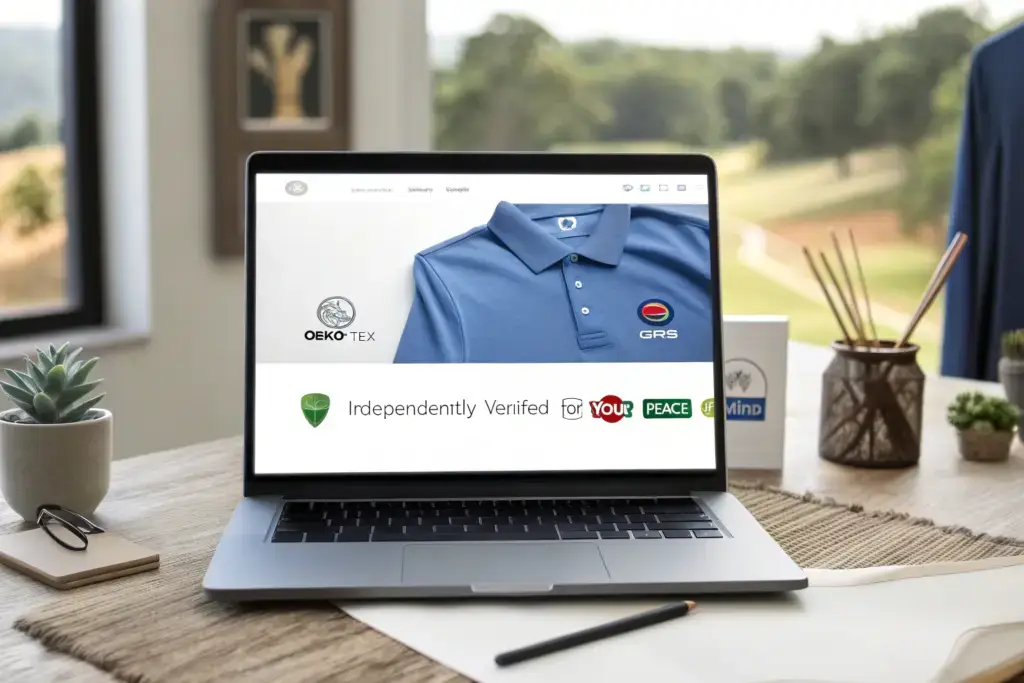
Avoid jargon. Don't just say "Third-party verified." Say: "Independently tested for harmful substances. Every batch." Use the official certification logos as visual shorthand for trust. Include a short, accessible explanation: "We don't just test our fabrics in-house. We send them to [Name of Institute, e.g., Hohenstein Institute], a world-leading independent lab, to verify they meet the strict OEKO-TEX Standard 100 for your safety." This tells a complete story: the claim, the proof, and the beneficiary.
How Can You Use This in Broader Brand Storytelling?
Leverage content marketing. Create a short video or blog post titled "Behind the Seal: The Journey of a Certified Golf Shirt." Feature interviews (with permissions) with the factory's compliance manager or footage from an audit (staged or with an auditor's consent). Highlight the partnership between your brand, your manufacturer (Shanghai Fumao), and the verifier. This transparency directly addresses sophisticated consumers' skepticism and builds an emotional connection based on integrity and diligence. It turns a compliance cost into a core brand asset.
Conclusion
Third-party verification is the critical linchpin that transforms a golf apparel certification from a marketing accessory into a cornerstone of brand trust and operational excellence. It provides the objective proof that safeguards your brand against greenwashing accusations, streamlines your supply chain through enforced transparency, and delivers a credible story you can confidently share with retailers and end-users. In a market where claims are abundant but proof is scarce, independent verification is your most powerful differentiator.
Building a certified product line requires a manufacturing partner committed to this level of transparency and rigor. If you are looking to develop golf apparel backed by credible, verifiable certifications and a seamless DDP mode export process, let's build a program that stands up to scrutiny. For a partnership founded on verifiable quality, contact our Business Director Elaine at Shanghai Fumao. Reach her at elaine@fumaoclothing.com to start a conversation about your next certified collection.