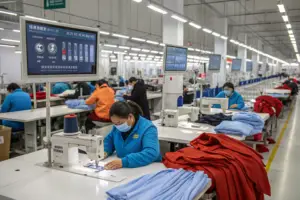
Imagine this: you've spent weeks negotiating with a garment factory in China for 5,000 units of a new jacket design. You agree on a price via email and send a 30% deposit. The goods arrive three months later, but the customs declaration shows a completely different value. Now you're facing unexpected duties, your clearance is delayed, and when you open the boxes, the quantity is wrong. The factory points back to a vague email chain. This costly scenario happens more often than you think, and it usually stems from one missing document: a proper Proforma Invoice.
A Proforma Invoice (PI) is critically important for clothing importers because it serves as the foundational, legally-recognized commercial agreement before any transaction occurs. It legally outlines all critical details—price, quantity, description, terms—and is the essential document required for securing import licenses, arranging trade finance, and clearing customs accurately, preventing costly delays and disputes.
While it's not a demand for payment, treating a PI as a mere formality is a dangerous mistake. For anyone importing garments from countries like China or Vietnam, a well-drafted PI is your first line of defense. Let's break down exactly why this document is non-negotiable for a smooth and profitable import process.
How Does a Proforma Invoice Prevent Costly Misunderstandings?
In the fast-paced world of apparel sourcing, details are everything. A verbal agreement or a scattered email thread about "those jackets we discussed" is a recipe for error. The Proforma Invoice acts as the single source of truth, freezing all negotiated terms in a formal document before any money or production begins.
The Proforma Invoice prevents misunderstandings by providing a clear, written record of every agreed-upon specification—from exact measurements and fabric composition to packaging details and delivery terms. It transforms subjective discussions into objective, actionable data that both buyer and supplier must formally acknowledge, eliminating the "he said, she said" conflicts that plague international trade.
What Key Garment Details Must Be Specified in a PI?
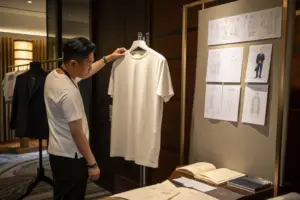
For clothing, generic descriptions like "Ladies' Blouse" are worthless. A proper PI must include technical specifications that leave no room for interpretation. At Shanghai Fumao, our PIs for a basic T-shirt include:
- Detailed Description: "100% Combed Cotton, 180gsm, Single Jersey, Tubular Knit T-shirt. Color: Heather Grey."
- Specifications: Reference to a tech pack number, with details on stitch type (e.g., coverstitch on hem), label placement, and packaging (e.g., 50 pcs per polybag, 10 polybags per export carton).
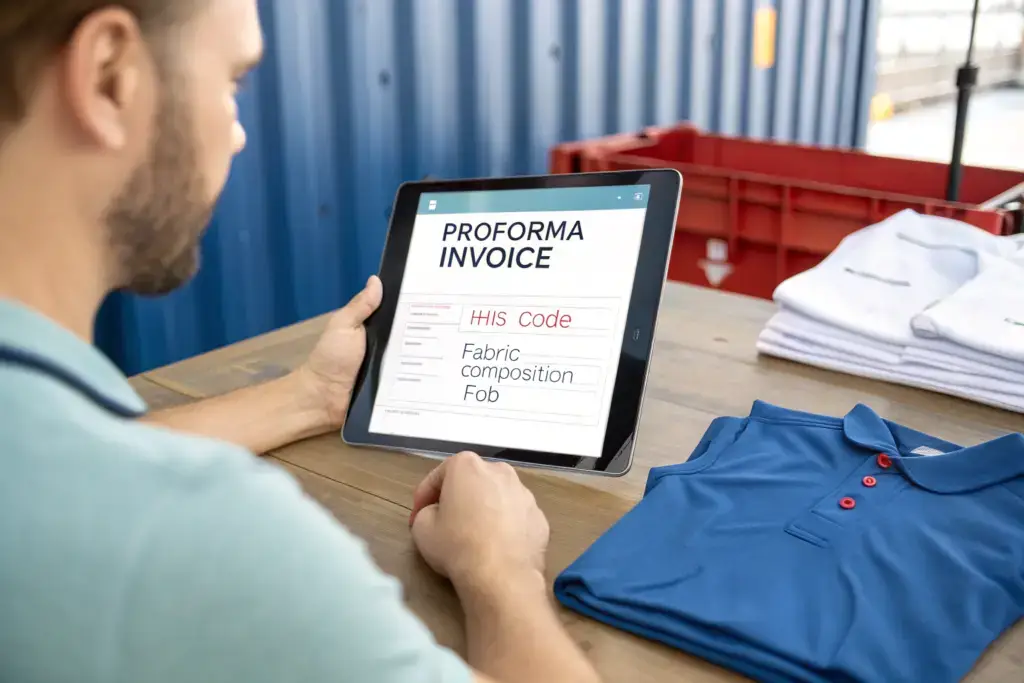
- HS Code: The Harmonized System code for the garment (e.g., 6109.10 for cotton T-shirts). This is crucial for customs.
Last year, a client ordered "men's casual pants." Our PI specified "98% Cotton, 2% Spandex, Twill Fabric, with 4-needle flat-felled seams." The client approved it. The finished product matched exactly. Without that detail, they could have received a cheaper polyester blend with simple overlook stitches, leading to a dispute and potential rejection of the shipment.
How Does a PI Formalize Financial and Logistics Terms?
Beyond the product, the PI locks in the commercial framework. It explicitly states:
- Unit Price and Total Value: e.g., "FOB Shanghai USD $8.50/unit."
- Payment Terms: "30% deposit by T/T, 70% balance against copy of Bill of Lading."
- Delivery Terms: Incoterms 2020 (e.g., FOB, CIF, or DDP), which dictate who pays for freight, insurance, and duties.
- Shipment Date: An estimated timeline from order confirmation.
This clarity is your shield. We once had a new buyer insist on "net 60" terms after production started, claiming it was agreed verbally. We politely referred them to the signed PI which stated "50% deposit, 50% before shipment." The PI settled the matter immediately, protecting our cash flow.
Why Is the PI a Critical Document for Customs Clearance?
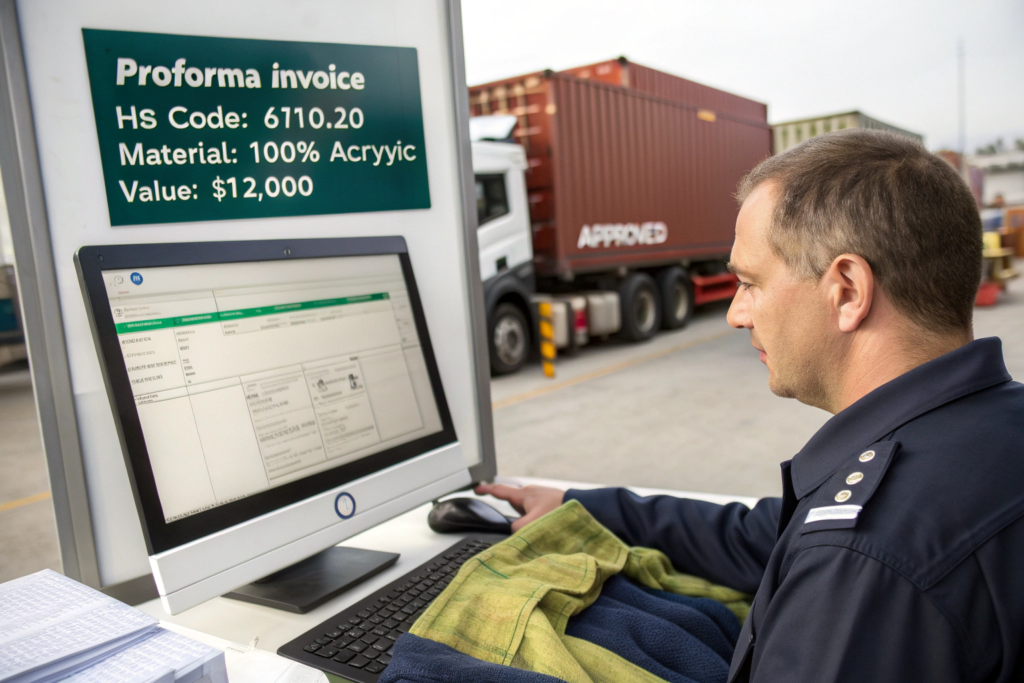
This is where the PI moves from being a commercial tool to a legal necessity. Customs authorities in the U.S. (CBP) and the EU use the information on your PI to assess duties, apply quotas, and ensure the shipment complies with regulations. Inaccuracies here don't just cause delays—they can result in fines, seizure of goods, or accusations of fraud.
The Proforma Invoice is critical for customs because it provides the declarative value, product description, and country of origin that customs officials use to classify the goods under the correct HS code, calculate applicable tariffs and taxes, and enforce trade agreements. An incorrect or vague PI directly causes customs holds, storage demurrage charges, and missed retail deadlines.
How Can an Inaccurate PI Lead to Customs Holds and Fines?
If the PI states "100% Cotton Sweaters" but the actual goods contain 5% elastane (spandex), they fall under a different HS code with a potentially different duty rate. Customs may deem this a mis-declaration. Similarly, if the declared value is suspiciously low ("$5,000" for a container of leather jackets), it can trigger an investigation for duty evasion. We assisted a client who faced a week-long hold because their previous supplier's PI listed the wrong country of origin. The resulting storage fees and missed launch date cost them over $15,000.
What Role Does the PI Play in DDP Shipments?
For importers using Delivered Duty Paid (DDP) terms, where the supplier handles all costs and risks to the final destination, the PI is even more vital. It is the basis upon which your supplier (like us at Shanghai Fumao) calculates the total landed cost, including estimated duties and local taxes. A precise PI ensures our quote is accurate, and you receive a firm, all-in price with no surprise fees upon delivery. This model has become a major selling point for U.S. brands that want predictable costs.
How Does the PI Facilitate Financing and Payment Processes?
Before a bank transfers six figures overseas or a financial institution provides a loan against inventory, they need proof of a legitimate transaction. The Proforma Invoice serves as that official proof of order and expected commercial value.
The PI facilitates financing by acting as the primary document banks and fintech lenders require to process international wire transfers, issue Letters of Credit (LC), or approve supply chain finance facilities. It provides the transactional evidence needed to move money across borders securely and in compliance with anti-money laundering (AML) regulations.

Why Do Banks Require a PI for Wire Transfers?
When you instruct your bank to send a deposit, their compliance department will likely ask for the underlying commercial contract—the PI. This is standard Know Your Customer (KYC) and AML procedure. The PI proves the transfer is for a real goods purchase, not an illicit flow of capital. Having a detailed PI ready speeds up this process dramatically. We advise all clients to send the approved PI to their bank before initiating the payment to prevent unnecessary delays.
Can a PI Be Used to Secure a Letter of Credit or Trade Loan?
Absolutely. To open a Letter of Credit, the issuing bank will draft the LC terms directly based on the conditions stipulated in the Proforma Invoice. Any discrepancy between the PI and the LC can cause the documents to be rejected. For trade loans or purchase order financing, lenders use the PI to verify the order's size and legitimacy with the supplier before advancing funds to the buyer. A clear PI makes you a more credible borrower.
What Are the Common Pitfalls and How to Avoid Them?
Even with a PI, errors occur. The most common pitfalls stem from treating the PI as a final step rather than a collaborative, living document during the negotiation phase.
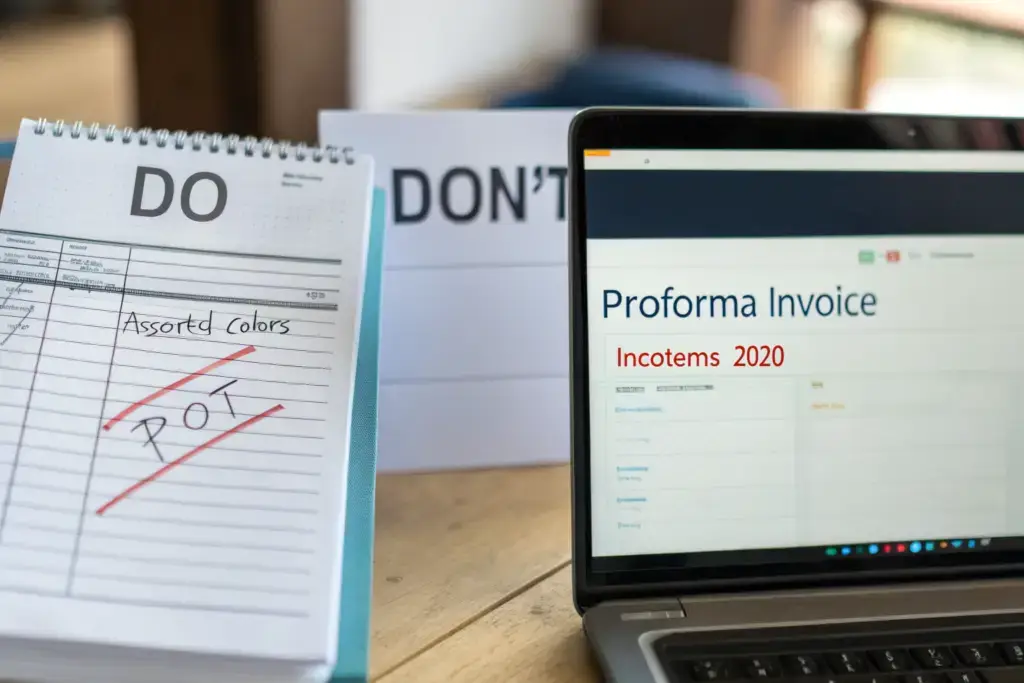
Common pitfalls include accepting generic product descriptions, omitting Incoterms details, using outdated templates, and not having both parties formally sign/approve the document. Avoid these by insisting on tech-pack-level detail, confirming all Incoterms responsibilities, using a standardized digital format, and obtaining a stamped approval from the supplier before proceeding.
What Should You Do If the Final Commercial Invoice Differs from the PI?
Minor variances (like a 1-2% change in total quantity) are normal. However, significant differences in value or description are red flags. The final Commercial Invoice presented for payment should closely mirror the PI. If it doesn't, pause and investigate. We had a case where a client's freight forwarder received a Commercial Invoice with a 40% lower value than the PI—a clear attempt by a disreputable factory to help the client "save on duties." We warned the client this was fraud that could lead to severe penalties, and they canceled the relationship with that factory.
How Can Digital Tools Improve the PI Process?
Forward-thinking manufacturers and buyers are moving away from PDFs and emails. Integrated platforms allow for the creation, approval, and tracking of PIs directly linked to tech packs and order management systems. This creates an auditable trail and ensures data consistency from quote to delivery. At Shanghai Fumao, we are implementing such a system to provide clients with real-time PI status and seamless integration with their own procurement software.
Conclusion
In the intricate dance of global apparel importing, the Proforma Invoice is your sheet music. It sets the rhythm, defines every note, and ensures all players are in harmony. It is far more than a simple price quote; it is a binding pre-contract, a customs necessity, a financial enabler, and your most powerful tool for preventing expensive errors and disputes.
Neglecting its importance—by accepting vague terms, skipping details, or failing to get formal approval—invites risk at every stage of your supply chain. Conversely, mastering the PI process, as we prioritize at Shanghai Fumao, builds a foundation of transparency, professionalism, and trust that leads to smoother transactions and more profitable long-term partnerships.
If you want to eliminate the hidden costs and headaches from your import process and work with a manufacturer that values clarity and precision from the very first document, let's connect. We can show you how our detailed PI and order process protects your business. Contact our Business Director, Elaine, to start your next order on the right footing at strong>elaine@fumaoclothing.com</strong.