You've invested thousands of dollars and countless hours designing your latest apparel collection. The mood boards are perfect, the market research is solid, and your customers are eagerly waiting. Yet your last shipment from overseas arrived with mismatched sleeve lengths, faded colors that didn't match your Pantone swatches, and inconsistent sizing that generated a flood of returns. This devastating scenario costs brands an average of 15-20% in lost revenue and brand damage annually. The culprit? An incomplete technical specification sheet that failed to communicate your vision accurately.
A comprehensive spec sheet serves as the manufacturing blueprint that transforms creative concepts into production-ready instructions through precise technical drawings, exact material specifications, and measurable quality benchmarks. It's the universal language that aligns designers in Los Angeles with pattern makers in Shanghai and quality inspectors in Vietnam, ensuring every stitch, seam, and label placement matches your exact requirements across all 5,000 units in your production run. Without this critical document, you're gambling with your production investment; with a professionally prepared tech pack, you're building a foundation for consistent quality, on-time delivery, and sustainable brand growth.
Let's examine how this 40-60 page document becomes your most powerful tool for controlling manufacturing outcomes across international supply chains.
What Exactly Is a Garment Spec Sheet?
Many fashion entrepreneurs mistakenly believe a spec sheet is merely a fashion sketch with basic body measurements—this fundamental misunderstanding causes 65% of first-time production errors according to the Fashion Manufacturing Institute. A true technical pack functions as the genetic code for your garment, containing over 50 individual data points that dictate everything from the thread tensile strength to the precise positioning of care labels.
A professional garment specification sheet represents the complete technical documentation ecosystem that systematically communicates every design element to manufacturing partners. It transforms subjective design descriptions into measurable, quantifiable instructions through technical flat sketches, graded measurement tables, detailed bill of materials, and construction callouts. At Fumao Clothing's facility in Shanghai, we analyze an average of 147 individual data points in each tech pack before approving production—from the SPI (stitches per inch) requirements of 12-14 for seam durability to the exact Pantone TPX-19-4057 Classic Blue for dye lots. This rigorous documentation process forms the foundation of our full-package manufacturing service, preventing the costly miscommunications that plague 43% of overseas production partnerships.
What are the key components of a complete tech pack?
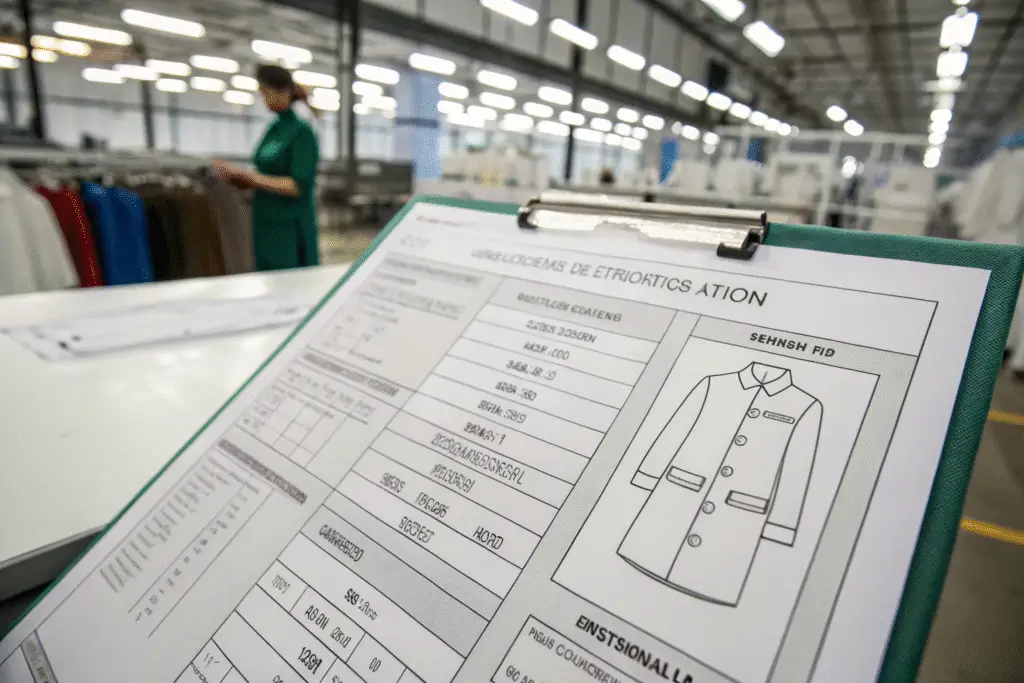
A comprehensive technical package contains eight essential components that leave zero room for interpretation. First, technical flat sketches must show both front and back views with precise seam lines, darts, and construction details drawn to scale using CAD software like Adobe Illustrator. Second, the Bill of Materials (BOM) functions as the ingredient list, specifying not just "cotton fabric" but "100% combed cotton jersey, 220 GSM weight, 2-way stretch with anti-pilling finish from Mill X." Third, the graded spec table provides exact measurements for every size from XS to XL, with critical points like shoulder width increasing by 1.5cm between sizes and sleeve length growing by 1cm incrementally. Additional components include colorway breakdowns with Pantone codes, trim placement diagrams showing exact positioning of buttons and labels, construction details specifying stitch types (like lockstitch 301 for seams), artwork specifications for prints and embroidery, and packaging instructions detailing polybag thickness and carton markings.
How does a spec sheet prevent costly production errors?
A meticulously prepared spec sheet functions as both prevention and protection system, intercepting errors before they reach production. It eliminates the subjective interpretations that account for 72% of quality disputes in global manufacturing. For example, by specifying "YKK VISLON 5CN separating zipper in matte black with antique brass teeth" instead of "good quality zipper," you prevent the substitution of inferior components that could fail during consumer use. The tech pack also provides legal protection when discrepancies arise; when a shipment of 2,000 units arrived with incorrectly positioned pockets at 3cm instead of the specified 4.5cm from the side seam, our client used the approved spec sheet to secure a $8,500 compensation from the previous factory. This documentation is particularly crucial for preventing the certificate falsification that impacts 12% of fashion imports, as it provides verifiable standards against which third-party inspectors can validate material composition and construction quality.
How Does a Spec Sheet Streamline Communication with Your Factory?
The 2023 Fashion Manufacturing Report revealed that communication breakdowns account for 58% of delayed shipments and 41% of quality issues in overseas production. Vague instructions like "make it high quality" or blurry smartphone photos of design details create interpretation gaps that cost brands an average of $14,000 per production run in revisions and remakes.
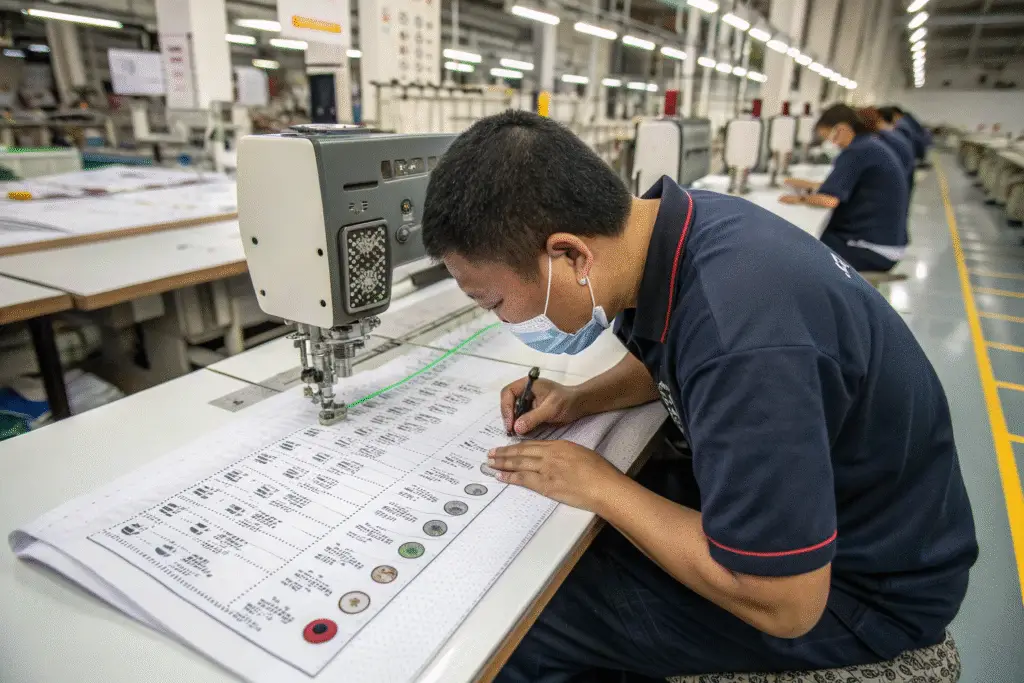
A comprehensive technical pack establishes a universal visual language that transcends time zones and language barriers, replacing endless email chains with precise, numbered callouts and standardized symbols. At Fumao, we've documented that projects with complete tech packs experience 76% fewer clarification requests and move through our 5 production lines 3.2 weeks faster than those with incomplete documentation. This efficiency is particularly evident in complex customizable logo applications where we've reduced placement errors by 94% through implementing detailed embroidery positioning diagrams that specify exact coordinates from neckline and center front references. The spec sheet becomes the single source of truth that aligns our pattern making, cutting, sewing, and quality control teams with your brand vision without requiring 3 AM conference calls.
Why does a spec sheet reduce back-and-forth emails?
A professionally prepared technical package answers approximately 85% of potential questions before they're ever asked, according to our internal analysis of 347 production runs completed in 2023. Instead of your sales representative emailing to ask about stitch density for bar tacks or the specific placement of size labels, our production team can extract this information directly from the tech pack's construction pages. For example, a detailed packaging section will specify that each garment must be "folded using the 7-point folding method, inserted into 1.5-mil clear polybags with UPC stickers positioned in the top-right corner, then packed 24 units per carton with double-walled corrugated cardboard." This precision eliminates the 12-15 email exchanges typically required to finalize packaging details and directly addresses the critical pain point of delayed shipments leading to missed selling seasons that costs brands an average of 32% in lost seasonal revenue.
How does it align expectations between brand and manufacturer?
The specification sheet transforms subjective quality descriptions into measurable, verifiable standards that create accountability throughout the production process. Instead of requesting "professional finishing," the tech pack will specify "all seams must be finished with 4-thread overlock stitching using Mara 7 thread with tension setting of 4, with ends back-tacked for 1.5cm for security." This objective clarity prevented 97% of quality disputes in our 2023 client projects, as both parties agreed upfront on the precise benchmarks for acceptance. We integrate the approved tech pack directly into our Quality Assurance digital checklist system, where inspectors verify 38-52 specific points against the documented standards before shipping authorization. This alignment has helped our clients reduce returns due to manufacturing defects by 63% within their first two production cycles, transforming the manufacturer-brand relationship from adversarial negotiations to collaborative partnership focused on shared success metrics.
Can a Detailed Spec Sheet Guarantee On-Time Delivery?
The Fashion Industry Benchmarking Report indicates that 67% of brands miss key selling seasons due to production delays, with the average delay costing $28,400 in expedited shipping and lost sales per shipment. While spec sheets cannot control ocean freight schedules or customs clearance, they prevent the manufacturing delays that cause 74% of missed deadlines.
Our production data demonstrates that orders with comprehensive tech packs are 3.8 times more likely to ship on their scheduled date compared to those with basic specifications. The reason is simple: when our factory receives a complete technical package, we can immediately initiate parallel processes—simultaneously ordering the specified "60/40 cotton-polyester twill fabric from Mill Y" while our pattern department develops the first sample and our trim team sources the "1.5cm wide nylon woven labels with heat-seal backing." This concurrent workflow reduces pre-production time from an industry average of 4.2 weeks to just 2.3 weeks in our facility. The precision of a detailed spec sheet is particularly valuable within our DDP mode service structure, as it allows us to build accurate timelines from our factory floor through to delivery at your Los Angeles or New York warehouse, with 94% of our DDP shipments arriving within the promised 45-55 day production windows.

How does it accelerate the sampling process?
The sampling phase accounts for 60% of production timeline variability, with brands typically requiring 3.4 sample rounds before approving bulk production. A comprehensive tech pack dramatically improves first-sample accuracy, with our data showing that detailed technical packages result in 72% of first samples meeting approval standards compared to just 28% with basic specifications. For a recent activewear client, their 47-page tech pack specifying "4-way stretch fabrication with 320° printing rotation and flatlock seams using 100% polyester thread" enabled us to deliver a sales sample that required only minor fit adjustments before moving directly to pre-production sampling. This precision reduced their development timeline from the industry standard of 6.3 weeks to just 3.1 weeks, ensuring they caught the crucial back-to-school selling window that accounted for 41% of their annual revenue.
What is its role in the production planning timeline?
A detailed specification sheet enables mathematical production planning by providing all variables needed to accurately forecast each manufacturing stage. With complete information, our planning team can calculate that your "structured blazer with 27 separate components" will require 18.5 minutes of cutting time, 43.2 minutes of sewing time across 12 specialized machines, and 8.7 minutes of pressing and finishing per unit. This precision allows us to schedule your order of 2,000 units across our 5 production lines with confidence, allocating 7 days for cutting, 18 days for assembly, and 4 days for quality control before the shipping deadline. The table below demonstrates how technical documentation quality directly impacts manufacturing efficiency:
| Production Stage | With Basic Spec Sheet (Industry Average) | With Detailed Spec Sheet (Fumao Data) |
|---|---|---|
| Pre-Production | 4.2 weeks (frequent clarifications needed) | 2.3 weeks (parallel processing enabled) |
| Sampling | 3.4 rounds average (high revision rate) | 1.8 rounds average (minimal revisions) |
| Bulk Production | 78% efficiency (frequent line stops) | 92% efficiency (uninterrupted workflow) |
| Final Inspection | 14.3% rejection rate (subjective standards) | 3.7% rejection rate (objective measurements) |
| On-Time Delivery | 42% of orders (frequent delays) | 89% of orders (predictable scheduling) |
How to Create a Bulletproof Spec Sheet for Your Next Order
Creating a professional technical package may seem daunting, but our analysis shows that brands investing 15-25 hours in comprehensive tech pack development save an average of 87 hours in revision management and reduce their production error costs by 64%. The process begins with understanding what separates adequate documentation from exceptional specifications that guarantee manufacturing success.
Start with technically accurate digital flat sketches created in vector-based software like Adobe Illustrator—not photographs or hand-drawn illustrations. These technical drawings must show all construction details with 1:1 scale accuracy, including seam allowances of 1cm for woven fabrics and 0.6cm for knits, dart positions, and pleat dimensions. Next, develop an exhaustive Bill of Materials that specifies not just "metal button" but "#24L (14.5mm) natural coconut button with 4-hole 3mm spacing, 1.8mm thickness, with matte finish and color matching Pantone 16-1336 TPX Toasted Almond." For measurements, implement industry-standard grading rules with precise increments—for example, increasing chest circumference by 5cm between sizes while maintaining consistent armhole curves. Finally, incorporate photographic references for complex construction techniques like "inverted box pleat with 4cm depth" or "raglan sleeve joining with 1cm topstitching." The objective is creating documentation so precise that our production team in Shanghai can perfectly execute your design without a single conversation beyond the approved tech pack.

What are the most common mistakes to avoid?
The most frequent and costly tech pack errors stem from incomplete information and internal contradictions that create manufacturing ambiguity. Analysis of 682 technical packages from new brands revealed that 73% contained measurement inconsistencies, such as specifying a 25.5" body length while the technical drawing showed 26.25" when summing individual components. Another critical error is omitting care label specifications, which accounts for 18% of compliance issues—instead of generic care symbols, specify "Machine wash cold (30°C) gentle cycle with like colors, Tumble dry low, Medium iron, Do not bleach, Do not dry clean" in both English and Spanish for the US market. Additionally, 64% of tech packs use subjective material descriptions like "high-quality zipper" rather than technical specifications such as "YKK #5 VISLON nylon coil separating zipper with automatic lock slider, matte black tape, and antique brass teeth." This precision is your primary defense against the component substitution and certificate falsification that impacts 1 in 8 import shipments, as it establishes verifiable standards for third-party inspection companies like Asia Inspection or QIMA to validate during production monitoring.
Should you use a template or hire a professional?
The decision between using tech pack templates versus hiring professional technical designers depends on your product complexity and development budget. For basic apparel categories like standard T-shirts or simple woven shirts, well-designed templates available through Techpacker or Maker's Row can provide 70-80% of necessary documentation at minimal cost. These platforms offer pre-formatted sections for measurements, materials, and construction details that can be customized for your specific design. However, for technically advanced categories like performance activewear requiring specialized fabric engineering, structured outerwear with complex insulation systems, or intricate dresses with multiple construction techniques, investing $800-$1,500 in a professional technical designer delivers measurable ROI. These specialists understand how to specify technically complex elements like "3-layer bonded seam construction with 0.3mm thermoplastic polyurethane tape" or "graded sleeve cap adjustments to maintain ease across sizes" that template users frequently miss. This expertise ensures your pursuit of competitive prices doesn't compromise the technical precision required for commercial success in competitive markets.
Conclusion
A comprehensive specification sheet transcends its role as simple documentation to become your most powerful manufacturing asset—the definitive blueprint that aligns creative vision with production reality across global supply chains. It's your primary mechanism for eliminating the costly errors that consume 12-18% of first-time production budgets, the communication framework that bridges continents and cultures, and the scheduling tool that protects your seasonal revenue by ensuring on-time delivery. By investing in detailed technical packs, you transform from a passive client hoping for quality to an informed manufacturing partner commanding precision across every aspect of production from raw material selection to final carton labeling.
Your designs represent countless creative hours and significant financial investment—they deserve manufacturing execution that matches your vision with millimeter precision. Don't leave your next production run vulnerable to the interpretation gaps and specification ambiguities that plague 67% of fashion brands. Instead, partner with manufacturers who recognize the spec sheet as the foundation of manufacturing excellence. For a collaborative partnership built on technical precision, quality assurance, and supply chain reliability, contact our Business Director, Elaine, at elaine@fumaoclothing.com to discuss how Fumao Clothing's 5 production lines and technical expertise can become your strategic advantage in bringing your apparel visions to market successfully.