The women's golf apparel market is shifting dramatically. It's no longer just about color-blocking and classic silhouettes. Today's female golfer demands high-performance, technical fabrics in styles that are both fashionable and functional. But beneath the surface of this design revolution lies a more critical, non-negotiable requirement: safety. Increasingly, brands aren't just asking for OEKO-TEX certification—they are demanding it for every women's skirt and dress they source. Why has this specific certification moved from a "nice-to-have" to a core purchasing specification? The answer lies at the intersection of consumer awareness, regulatory pressure, and the unique performance demands of the modern woman's game.
Brands are demanding OEKO-TEX for women's golf skirts and dresses because the female consumer is highly educated about product safety and skin health, and these garments involve extensive, direct skin contact during physical activity. OEKO-TEX Standard 100, Class 1 certification provides an independent, scientific guarantee that the fabrics are free from harmful substances, protecting the brand from liability, enabling retailer compliance, and serving as a powerful trust signal in a competitive market. A skirt that causes chafing or irritation is a product failure, but one that carries a hidden chemical risk is a brand catastrophe.
We witnessed this shift firsthand two seasons ago. A well-known brand launching a new line of performance golf dresses had their initial production held up because their fabric supplier could only provide a generic "compliance letter" instead of a valid OEKO-TEX certificate. The brand's leadership made a decisive call: they scrapped the entire fabric order, found a new certified mill, and delayed their launch by eight weeks to ensure safety. They told us, "Our customer trusts us with her comfort and her health. We can't gamble with that." This story underscores that for leading brands, OEKO-TEX is now a fundamental component of product development, not an afterthought.
1. The Female Consumer: Informed, Concerned, and Driving Change
The modern female golfer is a informed buyer. She researches products online, reads labels, and participates in communities that discuss everything from swing techniques to sustainable apparel. She is acutely aware of topics like hormonal health, skin sensitivity, and the long-term effects of chemical exposure. For her, clothing is not just a covering; it's a layer that interacts with her body for hours during a round.
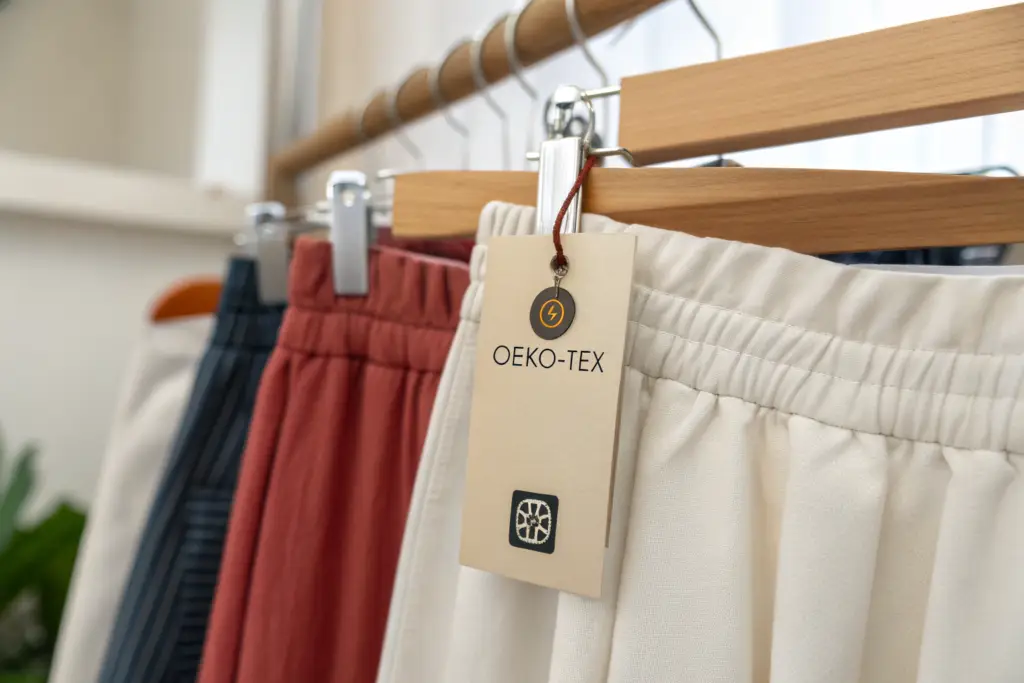
This demographic is actively seeking out brands that align with their values of wellness and transparency. OEKO-TEX certification serves as an instantly recognizable, third-party validation that a brand takes product safety seriously. It answers the unspoken question: "Can I trust what's in this fabric touching my skin all day?" In a market where women have countless choices, this trust becomes a primary differentiator. A skirt with a recognizable OEKO-TEX label on its hangtag communicates care and credibility before the first swing is ever taken.
How Transparency Translates to Purchase Decisions
Brands are responding to a clear market signal. When a consumer sees two similar golf skirts at the same price point, the one with the credible certification often wins the sale. This is especially true in the direct-to-consumer (DTC) and premium retail spaces, where brand storytelling is key.
- E-commerce Power: Online, where customers can't feel the fabric, certifications act as surrogate trust signals. Listing OEKO-TEX in the product description and displaying the label in photos reduces purchase hesitation.
- Community Influence: Women's golf forums and social media groups frequently discuss brand reputations. A single post questioning the safety or sourcing practices of a brand can cause significant damage. Proactive certification is a form of reputational risk management.
We helped a boutique brand leverage this last year. By reformulating their bestselling stretch-skirt fabric to meet OEKO-TEX Class 1 standards and prominently featuring this in their marketing, they saw a 22% increase in conversion rates on that product page and a notable decrease in post-purchase inquiries about fabric content and safety. This direct commercial benefit makes the investment in certification immediately justifiable.
The Specific Skin-Contact Concerns in Women's Golf Apparel
The design of women's golf skirts and dresses creates unique exposure points. Unlike a loose men's polo, these garments often feature:
- Close-fitting waistbands and liners: In constant, snug contact with sensitive skin.
- High hemlines and movement: The inner thigh area of a skirt is prone to friction and sweat, increasing the potential for any residual chemicals in the fabric to cause irritation.
- Stretch fabrics: The elastane or spandex blends essential for freedom of movement require specific dyes and processing chemicals that must be rigorously tested.
An uncomfortable experience related to any of these points doesn't just lead to a return; it leads to a lost customer. OEKO-TEX testing specifically looks for allergenic dye stuffs and skin-irritating substances, directly addressing these very concerns. It's preventative quality assurance for the wearer's experience.
2. Beyond Marketing: The Compliance and Liability Shield
While consumer demand is a powerful driver, the requirement for OEKO-TEX is also a strategic business decision rooted in hard-nosed risk management. For brands, especially those scaling or entering new markets, certification is a shield against two major threats: regulatory non-compliance and product liability lawsuits.
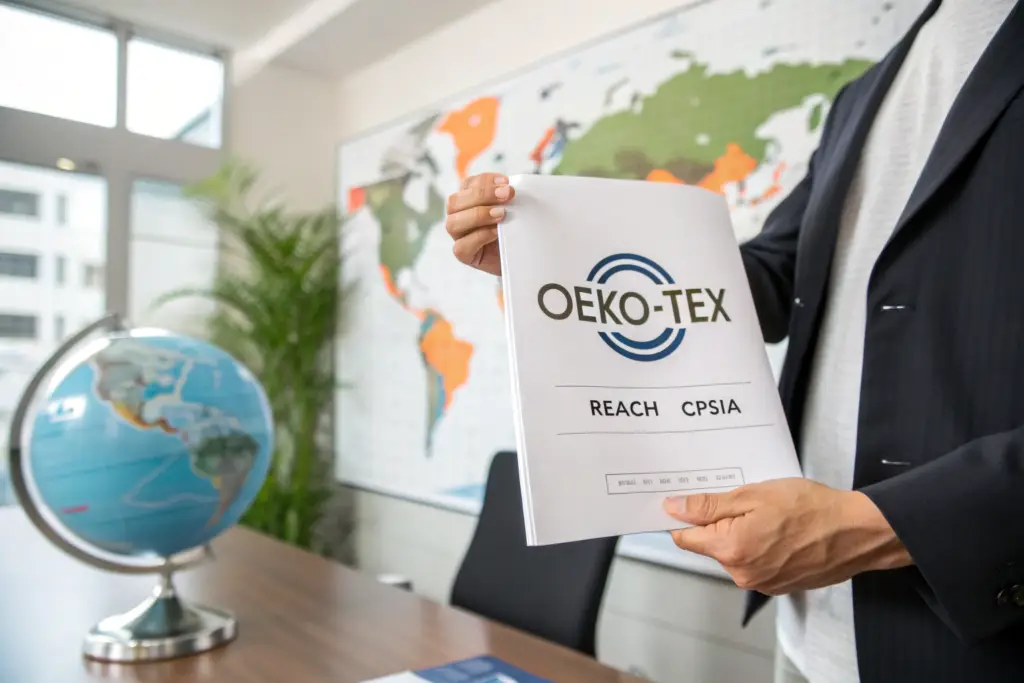
In today's global market, OEKO-TEX certification is often the most efficient way to demonstrate pre-compliance with a complex web of international regulations, such as the EU's REACH (Registration, Evaluation, Authorisation and Restriction of Chemicals) and the US CPSIA (Consumer Product Safety Improvement Act). For a brand importing into multiple countries, managing separate compliance proofs for each is a logistical nightmare. A valid OEKO-TEX certificate simplifies this dramatically, smoothing the path through customs and satisfying retailer vetting processes.
The High Cost of Non-Compliance
The consequences of ignoring this can be severe:
- Retailer Rejection: Major golf retailers and department stores are increasingly making OEKO-TEX or equivalent certification a mandatory condition for wholesale partnerships. Your product literally cannot be placed on their shelves without it.
- Customs Delays and Seizures: Shipments can be held for testing, leading to missed selling seasons. In the worst case, non-compliant goods can be rejected or destroyed.
- Legal Liability: If a product is alleged to cause harm, the presence of a respected, independent certification like OEKO-TEX forms a crucial part of a "duty of care" defense. It proves the brand took reasonable steps to ensure product safety.
At Shanghai Fumao, our full-package manufacturing service includes managing this compliance layer. For a client launching a dress line in both North America and Europe last spring, we consolidated all testing and provided a certification pack that covered both regional requirements. This turnkey approach prevented what could have been months of back-and-forth with different testing agencies, allowing the brand to focus on marketing and sales.
How Certification Mitigates Supply Chain Risk
Demanding OEKO-TEX from your manufacturer also mitigates supply chain opacity. It forces a level of traceability and documentation that exposes weaker, less reliable suppliers. A factory that cannot or will not provide valid, specific certificates is a factory that likely cuts corners elsewhere in production.
By partnering with a manufacturer like us, who builds certification into the fabric sourcing stage, brands de-risk their entire production process. We only work with mills that provide current, Class 1 certificates, and we verify them before fabric enters our cutting room. This systematic approach, part of our integrated service, directly addresses the brand's pain point of inconsistent quality and hidden supply chain dangers.
3. The Performance-Safety Nexus in Technical Fabrics
Women's golf skirts and dresses are now engineered garments. They incorporate moisture-wicking treatments, UV protection, stretch recovery, and wrinkle resistance. Each of these performance features is achieved through chemical finishes or specialized fabric constructions. This is the "performance-safety nexus": the very technologies that make the garment functional must also be proven safe.
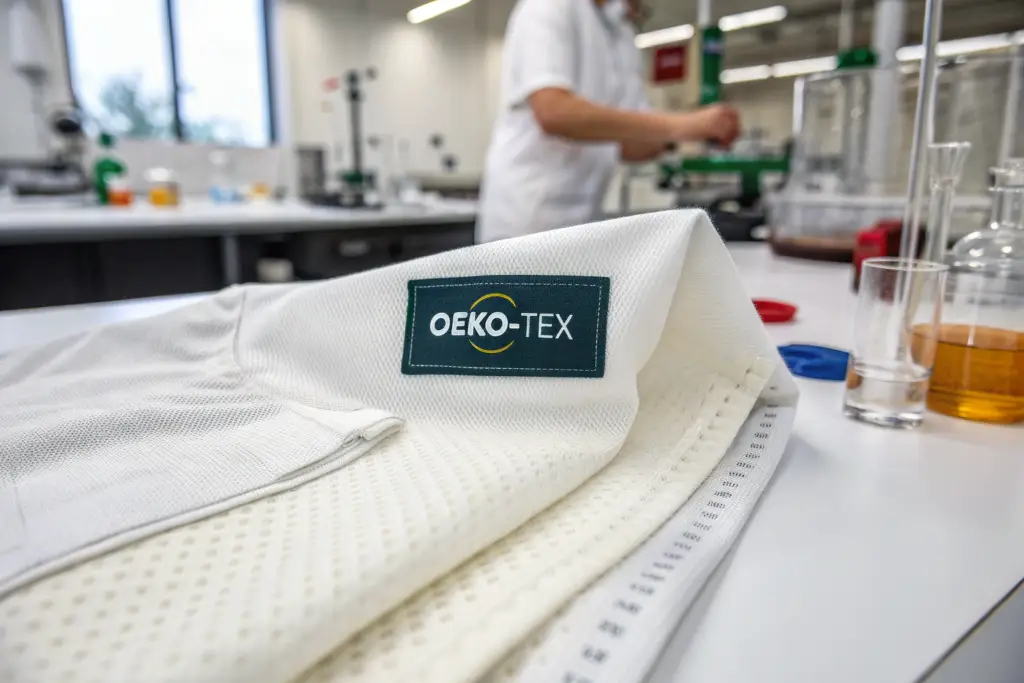
OEKO-TEX certification does not oppose performance; it validates its safety. The test criteria include residues from functional finishes, ensuring that a fabric designed to pull sweat away from the skin isn't also leaching unwanted chemicals in the process. This is critical for brands marketing "technical" or "smart" fabrics to a health-conscious audience.
Case Study: Moisture-Wicking and Odor Resistance
A common feature in golf apparel is antimicrobial or odor-control treatment. These treatments, often based on silver ions or other compounds, must be tested for safe concentration levels and to ensure they do not release harmful substances. An OEKO-TEX Class 1 certificate confirms this.
We developed a line of golf dresses for a brand that specifically wanted a natural-feeling odor-control solution. Our fabric mill proposed a technology, but the initial test batch failed the OEKO-TEX criteria for a specific substance. We worked with them to reformulate the finish until it passed the stringent Class 1 limits, all before presenting the option to our client. This behind-the-scenes product development work is what ensures the final product is both high-performing and unquestionably safe.
Building a Brand Story on a Foundation of Trust
Ultimately, demanding OEKO-TEX is about building a durable brand. In the women's athletic wear space, trust is the ultimate currency. A brand known for its commitment to safety and transparency can command loyalty and a price premium.
- Marketing Narrative: Certification allows brands to tell a deeper story. It's not just "our skirts are comfortable," but "our skirts are scientifically certified safe for your skin, so you can focus on your game with total confidence."
- Long-Term Value: Investing in certified materials builds a reputation for integrity. This pays dividends in customer retention, positive press, and smoother business operations with retailers and distributors.
Conclusion
The demand for OEKO-TEX in women's golf skirts and dresses is not a passing trend; it is a reflection of a mature market where the consumer is educated, regulations are stringent, and brand accountability is paramount. It represents a convergence of ethical sourcing, smart business practice, and cutting-edge product design.
For brands, this demand is an opportunity to lead. It's a chance to differentiate in a crowded field, build unshakeable consumer trust, and future-proof your supply chain against regulatory shifts. The question is no longer why brands are demanding OEKO-TEX, but how quickly they can integrate it into their core sourcing strategy.
Is your brand ready to meet this demand with confidence? Partnering with a manufacturer that views OEKO-TEX not as a hurdle, but as a baseline standard, is the first step. At Shanghai Fumao, we specialize in crafting high-performance women's golf apparel that is as safe as it is stylish. Our process is built from the ground up to deliver verified, certified quality. Let us help you ensure your next collection meets the standard your customers expect. Contact our Business Director, Elaine, to discuss how we can integrate OEKO-TEX certification seamlessly into your production: elaine@fumaoclothing.com.