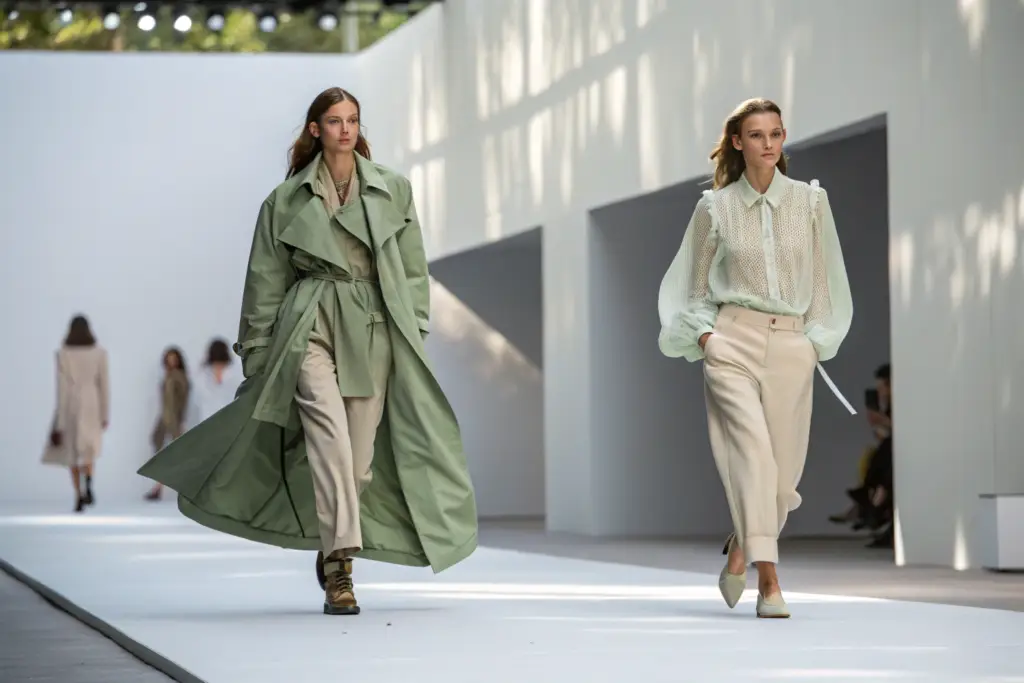
Last month, I sat with a brand director from Los Angeles in our Shanghai Fumao showroom. She had just returned from Copenhagen Fashion Week. Her mood board was covered in images, but her expression was worried. "I love the clean lines," she said, "but I don't know how to translate this 'quiet luxury' into a commercial production run that my customer can actually afford." She had seen the flowing silhouettes and the technical fabrics, but her previous factory had told her those complex, oversized patterns were too wasteful to cut and those recycled blends were too difficult to source. She was stuck between inspiration and reality. This is a conversation I have with American brands every season. The runway is beautiful, but the supply chain makes it wearable.
The defining women's wear trends emerging from Scandinavian Spring fashion weeks center on utilitarian elegance, bio-based fabric innovations, and modular layering that blends masculine tailoring with feminine fluidity. The overarching theme is an investment in "forever pieces" made from certified circular materials, with a color palette dominated by digital lavender, sage green, and warm ecru. At Shanghai Fumao, we are already developing these exact fabrications and oversized block patterns for U.S. brands transitioning from fast fashion to conscious, durable collections.
Scandinavian fashion is no longer a niche regional aesthetic. It has become the global blueprint for how modern women want to dress: sharp but soft, sustainable but luxurious, minimal but never boring. For a brand buyer, the opportunity is clear. The challenge is execution. Let me break down the specific trends, the fabrics behind them, and the production strategies that make them viable for your next collection.
How Is "Quiet Luxury" Being Redefined by Nordic Minimalism?
The old "quiet luxury" was about hidden logos and high price tags. The Scandinavian version strips it down further. It is about the garment itself. The construction, the drape, the raw edge of a seam. I walked through a showroom in Copenhagen and noticed that the blazers had no buttons. The coats had no visible zippers. The luxury came from the weight of the fabric and the precision of the cut. One designer showed a double-face cashmere coat that was entirely unlined. The inside was as beautiful as the outside. There was nothing to hide behind. This creates a massive production challenge because every stitch is visible, but it also creates a massive opportunity for a factory that specializes in precision finishing.
Nordic minimalism elevates quiet luxury by removing all ornamental distractions and relying entirely on material integrity and sculptural silhouette. The trend demands heavy, structured fabrics like compact double-face wool, dense cotton twills, and heavy silk crepes that hold an architectural shape without interfacing. The color story is monochromatic, moving through tones of oatmeal, charcoal, and buttercream, creating a wardrobe that is entirely interchangeable.
This is not about making a simple T-shirt. This is about engineering a garment that stands up on its own. Here is what that means for fabric sourcing and construction.

What Fabric Weights Achieve the "Sculptural Softness" Effect?
The silhouette is oversized but never sloppy. A coat looks like a cocoon, but the shoulders hold their shape. That requires a specific fabric density. We are working with wool-poly blends in the 480 to 520 GSM range. These weights are heavy enough to mold into a curved shoulder seam without shoulder pads, but not so heavy that the garment feels like armor.
I recently sourced a GRS-certified recycled wool blend for a New York brand that wanted this exact look. The challenge was getting the stiffness right. A standard melton wool was too flat. We developed a fabric with a slightly brushed finish that gave it a tactile softness while the dense weave maintained the architectural drape. The brand sold out of their first production run in three weeks. The key is to test the bending rigidity, which we do in-house with a simple drape meter, before committing to the bulk fabric. If the fabric folds too easily, the sculptural shape collapses.
Why Is "Inside-Out" Construction a Quality Benchmark?
When a garment has no lining, the inside finish becomes the benchmark. We are now using French seams, bound seams, and flat-felled seams on the inside of coats and jackets. This used to be reserved for haute couture. Scandinavian brands have made it the standard for everyday luxury.
At Shanghai Fumao, we had to retrain our finishing team for this. A French seam on a lightweight silk blouse is standard. A French seam on a heavy wool coat is a different animal. The feed mechanism on the sewing machine has to be adjusted to prevent the plies from shifting. But the result is a coat that a customer can drape over a chair, revealing a perfectly finished interior. It communicates quality without a logo. I recommend brands allocate an extra 8% to 12% in their sewing budget for these interior finishes.
Scandinavian fashion week is not just a style show. It is a materials science convention. The designers talk about fiber origins the way sommeliers talk about grape varietals. I attended a seminar in Stockholm where a designer presented a gown made from Finnish birch tree pulp. It felt like silk charmeuse. Another showcased a blazer woven from recycled ocean plastic with a hand feel indistinguishable from virgin polyester. The message is clear: the fabric story is now as important as the silhouette story. For a brand, this means you need a factory that can source and verify these next-generation materials.
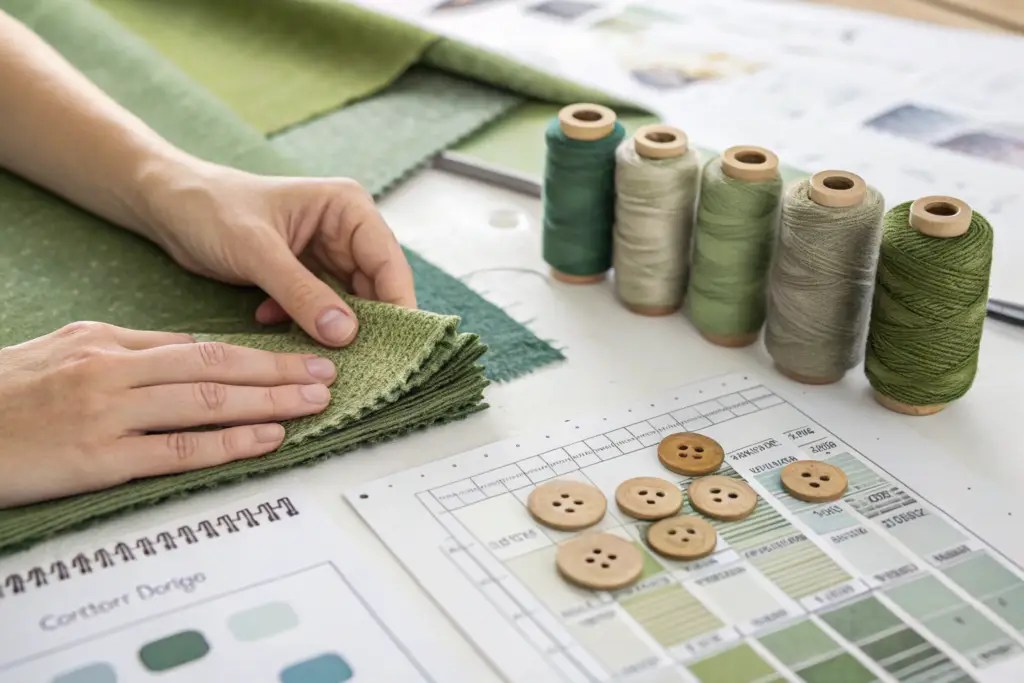
The material innovation focus for Spring leans heavily on regenerated cellulosic fibers like Infinna and Circulose, as well as bio-treated linens that eliminate the scratchy hand feel of traditional flax. Designers are actively replacing conventional cotton with low-impact alternatives that use closed-loop chemical processes. The palette reflects this shift, with colors derived from natural plant dyes like birch leaf, clay, and fermented indigo.
Sourcing these materials is not as simple as ordering from a stock catalog. The supply chain is still boutique and requires deep relationships with mills in Scandinavia and Japan. Here is how we navigate two of the most requested categories.
How Are "Circular Cellulosics" Replacing Traditional Viscose?
Conventional viscose has a dirty secret. Its production often involves deforestation and toxic carbon disulfide. The Scandinavian market has effectively rejected it. In its place, we are sourcing Circulose, which is made from cotton textile waste dissolved back into a pulp and extruded into new fiber. It looks and feels like a high-end cupro.
I just placed an order for 3,000 yards of a Circulose twill for a women's trouser program. The lead time was six weeks longer than standard viscose, and the cost was 25% higher. But the brand could legally market the garment as "made from 100% recycled textiles." The hangtag tells the story, and the customer pays a premium. For a factory, the challenge is wash stability. These regenerated fibers can fibrillate in the wash if they are not treated with an anti-fibrillation enzyme. We run a full AATCC wash test on every new circular fiber batch to ensure the customer does not see white micro-fuzz after three launderings.
Can Bio-Treated Linen Achieve a Silk-Like Drape?
Traditional linen wrinkles if you look at it. That is part of its charm, but it limits its application in dressy women's wear. The new bio-treated linens, sometimes called "enzyme-washed" linen, are different. The enzymatic process eats away the microscopic splinters on the flax fiber surface. The result is a linen that is softer, drapier, and less prone to sharp creasing.
We developed a capsule collection of blouses for a California brand using a bio-washed linen from a Belgian mill. The fabric had a subtle sheen that photographed beautifully. The production challenge was cutting. Enzyme-washed linen is slightly more slippery than untreated linen. We had to reduce the cutting lay height by 20% and slow down the automatic cutter speed to maintain precision. That added time, but the finished garment had a fluidity that convinced the buyer to double their order for the next season.
How Are Oversized Blazers and Wide-Leg Trousers Engineered for the Mass Market?
The Scandinavian runways were dominated by one silhouette: the oversized blazer paired with a wide-leg, pooling trouser. The look is borrowed-from-the-boys but refined for the female form. The shoulder is dropped, the lapel is wide, and the trouser leg breaks over the shoe. This is not just a style choice. It is a technical pattern-making challenge. An oversized garment is not simply a Medium graded up to an Extra Large. The proportions shift. The armhole depth changes. The balance point of the shoulder moves.
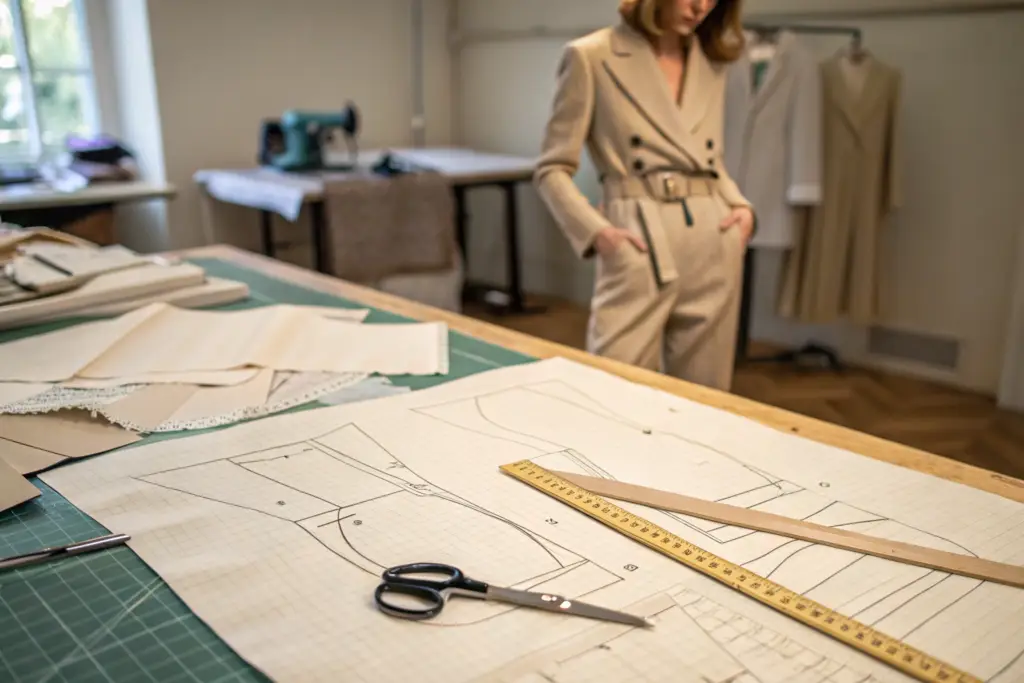
Engineering oversized tailoring for mass production requires a complete regrade of the base size, not just incremental size adjustments. The pattern must be developed on a specific fit model with the intended "slouch" factored into the armhole and crotch curve. Factories that try to scale a standard pattern often create a garment that is large but ill-fitting, with tight armholes on a dropped shoulder or a crotch that pulls when the leg is intentionally wide.
This is where my pattern room at Shanghai Fumao earns its keep. We do not just sew. We re-engineer the fit so the garment looks intentional, not just big.
Why Does a "Dropped Shoulder" Require a New Base Pattern?
A standard shoulder seam sits on the acromion bone. A dropped shoulder seam sits three to four inches down the upper arm. If you simply extend the shoulder seam on a standard pattern, you get a strange tenting effect under the arm. The armhole must actually be cut deeper and wider to accommodate the lower shoulder point.
I worked with a Chicago brand last year on an oversized boyfriend blazer. Their initial sample, made from a standard pattern that was just sized up, had a terrible sleeve pitch. The sleeve twisted forward. We had to rotate the sleeve cap by 8 degrees and lower the armhole by 2 inches. The fix transformed the jacket. It draped straight down from the dropped shoulder point without pulling. This is not a secret technique. It is just geometry. But it requires a pattern maker who understands that a style change is a structural change, not a surface tweak.
How to Control Fabric Waste on Wide-Leg Pattern Pieces?
Wide-leg trousers consume more fabric. A standard straight-leg trouser uses maybe 1.5 yards of 58-inch fabric. A full, palazzo-style wide leg can use 2.2 yards. That is a 45% increase in material cost. For a brand with tight margins, that can kill the style's viability.
We attack this with marker efficiency software. We nest the wide leg pieces together like a jigsaw puzzle. Sometimes we interlock the front and back leg panels. In one recent production run, we achieved an 82% marker efficiency on a 32-inch wide-leg trouser, which is exceptional. We also use a technique called "fabric saving via pocket placement." The pocket bags and facing are cut from the dead space inside the leg curve. I recommend brands ask their factory for a marker efficiency report before approving a wide-leg style. If the efficiency is below 78%, the pattern can likely be adjusted to save money without changing the visual silhouette.
What Accessory and Trim Details Are Defining the "Scandi" Aesthetic?
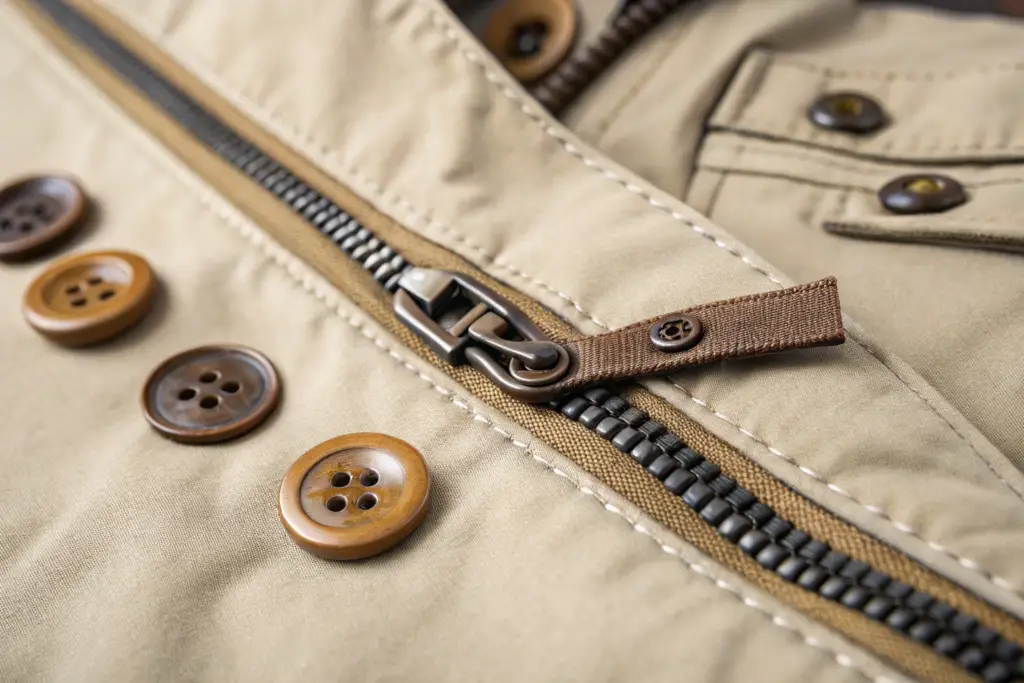
The details are where Scandinavian fashion separates itself from basic minimalism. I walked the showrooms and found that the trims were not an afterthought. They were the focal point. A simple wool coat had buttons carved from corozo nut, each one with a slightly different grain pattern. A cotton trench had a chunky, exposed zipper that was deliberately left raw and industrial. The message is that the hardware should look and feel like it came from nature or from a machine, not from a plastic mold. This is a sourcing challenge. Mass-market trims are designed to be uniform and cheap. Scandinavian trims are designed to be individual and tactile.
The defining trim aesthetic is an embrace of natural and industrial materials. Buttons are made from corozo nut, horn, or recycled paper composite. Zippers are oversized metal with leather pulls. Labels are woven from organic cotton with undyed, natural backgrounds. The color of the hardware is consistently a muted, matte gold or raw nickel, never shiny brass. These details communicate a commitment to environmental responsibility and functional design in equal measure.
Sourcing these trims requires a different supplier network than standard plastic buttons and polyester zippers. Here is where we find them and how we use them.
Where to Source Corozo and Other Natural Buttons?
Corozo is a vegetable ivory from the tagua palm nut. It is harvested by hand in South America. It dyes beautifully and takes on a matte, almost soft-touch finish. I source our corozo buttons from a small supplier in Italy that specializes in natural materials. The minimum order quantity is higher than plastic, and the lead time is usually four to five weeks.
For a women's blazer program, we replaced a standard resin button with a 24-ligne corozo button in a dark taupe. The cost per button went up by $0.35. On a jacket with four buttons, that is a $1.40 cost increase per unit. But the brand was able to use the "vegetable ivory button" as a marketing point on their e-commerce site, which justified a $15 retail price increase. The tactile experience of a customer touching a cool, heavy, natural button in a dressing room is a conversion driver. Natural materials feel expensive because they are expensive, and the customer knows the difference.
How to Apply Raw Hem and Frayed Edge Finishes at Scale?
The raw hem is everywhere in Scandinavian styling. A linen skirt with an unstitched, fraying edge. A denim jacket with a raw, deconstructed hem. This looks effortless, but it requires precise process control to execute in a factory. If you simply leave a fabric edge unfinished, it will unravel in the wash into a chaotic mess.
We have developed a "controlled fray" process. First, we stitch a stay line exactly 5mm from the raw edge. This limits the fraying to a contained, aesthetic zone. Then the garment goes through an enzyme wash to accelerate the fraying to the desired level. Finally, the garment is dried and inspected. Any edge that has frayed beyond the stay line is trimmed. This process is repeatable across thousands of units. A brand owner recently told me she had previously tried to do this with a cut-and-sew contractor who did not understand the wash effect. Her first batch of skirts frayed up to the knee. The stay line is the secret, and it costs nothing but attention.
Conclusion
Scandinavian fashion weeks have spoken, and the message is consistent. Women want clothes that feel like architecture and wear like a second skin. They want to know the name of the sheep, the story of the button, and the chemistry of the dye. They want an oversized blazer that fits like it was tailored for them, not just sized up from a template. This is not an easy aesthetic to manufacture. It demands a factory that understands pattern engineering, sustainable fiber sourcing, and the tactile importance of a raw hem or a corozo button.
At Shanghai Fumao, we have been building exactly this capability. We are not just cutting and sewing. We are reverse-engineering the fit of a dropped shoulder. We are testing the fibrillation rate of a new circular cellulosic. We are counting the stitches on a French seam inside an unlined coat. We do this so that when your customer walks into a store and touches your garment, she feels the quiet luxury that the Scandinavian runways promised her.
If you are planning a women's wear collection that draws from these Nordic trends and you need a manufacturing partner who can handle the complexity, let us build it together. We can walk you through our fabric library, our pattern room, and our trim sourcing network. Reach out to our Business Director, Elaine, at elaine@fumaoclothing.com. Let's turn those mood board images into a production run that sells.